
Last Updated: January 2026
AI-powered search engines have fundamentally changed how websites get discovered. With Perplexity processing millions of queries daily, ChatGPT handling over 1 billion weekly searches, and Google AI Overviews appearing in a significant portion of results, traditional SEO alone no longer guarantees visibility.
This guide provides a complete framework for optimizing your website for AI search engines in 2026—covering technical requirements, content structure, authority signals, and measurement approaches.
AI Search vs Traditional SEO: What Changed in 2026
The shift from traditional to AI-powered search represents more than an algorithm update. It's a fundamental change in how search engines process, understand, and present information.
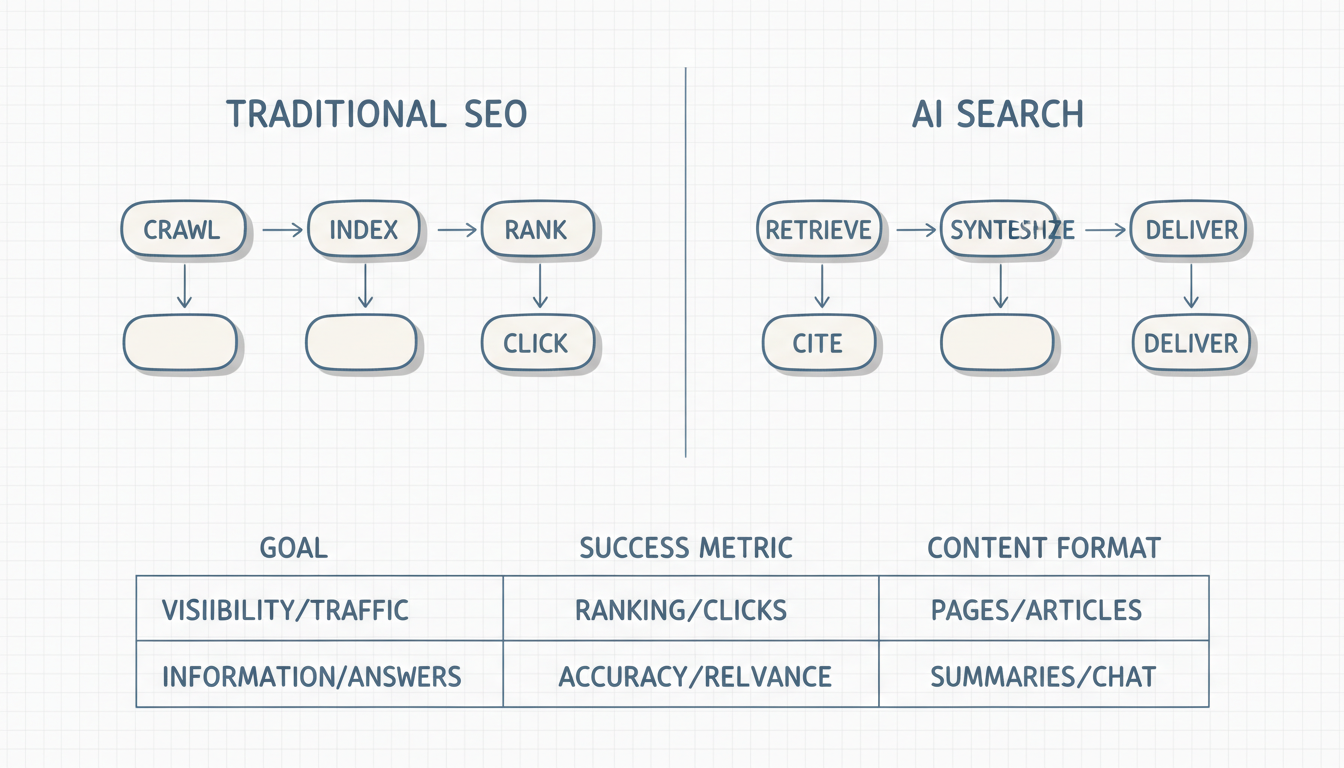
Traditional SEO Model
Traditional search engines operated on a relatively straightforward model:
- Crawl web pages and index content
- Rank pages based on relevance signals (keywords, links, engagement)
- Display ranked results as blue links
- Users click through to find information
Success meant ranking on page one. The goal was clear: optimize for specific ranking factors, earn backlinks, and outrank competitors.
AI Search Model
AI-powered search engines operate differently:
- Retrieve relevant content from multiple sources
- Synthesize information into coherent answers
- Cite sources within generated responses
- Users receive answers directly (clicks become optional)
Success now means getting cited. A page can rank #1 in traditional search but never appear in AI responses if the content isn't structured for AI extraction.
Key Differences in 2026
Factor | Traditional SEO | AI Search Optimization |
Primary goal | Page 1 ranking | Citation in AI responses |
Content format | Keywords + structure | Extractable facts + clarity |
Success metric | Click-through rate | Citation frequency |
Link value | Primary authority signal | One factor among many |
Content freshness | Important | Critical (especially Perplexity) |
Structured data | Helpful | Essential |
Research shows that Google AI Overviews maintain 86% domain overlap and 67% URL overlap with traditional organic results. Understanding the official Google position on AEO vs SEO helps marketers recognize that traditional SEO remains foundational—but additional optimization is required to capture AI visibility.
What Hasn'T Changed
Some fundamentals remain constant:
- Quality content that serves user intent
- Technical accessibility for crawlers
- Authority and trustworthiness signals
- Mobile-friendly, fast-loading pages
AI search optimization builds on these foundations rather than replacing them. Whether you're considering in-house vs agency AEO resources, the core principles remain essential.
How AI Search Engines Crawl, Index & Rank Content
Understanding how AI search platforms discover and evaluate content informs effective optimization strategies. A comprehensive AI search engine comparison reveals important differences in how each platform evaluates and ranks content.
AI Crawler Behavior
AI search platforms use specialized crawlers to index content. These crawlers differ from traditional search engine bots:
Perplexity's Crawler (PerplexityBot)
- Indexes over 200 billion URLs
- Strongly favors fresh content (update frequency matters significantly)
- Respects robots.txt directives
- Pulls from real-time web searches for current queries
ChatGPT's Web Browsing
- Leverages Bing's index as foundation
- Applies OpenAI's relevance algorithms
- Weights earned media presence heavily (85.5% of citations from third-party sources)
- Limited crawl budget compared to major search engines
Google AI Overviews
- Uses existing Google index
- Pulls from pages already ranking well organically
- Integrates Knowledge Graph data
- Applies additional AI relevance scoring
How AI Systems Select Sources
AI platforms evaluate potential sources through multiple lenses:
Relevance Assessment
- Does the content directly address the query?
- Are key concepts covered comprehensively?
- Does the page demonstrate topical expertise?
Authority Evaluation
- Domain reputation and history
- Author credentials and expertise signals
- Citation patterns (who links to and references the content)
- Cross-platform presence
Extractability Check
- Can specific facts be extracted cleanly?
- Is the content structure clear and parseable?
- Are claims supported with verifiable data?
Recency Factors
- When was content last updated?
- Does the page include current information?
- Is the topic time-sensitive?
Research indicates that word count correlates 0.191 with Perplexity citations, while Domain Rating shows 0.161 correlation with ChatGPT citations. These correlations suggest that comprehensive content and domain authority both matter, though neither alone guarantees visibility.
Ranking Factors by Platform
Different AI platforms weight factors differently. A detailed platform comparison shows how optimization strategies should adapt based on your target platforms:
Factor | Perplexity | ChatGPT | Google AI |
Content freshness | Very High | Medium | Medium |
Domain authority | High | Very High | High |
Schema markup | High | Medium | Medium |
Content length | Medium-High | Medium | Medium |
Earned media | Medium | Very High | High |
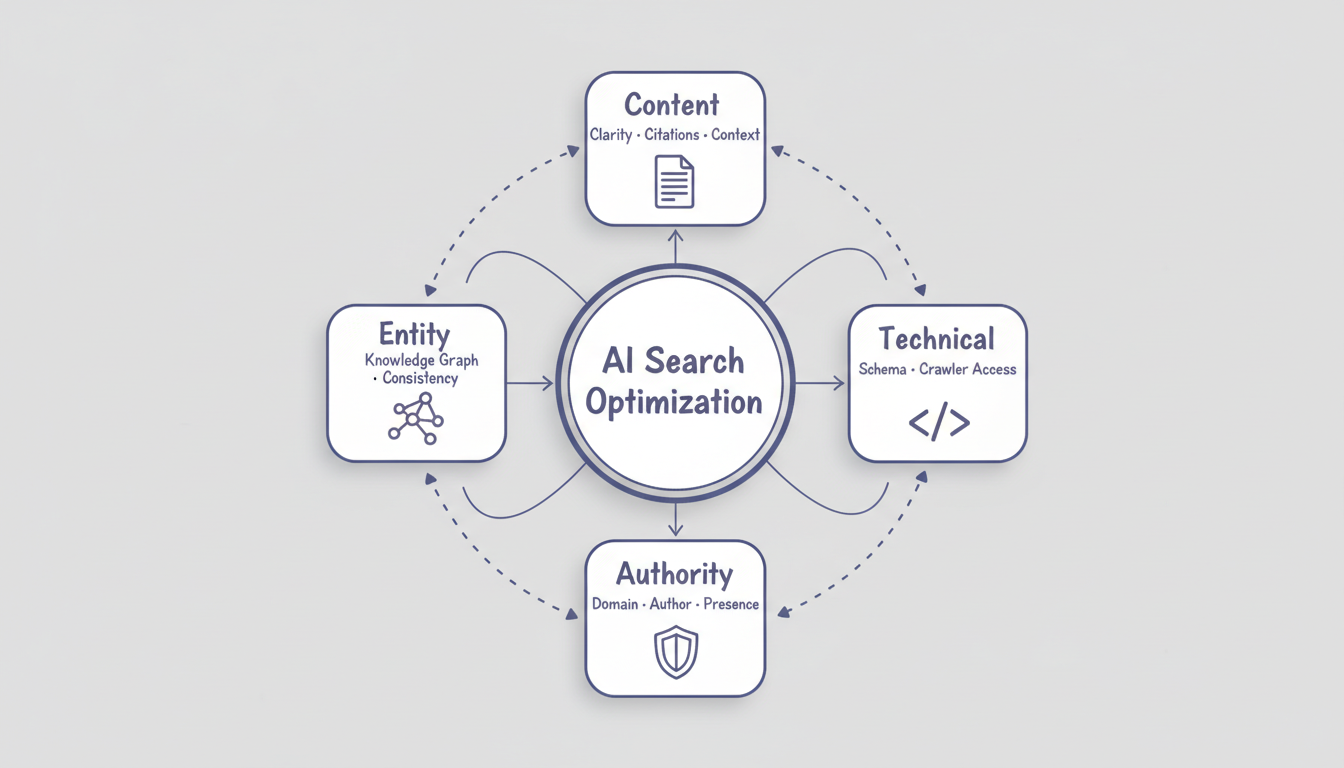
Content Requirements: Clarity, Citations & Context
AI systems need content they can understand, extract from, and confidently cite. This requires specific content approaches informed by AEO optimization best practices.
Clarity: Write for Extraction
AI systems extract specific passages to include in responses. Optimize for extraction by:
Front-Loading Key Information Place the most important information immediately after headings. AI systems often extract the first sentence or two under each heading.
Bad Example:
"When considering various factors that influence optimization success, it's important to understand the historical context and evolution of search algorithms before diving into specific tactics..."
Good Example:
"AI search optimization requires content structured for extraction, authority signals AI systems recognize, and technical implementation that enables AI crawlers to parse your pages effectively."
Using Direct Statements Replace vague language with specific, factual claims.
Instead of: "AI search is becoming more important" Write: "ChatGPT processes over 1 billion searches weekly as of 2026"
Breaking Content into Modules Create discrete sections that can function independently when extracted. Each section should:
- Answer a specific question completely
- Include standalone facts
- Make sense without surrounding context
Citations: Become Citation-Worthy
AI systems prefer content they can confidently cite. Research shows specific content elements increase citation likelihood:
- Statistics and data points: 22% increase in AI visibility
- Expert quotations: 37% increase in AI visibility
- Original research: High citation value
- Clear definitions: Easily extractable
Include primary sources for claims. When you cite research, studies, or data, AI systems can verify and confidently reference your content. Effective AEO link building strategies help establish the citation patterns AI systems value.
Context: Demonstrate Expertise
AI systems evaluate whether content demonstrates genuine expertise:
Topical Comprehensiveness Cover topics thoroughly rather than superficially. Comprehensive content correlates with AI citations—research shows articles under 4,000 words received only 3 citations in one study, while 10,000+ word articles received 187 citations.
Author Expertise Signals Include author bios with verifiable credentials. Link to author profiles on professional platforms (LinkedIn, industry publications).
Supporting Evidence Reference authoritative sources, include case studies, and provide specific examples that demonstrate practical knowledge. Organizations offering white label AEO services frequently emphasize this expertise signaling in their client work.
Structured Data & Schema Markup for AI Search
Schema markup serves as a translation layer between your content and AI systems. While AI can interpret unstructured content, schema dramatically simplifies the process. Understanding AEO schema markup priority helps you focus implementation efforts effectively.
Priority Schema Types
Implement these schema types in order of priority:
1. Article Schema (Essential)
{
  "@context": "https://schema.org",
  "@type": "Article",
  "headline": "How to Optimize for AI Search Engines",
  "author": {
    "@type": "Person",
    "name": "Author Name",
    "url": "https://yoursite.com/author"
  },
  "datePublished": "2026-01-15",
  "dateModified": "2026-01-15",
  "publisher": {
    "@type": "Organization",
    "name": "Your Company"
  }
}
2. FAQ Schema (High Priority) FAQ schema makes question-answer pairs explicitly extractable:
{
  "@context": "https://schema.org",
  "@type": "FAQPage",
  "mainEntity": [{
    "@type": "Question",
    "name": "How do AI search engines rank content?",
    "acceptedAnswer": {
      "@type": "Answer",
      "text": "AI search engines evaluate relevance, authority, extractability, and recency..."
    }
  }]
}
3. Organization Schema (High Priority) Establish your brand entity:
{
  "@context": "https://schema.org",
  "@type": "Organization",
  "name": "Your Company",
  "url": "https://yoursite.com",
  "sameAs": [
    "https://linkedin.com/company/yourcompany",
    "https://twitter.com/yourcompany"
  ]
}
4. HowTo Schema (Medium Priority) For instructional content, HowTo schema helps AI extract step-by-step information.
5. Person Schema (Medium Priority) For author pages, Person schema establishes expertise signals.
Implementation Best Practices
Use JSON-LD Format Place JSON-LD in the page head. Understanding JSON-LD vs microdata for knowledge graph optimization helps you choose the right implementation approach.
Validate All Markup Use Google's Rich Results Test and Schema.org validator. Invalid schema provides no benefit.
Match Schema to Content Schema should accurately represent page content. Misleading schema damages trust signals.
Keep Schema Updated Update dateModified when content changes. Freshness signals extend to structured data.
Research suggests schema contributes approximately 10% to ranking factors on Perplexity. While not the dominant factor, proper implementation provides meaningful advantage.
Entity Optimization & Knowledge Graph Integration
AI systems leverage knowledge graphs to understand relationships between concepts, brands, and topics. Entity optimization helps AI systems recognize and trust your brand. Implementing schema markup for knowledge graph integration strengthens these entity signals.
Establishing Entity Presence
Google Knowledge Graph
- Ensure consistent NAP (Name, Address, Phone) across web
- Claim and optimize Google Business Profile
- Build Wikipedia presence if notable (represents ~22% of major LLM training data)
- Secure Wikidata entry
Industry Databases
- Claim profiles in relevant industry directories
- Ensure consistent information across platforms
- Link profiles to your main website
Social Verification
- Verify social profiles (Twitter/X, LinkedIn, etc.)
- Link social profiles in Organization schema
- Maintain active, consistent presence
Building Entity Authority
Entity authority comes from consistent signals across the web:
Mentions in Authoritative Sources
- Earned media in trusted publications
- Industry report citations
- Academic references where applicable
Consistent Information
- Same name, descriptions, and details everywhere
- Correct attribution when cited
- Updated information across all platforms
Topic Association
- Consistent coverage of specific topics
- Clear expertise areas
- Related entity connections (authors, products, services)
Entity Optimization Checklist
- Google Business Profile claimed and optimized
- Wikipedia/Wikidata presence (if applicable)
- Social profiles verified and linked
- Consistent NAP across all platforms
- Organization schema implemented
- Author entities established with Person schema
- Industry directory listings claimed
Authority Signals AI Search Engines Value Most
AI systems evaluate authority differently than traditional search algorithms. Understanding these signals enables focused optimization.
Primary Authority Signals
Earned Media Presence Research from Muck Rack found 85.5% of ChatGPT citations come from earned media sources—Forbes, TechCrunch, industry publications. This makes PR and content distribution critical for AI visibility.
Domain Authority/Rating Domain Rating shows 0.161 correlation with ChatGPT citations. While not the only factor, established domains have advantages.
Author Expertise Expert author bios with verifiable credentials matter. Include:
- Professional background and qualifications
- Published work and speaking engagements
- Verifiable social/professional profiles
- Clear expertise indicators
Cross-Platform Presence Sites appearing on 4+ platforms are 2.8x more likely to appear in ChatGPT responses. Presence across multiple credible sources signals authority.
Building Authority for AI
Content Strategy
- Publish original research and data
- Create comprehensive resources on core topics
- Develop expert-authored content
- Build content depth, not just breadth
Distribution Strategy
- Pursue earned media opportunities
- Contribute to industry publications
- Participate in relevant online communities
- Build presence on platforms AI systems index
Citation Strategy
- Reference authoritative sources in your content
- Create content worthy of citation by others
- Build relationships that generate mentions
Authority Building Timeline
Authority builds over time. Realistic expectations:
Timeframe | Achievable Goals |
1-3 months | Technical optimization, schema implementation |
3-6 months | Content depth improvement, initial earned media |
6-12 months | Meaningful authority growth, consistent citations |
12+ months | Established authority, sustained visibility |
Technical SEO for AI Crawlers (Perplexity, ChatGPT, Etc.)
Technical implementation determines whether AI crawlers can access and parse your content effectively.
AI Crawler Access
Robots.txt Configuration Allow AI crawlers access unless you have specific reasons to block them:
User-agent: PerplexityBot
Allow: /

User-agent: ChatGPT-User
Allow: /

User-agent: GPTBot
Allow: /
Blocking AI crawlers prevents citation opportunities and reduces visibility.
Server-Side Rendering AI crawlers have limited JavaScript execution capabilities. Ensure:
- Critical content renders server-side
- Key information doesn't require JavaScript to display
- Fallback content available for limited crawlers
Crawl Budget Efficiency AI crawlers have limited budgets. Optimize by:
- Clean URL structures (helps AI systems understand content before parsing)
- Logical site architecture
- Updated XML sitemaps
- Fast page load times
Content Accessibility
URL Structure Clear, descriptive URLs help AI systems:
- Include primary keywords
- Use hyphens to separate words
- Keep URLs reasonably short
- Avoid parameter-heavy URLs
Internal Linking Strong internal linking helps AI understand:
- Topic relationships
- Content hierarchy
- Related resources
- Site structure
Mobile Optimization Mobile-first indexing applies to AI systems accessing Google's index:
- Responsive design
- Fast mobile load times
- Touch-friendly navigation
- Consistent content across devices
Technical Checklist
- AI crawlers allowed in robots.txt
- Server-side rendering for critical content
- XML sitemap submitted and updated
- Page speed optimized (<3 seconds)
- Clean URL structure
- Strong internal linking
- Mobile-optimized pages
- HTTPS enabled
- No soft 404s or redirect chains
Measuring AI Search Performance: Metrics & Tools
Traditional SEO metrics don't capture AI search performance. New measurement approaches are required. Learning how to check if your site appears in Google AI Overviews provides essential visibility into one key platform.
Essential Metrics
Citation Frequency How often your brand appears in AI responses across platforms. This is the primary success metric for AI optimization.
AI Referral Traffic Configure analytics to track traffic from AI sources:
- perplexity.ai
- chat.openai.com
- copilot.microsoft.com
- Other AI platforms
Citation Accuracy When AI cites your brand, is the information correct? Monitor for misrepresentations.
Share of Voice Your visibility compared to competitors for target queries across AI platforms.
Tracking Infrastructure
Analytics Configuration Set up custom channel groupings in GA4:
AI Search Channel:
- Source contains "perplexity"
- Source contains "openai"
- Source contains "copilot"
Citation Monitoring Tools Leading options for 2026:
- Otterly.AI (affordable, easy setup)
- Search Party (comprehensive analytics)
- Conductor (enterprise platform)
- Gracker.AI (B2B focus)
Manual Monitoring Supplement automated tools with periodic manual checks:
- Run brand queries in each AI platform
- Document citation presence and accuracy
- Track competitor visibility
Measurement Cadence
Activity | Frequency |
Citation monitoring review | Weekly |
AI referral traffic analysis | Weekly |
Competitor visibility check | Monthly |
Full AI visibility audit | Quarterly |
Understanding Citation Volatility
AI citation visibility fluctuates more than traditional rankings. Research indicates 40-60% volatility is normal. Focus on trends over time rather than daily fluctuations.
Monthly and quarterly comparisons provide more meaningful insights than week-over-week changes.
ROI Calculation
AI traffic often converts differently:
- Higher intent: Users clicking through from AI citations have clearer purpose
- Better engagement: Time on site and conversion rates frequently exceed organic averages
- Lower volume: Fewer total clicks but higher quality
Measure success by conversion quality, not just click volume.
FAQs
How long does AI search optimization take to show results? Technical improvements (schema, structure) can show impact within 4-8 weeks. Authority-building activities take 3-6 months for meaningful visibility improvement.
Should I optimize for AI search or traditional SEO first? Traditional SEO first. Google AI Overviews heavily weight existing rankings—86% domain overlap with organic results. Build the SEO foundation, then add AI-specific optimization.
Which AI platform should I prioritize? For most businesses: Google AI Overviews (largest audience), Perplexity (citation-heavy), and ChatGPT (growing rapidly). B2B companies should add Microsoft Copilot.
Does blocking AI crawlers protect my content? It prevents indexing, but AI systems may still reference your brand through third-party mentions. Blocking reduces visibility without fully protecting content.
How important is content freshness for AI search? Very important, especially for Perplexity. Research suggests updating high-priority content every 2-3 days for maximum Perplexity visibility. Include clear "last updated" signals.
Can small sites compete with large brands in AI search? Yes, particularly for specific topics. Comprehensive, authoritative content on niche subjects can earn citations even competing against larger competitors with thinner coverage.