
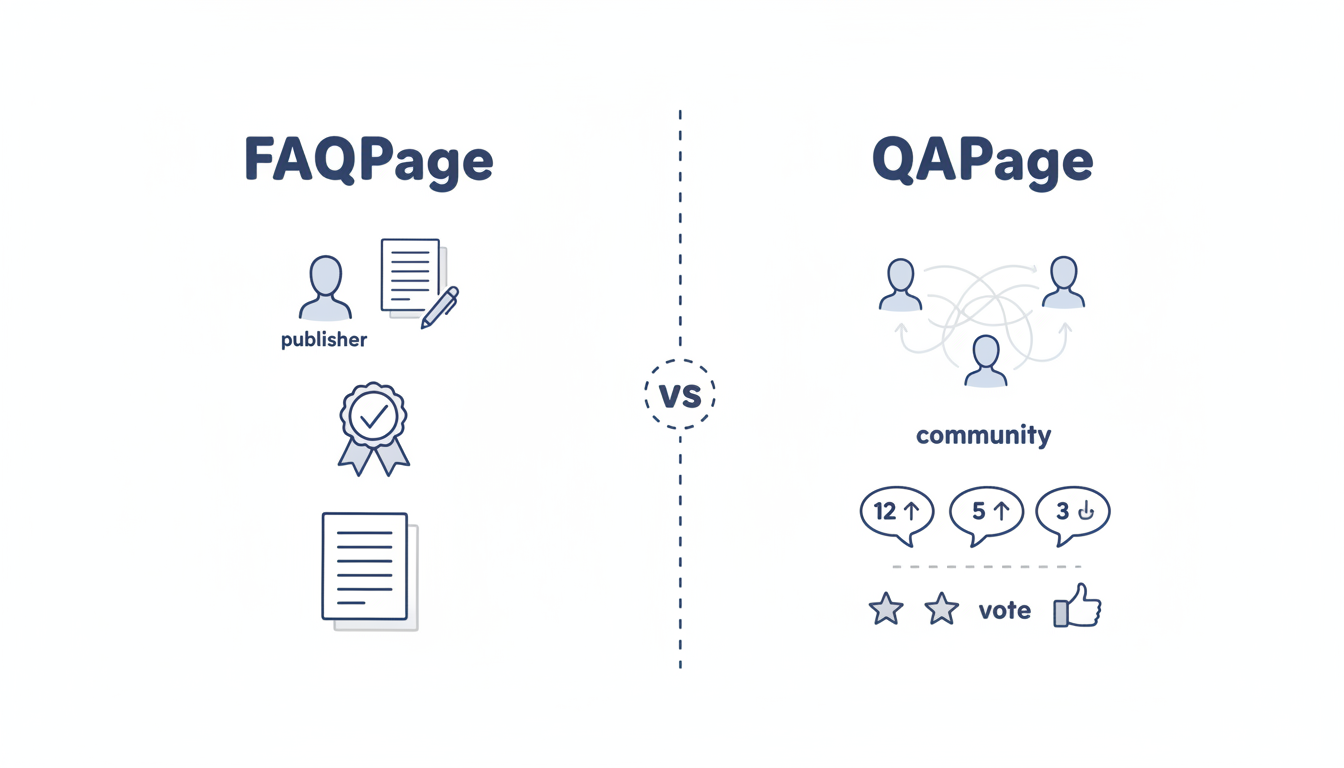
QAPage schema marks user-generated question-and-answer content for AI extraction. Unlike FAQPage (which is for publisher-controlled Q&A), QAPage is designed for community content where users submit both questions and answers—think Stack Overflow, Reddit, Quora, or forum discussions. AI systems increasingly cite community Q&A sources, making QAPage implementation valuable for platforms hosting user-generated expertise.
This guide covers when to use QAPage, implementation requirements, and optimization for AI citations.
Qapage vs Faqpage: When to Use Which
The two schema types serve different content patterns.
Schema selection guide:
Scenario | Use QAPage | Use FAQPage |
Single author writes both Q&A | No | Yes |
Users submit questions | Yes | No |
Multiple answers per question | Yes | No |
Voting/ranking on answers | Yes | No |
Community/forum content | Yes | No |
Static FAQ sections | No | Yes |
Key differences:
FAQPage Schema:
├── Publisher controls both questions and answers
├── One answer per question
├── Static, authoritative content
└── Common on brand websites, help pages

QAPage Schema:
├── Questions submitted by users
├── Multiple answers possible
├── Answers ranked by community
└── Common on forums, Q&A sites, communities
Using the wrong schema type creates confusion. AI systems expect specific patterns from each.
Qapage Schema Structure
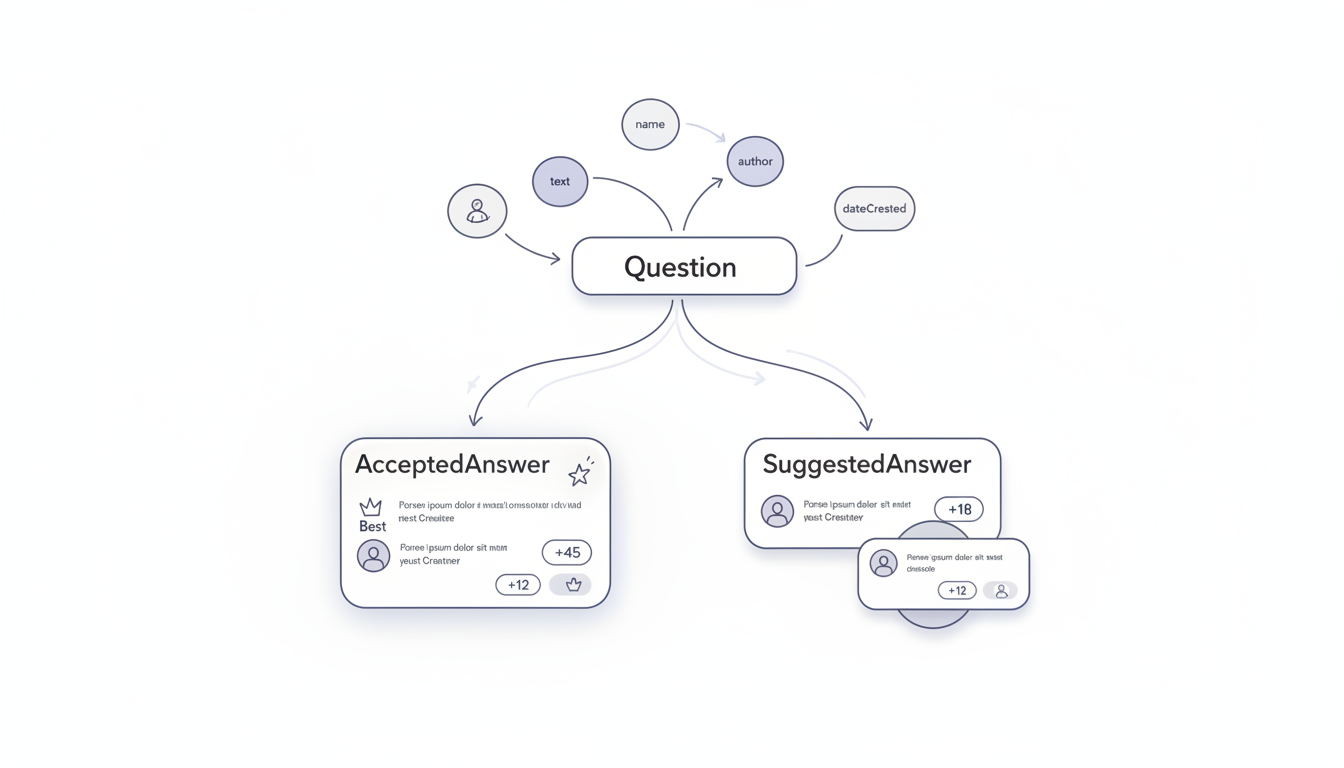
QAPage schema includes the question and one or more answers with metadata. When implementing structured data for AI search ranking factors, proper schema structure becomes critical for extraction accuracy.
Core structure:
{
  "@context": "https://schema.org",
  "@type": "QAPage",
  "mainEntity": {
    "@type": "Question",
    "name": "The question text",
    "text": "Expanded question with context",
    "answerCount": 3,
    "upvoteCount": 45,
    "dateCreated": "2026-01-10",
    "author": {
      "@type": "Person",
      "name": "User Name"
    },
    "acceptedAnswer": {
      "@type": "Answer",
      "text": "The accepted/best answer",
      "dateCreated": "2026-01-11",
      "upvoteCount": 28,
      "author": {
        "@type": "Person",
        "name": "Answerer Name"
      }
    },
    "suggestedAnswer": [
      {
        "@type": "Answer",
        "text": "Alternative answer",
        "upvoteCount": 12,
        "author": {
          "@type": "Person",
          "name": "Another User"
        }
      }
    ]
  }
}
Property Reference
QAPage includes several properties AI systems evaluate.
Question properties:
Property | Required | AI Benefit |
name | Yes | Query matching, extraction |
text | Recommended | Additional context |
answerCount | Recommended | Completeness signal |
upvoteCount | Optional | Popularity signal |
dateCreated | Recommended | Freshness evaluation |
author | Recommended | Attribution capability |
Answer properties:
Property | Purpose | AI Relevance |
text | The answer content | Primary extraction source |
upvoteCount | Community validation | Quality signal |
dateCreated | Answer freshness | Recency evaluation |
author | Who answered | Expertise attribution |
Acceptedanswer vs Suggestedanswer
QAPage distinguishes between accepted and suggested answers.
Answer type hierarchy:
Answer Extraction Priority:
├── acceptedAnswer (highest priority)
│   └── Marked by question author or community as best
│
├── suggestedAnswer with high votes (medium priority)
│   └── Alternative quality answers
│
└── suggestedAnswer with low votes (lower priority)
    └── Additional perspectives
AI behavior with answer types:
Answer Type | AI Citation Likelihood |
acceptedAnswer | Highest - treated as definitive |
Top suggestedAnswer | Medium - alternative viewpoint |
Other suggestedAnswer | Lower - supplementary info |
Marking an acceptedAnswer tells AI which response to prioritize. Without it, AI must infer from upvotes.
Implementation for Forums and Communities
Adapt QAPage to different community content types. For platforms looking to optimize community-generated content, understanding the broader context of SEO and AEO integration helps align technical implementation with discovery goals.
Platform implementations:
Platform Type | Implementation Approach |
Technical Q&A (Stack Overflow style) | Full schema with code blocks in answers |
Discussion forums | QAPage for threads with clear questions |
Product communities | QAPage for support questions |
Knowledge bases | Consider FAQPage unless user-submitted |
Forum thread example:
{
  "@context": "https://schema.org",
  "@type": "QAPage",
  "mainEntity": {
    "@type": "Question",
    "name": "How do I fix WordPress white screen of death?",
    "text": "My WordPress site shows a blank white page after updating plugins. I've tried clearing cache but it's still white.",
    "answerCount": 5,
    "upvoteCount": 23,
    "dateCreated": "2026-01-08",
    "acceptedAnswer": {
      "@type": "Answer",
      "text": "Disable plugins by renaming the plugins folder via FTP: 1) Connect to your server via FTP. 2) Navigate to wp-content. 3) Rename 'plugins' to 'plugins_old'. 4) Refresh your site. If it loads, re-enable plugins one by one to find the conflict.",
      "upvoteCount": 31,
      "dateCreated": "2026-01-08"
    }
  }
}
Maximize AI visibility with QAPage optimization. Tools that specialize in AEO tools software can help automate validation and monitoring of these implementations.
Content optimization:
Tactic | Implementation |
Clear question titles | Phrase questions as users search them |
Comprehensive answers | Include complete solution, not just hints |
Structured answer text | Steps, lists, or clear paragraphs |
Upvote accuracy | Reflect actual community voting |
Fresh content | Update dateCreated when answers edited |
Answer text formatting:
High AI extraction potential:
"To fix the issue: 1) Clear your browser cache.
2) Disable conflicting plugins. 3) Check your PHP
version. These three steps resolve 90% of cases."

Lower AI extraction potential:
"Try looking at the documentation, it might help.
Also some users have mentioned plugins could be
an issue but I'm not 100% sure about that."
Specific, actionable answers extract cleanly. Vague suggestions don't cite well.
Common Qapage Mistakes
Avoid errors that reduce AI visibility.
Mistakes and fixes:
Mistake | Problem | Solution |
Using FAQPage for forums | Wrong schema type | Switch to QAPage |
No acceptedAnswer | AI can't identify best response | Mark community-chosen answer |
Outdated upvoteCounts | Trust signals misaligned | Sync with actual votes |
Missing author info | Attribution gaps | Include author for both Q and A |
Answer text too long | Extraction truncation | Lead with key information |
Validation Requirements
Test QAPage implementation before relying on it. For automated validation workflows, consider using an AEO checker to continuously monitor schema accuracy.
Validation checklist:
- Google Rich Results Test - confirms valid markup
- Schema.org validator - syntax verification
- Check acceptedAnswer displays correctly
- Verify answerCount matches actual answers
- Confirm date formats are ISO 8601 compliant
How AI Search Engines Use Qapage Signals
Modern answer engines treat community question-and-answer content differently from publisher-authored FAQ pages. When a model assembles a response to a long-tail question, it weighs the structured signals inside QAPage to decide whether a community thread earns a citation. The vote counts and authorship fields are not decorative: they form the provenance layer AI systems rely on to judge whether an answer is trustworthy enough to quote. Teams working on technical SEO should treat QAPage as one component of a broader answer engine optimization program rather than an isolated markup task.
Three signals carry the most weight when a model chooses what to cite:
- An explicitly marked acceptedAnswer - models prefer the response the community already validated as definitive over a pile of undifferentiated replies.
- Upvote and answer counts - a thread with many engaged answers reads as a living source, not a stale forum post that drifted out of date.
- Author and date metadata - fresh, attributed answers survive freshness evaluation far better than anonymous, undated ones.
Connecting QAPage work to your AI search ranking factors strategy keeps the markup aligned with how models actually retrieve and rank community content.
Qapage and E-E-A-T: Why Provenance Signals Matter
Google's experience, expertise, authoritativeness, and trust framework applies as much to community content as to editorial pages. QAPage schema is the machine-readable expression of that provenance: it tells a crawler who asked, who answered, when, and how the community ranked the response. Without these fields, an answer that is objectively correct can still be deprioritized because the system cannot establish trust. This is why the author and dateCreated properties are recommended rather than optional in practice.
Practical ways to strengthen provenance on a community platform:
- Require a real author object on every answer - even a consistent display name beats an empty field.
- Update dateCreated when answers change, so freshness evaluation reflects reality instead of a stale timestamp.
- Surface the acceptedAnswer prominently in the rendered UI, not only in the schema, so visitors and crawlers see the same signal.
The schema and the visible page should agree. A mismatch between what readers see and what the markup claims is exactly the inconsistency that erodes trust for both human and machine audiences, and it undercuts the citation advantage QAPage is meant to provide.
Measuring Qapage Impact: Metrics That Matter
Schema work is only worthwhile if it moves discovery, and QAPage targets AI citations and rich results rather than classic blue-link rankings. Measure it with instruments built for answer surfaces. A dedicated AEO checker or continuous monitoring tool helps confirm the markup is valid and tracks whether the thread is being surfaced in answer experiences over time.
Track these outcomes to judge return on the implementation effort:
- Rich Results Test status - confirms the markup is valid and eligible before you trust any citation gain.
- AI overview and answer citations - the clearest signal that a community thread is being quoted by models.
- Answer impression share - visibility relative to competing threads covering the same question.
- Referral traffic from answer surfaces - downstream clicks that prove the citation converts, not just appears.
Tie these metrics back to your SEO and AEO roadmap so QAPage work is funded like the discovery channel it is, not treated as a one-time developer chore.
Implementation Checklist for Engineering Teams
Shipping QAPage cleanly is an engineering task with a clear definition of done. Hand the following checklist to the team that owns the community product so the markup lands correctly the first time and stays correct as the product changes.
- Emit QAPage on every thread that has a clear question and at least one answer; use FAQPage for static publisher content instead.
- Mark acceptedAnswer from the question owner or top community vote, and keep suggestedAnswer for the next best responses.
- Populate name, text, upvoteCount, and dateCreated on every question and answer object.
- Validate in the Rich Results Test on staging before the change reaches production traffic.
- Monitor schema accuracy in CI so a future template change cannot silently drop the markup.
Following this checklist turns QAPage from a fragile afterthought into a durable discovery asset for any platform that hosts user-generated expertise.
Key Takeaways
QAPage schema for AI search optimization:
- QAPage is for user-generated Q&A - Use FAQPage for publisher-controlled content instead
- AcceptedAnswer signals the best response - AI prioritizes marked answers over suggestedAnswer
- Multiple answers are expected - Include suggestedAnswer for alternative solutions
- Community signals matter - UpvoteCount influences AI quality assessment
- Clear question titles improve matching - Phrase questions as users would search
- Answer text should be actionable - Specific solutions extract better than vague guidance
- Validation is essential - Test with Rich Results Test before publishing
For platforms hosting community Q&A content, QAPage schema creates the machine-readable structure AI systems need to accurately extract and cite user-generated expertise.