
Schema markup has become essential for AI search visibility. But implementing structured data is only half the equation - validation ensures AI systems can actually parse and use your markup. Invalid schema gets ignored entirely, making your optimization efforts worthless.
Here are the essential validators and testing tools for ensuring your schema markup works for both traditional search and AI-powered answer engines.
Why Validation Matters for AEO
AI systems like Google's Gemini, ChatGPT, and Perplexity rely on structured data to understand content meaning and relationships. Syntax errors, missing properties, or incorrect implementations cause these systems to skip your markup entirely.
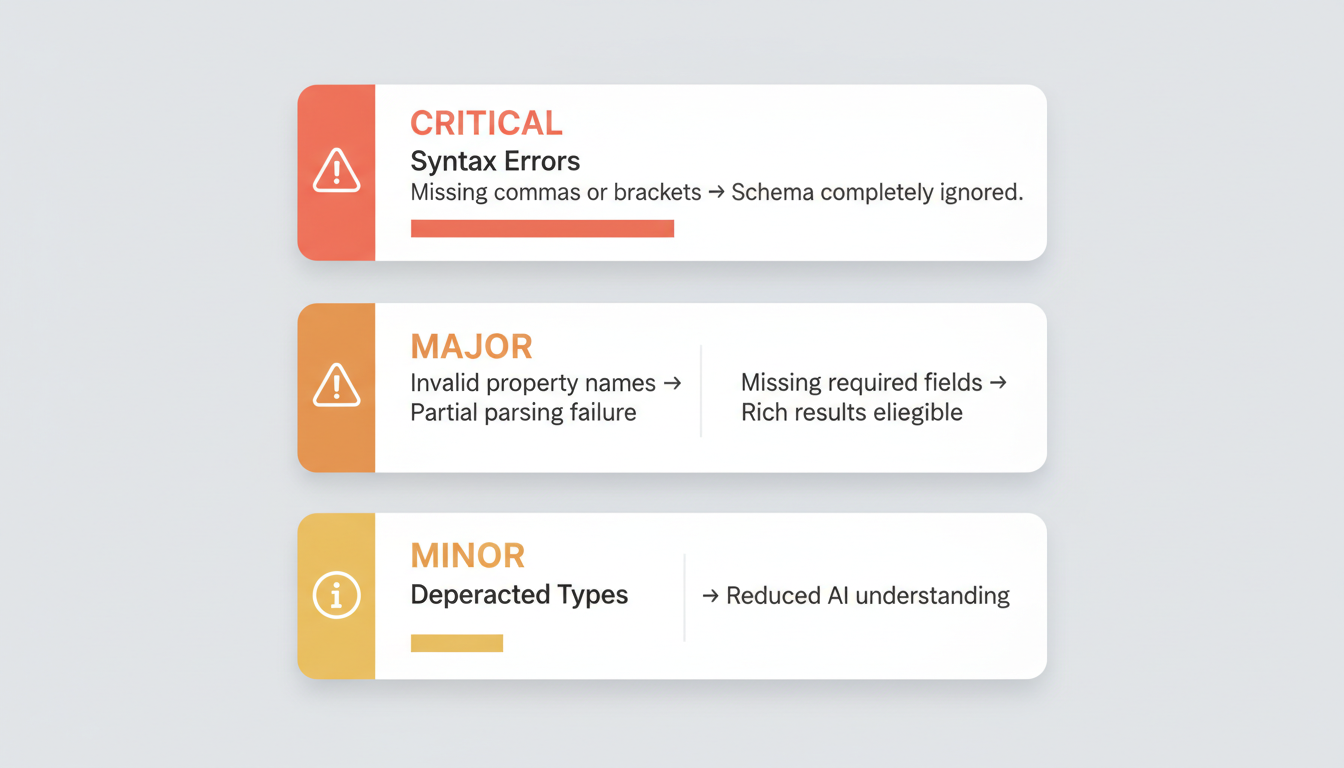
Validation Issue | Impact on AI Visibility |
Missing commas or brackets | Schema completely ignored |
Invalid property names | Partial parsing failure |
Missing required fields | Rich results ineligible |
Deprecated schema types | Reduced AI understanding |
Even small errors make the difference between visibility and invisibility in AI-generated responses.
Essential Schema Validators
Google Rich Results Test
Best for: Verifying Google-specific implementation and rich result eligibility
Google's Rich Results Test remains the gold standard for schema validation. It checks whether your markup meets Google's specific requirements and previews how rich results might appear in search.
Key capabilities:
- Tests live URLs or pasted code snippets
- Shows which rich result types your schema qualifies for
- Identifies missing required properties
- Previews potential SERP appearance
Limitations: Only validates schema types eligible for Google rich results. Won't catch all Schema.org errors.
Access: search.google.com/test/rich-results
Schema.Org Validator (Validator.Schema.Org)
Best for: Catching syntax errors and Schema.org compliance
The Schema.org Validator identifies coding mistakes that make markup invalid. It catches missing commas, unclosed brackets, and invalid properties that would cause search engines to ignore your structured data.
Key capabilities:
- Validates JSON-LD, RDFa, and Microdata formats
- Identifies syntax errors precisely
- Checks property validity against Schema.org vocabulary
- Tests live URLs or code snippets
Limitations: Doesn't tell you how to fix errors - just identifies them. Doesn't check Google-specific requirements.
Best practice: Run Schema.org Validator first to catch syntax issues, then Google Rich Results Test for search-specific compliance.
Schema Markup Validator (SMV)
Best for: Detailed syntax and general structured data validation
The Schema Markup Validator (SMV), powered by Google for the Schema.org community, provides comprehensive validation beyond Google-specific rich results.
Key capabilities:
- Extracts JSON-LD, RDFa, and Microdata from pages
- Reports structured data summary
- Identifies errors across all schema types
- Works for search engines beyond Google
This tool catches issues that might affect visibility in AI systems like Perplexity or Claude that use structured data differently than Google.
Secondary Validation Tools
Google Search Console
Best for: Ongoing monitoring and site-wide schema health
Search Console doesn't validate individual pages but monitors schema health across your entire site over time. Understanding AI overview Google SEO technical requirements helps you interpret Search Console data correctly.
What to monitor:
- Enhancements reports for specific schema types
- Errors, warnings, and valid items counts
- Rich result performance trends
- Email alerts for new issues
Schema issues in Search Console typically take days to weeks to appear after implementation changes.
Screaming Frog SEO Spider
Best for: Site-wide schema audits and bulk validation
For larger sites, Screaming Frog crawls your entire domain to identify missing or malformed schema markup at scale. This complements strategies outlined in our LLM optimization guide by ensuring technical implementation matches strategic intent.
Key capabilities:
- Identifies pages missing schema
- Detects inconsistent implementations
- Exports schema data for analysis
- Flags validation errors site-wide
This tool complements page-level validators by revealing patterns across thousands of pages.
Classy Schema Visualization Tool
Best for: Understanding entity relationships in your schema
Classy Schema visualizes the relationships you've created through schema markup, showing how entities connect to form a basic knowledge graph. For deeper knowledge graph implementation, see our knowledge graph case study demonstrating real-world results.
This visualization helps verify that your schema creates the entity connections AI systems need to understand your content context.
Validation Workflow for AEO
Follow this three-step validation process for reliable AI visibility:
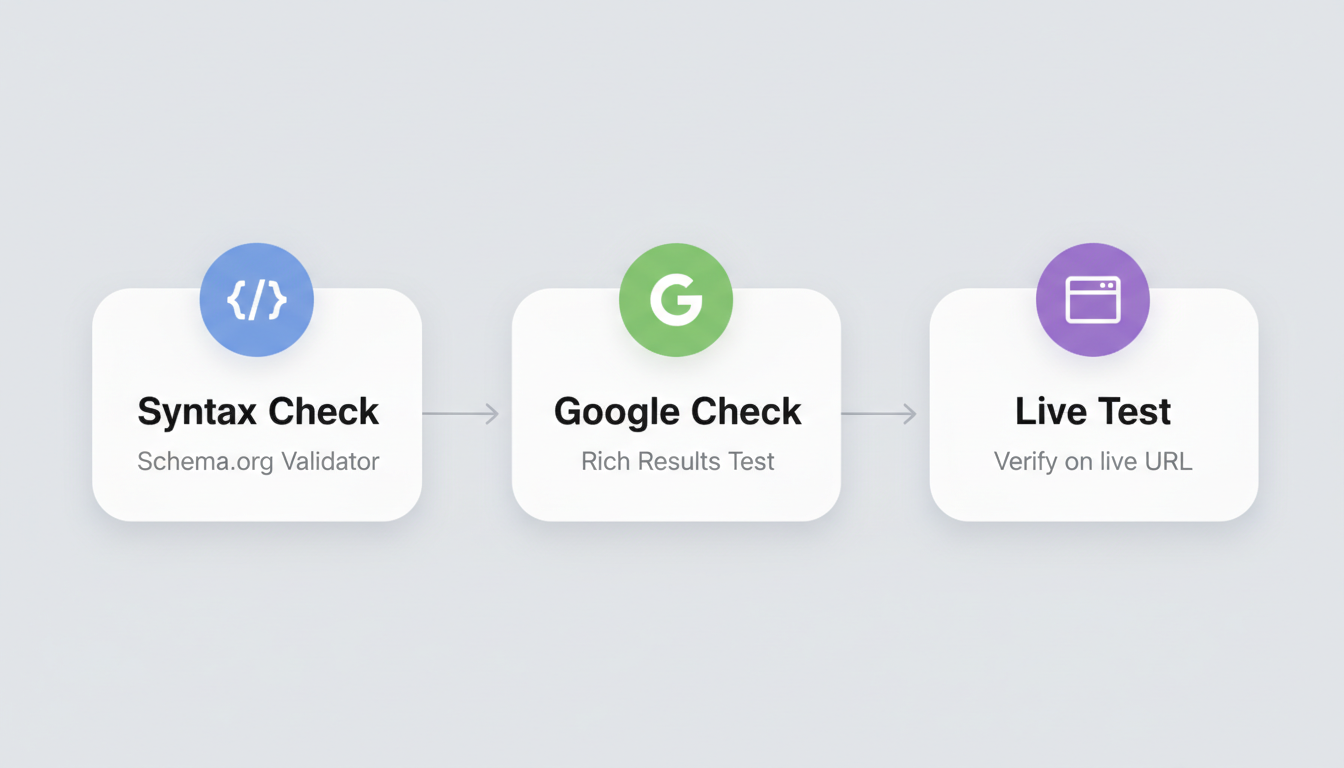
Step 1: Syntax Validation
Run your JSON-LD through Schema.org Validator first. Fix any syntax errors before proceeding - a single missing comma invalidates entire schema blocks.
Common syntax issues:
- Missing commas between properties
- Unclosed curly brackets
- Invalid URL formats
- Incorrect @type declarations
Step 2: Google Compliance
After passing syntax validation, run Google Rich Results Test to verify Google-specific requirements. Even syntactically correct schema may not meet Google's enhanced result criteria.
Check for:
- Required properties for your schema type
- Proper nesting and structure
- Valid URLs (absolute, not relative)
- Correct data types for each property
Step 3: Live Testing
After deployment, verify implementation with both validators using your live URL. Server configurations, CMS processing, or JavaScript rendering can affect how schema appears on live pages versus development.
AI-Specific Validation Considerations
While no tools specifically validate schema for ChatGPT or Perplexity, following these practices increases AI visibility. For ChatGPT-specific optimization tactics, review our ChatGPT SEO optimization guide.
Comprehensive coverage: AI systems use more schema types than Google rewards with rich results. Validate all your schema, not just types eligible for enhanced SERP features.
Entity relationships: Use tools like Classy Schema to verify sameAs connections to Wikipedia, Wikidata, and authoritative sources. These relationships help AI systems verify entity authenticity.
Freshness signals: Ensure dateModified properties update when content changes. AI systems factor freshness into source selection.
Building a Validation Routine
Make validation a step in your publish workflow, not a quarterly scramble. Every new page or schema change runs the Schema.org Validator, then the Google Rich Results Test, before it ships. Catching a missing comma at publish costs seconds; finding it after a month of ignored markup costs rankings.
Keep a shared log of recurring errors per template. If your FAQ schema fails the same way on every product page, fix the template once rather than each page. The log turns repeated mistakes into a one-time engineering fix.
Troubleshooting Common Failures
When valid schema still earns no rich results, the cause is usually content quality or authority, not syntax. Confirm the page itself is eligible - thin or duplicated pages rarely qualify no matter how clean the markup. Improve the underlying content, then re-validate.
For AI visibility specifically, check entity connections. A page with correct syntax but no sameAs links to Wikipedia or Wikidata is harder for models to verify. Add the relationships the validators confirm are well-formed, and freshness via dateModified, so the markup supports citation, not just rich results.
Validators vs. Real-World Parsing
Validators confirm correctness; they cannot confirm how each engine uses the data. ChatGPT, Perplexity, and Claude parse schema with different tolerances, so validate broadly and test live. Paste your production URL into each tool after deploy, because CMS or caching can alter markup between staging and the published page.
Treat a clean validator run as the floor, not the goal. The goal is markup that machines can parse, verify, and cite - which is why entity relationships and freshness matter as much as syntax. Validation is the gate; comprehension is the outcome.
FAQs
How Often Should I Validate Schema Markup?
Validate after every implementation change and during monthly technical SEO audits. Set up Search Console alerts for immediate notification of new schema errors across your site.
Can Valid Schema Still Fail to Generate Rich Results?
Yes. Validation confirms technical correctness, but Google decides whether to show rich results based on content quality, site authority, and user experience factors. Valid schema is necessary but not sufficient.
Which Validator Should I Use First?
Start with Schema.org Validator to catch syntax errors, then Google Rich Results Test for search-specific compliance. This sequence prevents wasting time on Google requirements when basic syntax issues exist.