
Search Atlas Review: AI SEO Features & Pricing (2026)
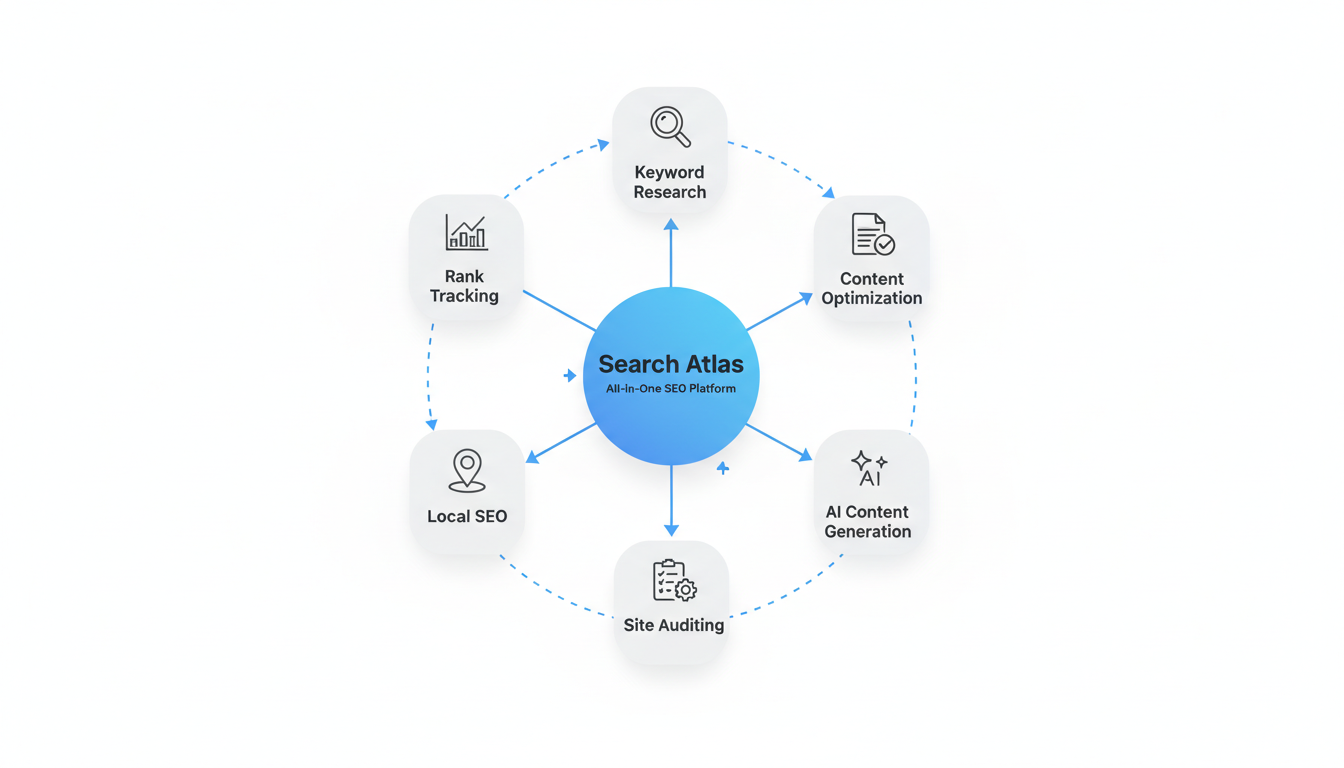
Search Atlas positions itself as an all-in-one AI-powered SEO platform that combines automation, content creation, and analytics into a single tool. With claims of replacing multiple SEO subscriptions, the platform has attracted attention from agencies and in-house teams alike.
According to OpenPR's platform analysis, Search Atlas combines AI SEO automation, advanced keyword and content research, rank tracking, local SEO tools, and AI visibility tracking in one platform.
This Search Atlas review examines the platform's features, pricing, and whether it delivers on its promises in 2026.
What Is Search Atlas?
Search Atlas is an AI-powered SEO and content platform designed to automate technical SEO, content creation, and performance tracking. Unlike traditional SEO tools that focus on data analysis, Search Atlas emphasizes automation—executing SEO tasks rather than just recommending them.
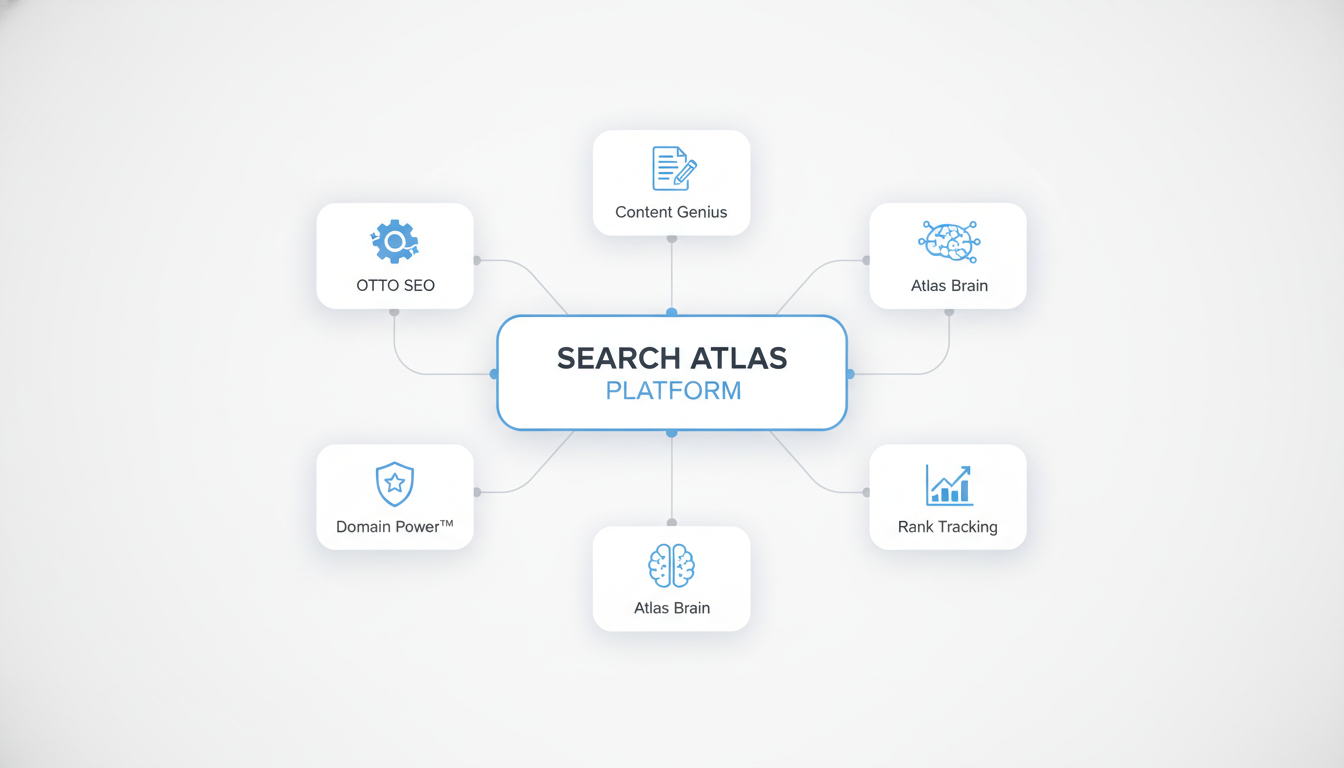
Core platform components:
Component | Function |
OTTO SEO | Automated technical SEO fixes |
Content Genius | AI content writing and optimization |
Atlas Brain | AI assistant for SEO guidance |
Rank Tracking | Position monitoring and alerts |
Domain Power™ | Proprietary authority metric |
According to Search Atlas blog, the platform integrates large language models (LLMs) and domain-specific classifiers trained on SEO performance datasets—distinguishing it from generic AI writing tools.
The company was founded with a mission to close the gap between SEO insight and SEO action, recognizing that most teams identify issues but lack the bandwidth to fix them systematically. This execution-first philosophy is reflected throughout the platform architecture: every feature is designed to move work from a backlog to completion with minimal manual effort.
The platform launched as a challenger to established tools like SEMrush and Ahrefs, initially targeting agencies priced out of enterprise solutions. It has since expanded its AI capabilities significantly, with OTTO SEO and Content Genius now covering use cases that previously required three or four separate tools. Its growing user base includes SaaS companies, e-commerce brands, and digital marketing agencies across North America and Europe.
The platform's roadmap prioritizes deeper AI integration across all five core modules, with regular feature releases that expand automation coverage to new site types and CMS platforms. This development pace distinguishes Search Atlas from legacy tools that release major updates only annually.
Key Features Breakdown
Search Atlas is built around five core modules, each targeting a distinct aspect of SEO execution. Here is how the key features work in practice.
OTTO SEO: Automated Technical Optimization
OTTO SEO represents Search Atlas's flagship automation feature. Rather than generating reports about technical issues, OTTO implements fixes automatically.
What OTTO automates:
- Schema markup implementation
- Meta tag optimization
- Internal linking suggestions and execution
- Technical error fixes (broken links, redirects)
- Core Web Vitals optimization recommendations
According to Trustpilot reviews, users highlight OTTO as a major differentiator:
"Atlas Brain instantly makes anyone an SEO and AIO expert... Came from SEMRush... Search Atlas BLOWS THEM AWAY!" — Verified Trustpilot reviewer
Brands & agencies love OTTO for dramatically cutting the manual work required to maintain technical SEO health across multiple domains.
Limitations:
- Requires website access for automatic implementation
- Some fixes still need manual review
- Complex technical issues may need developer involvement
Despite these limitations, teams that grant OTTO full access consistently report faster resolution of technical debt. A typical agency site sees schema markup, canonical issues, and broken links addressed within the first week of deployment—fixes that would otherwise sit in a developer backlog for months.
Content Genius: AI-Powered Writing
Content Genius combines AI content generation with SEO optimization in a single workflow.
Content Genius capabilities:
- AI article generation based on target keywords
- Real-time SEO scoring during writing
- Competitor content analysis
- NLP optimization for semantic relevance
- Readability scoring and suggestions
The platform uses proprietary SEO training data rather than relying solely on general-purpose LLMs. This means content suggestions align with actual ranking factors rather than generic writing advice. For teams exploring generative AI search optimization strategies, understanding how specialized training data improves content quality is crucial.
In practice, Content Genius generates an article brief, suggests target NLP terms based on competitor analysis, assigns a real-time SEO score as you write, and flags readability issues before publication. This workflow reduces the typical content production cycle from days to hours while ensuring each piece targets the right signals. Teams report producing 3x more optimized content per week compared to manual SEO writing workflows.
Content Genius also supports topic cluster planning, helping teams build topical authority by mapping pillar and spoke content around core subjects. This is particularly valuable for newer sites working to establish domain relevance before competing for high-volume keywords.
Atlas Brain: AI SEO Assistant
Atlas Brain serves as a conversational AI assistant that answers SEO questions and provides strategic guidance.
Use cases for Atlas Brain:
- Keyword research recommendations
- Content strategy planning
- Technical SEO troubleshooting
- Competitive analysis insights
- Answer Engine Optimization (AEO) guidance
According to user reviews, Atlas Brain particularly helps teams without deep SEO expertise make informed decisions quickly. When comparing different AI SEO tools under $100, conversational assistants like Atlas Brain stand out for democratizing SEO knowledge. It effectively bridges the gap between raw data and strategic action by translating platform metrics into plain-language recommendations that non-specialists can act on immediately, reducing dependency on external SEO consultants.
Unlike generic AI chatbots, Atlas Brain is trained specifically on SEO methodology, algorithmic patterns, and content performance data—giving it context that general-purpose assistants lack. It can diagnose why a page is underperforming, suggest a prioritized fix list, and explain the reasoning behind each recommendation in plain language. For marketers transitioning into SEO ownership, this reduces the learning curve from months to weeks.
Domain Power™ Metric
Search Atlas introduces Domain Power™ as an alternative to traditional Domain Authority (DA) metrics.
According to eesel.ai's analysis, Domain Power™ measures a site's strength using its actual organic traffic and keyword rankings pulled from Google Search Console—rather than relying solely on backlink profiles.
Domain Power™ vs. Domain Authority:
Aspect | Domain Power™ | Domain Authority |
Data source | Google Search Console | Backlink database |
Updates | Real-time with GSC | Monthly crawl-based |
Focus | Actual traffic performance | Link equity signals |
Manipulation risk | Lower (GSC verified) | Higher (link schemes) |
This metric provides a different perspective on site strength, though it requires Google Search Console integration to function.
In practice, Domain Power™ is most useful for competitive benchmarking and tracking progress over time. Because it uses real traffic signals rather than inferred link equity, it can reveal that a site with modest backlinks but strong content rankings outperforms a heavier-linked competitor—a distinction that traditional DA metrics would miss entirely.
Search Atlas Pricing (2026)
Search Atlas offers tiered pricing based on feature access and usage limits, with plans starting at $99/month.
According to Search Atlas pricing information, plans range from $99 to $399 per month:
Plan | Price | Best For |
Starter | $99/month | Individual bloggers, small sites |
Growth | $199/month | Growing businesses, content teams |
Pro | $399/month | Agencies, enterprise SEO teams |
What's included at each tier:
- Starter: Basic OTTO automation, limited Content Genius usage, rank tracking
- Growth: Full OTTO features, expanded content limits, Atlas Brain access
- Pro ($399/month): Unlimited content, white-label reports, priority support, API access
Annual billing typically offers discounts, though specific savings vary by plan. For teams evaluating this Search Atlas review against budget constraints, the platform also offers a free trial that includes OTTO automation, Content Genius, and rank tracking features—enough to validate the platform's fit before committing to a paid plan.
Pricing Comparison
How does Search Atlas pricing compare to alternatives?
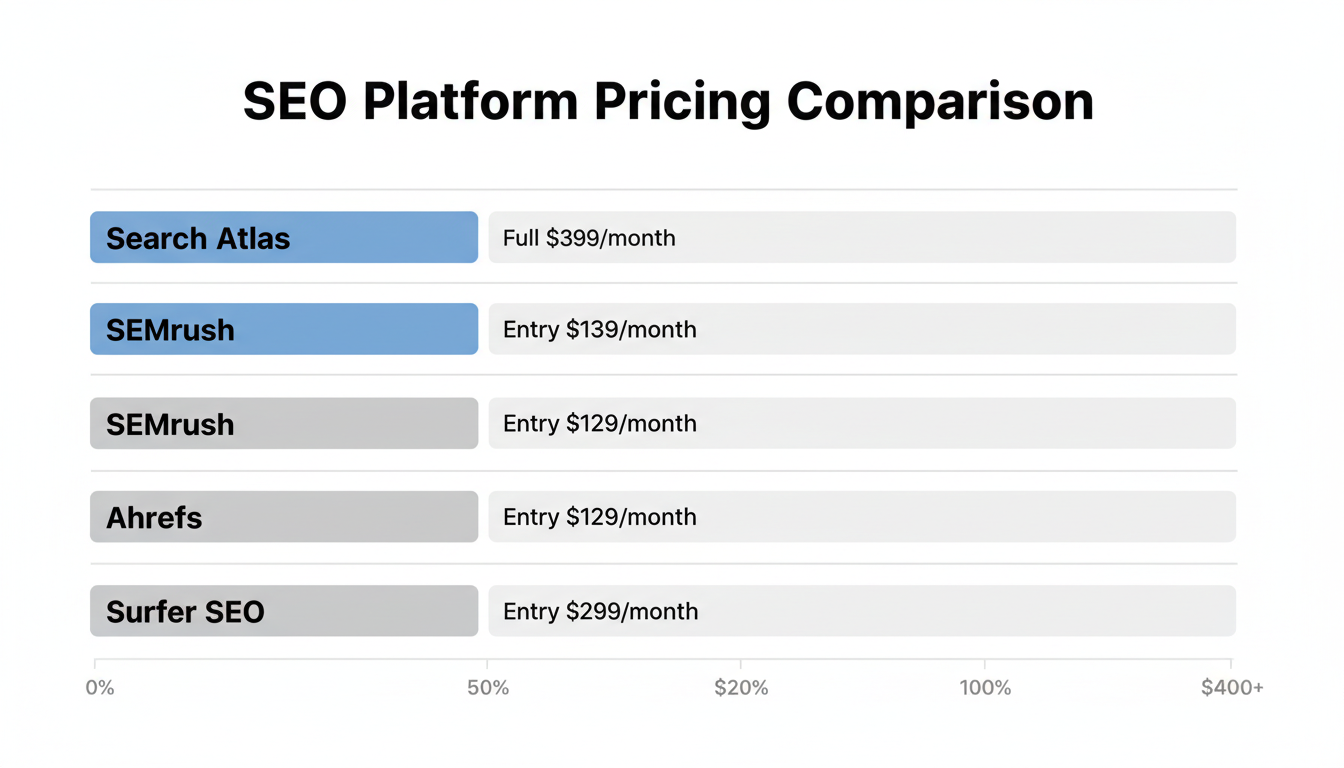
Platform | Entry Price | Full-Featured Price |
Search Atlas | $99/month | $399/month |
SEMrush | $139/month | $449/month |
Ahrefs | $129/month | $449/month |
Surfer SEO | $99/month | $299/month |
Search Atlas competes at similar price points to established tools while offering more automation features — its Starter plan is 29% cheaper than SEMrush's entry tier. The value proposition centers on replacing multiple tools with one integrated platform that executes rather than just reports.
Who Search Atlas Is Best For
Based on feature analysis for this Search Atlas review, the platform fits specific use cases well.
The primary audience for Search Atlas is growth-focused teams that need SEO to scale without proportionally scaling headcount. Whether you manage 5 client sites or 50, the automation layer means one person can monitor and act on technical issues that would otherwise require a dedicated engineer.
Content teams benefit from built-in optimization guardrails that reduce the back-and-forth with SEO specialists on every article. This Search Atlas review finds it most compelling for organizations that have identified SEO as a growth channel but struggle to execute consistently at scale.
Ideal for:
- Agencies managing multiple clients: OTTO automation saves time across sites
- Content-heavy sites: Content Genius streamlines production
- Teams without dedicated SEO expertise: Atlas Brain provides guidance
- Those frustrated with report-only tools: Automation executes, not just recommends
Less ideal for:
- Enterprise with complex tech stacks: May need more customizable solutions
- Those only needing backlink analysis: Ahrefs/Moz remain stronger
- Budget-constrained users: $99/month may exceed small site budgets
Service-based businesses that publish educational content regularly represent another strong fit. The combination of Content Genius for article production and OTTO for technical maintenance allows small marketing teams to maintain competitive organic presence without dedicated SEO specialists on staff.
User Reviews and Reputation
For this Search Atlas review, we found the platform maintains positive ratings across review sites.
According to Trustpilot, Search Atlas has 122 reviews with users particularly praising:
- OTTO automation saving manual work
- Content Genius quality improvements
- Atlas Brain making SEO accessible
- Responsive customer support
Common criticisms include:
- Learning curve for new users
- Some features still maturing
- Limited historical data compared to established tools
The platform won Best SEO Platform at the Global Search Awards, adding third-party validation to user reviews. Review data from Capterra and G2 echoes Trustpilot findings: users consistently rate Search Atlas 4.5+ out of 5 stars across platforms, with OTTO automation receiving the highest individual feature scores. The most cited complaint across review sites is the initial onboarding complexity, though most reviewers note that customer support helped resolve setup friction within the first week.
"The onboarding was a bit steep but once we got OTTO connected to our sites, we recovered 18% more organic traffic in 45 days. Worth every dollar." — G2 reviewer
Third-party award recognition (Best SEO Platform, Global Search Awards) further validates the platform's standing among enterprise buyers and agencies.
Review volume continues to grow on Capterra and G2, where verified buyers highlight the same strengths: time savings from OTTO automation and quality improvements from Content Genius. Teams that previously spent 10-15 hours per week on manual SEO tasks report cutting that down to 2-3 hours after full platform deployment.
Search Atlas vs. Competitors
How does Search Atlas stack up against the most popular alternatives? Below are side-by-side comparisons on the factors that matter most.
Search Atlas vs. Semrush
Search Atlas and SEMrush compete on price and features, but take fundamentally different approaches: one automates execution while the other focuses on research and reporting.
Factor | Search Atlas | SEMrush |
Automation | Native OTTO execution | Recommendations only |
Content AI | Integrated Content Genius | Separate ContentShake AI |
Data depth | Growing database | Extensive historical data |
Price | $99-$399/month | $139-$499/month |
Choose Search Atlas if: You want automation that executes, not just reports.
Choose SEMrush if: You need comprehensive historical data and established integrations.
SEMrush's strengths lie in its decade of competitive intelligence, broad API ecosystem, and robust keyword database. However, teams that have accumulated a backlog of technical SEO issues they lack the bandwidth to fix may find Search Atlas's automation model more effective at driving actual rank movement, even if the underlying data depth is less mature.
Search Atlas vs. Surfer SEO
Both tools offer AI-assisted content optimization, but Search Atlas adds technical SEO automation that Surfer SEO lacks entirely.
Factor | Search Atlas | Surfer SEO |
Focus | All-in-one platform | Content optimization |
Technical SEO | OTTO automation | Limited |
AI writing | Content Genius | Surfer AI |
Price | $99-$399/month | $99-$299/month |
Choose Search Atlas if: You need technical SEO automation alongside content.
Choose Surfer SEO if: Content optimization is your primary focus. For a deeper comparison, see our Surfer SEO vs Clearscope analysis.
Surfer SEO excels at real-time NLP scoring within the writing editor, which is valuable for content writers optimizing individual articles. It does not address technical SEO, rank tracking, or AI-assisted strategy—meaning teams that choose Surfer SEO often need to supplement it with additional tools for a complete SEO program.
Implementation Considerations
Before adopting Search Atlas, this Search Atlas review surfaces key implementation factors to consider.
Technical requirements:
- Google Search Console integration (for Domain Power™)
- Website access for OTTO automation
- CMS compatibility for direct publishing
Onboarding process:
- Connect Google Search Console and Analytics
- Set up OTTO for your domains
- Configure content workflows
- Train team on Atlas Brain
Time to value:
Most users report meaningful results within 30-60 days, with OTTO automation showing impact faster than content-driven improvements. Technical SEO fixes typically show rank movement within 2-4 weeks, while content improvements compound over 60-90 days as new pages index and gain authority.
The prerequisite for OTTO automation is granting direct CMS access. Without it, the platform functions as a standard audit tool. Ensuring your team completes this step during onboarding unlocks the full value that this Search Atlas review highlights as the platform's defining advantage over traditional SEO tools. Organizations implementing an AEO marketing strategy template can leverage these features to accelerate answer engine visibility.
Key Takeaways
Based on our Search Atlas review, the platform represents a shift toward execution-focused SEO tools:
- Automation differentiates: OTTO SEO implements fixes rather than just reporting them—a genuine workflow improvement over traditional tools
- AI integration is native: Content Genius and Atlas Brain are built into the platform, not bolted on—creating smoother workflows
- Pricing is competitive: $99-$399/month aligns with industry standards while offering more automation
- Best for action-oriented teams: Those wanting to execute quickly will benefit; teams needing extensive historical data may want supplementary tools. Understanding the LLM optimization guide can help maximize Search Atlas's AI capabilities.
- Still maturing: As a newer platform, some features are less developed than decade-old competitors—but rapid development continues
For teams frustrated with SEO tools that generate reports without action, Search Atlas offers a compelling alternative. The automation-first approach reduces the gap between identifying issues and fixing them—which ultimately determines SEO success.
As the SEO software market evolves toward AI-first workflows, Search Atlas is well-positioned to capture teams making the transition from legacy tools. The platform's continued investment in OTTO, Content Genius, and Atlas Brain suggests a roadmap that prioritizes execution over reporting—a differentiation that should strengthen as competitors gradually add similar AI capabilities to existing report-centric architectures.