
Last Updated: January 2026
AI has transformed how SEO professionals approach their work. From keyword research to content creation, AI tools now assist with tasks that once required hours of manual effort. This guide explains how to use AI effectively for search engine optimization while maintaining quality and strategic control.
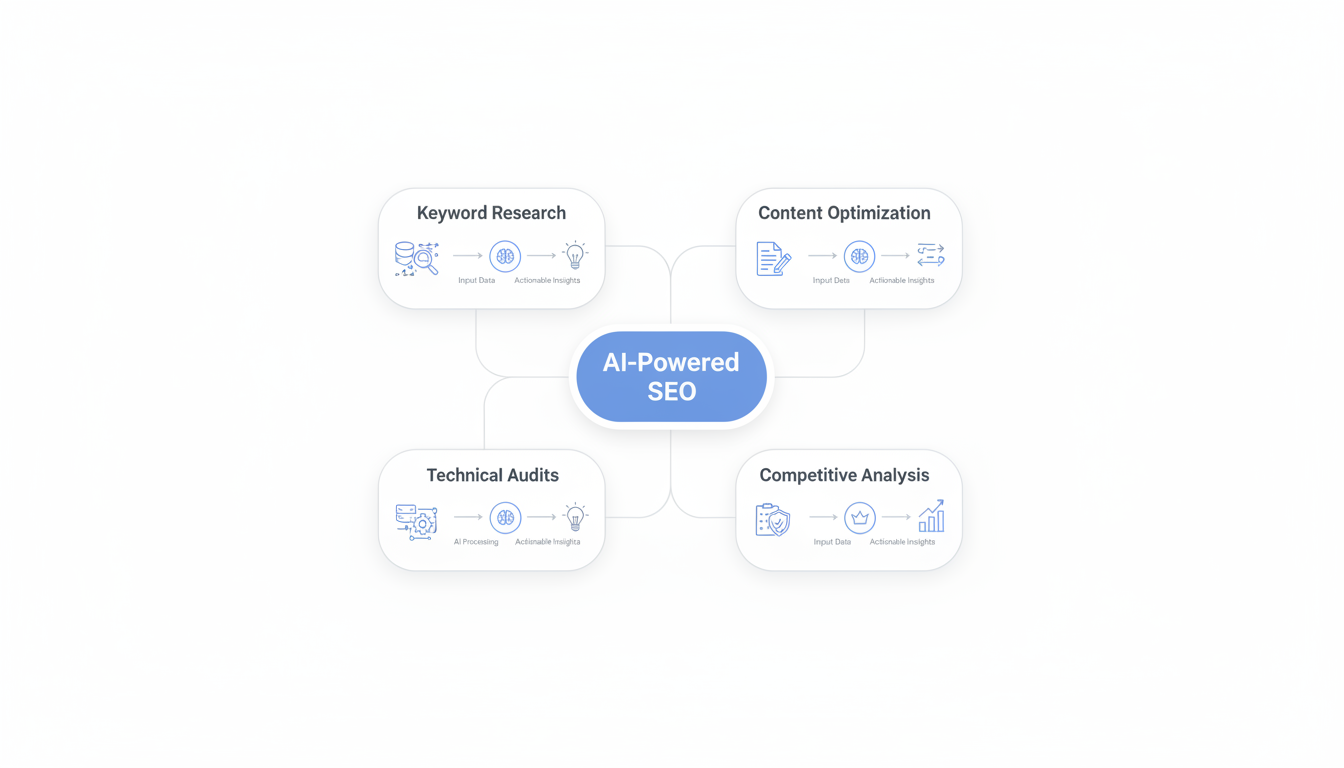
Where AI Improves SEO Workflows
AI tools excel at specific SEO tasks, accelerating work while improving accuracy.
Keyword Research and Analysis
AI enhances keyword research by:
- Processing volume at scale: Analyze thousands of keywords simultaneously, identifying patterns humans would miss
- Understanding intent: Classify keywords by user intent with greater accuracy than manual review
- Identifying gaps: Find keyword opportunities competitors target that you're missing
- Clustering topics: Group related keywords into logical content clusters
What previously took days of spreadsheet work now completes in hours.
Content Optimization
AI assists content optimization through:
- On-page analysis: Evaluate content against ranking pages for comprehensiveness and structure
- Semantic recommendations: Suggest related terms and topics to strengthen topical coverage
- Readability assessment: Identify passages that need simplification
- Structure suggestions: Recommend heading hierarchy and content organization
These tools help optimize existing content and guide new content creation, particularly for on-page AEO optimization strategies.
Technical SEO Auditing
AI improves technical audits by:
- Pattern recognition: Identify site-wide issues from large datasets
- Prioritization: Rank technical fixes by likely impact
- Predictive analysis: Estimate which changes will move rankings
- Automation: Flag issues as they appear rather than waiting for scheduled audits
Technical SEO at scale becomes manageable with AI assistance.
Competitive Analysis
AI accelerates competitive research:
- Content gap analysis: Identify topics competitors cover that you don't
- Backlink pattern detection: Find link building strategies that work in your space
- SERP feature tracking: Monitor who wins featured snippets and AI Overviews
- Strategy inference: Understand competitor priorities from their content patterns
Better competitive intelligence informs more effective strategy, especially when analyzing AI-powered search engines comparison data.
Practical AI Applications for SEO
Specific AI applications deliver immediate value.
Content Brief Generation
AI tools create comprehensive content briefs by analyzing top-ranking content for target keywords. These briefs include:
- Required topics and subtopics
- Questions to answer
- Entity relationships to establish
- Suggested structure and word count
- Competitor strengths to match or exceed
Teams spend less time researching and more time creating.
Meta Description Writing
AI generates meta descriptions at scale:
- Batch process thousands of pages
- Maintain brand voice consistency
- Include target keywords naturally
- Optimize for click-through rates
Manual meta description writing for large sites becomes impractical without AI assistance.
Internal Linking Recommendations
AI identifies internal linking opportunities by:
- Mapping topical relationships across content
- Finding orphaned pages needing links
- Suggesting anchor text variations
- Prioritizing links by page authority and relevance
Better internal linking distributes authority and improves crawlability.
Content Refresh Identification
AI helps prioritize content updates:
- Flag pages with declining traffic
- Identify outdated information
- Find content cannibalization issues
- Recommend consolidation opportunities
Systematic content maintenance keeps sites competitive.
AI Tools for SEO Professionals
Several tool categories support AI-powered SEO.
AI-Enhanced SEO Platforms
Major SEO platforms have integrated AI capabilities:
- Ahrefs: AI-powered keyword clustering and content gap analysis
- Semrush: Content optimization and technical audit automation
- Conductor: AI intelligence for enterprise SEO management
- Surfer SEO: AI content optimization and SERP analysis
These platforms combine traditional SEO data with AI processing. For businesses evaluating investments, understanding your AI search optimization budget helps determine which platform fits your needs.
AI Writing Assistants
Content creation tools support SEO workflows:
- Jasper: Long-form content generation with SEO optimization
- Copy.ai: Marketing copy and meta description creation
- Writer: Enterprise content creation with brand voice consistency
Writing assistants accelerate content production when used with human oversight.
Specialized AI Tools
Purpose-built tools address specific needs:
- Clearscope: AI content optimization for comprehensiveness
- MarketMuse: Topic modeling and content planning
- Frase: Research and content brief automation
Specialized tools often outperform general-purpose alternatives for specific tasks. Many organizations also leverage dedicated AEO software for answer engine optimization.
Best Practices for AI-Assisted SEO
Effective AI use requires intentional approaches.
Maintain Human Oversight
AI tools make mistakes. Human review ensures:
- Content accuracy and brand alignment
- Strategic decisions reflect business context
- Quality standards remain consistent
- Ethical guidelines are followed
Use AI for efficiency, not replacement of judgment.
Validate AI Outputs
Before publishing or implementing AI recommendations:
- Verify facts and statistics independently
- Check that recommendations make strategic sense
- Test technical suggestions on staging environments
- Review content for tone and brand voice
Trusting AI outputs without verification creates risk.
Combine AI and Human Strengths
The most effective workflows leverage both:
- AI handles: Data processing, pattern recognition, first drafts, routine tasks
- Humans handle: Strategy, creativity, quality control, final decisions
Neither performs optimally alone.

Document Processes
As AI integrates into workflows:
- Record which tools you use for which tasks
- Note configuration settings and prompts that work
- Track results to identify what delivers value
- Share knowledge across teams
Systematic documentation improves consistency and enables optimization.
Key Takeaways
AI accelerates SEO work significantly. Tasks that took hours now complete in minutes. This efficiency gain is competitive-teams not using AI fall behind.
AI assists but doesn't replace expertise. Strategic thinking, quality judgment, and brand understanding remain human responsibilities. AI handles processing; humans handle decisions.
Tool selection matters. Different tools excel at different tasks. Build a stack that addresses your specific needs rather than expecting one tool to do everything.
Process development enables value. Raw AI capability only delivers results through thoughtful integration into workflows. Invest time in building effective processes.
FAQs
Can AI Write All My SEO Content?
AI can draft content, but human editing improves quality and ensures brand alignment. AI-generated content without human review often lacks nuance, contains errors, and fails to differentiate from competitors. Use AI for efficiency in first drafts, then apply human expertise for final quality.
Which AI SEO Tool Should I Start With?
Start with AI features in tools you already use. Most major SEO platforms have added AI capabilities. Once comfortable, evaluate specialized tools for specific needs like content optimization or technical auditing. Avoid purchasing multiple tools before validating value from initial investments.
Does Google Penalize AI-Generated Content?
Google evaluates content quality regardless of how it's created. Low-quality AI content may struggle to rank, but well-edited AI-assisted content performs comparably to human-written content. Focus on quality, accuracy, and user value rather than production method.
Measuring the Impact of AI-Assisted SEO
Adding AI to your SEO workflow changes speed, but you should verify it changes results. Track a small set of before-and-after metrics when you roll out AI tooling so you can prove the value rather than assume it.
- Time per brief: Measure how long content planning took before and after AI assistance.
- Content volume: Count pages produced per month at the same quality bar.
- Ranking movement: Watch target keywords for position gains over a quarter.
- AI citations: Check whether your pages appear in ChatGPT, Perplexity, and AI Overviews for key queries.
AI helps most when it removes repetitive work and humans reinvest that time in strategy. If the tool saves two hours a week but the team fills it with low-value tasks, the investment stalls. Set an explicit rule: reclaimed time goes to topically deeper content, stronger internal linking, and testing - the work that actually moves rankings.
Building an AI-Augmented SEO Workflow
Start with one repeatable task, such as meta description generation, and validate the output quality. Once the team trusts it, expand to briefs, then to technical audit triage. Resist adopting five tools at once; each addition carries a learning cost. A focused stack of two or three well-understood tools outperforms a sprawling collection nobody fully uses. Document the prompts and settings that work, review outputs monthly, and retire any tool that stops earning its place.