
SearchGPT - OpenAI's search-enabled ChatGPT - doesn't provide analytics dashboards like Google Search Console. When SearchGPT cites your content in responses, you won't receive a notification or see it in standard analytics. Tracking your SearchGPT visibility requires deliberate monitoring approaches designed for this specific platform's behavior.
This guide focuses specifically on SearchGPT citation tracking, not general AI visibility monitoring.
Understanding SearchGPT Citations
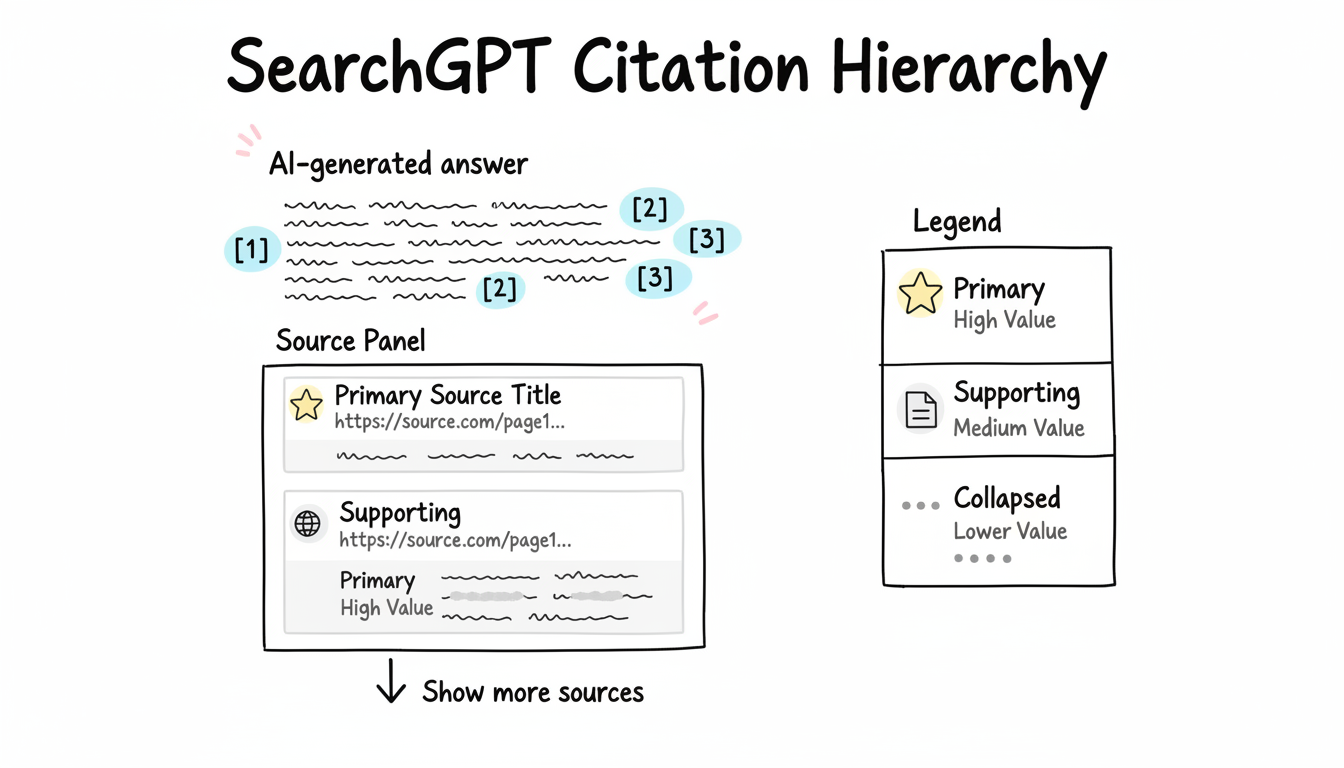
SearchGPT displays citations differently than traditional search results.
How SearchGPT presents sources:
SearchGPT Response Structure:
+-- AI-generated answer (synthesized text)
+-- Inline citation markers [1] [2] [3]
+-- Source panel (expandable)
|   +-- Website favicon
|   +-- Page title
|   +-- URL
|   +-- Brief excerpt
+-- "Show more sources" expansion
Citation types in SearchGPT:
Type | Appearance | Value |
Primary citation | Numbered in main answer | High |
Supporting source | Listed in source panel | Medium |
Collapsed source | Behind "show more" | Lower |
Your tracking should distinguish between these citation levels.
Manual SearchGPT Visibility Testing
Without automated tools, manual testing remains the foundation of SearchGPT tracking. Understanding how to optimize website ai-powered search engines provides essential context for interpreting your citation data.
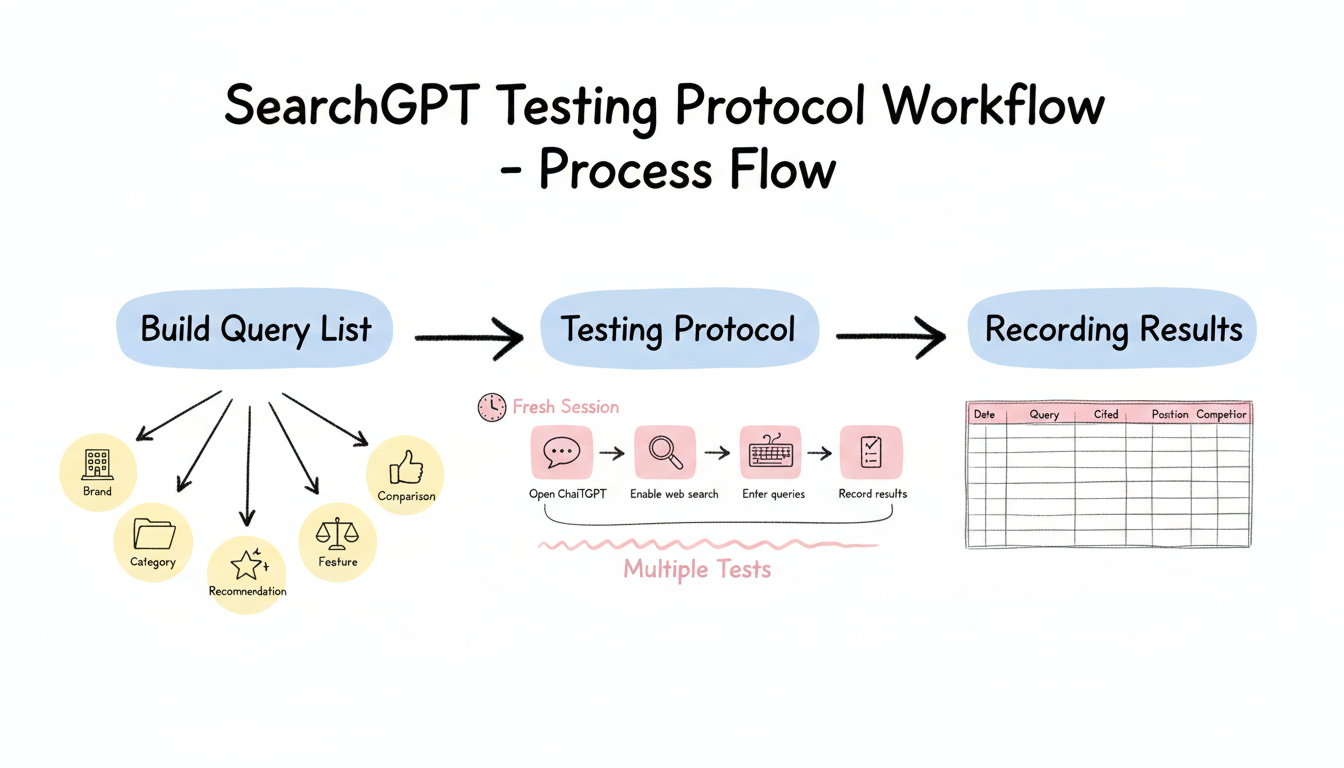
Building Your Test Query List
Focus on queries relevant to your business that SearchGPT handles with citations.
Query types to test:
Query Category | Example | Why Test |
Brand queries | "[Your company name]" | Direct recognition |
Category queries | "Best [your category]" | Competitive positioning |
Comparison queries | "[Your brand] vs [competitor]" | Head-to-head visibility |
Feature queries | "How to [solve problem you address]" | Use case alignment |
Recommendation queries | "What's the best way to [outcome]" | Citation likelihood |
Sample test query list:
Brand/Direct:
1. "[Company name]"
2. "[Company name] review"
3. "Is [company name] good?"

Category/Competitive:
4. "Best [your category] 2026"
5. "[Category] comparison"
6. "Top [category] tools"

Problem/Solution:
7. "How to [solve problem]"
8. "What's the best way to [achieve outcome]"
9. "[Problem] solutions"

Comparison:
10. "[Your brand] vs [competitor 1]"
11. "[Your brand] vs [competitor 2]"
Consistent testing produces meaningful data.
Daily/weekly testing process:
- Open ChatGPT Plus (SearchGPT requires subscription)
- Enable web search toggle
- Enter each test query
- Record whether SearchGPT cites your site
- Note citation position if present
- Document competitor citations
Recording template:
Date | Query | Your Site Cited | Position | Top Competitor |
[date] | [query] | Yes/No | 1/2/3/N/A | [domain] |
SearchGPT-Specific Behavior Patterns
SearchGPT behaves differently from other AI search platforms. The searchgpt vs chatgpt search technical differences reveal important distinctions that affect citation tracking strategies.
Response Variability
SearchGPT doesn't give identical answers to the same query.
Variability factors:
Factor | Impact on Citations |
Session context | Previous questions influence responses |
Time of query | Source selection changes over time |
Response regeneration | Same query may yield different sources |
Account history | Personalization may affect results |
Accounting for variability:
- Test each query multiple times
- Use fresh sessions (new chat)
- Test at different times of day
- Regenerate responses to see variation
Citation Trigger Patterns
Certain query structures more reliably trigger SearchGPT citations.
High-citation queries:
Patterns that generate citations:
+-- "What is [topic]" - definitional, cites educational content
+-- "Best [category] for [use case]" - recommendation, cites reviews
+-- "How to [task]" - instructional, cites tutorials
+-- "[Thing A] vs [Thing B]" - comparison, cites comparison content
+-- "[Topic] in 2026" - recency-dependent, cites recent content
Low-citation queries:
- Conversational/chat queries
- Simple factual questions (no sources needed)
- Opinion requests (AI responds from training)
- Tasks AI can complete without external info
Tools Supporting SearchGPT Tracking
Some platforms offer SearchGPT-specific monitoring.
Tools with SearchGPT coverage:
Tool | SearchGPT Feature | Limitations |
Otterly AI | ChatGPT tracking | Subscription required |
Semrush AI Toolkit | Multi-platform including ChatGPT | Part of broader suite |
Surfer SEO AI Tracker | SearchGPT monitoring | Limited query volume |
Manual testing | Full control | Time-intensive |
What tools actually track:
- Whether your domain appears in SearchGPT responses
- Citation frequency for tracked queries
- Competitor citation comparison
- Some sentiment analysis
What tools can't track:
- Exact citation position within responses
- Click-through from SearchGPT to your site
- Impression counts (SearchGPT provides none)
- Real-time monitoring (all use periodic sampling)
Measuring Progress Over Time
Meaningful SearchGPT visibility measurement requires longitudinal tracking. Similar to tracking ai overview performance, establishing consistent metrics helps identify optimization opportunities.
Baseline Establishment
Before optimization, establish your current state.
Baseline metrics to capture:
- Citation rate (% of test queries where you appear)
- Position distribution (1st, 2nd, 3rd citation when appearing)
- Query type performance (which categories cite you most)
- Competitor comparison (citation rate vs. top competitors)
Trend Tracking
Track changes monthly to detect improvement or decline.
Monthly tracking spreadsheet:
Month | Total Queries Tested | Your Citations | Citation Rate | Avg Position |
[month] | 20 | 8 | 40% | 2.3 |
Correlation Analysis
Connect optimization activities to visibility changes. Applying broader search engine optimization ai principles helps correlate content improvements with citation rate changes.
What to correlate:
Activity | Expected Impact Timeline |
New content published | 2-4 weeks |
Review volume increase | 4-6 weeks |
Backlink acquisition | 4-8 weeks |
Schema implementation | 2-4 weeks |
Interpreting SearchGPT Citation Data
Raw citation counts need context to be actionable.
Positive Indicators
Signal | What It Suggests |
Consistent citation presence | Stable authority recognition |
Improving citation position | Growing relevance |
Citations across query types | Broad topic authority |
Citation after content update | Content being re-indexed |
Warning Signs
Signal | Potential Issue |
Declining citation rate | Competitor improvement or your decline |
Position drops | Relative authority decrease |
Disappearing from query types | Topical relevance loss |
Competitor citations increasing | Market share shift |
Building a SearchGPT Visibility Dashboard
Manual checks are useful but do not scale on their own. Roll your findings into a simple dashboard that records the date, the query, whether you were cited, and the snippet shown, so movement is visible at a glance. A shared record turns scattered tests into a trend line leadership can read without re-running the checks.
Keep the query list fixed across reports so the comparison is honest. Adding and dropping queries week to week makes the numbers move for the wrong reasons, so discipline about the measured set matters more than the tooling behind it. The dashboard's job is to show change against a stable baseline.
How to Read a Citation Drop
When a citation disappears, resist panic. First confirm the overview still triggers for that query and that a competitor has not simply published a fresher, clearer page. A drop often means someone else raised the bar, not that your content broke.
Then compare your page to the new citation on depth, recency, and structure. If the winner answers faster or with newer evidence, update your page to match or beat it. Treat the drop as a scheduled prompt to improve rather than as a mystery to investigate endlessly.
Tying Visibility to Business Outcomes
Visibility is a means, not the goal. Pair your citation tracking with downstream metrics such as assisted conversions and branded search lift, because a cited answer that never influences a buying decision is a vanity signal. The connection to revenue is what justifies the tracking effort.
Report the link in plain terms: where you appear, who that audience is, and whether the appearance correlates with movement in a metric you care about. A one-page monthly summary that joins visibility to outcome is far more useful than a raw export of every check you ran.
Key Takeaways
Tracking your SearchGPT visibility:
- Build a test query list - 10-20 queries across brand, category, and problem/solution types
- Test consistently - Weekly minimum, same queries, fresh sessions
- Account for variability - SearchGPT responses change; test multiple times
- Use tools where helpful - Automated tracking supplements but doesn't replace manual testing
- Track trends over time - Monthly comparison reveals actual progress
- Connect activities to results - Correlate optimization efforts with citation changes
SearchGPT doesn't provide native analytics. Your visibility tracking depends on deliberate, systematic testing. Businesses that monitor their SearchGPT presence can identify what's working and adjust strategies based on actual citation patterns.