
Content format significantly impacts how AI search platforms like SearchGPT and ChatGPT Search extract, synthesize, and cite information. Research consistently shows that structured formats-particularly well-organized lists-outperform narrative prose for AI citation, but the story is more nuanced than simply "lists beat paragraphs."
Understanding which formats work best, when to use each, and how to combine them creates content that serves both AI systems and human readers effectively.
Why Format Matters for SearchGPT
AI language models process content differently than human readers scan pages. When SearchGPT or ChatGPT Search encounters a query, it needs to:
- Identify relevant information quickly across multiple sources
- Extract specific facts, steps, or recommendations
- Synthesize coherent responses from structured data
- Present information in a format users can act upon
Content format directly affects how well AI systems accomplish these tasks. Poorly structured content-even when substantively excellent-creates extraction challenges that lead AI to favor cleaner alternatives.
The core principle: AI systems prioritize content they can parse and quote cleanly. Format reduces friction in this extraction process.
List-Based Content (Highest Priority)
Lists consistently outperform other formats in AI citation testing. Research shows structured lists provide 15-25% higher citation rates compared to equivalent information presented in narrative paragraphs.
Why lists work for AI:
- Clear item separation eliminates parsing ambiguity
- Parallel structure makes comparison and extraction simple
- Scannable format enables rapid relevance assessment
- Quotable units allow direct citation without modification
Effective List Formats
Numbered lists work best for sequential processes, rankings, and prioritized information:
1. Identify target queries your content should answer
2. Research how AI platforms currently respond to those queries
3. Structure content with clear answer formatting
4. Implement schema markup to signal content organization
5. Monitor citation frequency and adjust approach
Bulleted lists work best for non-sequential items, features, or characteristics:
- Direct answers in the first 40-60 words
- Clear heading hierarchies using H2, H3, H4
- FAQ sections addressing common questions
- Schema markup (FAQ, HowTo, Article types)
List Optimization Best Practices
- Lead items with key information: Don't bury the important detail at the end of list items
- Keep items consistent: Parallel grammatical structure improves AI comprehension
- Limit list length: 5-10 items per list optimizes readability; break longer lists into categories
- Avoid nested complexity: Simple lists outperform deeply nested structures
Comparison Tables
Tables represent the highest-performing format for comparative information. When users ask "What's the difference between X and Y?" or "Which option is best for Z?", AI systems strongly prefer tabular data.
Table advantages:
Factor | Tables | Lists | Paragraphs |
Comparison clarity | Excellent | Good | Poor |
AI extraction ease | Highest | High | Moderate |
Information density | High | Moderate | Low |
Mobile readability | Variable | Excellent | Good |
When to use tables:
- Feature comparisons between products or services
- Pricing tier breakdowns
- Pros/cons evaluations
- Specification summaries
- Any content answering "compare" or "versus" queries
Table best practices:
- Include clear column headers
- Keep tables under 6-7 columns for mobile readability
- Use consistent data types within columns
- Lead with the most important comparison factor
Structured Data Formats
Beyond visible formatting, structured data markup signals content organization to AI systems at a technical level. Understanding the relationship between SEO knowledge graph implementation and content structure helps AI platforms connect your content to broader topic relationships.
High-impact schema types:
- FAQ Schema: Explicitly marks question-answer pairs for extraction
- HowTo Schema: Structures step-by-step content AI can parse cleanly
- Article Schema: Provides publication context and authorship signals
- ItemList Schema: Reinforces list structure for AI comprehension
Structured data doesn't guarantee citation-it cannot fix poor content quality. However, it removes technical barriers that might otherwise prevent AI systems from understanding well-written content.
Narrative Content Performance
Pure narrative content (unbroken paragraphs without structural elements) shows the lowest AI citation rates. However, narrative isn't inherently bad-it serves purposes that structured formats cannot.
When narrative works:
- Complex explanations requiring nuanced development
- Storytelling that builds context or credibility
- Expert analysis connecting multiple concepts
- Content requiring qualification and caveats
Why narrative underperforms for AI citation:
Testing reveals that storytelling approaches confuse AI systems when facts get embedded within narrative flow. AI models struggle to extract specific claims from prose that prioritizes readability over extractability.
A study examining product description optimization found that narrative storytelling actually reduced AI rankings because critical context got lost within the story structure.
The narrative reality: AI systems won't cite content they can't easily quote. Narrative paragraphs require more processing to extract quotable statements, making alternative sources more attractive.
Hybrid Approaches
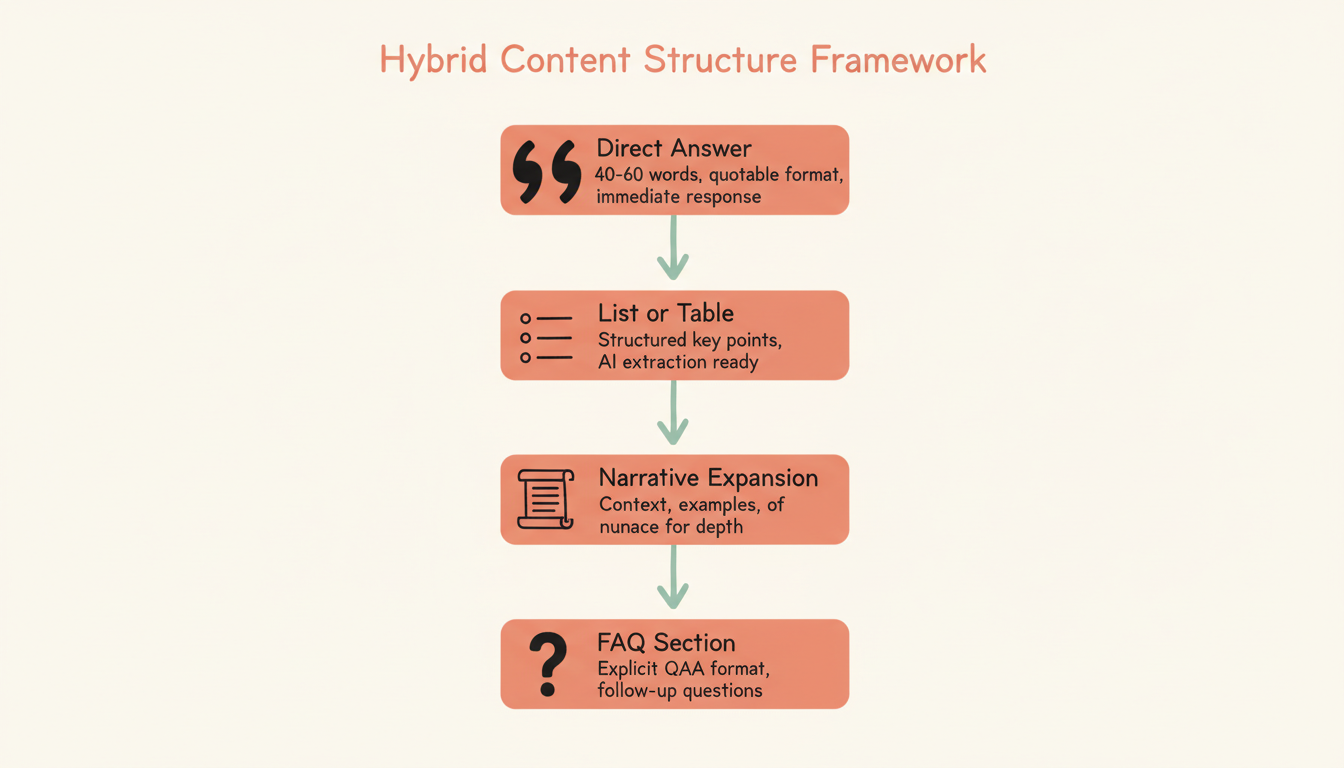
The optimal format for most content combines structural elements with narrative depth-giving AI systems what they need while serving human readers. Examining successful platform-specific content strategies format structure reveals how different AI platforms respond to various formatting approaches.
The hybrid structure:
- Direct answer (40-60 words): Immediately provide the core information in quotable format
- List or table: Structure the key points for AI extraction
- Narrative expansion: Add context, examples, and nuance for human depth
- FAQ section: Address follow-up questions in explicit Q&A format
This layered approach ensures AI systems find extractable content at multiple points while human readers receive comprehensive coverage.
Hybrid Example
Question-based header: How do you optimize content for SearchGPT?
Direct answer: Optimize content for SearchGPT by leading with direct answers, using clear list structures, implementing schema markup, and creating FAQ sections that address specific user questions in quotable format.
Supporting list:
- Structure content around user questions, not just keywords
- Use numbered lists for processes, bullets for features
- Add comparison tables for "versus" queries
- Implement FAQ schema on question-answer sections
Narrative expansion: The shift toward AI-optimized content doesn't mean abandoning readability. SearchGPT and similar platforms evaluate source quality based on signals beyond pure structure-authority, accuracy, and depth all contribute to citation decisions. Understanding what is AEO vs SEO helps clarify why format choices matter differently across traditional search and AI-powered platforms.
Format Testing Results
Industry testing reveals consistent patterns across AI platforms:
Citation rate by format (relative performance):
Format | Citation Rate | Best Use Case |
Tables | Highest (+30%) | Comparisons, specifications |
Numbered lists | High (+20%) | Processes, rankings |
Bulleted lists | Above average (+15%) | Features, characteristics |
Hybrid (list + narrative) | Above average (+10%) | Comprehensive guides |
Pure narrative | Baseline | Complex analysis |
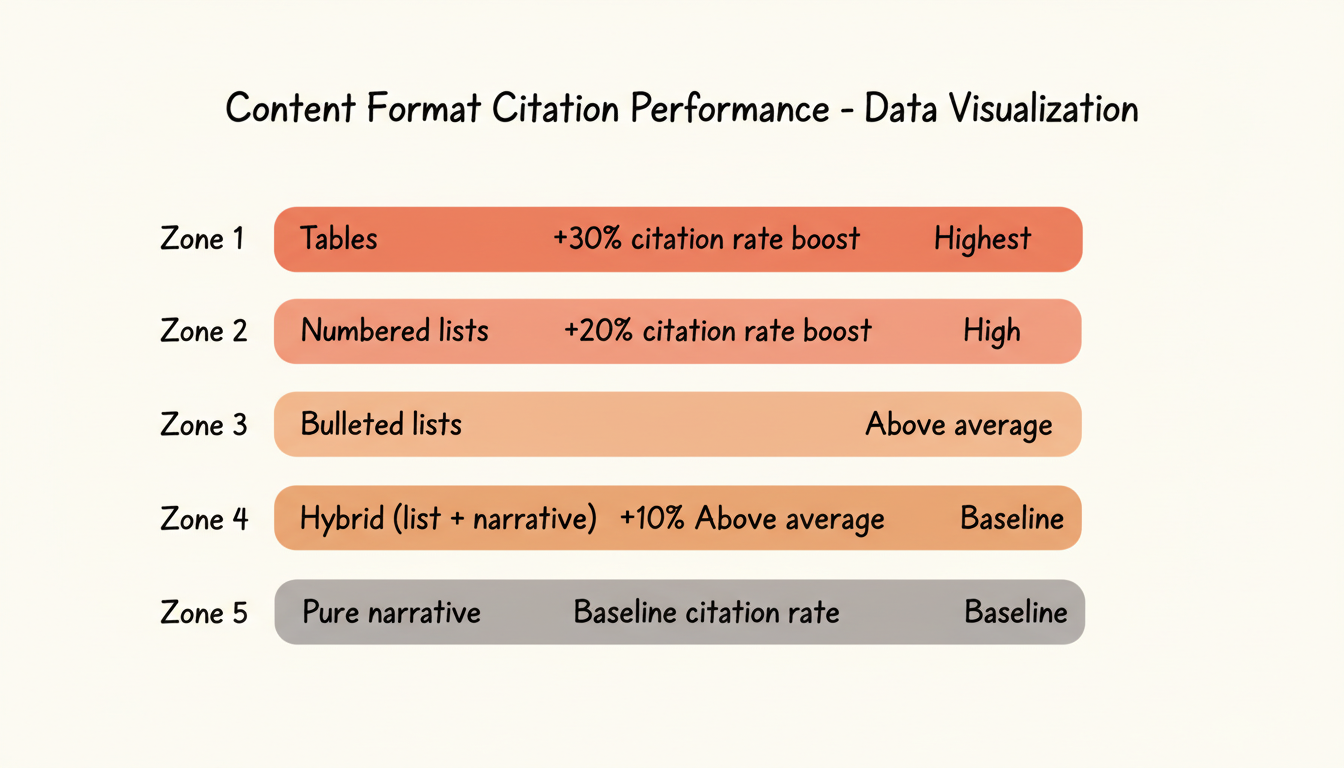
These patterns hold across SearchGPT, ChatGPT Search, Perplexity, and Google AI Overviews, suggesting universal AI preference for structured content. For detailed analysis of how different platforms handle citations, see our AEO platform comparison guide.
FAQs
Q: Should I avoid narrative content entirely? A: No. Narrative provides value for human readers and supports E-E-A-T signals through demonstrated expertise. Use hybrid approaches that include both structural elements and narrative depth.
Q: Do lists work for all types of content? A: Lists work best for factual, actionable, or comparative content. Abstract concepts, opinion pieces, and complex analysis may require more narrative treatment.
Q: How many items should a list contain? A: 5-10 items represents the optimal range. Longer lists should be broken into categorized subsections to maintain readability and AI comprehension.
Q: Can formatting alone improve AI citations? A: No. Research confirms that structure improves extraction but cannot fix poor content quality. Strong formatting with weak substance underperforms quality content with moderate formatting.
Q: Should I reformat existing content for AI optimization? A: Prioritize high-performing pages with clear AI citation potential. Adding structural elements to existing quality content often produces significant gains with moderate effort.
Applying Format Strategy to Your Editorial Process
Knowing that structure affects citation is useful only if it changes how you publish. Build format choices into your content brief so writers decide list versus narrative at the outline stage, not after drafting.
- Tag each section of the brief as process, concept, comparison, or analysis.
- Assign numbered lists to process sections and tables to comparisons by default.
- Reserve narrative for concept and analysis sections where reasoning must flow.
- Require a direct-answer opening of 40-60 words on every new page.
After publishing, review performance by format. Pages built as clean tables or lists for comparison queries should show up more often in AI answers than equivalent narrative treatments. When a narrative page underperforms for a comparison intent, refactor it into a table rather than rewriting the prose. Small, format-first edits to existing strong content often deliver faster citation gains than publishing entirely new posts, because the underlying substance already earns trust. Make format a checklist item in every editorial review so it becomes habit rather than an afterthought.