
SearchGPT doesn't have a universal preference for lists over narrative content-or vice versa. Its format preferences depend on the query type, the information being presented, and how well the format serves the user's needs. Understanding when SearchGPT favors structured lists versus explanatory prose helps you format content for citation.
This guide covers the list vs. narrative decision specifically for SearchGPT optimization.
How SearchGPT Processes Different Formats
SearchGPT evaluates content format based on how well it serves the query.
Format evaluation process:
User Query  SearchGPT Analysis:
 Identifies query type (how-to, what-is, comparison, etc.)
 Determines information structure needed
 Evaluates source formats against query needs
 Extracts from format that best matches intent
 Synthesizes into response (may reformat)
Key insight: SearchGPT may cite list content and present it as narrative, or cite narrative content and restructure it as a list. The original format matters for extraction likelihood, not necessarily final presentation.
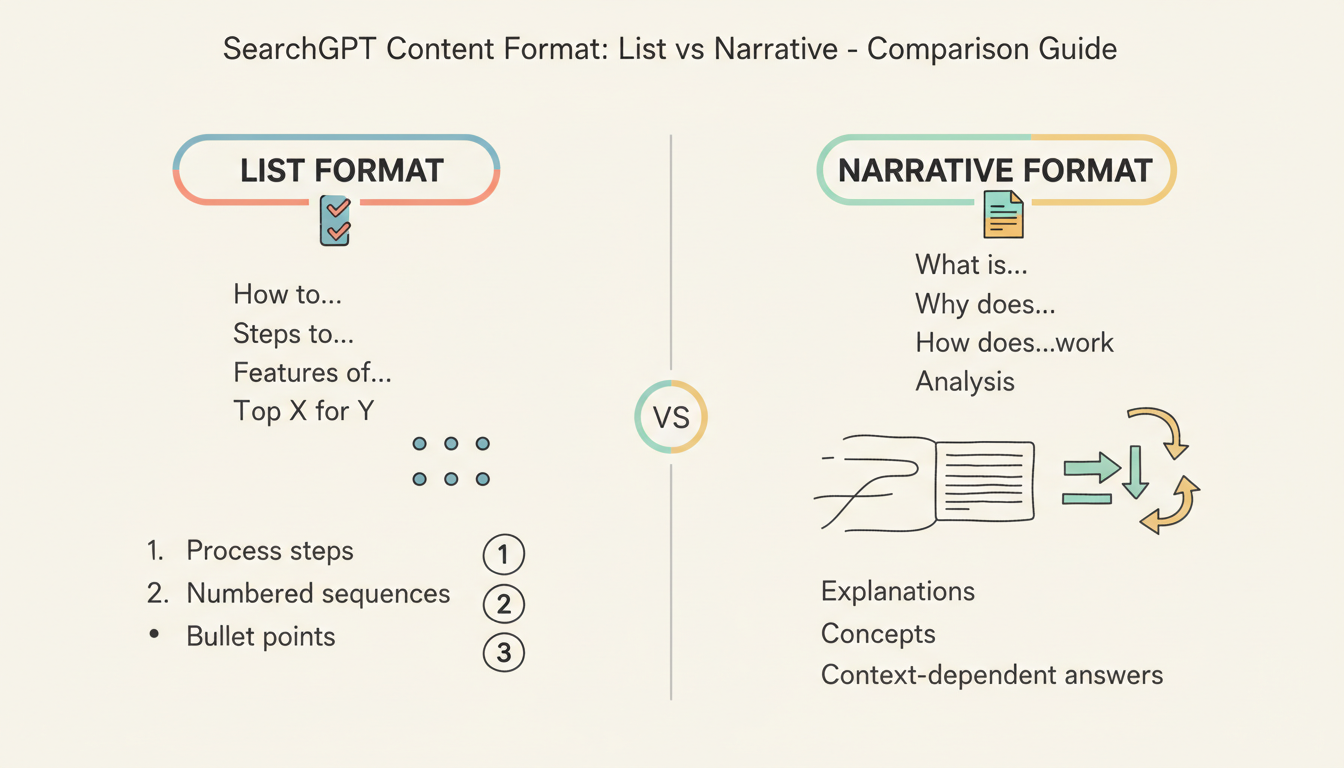
When SearchGPT Prefers Lists
Certain query types strongly favor list-formatted content.
Process and Step Queries
High list preference:
Query Pattern | Example | Why Lists Work |
"How to [action]" | "How to optimize for SearchGPT" | Steps need clear sequence |
"Steps to [outcome]" | "Steps to improve AI visibility" | Numbered structure expected |
"Guide to [process]" | "Guide to content optimization" | Process naturally sequential |
Optimal list format for process queries:
## How to [Achieve Outcome]

1. **[Step 1 action verb]** - [Brief explanation of what and why]
2. **[Step 2 action verb]** - [Brief explanation of what and why]
3. **[Step 3 action verb]** - [Brief explanation of what and why]
Each step should be executable without reading other steps.
Feature and Benefit Queries
List preference scenarios:
Query Type | Example | Best Format |
"Features of X" | "SearchGPT features" | Bullet list |
"Benefits of X" | "Benefits of AI optimization" | Bullet list |
"Pros and cons of X" | "Pros and cons of AEO" | Two-column or labeled bullets |
"Top X for Y" | "Top tools for AI SEO" | Numbered list |
Format example:
**Key benefits:**

- **[Benefit 1]:** [Specific outcome or value]
- **[Benefit 2]:** [Specific outcome or value]
- **[Benefit 3]:** [Specific outcome or value]
When users seek scannable information, lists extract better.
Quick reference scenarios:
- Requirements lists
- Specifications
- Pricing tiers
- Tool comparisons
- Checklist items
Understanding how to structure content for different AI search engines helps maximize citation opportunities across platforms.
When SearchGPT Prefers Narrative
Not everything should be a list. SearchGPT values narrative for certain content types.
Explanation and Concept Queries
High narrative preference:
Query Pattern | Example | Why Narrative Works |
"What is [concept]" | "What is answer engine optimization" | Concepts need context |
"Why does [thing happen]" | "Why does SearchGPT cite some sites" | Causation requires explanation |
"How does [thing] work" | "How does SearchGPT rank content" | Mechanisms need narrative flow |
Optimal narrative format:
## What Is [Concept]

[Concept] is [clear definition in 1-2 sentences]. [Context or background
that establishes relevance]. [Key distinguishing characteristic or
important nuance].

This matters because [implication or application]. [Brief example or
illustration if helpful].
Opening with a clear definition gives SearchGPT an extractable statement.
Analysis and Opinion Queries
SearchGPT cites expert analysis that requires connected reasoning.
Narrative preference scenarios:
Query Type | Why Narrative |
Industry analysis | Arguments need logical flow |
Strategic recommendations | Context affects advice |
Trend interpretation | Nuance matters |
Comparative evaluation | Trade-offs need explanation |
Lists can't convey "it depends" situations-narrative can.
Context-Dependent Information
When the answer depends on circumstances, narrative explains better than lists. This principle applies whether you're optimizing for SearchGPT market share or other AI-powered platforms.
Example query: "Should I focus on SearchGPT or Google AI Overviews?"
Weak (list format):
- Focus on SearchGPT if you're B2B
- Focus on Google if you want traffic
Strong (narrative format):
"The platform priority depends on your audience's search behavior. B2B companies often see higher-value engagement from SearchGPT because business users increasingly use ChatGPT for research. However, Google AI Overviews drive more total traffic volume due to Google's search market share. Consider where your specific audience searches and what conversion actions matter most."
Narrative allows for conditional logic lists can't capture.
Hybrid Formatting for SearchGPT
The most citation-friendly content combines both formats strategically.
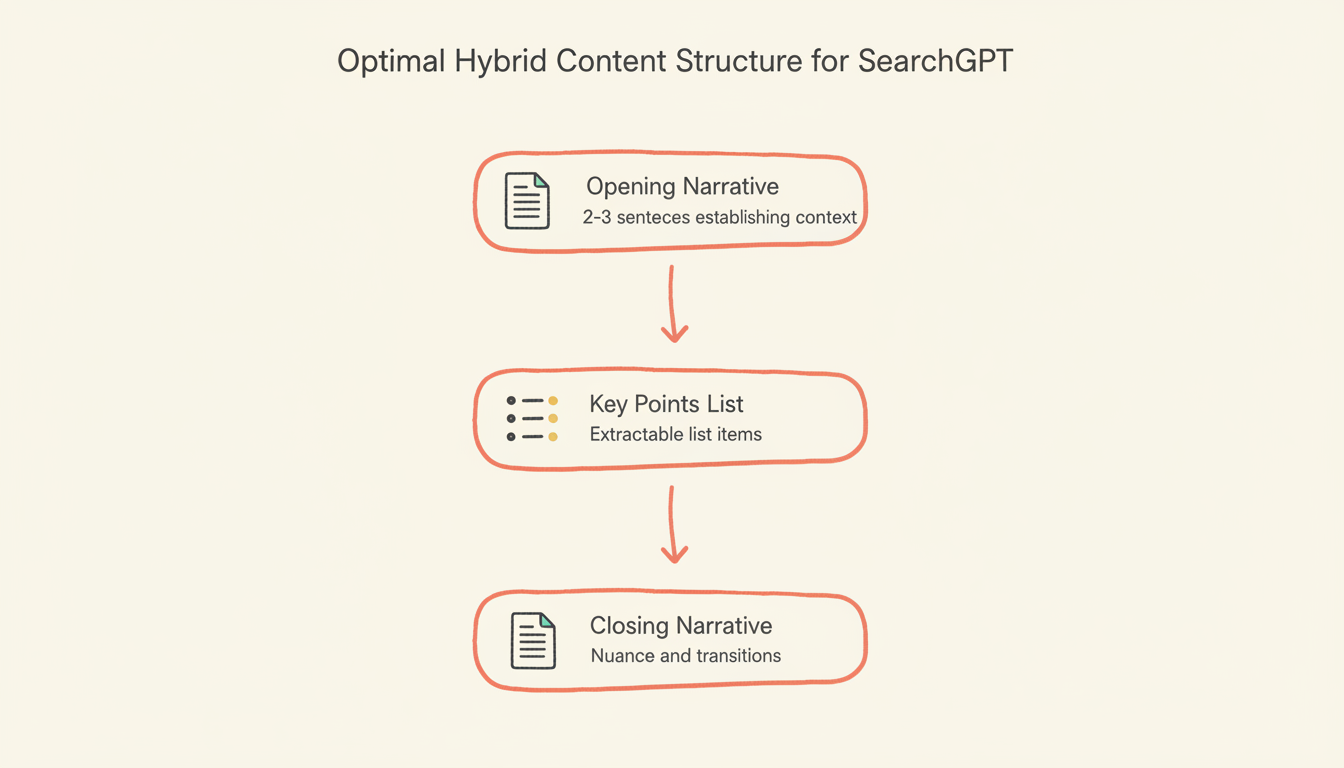
The Optimal Hybrid Structure
## [Section Header]

[Opening narrative paragraph establishing context - 2-3 sentences]

**Key points:**

- [List item 1]
- [List item 2]
- [List item 3]

[Closing narrative that adds nuance or transitions - 1-2 sentences]
This structure:
- Provides context SearchGPT needs for explanation queries
- Offers extractable list items for quick-reference queries
- Adds nuance that pure lists can't convey
When to Use Each Within a Single Article
Structure recommendation:
Content Section | Format | Reason |
Introduction | Narrative | Establishes context |
Core concepts | Narrative with key points list | Balances explanation with extraction |
Process/steps | Numbered list | Naturally sequential |
Recommendations | Bullet list | Discrete, scannable items |
Analysis | Narrative | Requires reasoning flow |
Conclusion | Narrative | Synthesizes takeaways |
Common Format Mistakes
Mistakes that reduce SearchGPT citation likelihood:
Mistake | Problem | Fix |
Forcing lists where narrative fits | Loses nuance, feels choppy | Match format to content type |
Long paragraphs with no structure | Hard to extract | Add subheadings and key points |
Lists with incomplete items | Context missing | Each item should stand alone |
Inconsistent formatting | Confuses extraction | Maintain parallel structure |
No narrative context for lists | Lists float without meaning | Add framing paragraphs |
Testing Your Format Choices
Evaluate whether your format choices work:
Self-assessment questions:
- Does each list item make sense without reading others?
- Do narrative sections have clear topic sentences?
- Can a key fact be extracted from the first sentence of each paragraph?
- Do lists use parallel grammatical structure?
- Is there a clear reason for choosing list vs. narrative in each section?
A comprehensive generative engine content strategy accounts for these format considerations across all AI search platforms.
Key Takeaways
Choosing between list and narrative formats for SearchGPT:
- Process queries favor lists - Steps, how-tos, and sequences work best as numbered lists
- Concept queries favor narrative - Definitions, explanations, and analysis need prose
- Context-dependent answers need narrative - "It depends" situations require explanation
- Hybrid formatting often works best - Combine narrative context with extractable list elements
- Each list item should stand alone - Complete information without requiring context
- Opening sentences matter for narrative - Lead with the key fact or definition
- Match format to content type - Don't force lists where narrative fits better
The right format isn't always a list-it's the format that best serves the query type your content addresses. SearchGPT cites content that answers questions effectively, regardless of whether that answer comes as a list or narrative.
Putting the List vs Narrative Decision into Practice
The framework only helps if it guides day-to-day writing. Before drafting, label the primary intent of the page: is it teaching a process, defining a concept, comparing options, or arguing a position? That label determines your dominant format, and you layer the other format in where it earns its place.
- Process or steps: lead with a numbered list, add narrative only to explain why.
- Definition or concept: open with a tight narrative definition, then support with a list.
- Comparison: use a table or two-column list, with narrative framing the trade-off.
- Opinion or analysis: narrative first, with a bullet list of the core claims.
A Quick Reference for Format Choice
If a reader could act on a single sentence without the rest, that sentence belongs in a list item. If the meaning depends on the sentences around it, narrative is the right home. Most strong AI-cited pages do both: they give SearchGPT extractable units and give humans the reasoning those units sit inside. Audit one existing post this week - mark every paragraph as list-candidate or narrative-candidate, then restructure the list-candidates into real lists and confirm the narrative sections open with their key fact. That single edit often improves extractability more than any new content would.