
ChatGPT Search and Google's AI features - AI Overviews and AI Mode - represent fundamentally different search ecosystems with distinct citation patterns, user behaviors, and optimization requirements. The question "which platform should I prioritize?" depends on your audience, industry, and resource constraints. This guide provides a decision framework for allocating AI search optimization efforts effectively.
According to Econsultancy's 2026 search predictions, Google is launching LLM models that are better and faster than ChatGPT's, and after more than two decades of dominating organic search, Google is very likely to dominate AI search too. However, client demand for ChatGPT marketing continues growing - making optimization for both platforms strategically important.
Platform Market Position in 2026
Understanding current market dynamics informs prioritization decisions.
According to SE Ranking's AI Mode analysis, both Google AI Mode and ChatGPT rely on authority, content quality, technical performance, and social signals - but the relative importance differs significantly. ChatGPT traffic projections suggest it could overtake Google organic search traffic by mid-2026 if current trajectories continue.
Market position comparison:
Metric | ChatGPT Search | Google AI | Implication |
Monthly visits | 5.72B | Billions (in SERP) | Both have massive reach |
Market share | 81% AI assistants | Dominant search engine | Different competitive contexts |
Growth trajectory | Steep upward | Stable + expanding | ChatGPT gaining rapidly |
User intent | Conversational queries | Mixed intent types | Different use cases |
Mobile behavior | App + web | Primarily search | Platform-specific patterns |
Citation Factor Differences
The platforms weight ranking factors differently - requiring tailored optimization.
According to SE Ranking's comparative analysis, AI Mode leans more heavily on domain traffic, brand recognition, and semantic relevance, while ChatGPT prioritizes referring domains, domain trust, and overall authority. Both value technical performance and structured content.
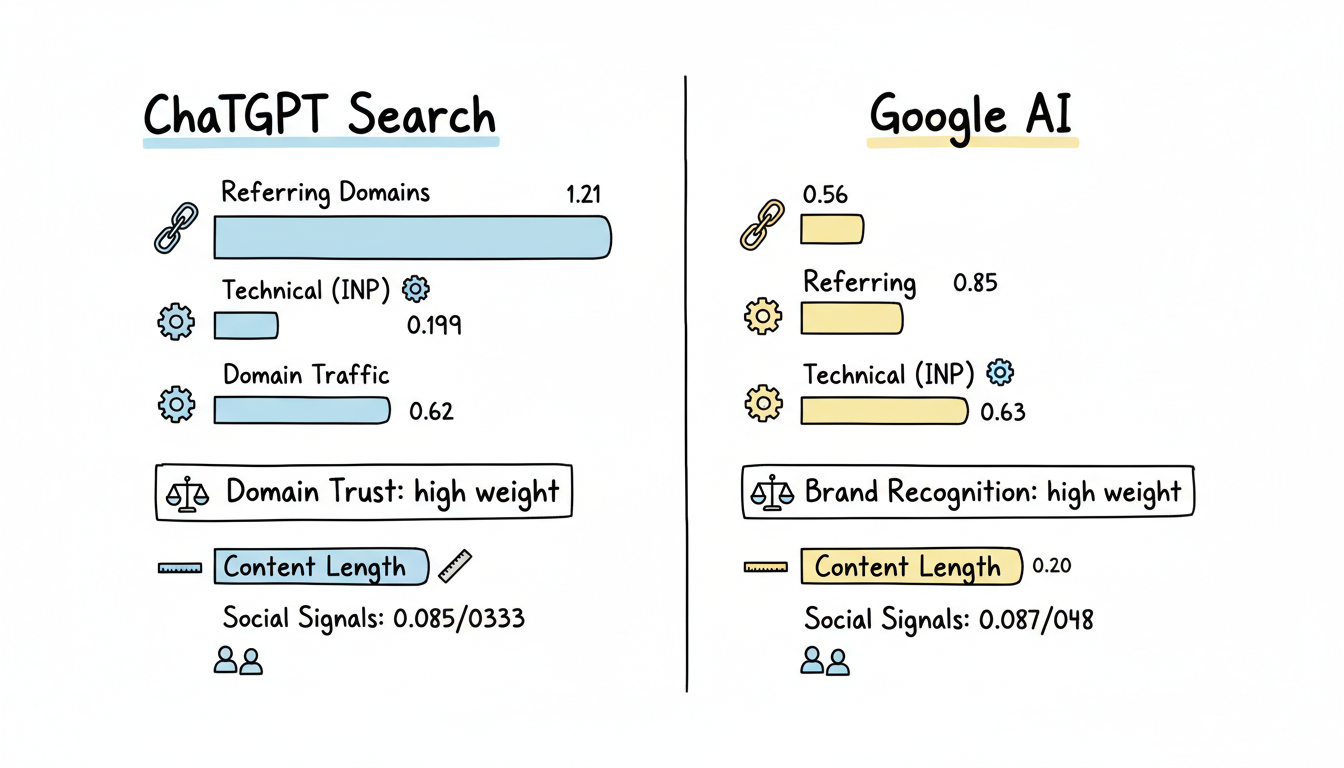
Citation factor comparison:
Citation Weight Differences (SHAP Values)
+-- Referring Domains
|   +-- ChatGPT: 1.21 (dominant factor)
|   +-- AI Mode: 0.56 (secondary factor)
|   +-- Implication: Link building more critical for ChatGPT
|
+-- Domain Traffic
|   +-- ChatGPT: 0.62
|   +-- AI Mode: 0.63
|   +-- Implication: Both value high-traffic domains
|
+-- Content Length
|   +-- ChatGPT: 0.06
|   +-- AI Mode: 0.20
|   +-- Implication: AI Mode favors longer content
|
+-- Social Signals (Reddit/Quora)
|   +-- ChatGPT: 0.085/0.033
|   +-- AI Mode: 0.087/0.048
|   +-- Implication: AI Mode slightly more social-influenced
|
+-- Technical Metrics (INP)
    +-- ChatGPT: 0.199
    +-- AI Mode: 0.085
    +-- Implication: ChatGPT values page speed more
ChatGPT optimization should take priority in specific scenarios.
According to Nick Lafferty's AI visibility analysis, Google AI Overviews heavily favor YouTube with 25% citation rates, while ChatGPT rarely cites YouTube (less than 1%) - indicating platform-specific optimization needs based on your content format.
Prioritize ChatGPT Search when:
Scenario | Why ChatGPT | Optimization Focus |
B2B/SaaS products | Tech-savvy audience uses ChatGPT | Technical content depth |
Strong domain authority | ChatGPT weights referring domains heavily | Leverage existing backlinks |
Limited video content | YouTube disadvantaged on ChatGPT | Double down on text content |
International audience | Less Google dependence in some markets | Broad language optimization |
Direct answer queries | Conversational interface matches intent | Answer-first content structure |
ChatGPT-specific tactics:
- Build referring domains - Most heavily weighted citation factor (1.21 SHAP)
- Optimize page speed - INP weighted 0.199 (higher than AI Mode)
- Focus on text content - YouTube citations under 1%
- Improve domain trust - Slightly higher weight than AI Mode
- Target conversational queries - Match user intent patterns
When to Prioritize Google AI
Google AI (Overviews and AI Mode) should lead in different circumstances.
According to ReviewlyHub's optimization guide, if you must prioritize, start with Google AI Overviews (largest audience) and Perplexity (highest citation rates), with ChatGPT following as secondary priority.
Prioritize Google AI when:
Scenario | Why Google AI | Optimization Focus |
Local businesses | Google Business Profile integration | Complete GBP + local SEO |
Video content strategy | YouTube most-cited in AI Overviews | YouTube optimization |
Brand recognition focus | AI Mode weights brand signals higher | Entity building |
Traditional SEO strength | High overlap with organic rankings | Leverage existing rankings |
Featured snippet winners | Strong correlation with AI Overview citation | Snippet optimization |
Google AI-specific tactics:
- Create longer content - AI Mode weights content length 0.20 vs ChatGPT's 0.06
- Invest in YouTube - 25% citation rate in AI Overviews
- Build brand signals - AI Mode values brand recognition more
- Optimize for semantic relevance - Higher weight (0.06-0.07 vs 0.018)
- Maintain Reddit/Quora presence - Slightly higher influence on AI Mode
The Both/and Strategy
Most businesses benefit from optimizing for both platforms with weighted allocation.
According to ALM Corp's query fan-out analysis, websites ranking for multiple fan-out queries are 161% more likely to earn AI Overview citations. Diversifying platform presence across ChatGPT, Perplexity, Gemini, and emerging platforms protects against concentration risk.
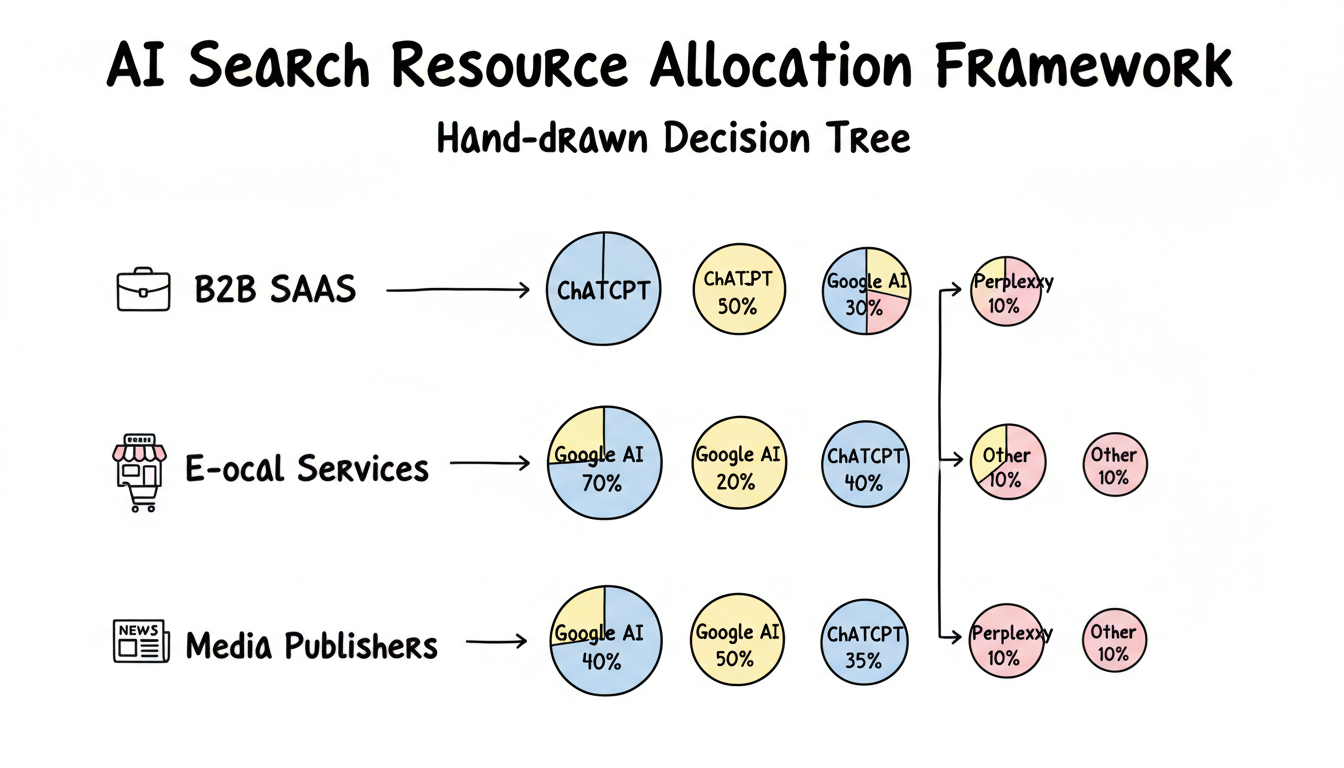
Balanced allocation framework:
Resource Allocation by Business Type
+-- B2B SaaS / Technical Products
|   +-- ChatGPT Search: 60%
|   +-- Google AI: 30%
|   +-- Perplexity: 10%
|   +-- Rationale: Tech audience preference
|
+-- Local Services / Retail
|   +-- Google AI: 70%
|   +-- ChatGPT Search: 20%
|   +-- Other: 10%
|   +-- Rationale: GBP integration critical
|
+-- E-commerce / Consumer Products
|   +-- Google AI: 50%
|   +-- ChatGPT Search: 40%
|   +-- Perplexity: 10%
|   +-- Rationale: Shopping features on both
|
+-- Media / Publishers
    +-- Google AI: 55%
    +-- ChatGPT Search: 35%
    +-- Perplexity: 10%
    +-- Rationale: Traffic volume priority
Certain optimization tactics benefit visibility across all AI platforms.
According to USIM's Q4 2025 analysis, Google's algorithm is looking for high-quality signals from real user behavior and genuine brand participation - principles that apply across AI-powered search engines.
Universal optimization priorities:
Strategy | ChatGPT Impact | Google AI Impact | Implementation |
Domain authority building | High (1.21) | Medium (0.56) | Quality backlinks |
Technical performance | High (INP 0.199) | Medium (INP 0.085) | Core Web Vitals |
Content depth | Medium | High (0.20) | Comprehensive coverage |
Schema markup | Medium | High | Structured data |
Entity consistency | High | High | Cross-platform NAP |
Fresh content | Medium (0.026) | Higher (0.071) | Regular updates |
Measuring Platform-Specific Performance
Track visibility separately to refine allocation decisions.
According to Vertu's AI visibility tools guide, tools like Surfer AI Tracker monitor visibility across Google AI Overviews, SearchGPT, Perplexity, Claude, and ChatGPT - tracking brand, product, and topic mentions in AI-generated answers.
Measurement approach:
- Track citations separately - Don't combine platform metrics
- Monitor traffic sources - Attribute referrals by platform
- Test identical queries - Compare citation differences
- Benchmark competitors - Assess relative visibility per platform
- Review monthly - Adjust allocation based on results
Key Takeaways
Platform prioritization depends on your specific context:
- ChatGPT priorities - Strong when you have domain authority, limited video, and B2B audience
- Google AI priorities - Strong for local businesses, video content, and brand-building focus
- Citation factors differ significantly - Referring domains dominate ChatGPT; content length matters more for AI Mode
- YouTube is platform-specific - 25% citation rate in AI Overviews vs under 1% in ChatGPT
- Both platforms value authority - Domain traffic matters on both (0.62-0.63)
- Diversification protects - 161% higher citation likelihood for multi-platform visibility
According to Econsultancy, the overlap between Google organic search citations and ChatGPT citations ranges from 30-60% - meaning significant optimization opportunity exists on both platforms. The winning strategy isn't choosing one over the other but allocating resources strategically based on where your audience searches and what content formats you produce, whether you're implementing GEO optimization tactics or measuring success with AEO measurement tracking.
Quarterly Reallocation Review Process
Platform weights shift as adoption and algorithms change, so treat your allocation as a living plan rather than a fixed split. A lightweight quarterly review keeps spend aligned with where citations and referrals actually come from.
- Pull separate citation and traffic reports for ChatGPT, Google AI, and Perplexity for the quarter.
- Compare against the prior quarter and flag any platform that moved more than ten points in share.
- Rebalance the percentage allocation using the business-type framework as your starting point.
- Document one experiment to run next quarter, such as longer content for AI Mode or more referring domains for ChatGPT.
This cadence prevents drift and ensures you invest where the audience is moving. Businesses that review annually often discover too late that a platform they ignored now drives a meaningful slice of discovery.