
The most effective search marketing in 2026 integrates SEO and SEM into a unified strategy where each channel reinforces the other. According to search marketing experts, integration is key—your SEO and SEM strategies should inform each other, with keyword research feeding both channels and high-converting landing pages incorporating optimization for both paid and organic visibility.
This guide shows you how to combine SEO and SEM for maximum results.
Why Integrate SEO and SEM
Running SEO and SEM as separate silos wastes opportunity. Integrated strategies outperform because each channel strengthens the other.
Complementary Strengths
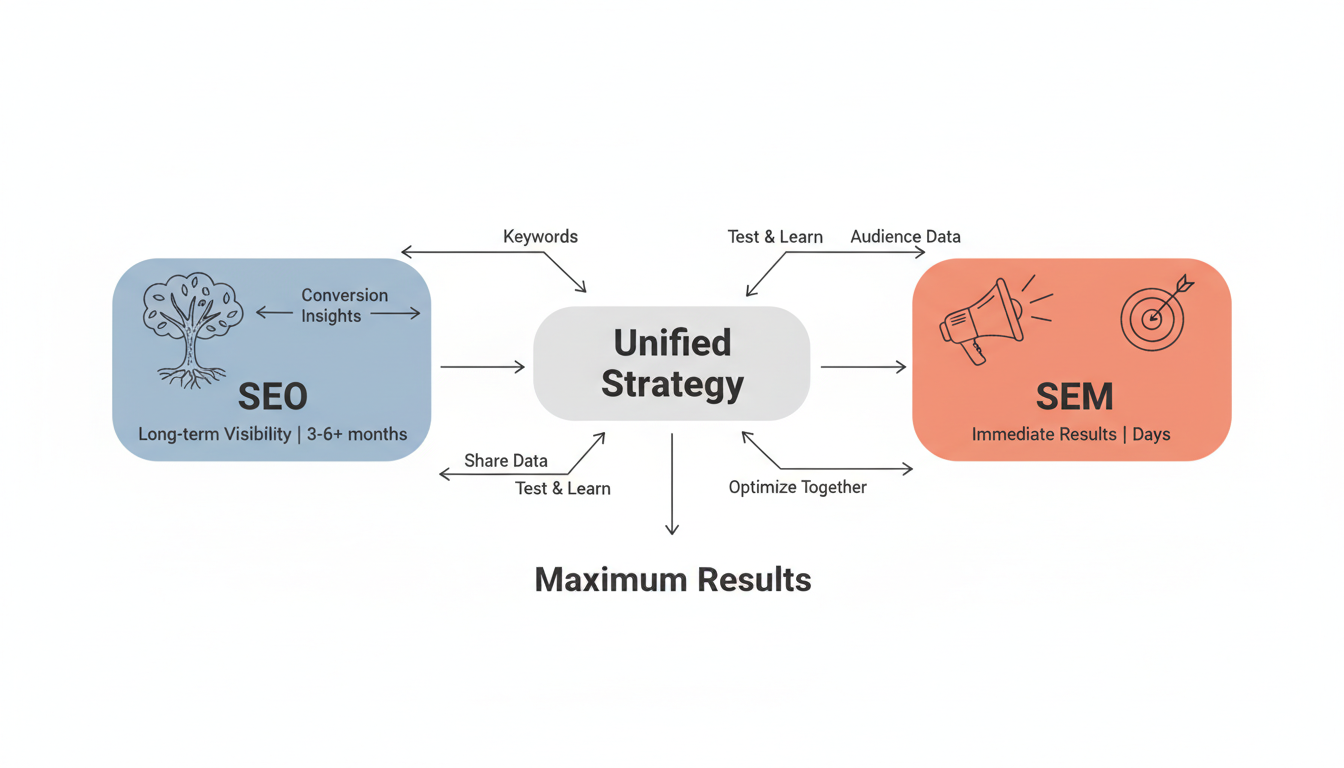
According to NinjaPromo research, SEO and PPC work well together because SEO builds awareness and trust while PPC captures ready-to-convert traffic:
Channel | Strength | Timeline |
SEO | Long-term visibility, authority building | 3-6+ months |
SEM | Immediate placement, direct response | Days |
The Business Case for Integration
Full funnel marketing experts identify key benefits of unified digital strategies:
- Clearer direction: All channels point to common conversion points
- Consistent messaging: Prospects receive coherent narratives regardless of entry point
- More effective spending: Each dollar works more efficiently
- Better data: Insights from one channel improve the other
"Breaking down silos unites audience strategy, media buying, and analytics in a holistic approach that promotes cross-channel consistency." — New Target
Synergies to Leverage
Smart marketers exploit specific synergies between organic and paid search.
Keyword Intelligence Sharing
PPC provides fast keyword validation that informs SEO priorities:
- Test with PPC: Run paid campaigns targeting broad keyword sets
- Identify winners: Find keywords with highest conversion rates
- Prioritize for SEO: Create organic content targeting proven converters
- Reduce costs over time: As organic rankings improve, reduce PPC spend on those terms
According to NinjaPromo, using paid search to test messaging quickly lets you validate approaches before committing to SEO changes that take longer to implement and adjust. This approach works particularly well when you're evaluating ppc campaign optimization tips that can inform your long-term organic strategy.
Dual Visibility Benefits
Appearing in both paid and organic results increases overall click-through rates and brand trust. Studies consistently show that dual presence captures more total clicks than either channel alone.
When to pursue dual visibility:
- High-value, high-competition keywords
- Brand terms (protect from competitor bidding)
- Keywords where you're not yet ranking #1 organically
Conversion Data Transfer
Apply learnings from high-performing PPC landing pages to organic content:
- Headline and copy messaging that converts
- Page layouts and user experience patterns
- Call-to-action placement and language
- Trust signals and social proof elements
Audience Insights
PPC campaigns generate valuable data about your converting audience:
- Demographics of buyers
- Geographic performance patterns
- Device and time-of-day preferences
- Messaging that resonates
Use these insights to inform SEO content strategy, targeting, and user experience optimization. Understanding these patterns is essential whether you're managing campaigns in-house or working with ppc campaign management services to execute your strategy.
Data Sharing Tactics
Practical methods for sharing data between SEO and SEM teams (or efforts).
Search Term Analysis
Export PPC search query reports regularly to identify:
- New keyword opportunities for SEO content
- Negative keyword candidates to exclude from PPC
- Question-based queries for FAQ and content development
- Long-tail variations with conversion potential
Performance Benchmarking
Compare metrics across channels to identify opportunities:
Metric | Use Case |
Conversion rate by keyword | Prioritize SEO for high-converting terms |
CPC trends | Target expensive keywords with SEO to reduce paid costs |
Quality Score factors | Apply relevance improvements to organic content |
SERP position vs. CTR | Understand click distribution across positions |
Attribution Analysis
Implement cross-channel attribution to understand how SEO and SEM work together:
- Which channel initiates customer journeys?
- How often do prospects touch both before converting?
- Where does each channel add unique value?
According to industry analysis, performance evaluation at each stage of the funnel aids in resources reallocation and pinpoints growth drivers.
Unified Reporting
Create dashboards showing:
- Total search visibility (paid + organic)
- Combined traffic and conversions
- Channel-level and aggregate ROI
- Incrementality analysis
Budget Allocation
Smart budget allocation maximizes results across both channels.
Strategic Allocation Framework
According to marketing experts, integrated campaigns highlight which channels perform best, enabling smarter budget allocation:
Early stage (building SEO foundation):
- Heavier PPC investment for immediate visibility
- SEO budget focused on technical foundation and content development
- Use PPC data to inform SEO priorities
Growth stage (SEO gaining traction):
- Balanced investment across channels
- Shift some PPC budget to SEO as organic rankings improve
- Expand to new keywords through PPC testing
Mature stage (strong organic presence):
- Reduce PPC on keywords with strong organic rankings
- Maintain PPC for competitive terms and new opportunities
- Allocate freed budget to content expansion
Dynamic Reallocation
Adjust budgets based on performance signals:
- Reduce PPC when organic ranking achieves page one
- Increase PPC for competitive keywords where organic progress is slow
- Balance investment between immediate results (PPC) and long-term assets (SEO)
Budget Allocation Considerations
Scenario | Recommended Approach |
New market entry | Heavy PPC, establish SEO foundation |
High competition keywords | Dual investment until organic gains traction |
Strong organic rankings | Minimal PPC, focus on non-ranking keywords |
Seasonal campaigns | PPC surge with supporting SEO content |
Brand protection | PPC on brand terms, organic content for authority |
Implementation Guide
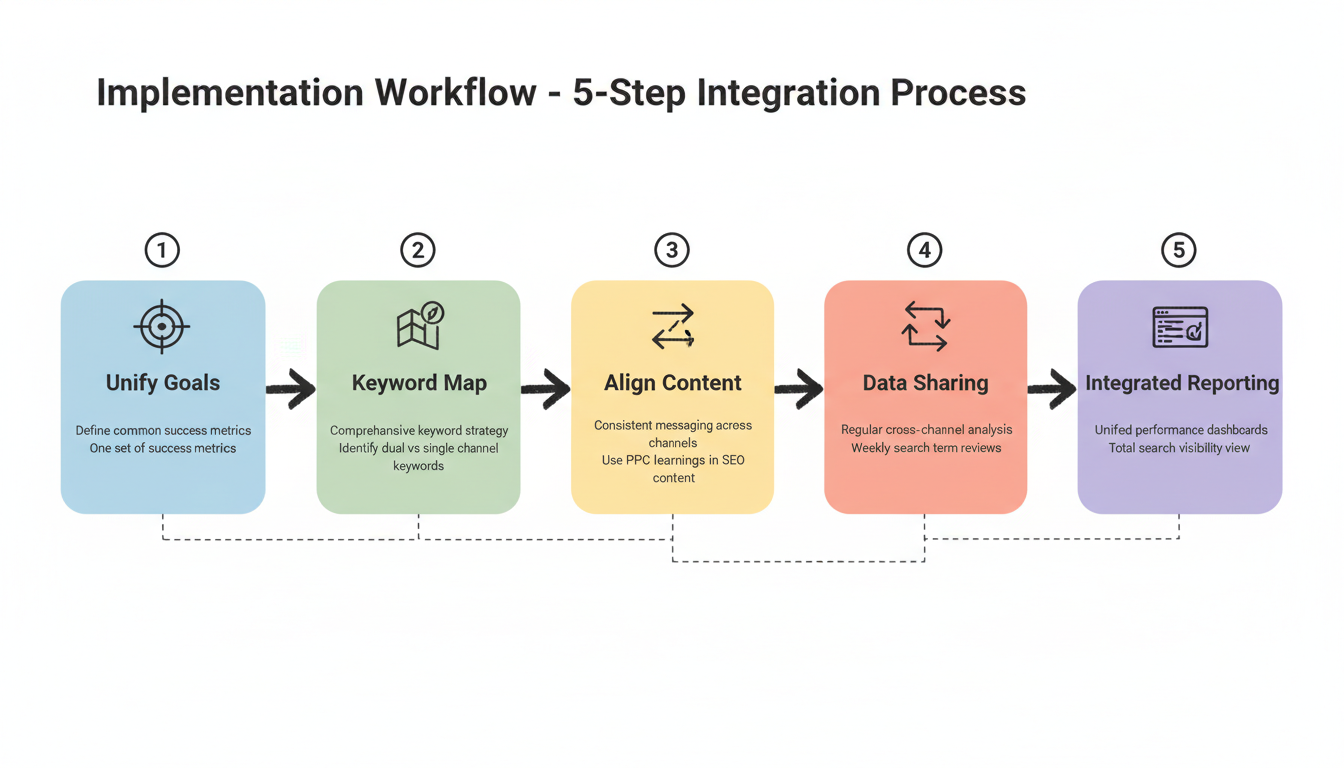
Follow this process to build an integrated SEO and SEM strategy.
Step 1: Unify Goals and Metrics
According to New Target, start by defining a single set of success metrics that all channels contribute toward. For example:
- Total qualified leads from search
- Combined revenue from organic + paid
- Aggregate cost per acquisition
- Overall search visibility share
Step 2: Create a Keyword Map
Develop a comprehensive keyword strategy that identifies:
- Keywords where you'll pursue both SEO and PPC
- Keywords prioritized for organic only (low competition, informational)
- Keywords for PPC only (high competition, testing)
- Keywords where organic investment can reduce future PPC spend
NinjaPromo explains that a keyword map helps you decide where dual visibility makes sense, where to invest in SEO to reduce long-term ad spend, and where PPC fills gaps while organic catches up. This planning process should leverage the same sem marketing tools best software you use for campaign execution to ensure data consistency.
Step 3: Align Content and Landing Pages
Ensure consistency across channels:
- Use proven PPC messaging in organic content
- Apply schema markup to PPC landing pages
- Maintain consistent brand voice and value propositions
- Create content that serves both paid and organic traffic
Step 4: Establish Data Sharing Processes
Set up regular cross-channel analysis:
- Weekly: Review PPC search terms for SEO opportunities
- Monthly: Compare channel performance and adjust priorities
- Quarterly: Strategic review of budget allocation
- Ongoing: Share winning elements between channels
Step 5: Build Integrated Reporting
Create unified dashboards showing:
- Channel-level performance
- Combined search visibility
- Cross-channel attribution
- ROI across the full search portfolio
Frequently Asked Questions
What'S the Difference Between SEO and SEM?
SEO (search engine optimization) focuses on improving organic search rankings through content, technical optimization, and authority building. SEM (search engine marketing) typically refers to paid advertising in search results. According to marketing experts, both work together to capture potential customers at different journey stages. The best results come from integrating both strategies rather than treating them as separate channels.
Should I Invest in SEO or SEM First?
Neither exclusively—both have value. According to research, SEO requires upfront investment that compounds into long-term organic visibility, while paid search delivers immediate placement for ongoing ad spend. Start with PPC to generate immediate results and learnings, while building SEO foundations for long-term sustainability. As organic rankings improve, shift budget from PPC to SEO for better overall ROI.
How Do I Measure Integrated SEO and SEM Performance?
Track both channel-specific and combined metrics. Marketing experts recommend measuring total search visibility, combined traffic and conversions, aggregate cost per acquisition, and overall search portfolio ROI. Use multi-touch attribution to understand how prospects interact with both channels before converting.
Key Takeaways
- Integrated SEO and SEM strategies outperform siloed approaches through data sharing, consistent messaging, and efficient spending
- Use PPC to test keywords and messaging quickly, then apply learnings to SEO for long-term results
- Share data between channels regularly: search terms, conversion insights, audience demographics
- Allocate budget dynamically based on organic rankings and competitive landscape
- Create unified reporting that shows combined search performance, not just channel-level metrics