
Last Updated: January 2026
For SEO professionals, the emergence of Answer Engine Optimization (AEO) raises practical questions. Does AEO replace SEO? Should resources shift away from traditional tactics? How do these disciplines intersect?
This guide examines the SEO vs AEO relationship from a practitioner's perspective - clarifying what changes, what stays the same, and how to integrate both approaches effectively.
SEO Fundamentals Still Work
Traditional SEO hasn't become obsolete. The core practices that drive organic visibility remain effective:
- Keyword research still identifies what audiences search for
- On-page optimization still helps search engines understand content
- Technical SEO still enables crawling and indexing
- Link building still establishes authority
- Content quality still determines relevance
Research shows that Google AI Overviews draw heavily from pages already ranking in traditional results. Pages with strong organic rankings have significantly higher chances of appearing in AI-generated responses.
The foundation matters. Understanding key differences between SEO and AEO helps clarify that AEO builds on SEO - it doesn't bypass it.
What AEO Adds to the Equation
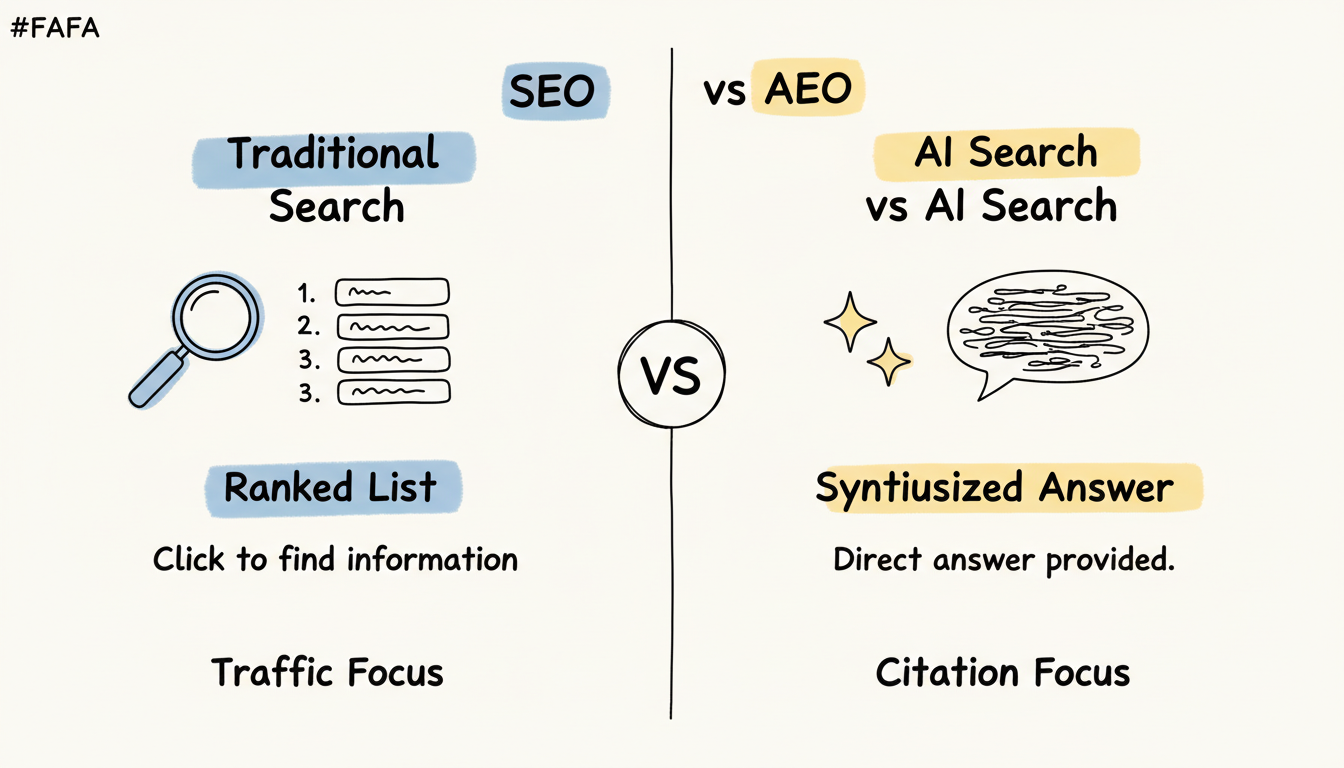
While SEO gets content indexed and ranked, AEO gets content cited. The distinction matters because AI search changes user behavior:
Traditional Search | AI Search |
User sees ranked list | User sees synthesized answer |
User clicks to find information | User may get answer directly |
Traffic is the primary metric | Citation is the primary metric |
Rankings determine visibility | Selection determines visibility |
AEO addresses this shift through optimization tactics that make content more extractable and quotable by AI systems.
Where SEO and AEO Diverge
Understanding the practical differences helps prioritize optimization efforts.
Content Structure
SEO approach: Comprehensive pages that thoroughly cover topics, often with 1,500+ words, targeting keyword density and topical completeness.
AEO approach: Modular content with clear, extractable statements. Short paragraphs (under 80 words) that stand alone when quoted. Key information front-loaded after every heading.
Success Metrics
SEO metrics: Rankings, organic traffic, click-through rates, time on page, bounce rate.
AEO metrics: Citation frequency and other key AEO optimization metrics, AI referral traffic, share of voice in AI responses, citation accuracy.
Optimization Focus
SEO optimization: Title tags, meta descriptions, header hierarchy, internal linking, backlink acquisition, page speed.
AEO optimization: FAQ sections, schema markup, entity consistency, content freshness, cross-platform presence, quotable statements.
The Integration Strategy
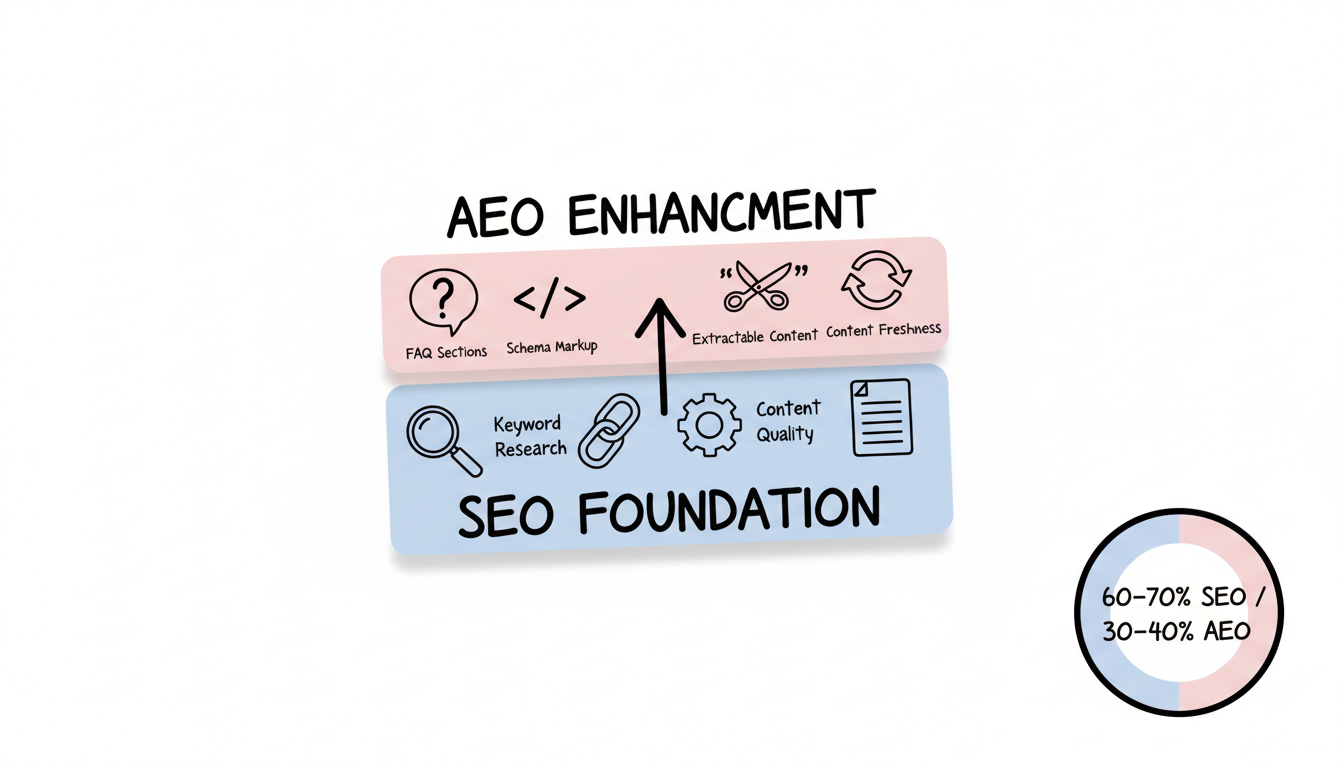
Effective digital visibility in 2026 requires both disciplines. Here's how to integrate them:
Layer AEO Onto Existing SEO
Don't rebuild from scratch. Take content that already ranks well and enhance it for AI extraction:
- Add FAQ sections with specific answers
- Implement Article and FAQ schema
- Break long paragraphs into shorter, standalone units
- Include statistics and expert quotes
- Update content regularly with timestamps
Following proven AEO best practices for 2026 ensures your enhancements align with current AI platform requirements.
Prioritize Based on Goals
Traffic-focused goals: Emphasize traditional SEO. Rankings still drive the majority of organic clicks.
Brand visibility goals: Emphasize AEO. AI citations build awareness even without clicks.
Comprehensive visibility: Balance both. Start with SEO foundations, layer AEO enhancements.
Allocate Resources Pragmatically
For most teams, a reasonable split:
- 60-70% effort on traditional SEO
- 30-40% effort on AEO enhancements
This ratio shifts as AI search adoption grows, but SEO fundamentals remain the foundation.
Common Misconceptions
"AEO Will Replace SEO"
Unlikely. AI search platforms rely on web content that SEO makes discoverable and credible. Without SEO producing authoritative, indexed content, AI systems would have little to cite.
"We Should Stop Link Building"
No. Domain authority still correlates with AI citations. Backlinks signal trustworthiness to both traditional algorithms and AI systems.
"Traditional Rankings Don'T Matter Anymore"
False. Research shows substantial overlap between top organic results and AI Overview citations. Strong rankings increase AI visibility, not decrease it.
"AEO Requires Completely Different Content"
Not entirely. The same quality content serves both purposes - AEO optimization is often about restructuring existing content rather than creating entirely new material.
Practical Next Steps for SEO Teams
For teams with established SEO practices, adding AEO involves incremental changes:
Immediate actions:
- Implement FAQ schema on key pages
- Add FAQ sections to top-performing content
- Ensure robots.txt allows AI crawlers
Short-term improvements:
- Restructure paragraphs for extractability
- Add statistics and citations to claims
- Update content timestamps regularly
Ongoing integration:
- Track AI referral traffic in analytics
- Monitor citation frequency across platforms
- Adjust content based on AI visibility data
Many organizations benefit from working with an experienced AEO agency to accelerate implementation while maintaining SEO fundamentals.
Key Takeaways
SEO isn't going anywhere. Traditional optimization remains essential for discoverability, authority, and the foundation that AI systems build upon.
AEO extends SEO's reach. Rather than replacing rankings, AEO captures visibility in the new AI search landscape.
Integration beats replacement. The most effective approach layers AEO onto strong SEO fundamentals rather than choosing one over the other.
Start with what you have. Existing high-ranking content is the best candidate for AEO enhancement. Restructure before you rebuild.
How AI Overviews Pull from Pages That Already Rank
The single most useful fact for an SEO team is that AI Overviews lean heavily on pages already ranking in traditional results. The model is not inventing sources; it synthesizes from what search already deemed authoritative and relevant. That means a strong organic position is often the precondition for a citation, which is why AEO is layered on SEO rather than run instead of it.
The practical takeaway is to anchor AEO work on your current top performers. Take the pages that already earn first-page rankings for AI-relevant queries and make them extractable with FAQ sections, schema, and front-loaded answers. You are not chasing a separate ranking system; you are helping the one you already rank in get quoted.
Team Skills and Org Design for SEO Plus AEO
Most SEO practitioners already hold the core skills AEO needs - content strategy, technical implementation, and data analysis - so the transition is upskilling, not rehiring. The new emphases are content structuring for extraction, schema implementation, and entity consistency, all of which map onto work an SEO or content lead can own. A small, cross-functional habit - reviewing priority pages for answer-readiness each quarter - is enough to start.
Org-wise, the mistake is creating a separate AEO silo that duplicates SEO. The cheaper, more durable model is one content program measured by two lenses: rankings and citations. When the same owner is accountable for both, the work compounds instead of competing for budget, and the team learns to ship content that serves crawlers and models at once.
What Changes When AI Search Grows
As more queries resolve inside AI answers, the balance of effort shifts toward AEO, but the floor stays SEO. The 60-40 split today moves toward something closer to parity over time, and the metrics that matter - assisted pipeline, branded search lift, citation share - gain weight alongside classic rankings. The teams that adapt are the ones treating the shift as a tuning of an existing program, not a rebuild.
The risk of ignoring AEO is a slow, quiet loss of visibility among users who now start with an assistant rather than a search box. The risk of abandoning SEO is losing the very authority that makes AI citation possible. Holding both, and rebalancing as adoption data dictates, is the stable position for 2026 and beyond.
FAQs
Should I Stop Doing Traditional SEO?
No. SEO remains fundamental to organic visibility. AEO optimization complements SEO but depends on the foundation that traditional optimization provides. Continue SEO practices while adding AEO enhancements.
How Do I Measure AEO Success Compared to SEO?
SEO success measures rankings and traffic. AEO success measures citation frequency and AI referral traffic. Track AI visits in analytics by filtering traffic from perplexity.ai, chat.openai.com, and similar sources. Use specialized tools like Otterly.AI to monitor citations.
Does AEO Require Different Skills Than SEO?
The core skills overlap - content strategy, technical implementation, data analysis. AEO adds emphasis on content structuring, schema implementation, and entity optimization. Most SEO practitioners can adapt existing skills with targeted upskilling.
Which Should I Prioritize If I Have Limited Resources?
SEO first. Build the foundation that enables both organic rankings and AI citations. Once SEO fundamentals are solid, allocate time to AEO enhancements starting with your highest-performing content.