
Single Page Application SEO: The Complete Guide to Ranking React, Angular, and Vue Apps
Your single page application loads fast, feels smooth, and delivers the experience your users want. Search engines see an empty div. That disconnect between user experience and crawler experience is the core challenge of single page application SEO -- and it costs SPA-driven businesses thousands of ranking opportunities every month.
The fix is not to abandon SPAs. The fix is to understand exactly how search engines interact with JavaScript-rendered content, then choose the rendering strategy that matches your indexing needs. This guide covers every layer of that decision -- from how JavaScript rendering affects crawlability to framework-specific solutions for React, Angular, and Vue. For the full technical foundation of how Google crawls and renders JavaScript, see our complete guide to JavaScript SEO.
What Is Single Page Application SEO and Why Is It Difficult?
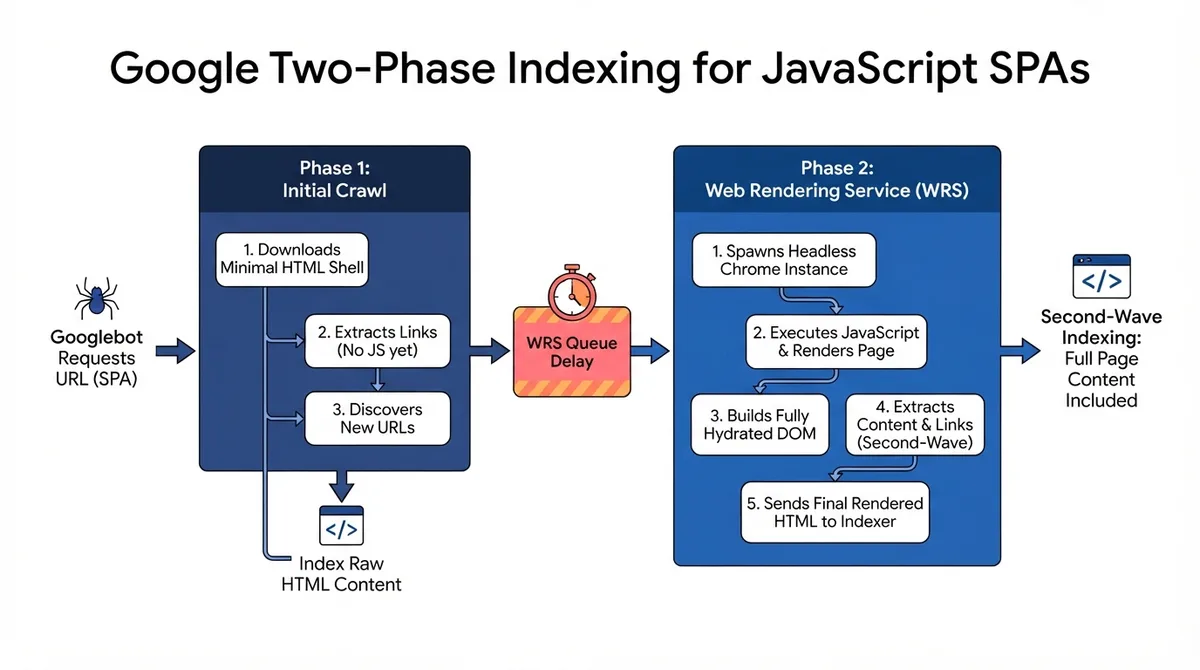
Single page application SEO is the practice of making JavaScript-rendered web applications fully visible, crawlable, and indexable by search engines. It is difficult because SPAs fundamentally change the relationship between a URL and its content.
Traditional websites serve complete HTML documents from the server. When Googlebot requests a page, it receives everything it needs to understand the content: headings, paragraphs, links, metadata. A single page application serves a minimal HTML shell -- often just a root div and a bundle of JavaScript. The content only materializes after the browser executes that JavaScript, fetches data from APIs, and renders the DOM.
This creates three distinct problems for search engines.
Rendering delay. Google uses a two-phase indexing process. First, Googlebot crawls the page and receives the raw HTML. Then, the Web Rendering Service (WRS) executes the JavaScript to see the final content. That second phase can be delayed by hours or days. During the gap, Google indexes only what it found in the initial HTML -- which for a pure client-side SPA is essentially nothing.
Crawl budget waste. Every JavaScript resource your SPA requires -- framework bundles, data fetches, lazy-loaded modules -- consumes crawl budget. If Googlebot has to execute 2MB of JavaScript just to see your product descriptions, it may deprioritize crawling deeper pages on your site. For large SPAs with thousands of routes, this becomes a serious bottleneck.
Navigation and URL discovery. SPAs handle navigation through the History API, updating the URL without triggering a full page request. If your internal links use JavaScript event handlers instead of standard anchor tags with href attributes, Googlebot cannot discover those URLs. Pages that users reach through click events are invisible to crawlers.
These problems are solvable. But solving them requires choosing the right rendering architecture from the start rather than patching issues after they surface in Search Console.
How to Choose the Right Rendering Strategy for Your SPA
The rendering strategy you choose determines whether search engines see your content immediately, after a delay, or not at all. There are three primary options, and each trades off developer experience, infrastructure complexity, and SEO performance differently.
Client-Side Rendering (CSR)
CSR is the default for most SPA frameworks. The browser downloads JavaScript, executes it, fetches data, and renders the page. The server sends only the application shell.
SEO impact: Poor for content-driven pages. Googlebot can render JavaScript, but the delay between crawl and render means your content enters the index slowly. Pages with frequently changing content may never reflect their current state in search results. Other search engines -- Bing, Yandex, Baidu -- have even less JavaScript rendering capability than Google.
When CSR works: Behind-authentication dashboards, internal tools, and applications where organic search traffic is irrelevant. If no one needs to find the page through a search engine, CSR is the simplest approach.
Server-Side Rendering (SSR)
SSR generates the full HTML on the server for every request. When Googlebot requests a page, it receives complete, rendered content without needing to execute JavaScript. The client-side framework then hydrates the page to make it interactive.
SEO impact: Strong. Search engines see complete content on first request. Metadata, structured data, and internal links are all present in the initial HTML. Server-side rendering delivers measurable SEO benefits across crawlability, indexing speed, and ranking stability.
When SSR works: Content-heavy sites, e-commerce product pages, blogs, marketing pages -- any route where organic search visibility matters. The tradeoff is server cost and increased Time to First Byte (TTFB) compared to serving static files.
Static Site Generation (SSG)
SSG pre-renders pages at build time, producing static HTML files that are served from a CDN. The content is baked into the files before any user or crawler requests them.
SEO impact: Excellent for content that changes infrequently. Pages load fast, are fully crawlable, and require no server-side computation. The drawback is that content updates require a new build and deploy cycle.
When SSG works: Documentation, blogs, landing pages, product catalogs that update on a schedule rather than in real time. Next.js and Nuxt.js both support SSG alongside SSR, letting you mix strategies per route.
Incremental Static Regeneration (ISR)
ISR is a hybrid that pre-renders pages at build time and re-renders them in the background on a defined interval. It combines the performance of SSG with the freshness of SSR.
SEO impact: Strong for sites with large page counts and moderate update frequency. New pages can be generated on first request and cached, which handles dynamic route creation without full rebuilds.
When ISR works: E-commerce catalogs with thousands of SKUs, news sites with evergreen archives, and marketplaces where product listings change daily but not per-request.
CSR vs SSR vs SSG: A Direct Comparison for SEO
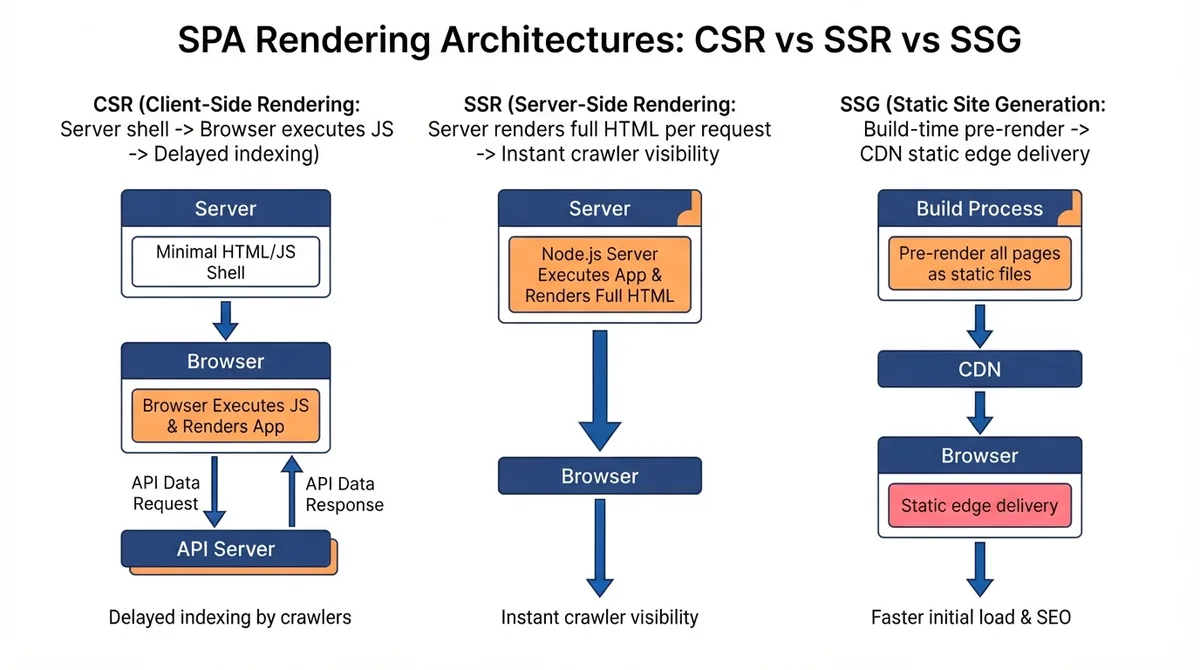
Choosing the wrong rendering strategy is the most expensive SEO mistake you can make with a single page application. Here is how the three approaches compare across the metrics that matter for search visibility.
| Factor | CSR | SSR | SSG |
|---|---|---|---|
| Initial HTML content | Empty shell | Complete page | Complete page |
| Googlebot first-pass indexing | No content indexed | Full content indexed | Full content indexed |
| Time to First Byte (TTFB) | Fast (static shell) | Slower (server renders) | Fastest (CDN-served) |
| Crawl budget efficiency | Poor (requires JS execution) | Good (no JS needed) | Best (lightweight responses) |
| Content freshness | Real-time | Real-time | Build-time (stale until rebuild) |
| Infrastructure complexity | Low | Medium-High | Low-Medium |
| Core Web Vitals (LCP) | Typically poor | Good | Best |
| Dynamic content support | Full | Full | Limited without ISR |
| Non-Google search engines | Not indexed | Fully indexed | Fully indexed |
The comparison makes the tradeoffs clear. CSR optimizes for developer simplicity at the expense of SEO. SSG optimizes for performance and SEO at the expense of content freshness. SSR sits in the middle, offering strong SEO with the flexibility to serve dynamic content, at the cost of server infrastructure.
Most production SPAs that depend on organic traffic use a hybrid approach: SSR or SSG for public-facing, indexable routes, and CSR for authenticated or interactive sections. This is the pattern that frameworks like Next.js and Nuxt.js are designed to support.
Common Single Page Application SEO Mistakes
These mistakes appear in nearly every SPA audit we conduct. Each one is fixable, but only if you know to look for it.
Relying on Hash-Based Routing
Hash fragments (#) in URLs are ignored by search engines. If your SPA uses routes like example.com/#/products/widget, Google treats every route as the same URL: example.com/. Switch to the History API with pushState so each route has a distinct, crawlable URL.
Missing or Duplicated Metadata
SPAs that manage metadata through client-side JavaScript often fail to update title tags and meta descriptions when navigating between routes. The result is either the same metadata on every page or metadata that only appears after JavaScript execution. Use server-side rendering or a pre-rendering solution to ensure each URL serves its own unique metadata in the initial HTML response.
Javascript-Only Internal Links
If your navigation renders links as <span onclick="navigate('/about')"> instead of <a href="/about">, Googlebot cannot follow them. Use standard anchor elements with href attributes for every navigable link. This is the most common crawlability failure in SPAs.
Blocking Critical Resources in Robots.Txt
Some developers block JavaScript files in robots.txt to reduce server load. This prevents Googlebot's rendering service from executing the scripts that produce your content. Never block JS or CSS files that are required to render page content.
No Sitemap for Javascript-Rendered Routes
Even with proper rendering, a comprehensive XML sitemap accelerates discovery. If your SPA has 500 product pages that are only reachable through search filters and pagination, Googlebot may never discover them through crawling alone. Generate and submit a sitemap that includes every indexable route. SPAs built from data-driven templates at this scale are prime candidates for programmatic SEO, which covers how to structure thousands of generated pages.
Ignoring Non-Google Search Engines
Google's rendering capabilities are years ahead of other search engines. Bing, DuckDuckGo, and international engines like Baidu and Yandex have limited or no JavaScript rendering. If you rely on CSR, you are invisible to a significant portion of global search traffic. SSR and SSG solve this for all engines simultaneously.
Not Implementing Structured Data Server-Side
JSON-LD structured data injected via client-side JavaScript may or may not be picked up by Google. Delivering structured data in the initial HTML response guarantees processing. This is especially important for rich results like FAQs, reviews, and product listings.
Emerging Trends in SPA SEO
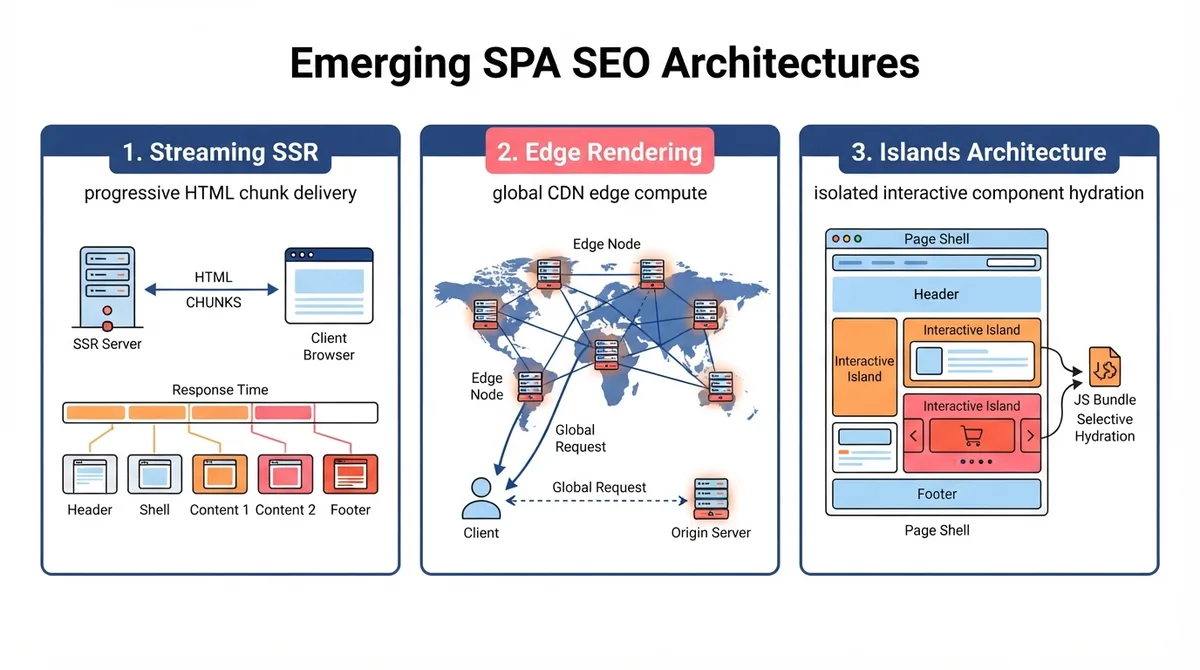
The gap between SPA architecture and search engine expectations is closing, but the direction of convergence matters for your technical roadmap.
Streaming SSR is becoming the default in frameworks like Next.js (React Server Components) and Nuxt.js. Instead of waiting for the entire page to render on the server, streaming sends HTML chunks as they become available. This reduces TTFB while maintaining full server-side rendering for SEO. Expect this pattern to become standard by 2027.
Edge rendering moves server-side rendering to CDN edge nodes, reducing latency to near-SSG levels while keeping the content dynamism of SSR. Vercel, Cloudflare Workers, and Deno Deploy all support this pattern. For SPAs with global audiences, edge SSR eliminates the TTFB penalty that historically made SSR slower than SSG.
Partial hydration and islands architecture reduce the JavaScript shipped to the client by only hydrating interactive components. Astro pioneered this approach, and frameworks like Qwik take it further with resumability -- eliminating hydration entirely. Less JavaScript means less work for rendering services and better Core Web Vitals scores.
Google's rendering improvements continue to narrow the gap. The WRS now runs an up-to-date version of Chromium and can handle most modern JavaScript. But "most" is not "all," and the rendering queue delay remains a structural limitation. The safest strategy is still to not depend on client-side rendering for SEO-critical content.
Headless CMS architectures are increasingly paired with SPA frameworks, decoupling content management from the rendering layer. This pattern works well for SEO when the headless CMS is connected to an SSR or SSG framework, but introduces risks if the content delivery relies entirely on client-side API calls.
The direction is clear: SPA frameworks are evolving to make server rendering the default rather than the exception. If you are starting a new project, choose a framework that treats SSR as a first-class concern -- not an afterthought bolted on through plugins.
Frequently Asked Questions
Can Google index single page applications without server-side rendering?
Yes, but unreliably. Google's Web Rendering Service can execute JavaScript and index CSR content, but there is a delay between crawling and rendering that can range from hours to weeks. During that delay, your content is invisible in search results. For any page where organic traffic matters, server-side rendering or static generation is the safer path.
Which SPA framework is best for SEO?
No framework is inherently better or worse for SEO. What matters is the rendering strategy it supports. React with Next.js, Vue with Nuxt.js, and Angular with Angular Universal all provide server-side rendering capabilities. The framework-specific implementations differ, but the SEO outcome -- serving complete HTML to crawlers -- is achievable with any of them.
Do I need to rebuild my existing SPA to fix SEO issues?
Not necessarily. If your SPA uses a framework that supports SSR, you can often migrate incrementally -- rendering your highest-traffic pages server-side first while keeping lower-priority routes client-rendered. Pre-rendering services like Prerender.io can also serve as a bridge solution while you work toward a full SSR implementation.
How do I check if Google is indexing my SPA correctly?
Use Google Search Console's URL Inspection tool. It shows both the crawled HTML (what Googlebot received) and the rendered HTML (what the WRS produced after executing JavaScript). If the rendered HTML is missing content or metadata that your users see, your SPA has a rendering gap that needs to be addressed. Also compare crawlability signals across your SPA to identify systemic indexation issues.
Related: for a deeper look, see our guide on spa seo.
Key Takeaways
- Single page application SEO fails when search engines receive an empty HTML shell instead of rendered content -- the rendering strategy you choose determines whether your pages get indexed.
- Server-side rendering (SSR) and static site generation (SSG) deliver complete HTML to crawlers on first request, eliminating the JavaScript rendering delay that makes client-side rendered SPAs unreliable for search.
- Use standard anchor tags with href attributes for all internal links; JavaScript-only navigation prevents Googlebot from discovering your pages.
- Modern frameworks like Next.js and Nuxt.js support hybrid rendering, letting you apply SSR to SEO-critical routes and CSR to authenticated sections within the same application.
- Always validate your SPA's rendering through Google Search Console's URL Inspection tool -- comparing crawled HTML against rendered HTML reveals gaps that cost you rankings.
- The SPA vs MPA comparison is no longer binary; hybrid architectures that serve pre-rendered HTML while preserving SPA interactivity represent the current best practice.