
Skincare is the most trust-sensitive segment in beauty: buyers will not put an unknown formula on their face without proof. The skincare Facebook ads that convert pair clinical or customer evidence with a funnel that nurtures skepticism, not one that bulldozes it. Here is the founder-led playbook for building skincare campaigns that earn the first purchase and the second.
Key Takeaways
- Skincare sells on trust, so lead with evidence (real journeys, formulator credibility) not adjectives.
- Build an education layer - a skin-type quiz - to answer 'will it work for my skin?' before the ask.
- Show a range of real skin types and keep claims defensible to avoid Meta rejections.
- LTV comes from repeat orders; model second-purchase payback into your target CAC.
- Retarget carts over 0-21 days and suppress purchasers so spend goes to won-back and new buyers.
Why Is Skincare Harder to Sell on Facebook Than Other Beauty?
Skincare sits between cosmetics and supplements: the risk of a bad outcome (breakouts, reactions) is personal and visible. That raises the proof bar. A lipstick is low-stakes; a retinol serum is a commitment. So the buying journey is longer, the objection set is bigger (will it work for my skin type, is it safe, is it a scam), and the creative must answer those before the ad even asks for the click. Brands that treat skincare like a fast impulse buy burn budget on cold traffic that was never going to convert without nurture.
What Facebook Campaign Structure Fits a Skincare Brand?
Skincare benefits from a layered structure because the consideration window is real:
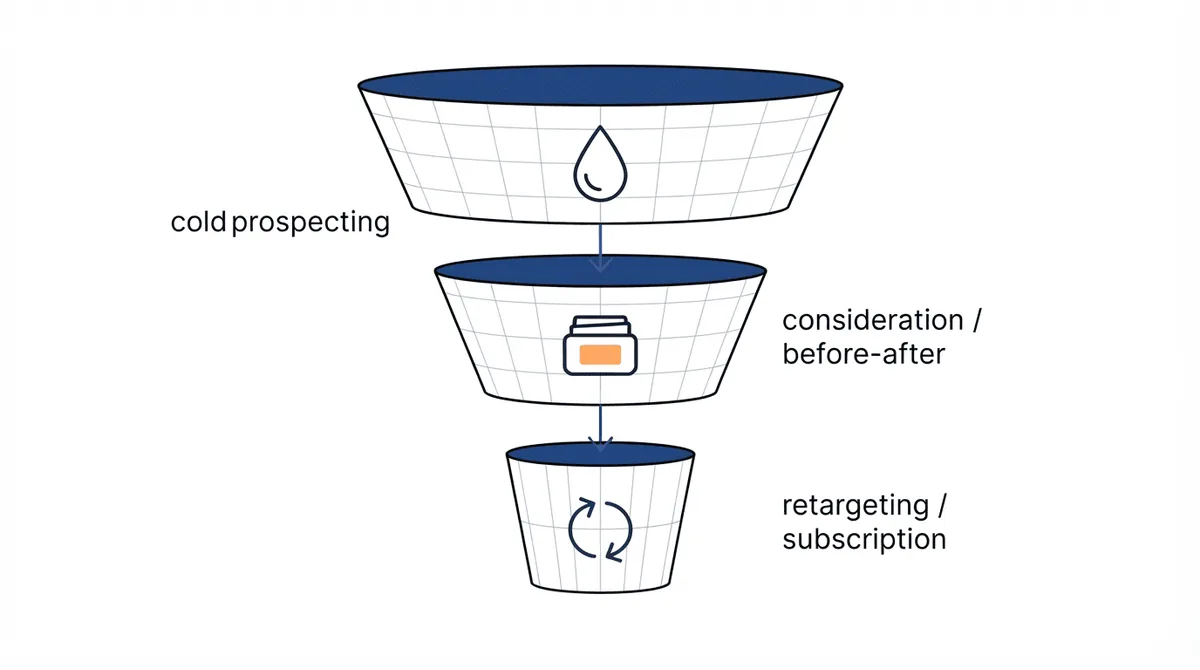
| Stage | Campaign | Role |
|---|---|---|
| Prospecting | Advantage+ Shopping or broad CBO | Find new skins at scale |
| Education | Video + lead forms for routine quiz | Answer 'will it work for me?' |
| Retargeting | Site + cart visitors | Recover and reassure |
| Loyalty | Repeat-purchase audience | Drive the second order |
The education layer is what separates skincare from a pure impulse product. A routine quiz or skin-type lead magnet captures an email you can nurture with proof while Meta's pixel keeps the retarget warm. This folds into the broader Facebook ads funnel strategy every durable brand needs.
What Creative Earns Trust in Skincare Ads?
Trust is built by evidence, not adjectives. The highest-converting skincare creative includes:
- Real customer journeys - 4-8 week progress clips with consistent lighting and honest timelines, not miracle-overnight claims that trigger skepticism and ad disapproval.
- Founder or formulator explanation - a 30-second why-this-ingredient reason builds credibility a model cannot.
- Review overlays and UGC - star ratings and verbatim text pulled from real orders.
- Texture and application shots - show the product behaving; skincare buyers research feel and finish before buying.
Avoid before-and-afters that look edited or promise results your terms cannot support - Meta flags skincare claims hard, and a rejected ad is wasted spend plus a trust hit. Keep claims defensible and let real customers supply the hype. This is the same discipline as Facebook ad creative strategy applied to a proof-heavy category.
How Do You Handle The 'Will It Work for My Skin?' Objection?
That single objection kills most skincare cold traffic, so design around it. Offer a skin-type or concern quiz that ends in a personalized routine; the quiz both segments your retargeting and gives the buyer a reason to believe the product fits them. In creative, show a range of real skin types using the product, not one flawless model. And on the landing page, lead with reviews that name the same concern your prospect has. The goal is to make the stranger feel seen, which is also why Facebook ads landing page optimization matters as much as the ad itself for skincare.
What Retargeting Recovers Skincare Carts?
Skincare carts abandon at high rates because the purchase is a decision, not a reflex. A useful sequence:
- 0-3 days: the exact product plus a customer review clip for it.
- 4-7 days: a routine bundle or sample incentive, framed as 'complete the regimen'.
- 8-21 days: founder story and bestseller social proof for non-engagers.
Cap frequency and suppress purchasers so you are not nagging won customers. Skincare's real LTV comes from the second and third order, so build a loyalty audience and retarget past buyers with a new concern or strength - that is far cheaper than re-acquiring. Tie it together with Meta retargeting strategy so the hand-off is automatic.
How Should a Skincare Brand Measure Facebook Ad Performance?
Move past blended ROAS to the metrics that predict a healthy brand:
- New-customer CAC versus your margin-based ceiling.
- Repeat purchase rate at 60 and 90 days - the real LTV driver in skincare.
- Quiz-to-purchase rate - proves the education layer is doing its job.
Many skincare brands look unprofitable on first-order ROAS but win on lifetime value, so model the second order into your target. If you need the measurement model, how to measure Facebook ads ROI lays it out. A Facebook ads strategy for startups keeps the structure sane as you scale spend.
What Mistakes Sink Skincare Facebook Ads?
- Making unsubstantiated efficacy claims that get the ad rejected and the brand flagged.
- Skipping the education layer and pushing cold traffic straight to a hard sell.
- Using one flawless model instead of a range of real skin types.
- Optimizing for first-order ROAS and cutting spend that actually pays back on repeat orders.
How Should a Skincare Brand Set Budget and Seasonality?
Skincare has a gentle seasonal rhythm - winter drives barrier and hydration demand, summer drives SPF and lighter routines - so plan creative and budget around it instead of spending flat. Start a new brand with a daily budget high enough to exit the learning phase, usually $30 to $50 per campaign, and scale only after a stable cost per purchase appears. Hold a separate test budget of 10-15% for new creative so your winners pipeline never runs dry, and resist the urge to chase a competitor's spend - your margin and LTV set your ceiling, not theirs. A simple Facebook ads strategy for startups keeps the plan disciplined when CPMs wobble.
Want a full-funnel build? a full Facebook ads funnel strategy covers the structure these campaigns slot into, and how to measure Facebook ads ROI shows how to read the numbers.
Frequently Asked Questions
Is Facebook Good for Skincare Brands?
Yes, but only with a trust-first funnel. Skincare buyers need proof before they put a product on their face, so pair native customer-journey video and formulator credibility with an education layer (quiz or lead magnet) that answers 'will it work for my skin?' before the ask.
What Claim Can Skincare Ads Safely Make on Facebook?
Stick to defensible, non-medical language: describe ingredients, show real customer timelines, and let reviewers supply the enthusiasm. Avoid before-and-afters that look edited or promises of specific results, since Meta flags skincare efficacy claims and rejects non-compliant ads.
How Do You Overcome The 'Will It Work for My Skin?' Objection?
Use a skin-type or concern quiz that ends in a personalized routine, show a range of real skin types in creative, and lead the landing page with reviews naming the same concern. The aim is to make a stranger feel the product fits them specifically.
Why Does Repeat Purchase Matter More Than First-Order ROAS in Skincare?
Skincare LTV is driven by the second and third order, and many brands look unprofitable on first-order ROAS while winning on lifetime value. Model the repeat purchase into your target CAC and retarget past buyers with a new concern or strength.
What Retargeting Window Works for Skincare Carts?
A 0-3 day window with the exact product plus a review clip, a 4-7 day bundle or sample incentive, and an 8-21 day founder-story and bestseller push for non-engagers. Cap frequency and suppress purchasers so you are not wasting budget on won customers.