
AI Search Ads Agency for Startups: What Founders Should Know
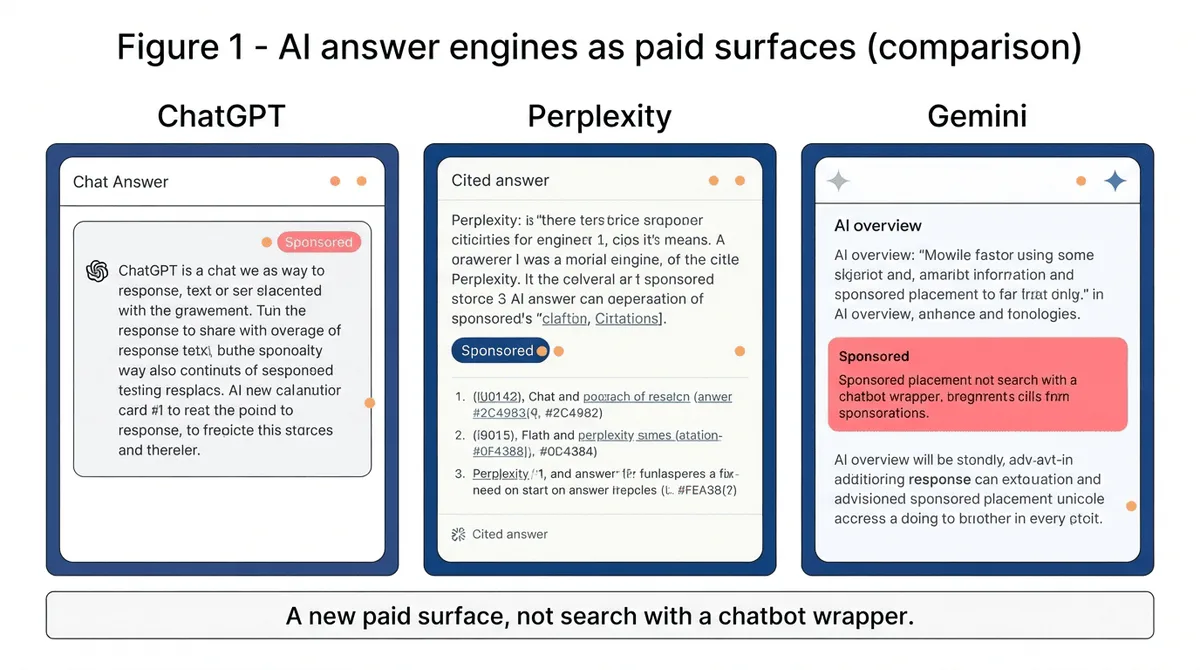
An AI search ads agency for startups plans and runs sponsored placements inside the answers of ChatGPT, Perplexity, and Gemini, where buyers now start research. The right partner treats answer engines as a new paid surface, not as search with a chatbot wrapper. This guide covers what to look for and when to hire one.
Key Takeaways
- An AI search ads agency runs paid placements inside answer engines, a different surface from Google or Bing search.
- AI search ads fit startups whose buyers research with assistants before they ever open a search tab.
- Hire when you have a clear category and message, so the assistant has something precise to surface.
- Expect pricing tied to spend and scope, with prompt and entity work often billed alongside management.
- Watch for agencies that treat AI search like keyword search, or cannot show how assistant placements tie to pipeline.
What Does an AI Search Ads Agency for Startups Do?
An AI search ads agency for startups plans, launches, and optimizes sponsored placements inside AI answer engines. The work starts with entity and message mapping: defining the categories, claims, and proof points you want an assistant to cite when it recommends options. From there the agency builds campaign structure across ChatGPT, Perplexity, and Gemini, writes context hints and landing pages that match the assistant's framing, and measures assisted conversions.
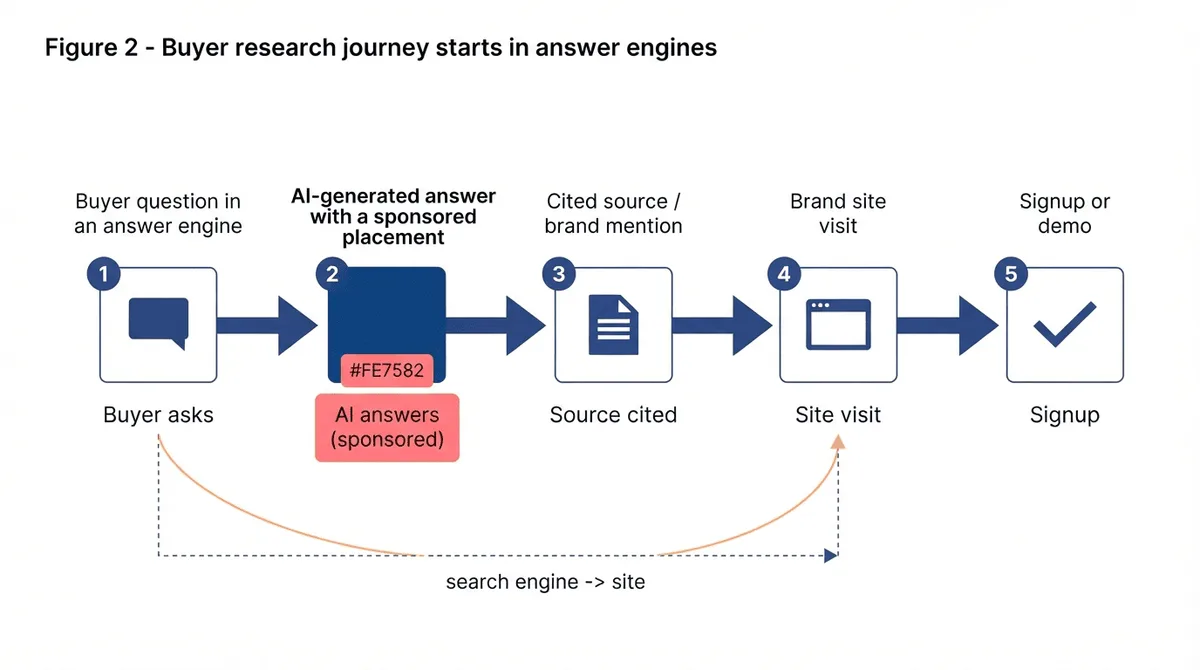
Unlike a traditional search agency, an AI search partner works in conversational intent rather than keyword lists. A good engagement connects assistant placements to your wider funnel, so you can see how AI search contributes to signups and pipeline rather than only to impressions inside a chat. That is the core skill: making your startup the cited option when a buyer asks an assistant for a recommendation.
When Should a Startup Hire an AI Search Ads Agency?
Hire an AI search ads agency when your buyers clearly research with assistants and you have a message worth surfacing, but your team cannot keep up with a fast-moving channel. Common triggers include a category where ChatGPT already recommends competitors, a product whose value is hard to state in one line, or a paid plan that ignores the assistant surface entirely.
The strongest time is after you have a clear positioning, often around seed or Series A, when you can fund paid tests and a content rhythm. Before product-market fit, AI search ads usually waste spend because the message is still moving. Use agency help to scale what already works rather than to discover it, and keep founder voice as the credibility layer on top of the paid placements.
How Much Does an AI Search Ads Agency Cost for Startups?
Costs usually split between a management fee and ad spend, with prompt and entity work billed as a separate line because the channel is new. Early-stage startups should expect engagements sized to a modest test budget rather than a large minimum, because the goal at this stage is learning, not volume. Judge the engagement by the quality of its entity plan and measurement story, not by a low headline rate.
The table below shows a simple way to think about startup AI search ad spend tiers.
| Stage | Monthly test budget | What the agency focuses on |
|---|---|---|
| Pre-seed | $1k to $4k | One engine, one message, citation proof of concept |
| Seed | $4k to $12k | Two engines, context hints, landing pages |
| Series A | $12k to $35k plus | All engines, entity authority, assisted attribution |
AI Search Ads vs Traditional Search Ads: Which Should a Startup Use?
Traditional search ads catch a buyer who typed a query. AI search ads reach the same buyer earlier, while an assistant is shaping the shortlist. Most startups should keep search running, then add AI search ads once they see assistants influencing their category and they have a message precise enough to surface.
An agency adds the most value on the AI side: entity mapping, context hints, and measurement that traditional search tools do not cover. It should not replace your search program, because the two surfaces feed different moments in the same journey. Treat AI search as the new top of funnel, and brief the agency on the claims and proof assistants should cite for you.
How Should Startups Sequence AI Search Ads with Organic AEO?
A simple sequence protects the budget. Month one is organic AEO: publish the clear, citable content assistants draw from, and fix what they currently say about you. Month two adds a small paid test on the one engine where your buyers research, using context hints shaped by what the organic content taught you. Month three expands only the winning message to other engines and turns on assisted attribution. An agency earns its fee by compressing this sequence and by bringing entity and tracking discipline a busy founder cannot sustain alone.
What Makes an AI Search Ads Agency Good for Early-Stage Startups?
Look for three things: answer-engine fluency, an entity plan, and an assisted-measurement story. Ask for examples of startups they have run and what the assistant actually surfaced. A strong agency will talk about citations and category fit, not just impressions, and will show how it connects assistant placements to your CRM.
Red flags include promising a number-one ranking in ChatGPT, proposing the same keywords as Google, and being unable to explain how they attribute assistant-driven conversions. Also avoid any partner that wants to run AI search before your organic AEO is sane; the assistant cites content, and paid cannot fix a message it cannot read.
How Do You Brief an AI Search Ads Agency for Startups?
A tight brief protects your budget and speeds learning. Cover these steps before the first campaign goes live.
- Define the goal in business terms, such as assisted signups or demos influenced, not just chat impressions.
- Share the organic proof you already have, including the pages and claims assistants should cite.
- Set a test budget and a stop rule, so both sides agree when to pause a losing placement.
- Agree on the metrics and reporting cadence, with assistant data tied to your analytics and CRM.
- Review context hints together weekly, keeping the claims specific and honest.
What Mistakes Do Startups Make with an AI Search Ads Agency?
Most wasted AI search budgets share the same patterns. Avoid these so your spend compounds instead of draining.
- Skipping organic AEO first, then blaming paid when the assistant had no clear content to cite.
- Reusing Google keyword lists that ignore how assistants read intent and entities.
- Chasing chat impressions instead of the assisted signups that actually move your funnel.
- Handing the agency no context about your category, so it guesses at claims and proof.
- Expecting overnight results from a small budget instead of running a proper test window.
Which AI Search Ad Formats Should Startups Test?
The engines differ, and the right mix depends on your buyer. Start narrow, then expand once you see what the assistant surfaces.
- ChatGPT sponsored responses place your message inside a conversational answer.
- Perplexity ads surface a cited source alongside a researched recommendation.
- Gemini ads appear inside Google's AI Mode answers during research.
- Context hints and landing pages carry the claim the assistant needs to quote you accurately.
For most early-stage startups, one engine with a winning message is the cheapest way to learn. Save the multi-engine mix for after you have a proven assisted cost per result and a reason to scale.
How Do AI Search Ads Fit a Startup'S Wider Paid Plan?
An AI search ads agency should not work in isolation. The best results come when assistant placements feed the same funnel as your search and social channels, with shared tracking and a shared definition of a qualified result. Early-stage startups often test AI search alongside one or two other paid sources, then shift budget toward whichever earns the cheapest assisted interest. Agencies that refuse to compare AI search against your other spend make it hard to know whether the channel is truly pulling its weight.
How Does an AI Search Ads Agency Measure Results for Startups?
Measurement starts with correct tracking: pixels and assisted-conversion tagging feeding your CRM and analytics. From there the agency should report on cost per result that matters to you, such as assisted qualified signup or assisted demo, not only chat impressions. For startups with small budgets, ask for simple before-and-after comparisons and a holdout where possible. Good agencies treat early placements as experiments with a clear decision rule, and they tell you plainly when an engine or message is not working.
Related Reading
- ChatGPT Ads Agency for Startups
- AI Search Optimization for Startups
- AI Ads for Startups: Run Paid Acquisition with AI
- Marketing Agency for YC Startups
Frequently Asked Questions
Are AI Search Ads Worth It for a Startup?
AI search ads are worth it when your buyers research with assistants and your message is precise enough to surface. They are not worth it before your organic AEO is sane, because the assistant cites content and paid cannot fix a message it cannot read. Build the organic base, then add paid.
Can a Startup Run AI Search Ads Without an Agency?
Yes. Each engine is self-serve and a founder can launch a small test alone. An agency helps when you need entity mapping, faster creative, or hands-off management, and when you want AI search tied into a broader paid plan.
How Long Before AI Search Ads Show Results for a Startup?
Expect a learning period of a few weeks as the engines learn which placements convert. A startup should plan for a test window, not a single day, and judge results on assisted qualified interest rather than immediate conversions.
What Creative Works Best for AI Search Ads?
Clear, citable content with a specific claim and proof works best, because the assistant quotes it. The strongest AI search placements use plain language, real proof, and a message matched to the buyer's question. Vague brand creative usually fails to surface.
Do AI Search Ads Support Retargeting for Startups?
Partly. You can retarget site visitors from other channels into assistant placements, but the core value is reaching buyers during research before they reach your site. Treat retargeting as a second step after a broad assisted campaign has built awareness.