
Surfer SEO vs Clearscope: AI Content Optimization Comparison (2026)
What you'll find in this article: a full feature breakdown, pricing comparison, ideal use cases, and guidance on how to choose the right tool. This Surfer SEO vs Clearscope comparison examines two leading AI content optimization platforms that approach the problem differently. Surfer prioritizes granular, data-driven optimization with real-time scoring. Clearscope focuses on comprehensive topic coverage and enterprise-grade content intelligence.
Choosing between them depends on your team size, budget, and workflow priorities. This comparison breaks down the features, pricing, and ideal use cases for each platform.
TL;DR: The biggest difference between Clearscope and Surfer is philosophy: Surfer optimizes for data-driven keyword scoring while Clearscope builds topical authority. Setting the record straight on value: why top brands stick with Clearscope often comes down to unlimited seats and enterprise-grade content monitoring, while Surfer wins on price and tactical depth for smaller teams.
What Is Surfer SEO?
Surfer SEO is a data-driven content optimization platform that analyzes top-ranking pages for your target keyword using natural language processing. It scores your content in real time through its Content Editor, guiding writers toward proven ranking patterns based on word count, keyword density, and semantic terms.
What Is Clearscope?
Clearscope is a topic authority platform that evaluates content comprehensiveness rather than keyword frequency. Its letter-grade scoring system measures how thoroughly your content covers a subject compared to ranking competitors, helping content teams build topical authority at scale.
Core Approach: How Each Tool Optimizes Content
Understanding the fundamental philosophy behind each tool in this Surfer SEO vs Clearscope breakdown reveals which fits your needs.
Surfer SEO: Data-Driven Optimization
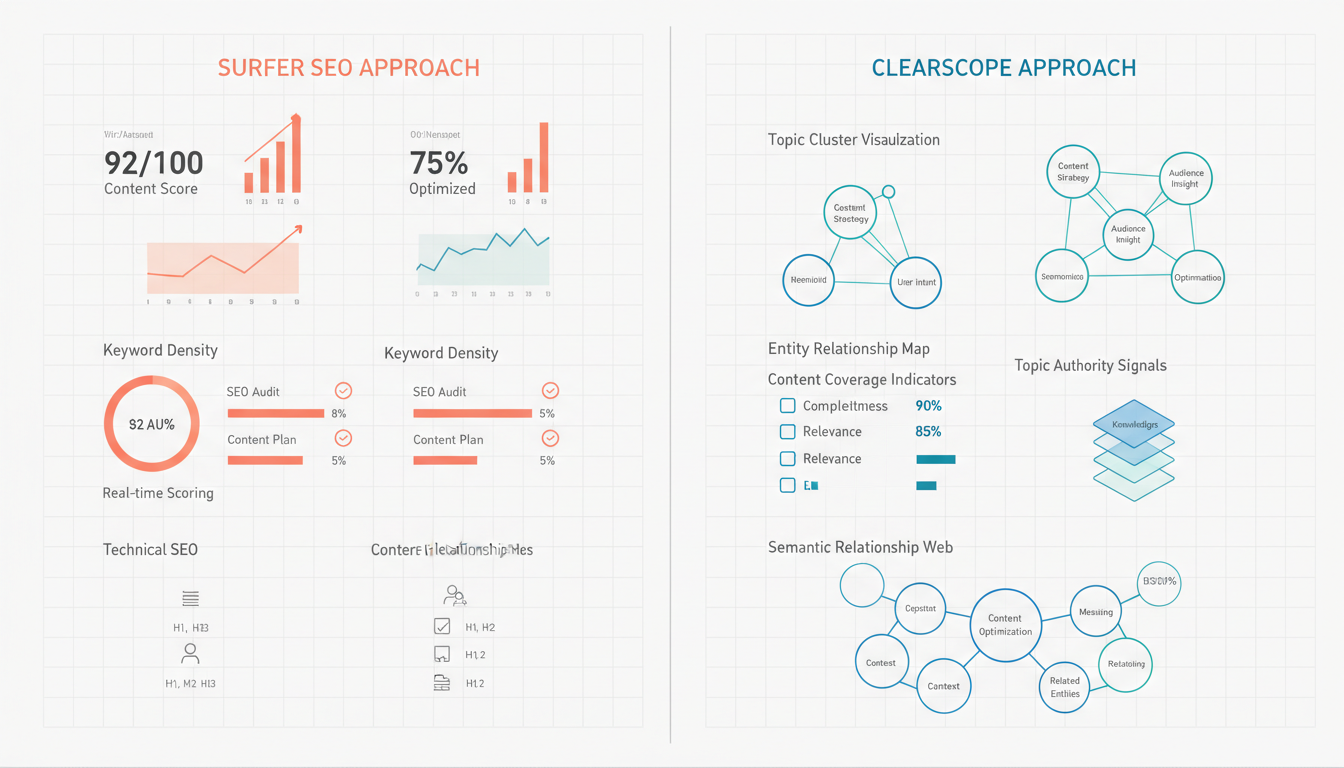
Both tools analyze the same data source — Google’s top-ranking SERP results — but produce very different output. Surfer analyzes top-ranking pages for your target keyword using natural language processing (NLP). It extracts patterns—word count, keyword density, semantic terms, heading structures—and scores your content against these benchmarks. The Content Editor provides real-time feedback as you write, gamifying optimization into a clear target score.
The platform focuses on matching proven ranking patterns. If top results for “content marketing strategy” average 2,500 words with 15 headings and specific semantic terms, Surfer guides your content toward those metrics.
Clearscope: Topic Authority Approach
Clearscope emphasizes comprehensive topic coverage over keyword density metrics. The platform identifies the entities, concepts, and related terms that signal topical authority to search engines. Rather than counting keywords, Clearscope evaluates whether your content addresses the full scope of a subject.
The grading system (A++ to F) measures how thoroughly your content covers a topic compared to ranking competitors. Writers focus on comprehensiveness rather than hitting specific word counts or keyword frequencies. This approach aligns with broader schema markup alignment aeo strategies that help search engines understand content structure.
Key Feature Showdown: Surfer SEO vs Clearscope
Both platforms share core optimization capabilities but differ in execution and scope.
Content Editor and User Experience
Surfer SEO The Content Editor displays real-time scores as you write, with specific recommendations for word count, headings, paragraphs, and term usage. A sidebar shows exactly which terms to include and how often. The visual interface makes optimization feel achievable—watch your score climb as you incorporate suggestions.
Integrations with Google Docs and WordPress allow optimization within existing workflows. Writers don’t need to copy content between systems.
Clearscope The editor grades content on a letter scale with a clean, focused interface. Recommendations emphasize topic coverage over keyword frequency. The system highlights which concepts are missing rather than prescribing exact term counts.
Clearscope’s interface prioritizes writer experience over technical metrics. Non-SEO writers often find it less overwhelming than dashboards packed with numbers.
AI Writing Tools
Surfer SEO Surfer AI generates complete SEO-optimized drafts based on your target keyword. The AI analyzes ranking content and produces articles designed to score well in Surfer’s own editor. This creates a fast starting point, though human editing remains essential for accuracy and voice.
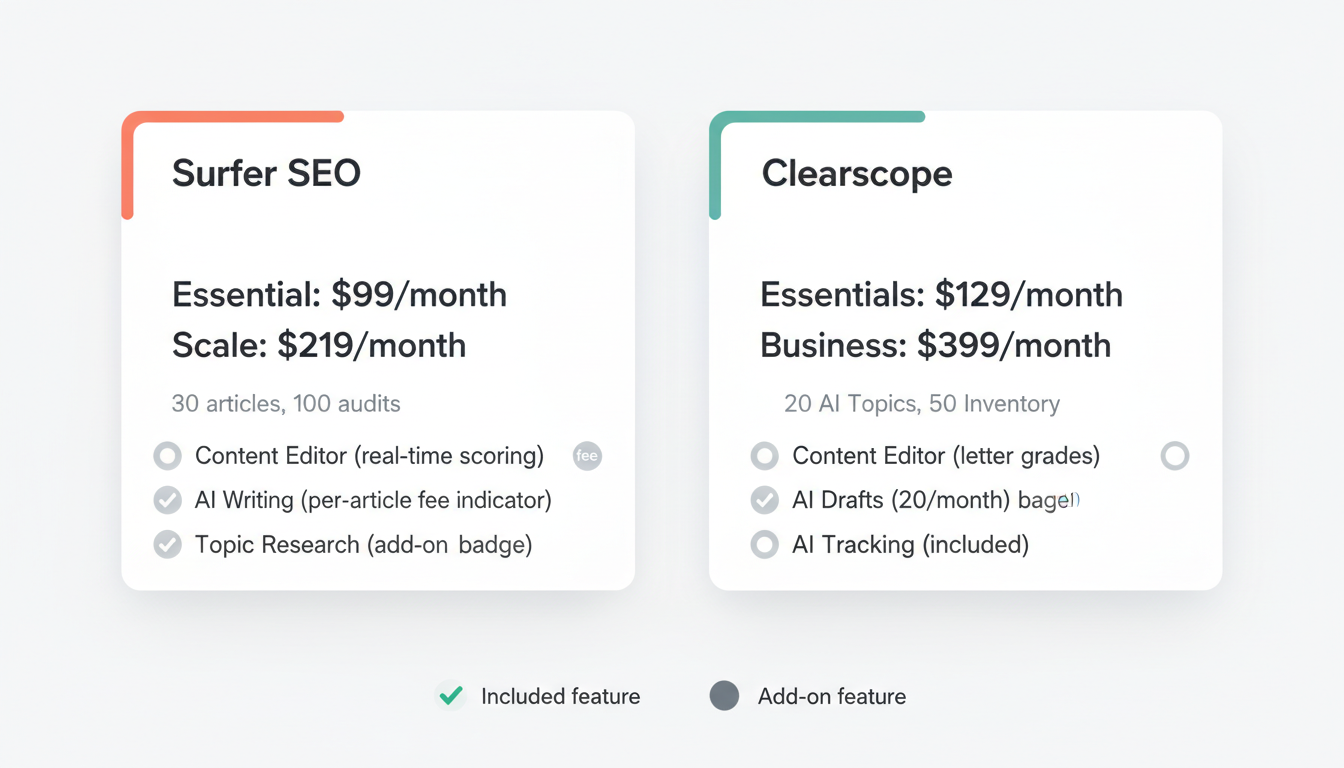
AI writing costs extra—per-article fees apply beyond your subscription.
Clearscope AI Drafts generate content outlines and full drafts within the platform. The monthly allocation varies by plan (20 AI Drafts at both Essentials and Business tiers). Clearscope’s AI focuses on topical completeness rather than keyword optimization.
Topic Research
Surfer SEO Keyword research and SERP analysis tools identify target opportunities. The platform shows keyword clusters, search intent signals, and competitive difficulty. Content Audit features analyze existing pages for optimization opportunities.
Clearscope Topic Explorations provide deep research into subject areas before writing. The platform maps related concepts, questions users ask, and content gaps in your coverage. This pre-writing research helps plan comprehensive content strategies that align with what is an answer engine best practices.
Content Inventory monitors published pages and flags content needing updates based on competitive shifts or declining performance.
SERP Analyzer
Surfer’s SERP Analyzer is a standalone research tool that breaks down why pages rank for a given keyword, examining top 50 results for word count, headings, NLP terms, and referring domains.
The SERP Analyzer also supports search intent analysis by categorizing whether top-ranking results are informational, commercial, or transactional—helping writers match the format and depth that Google rewards for each query. Clearscope handles intent mapping through its Topic Explorations feature, though with less granular SERP-level data.
Grow Flow
Surfer’s Grow Flow delivers weekly SEO task recommendations to your dashboard, identifying quick wins like internal linking gaps, content decay alerts, and new keyword targets.
Clearscope’s Content Inventory serves a similar purpose by flagging published content that needs refreshing, though it operates on a monitoring model rather than proactive weekly tasks.
Content Briefs
Both platforms generate content briefs, but they differ in approach. Surfer’s briefs pull from SERP analysis to suggest target word count, headings, questions to answer, and NLP terms to include. Writers receive a structured outline grounded in what currently ranks.
Clearscope’s brief generation focuses on topic coverage—identifying the concepts, entities, and subtopics that comprehensive content should address. The briefs emphasize breadth of coverage rather than structural formatting, which can be more useful for writers who prefer flexibility over rigid templates.
Content Score Accuracy
Content score accuracy and why it matters: a more predictive scoring model means fewer wasted optimization cycles and better ranking outcomes for your team.
Clearscope includes built-in readability scoring using Flesch-Kincaid metrics alongside its letter-grade content score. This helps writers balance topical depth with accessibility—particularly valuable for B2C content targeting general audiences. The readability grade appears directly in the editor alongside topic coverage recommendations.
Surfer’s Content Score focuses on NLP term alignment and structural benchmarks rather than readability metrics. An Originality.ai study found that Surfer’s Content Score correlated with rankings at 26% versus Clearscope’s 17.5%—suggesting Surfer’s scoring model may be slightly more predictive of ranking performance, though neither tool guarantees results.
An Originality.ai study found Surfer’s Content Score correlates with rankings at 26% versus Clearscope’s 17.5% — suggesting Surfer’s scoring model may be more predictive of ranking performance.
Multi-Language Support
Surfer SEO supports content optimization across virtually all languages, making it the stronger choice for international and multilingual content teams. Whether you’re optimizing content in Japanese, Portuguese, or Arabic, Surfer’s NLP models adapt to each language’s ranking patterns.
Clearscope currently supports approximately five languages: English, Spanish, French, German, and Italian. Teams producing content in other languages will need supplemental tools for optimization outside these supported markets.
Additional Surfer Tools
Surfer offers several specialized features that extend beyond core content optimization:
- Topical Map — Plans entire content clusters around a topic, identifying gaps in your site’s topical coverage and suggesting articles to build authority. This enables content strategy at scale across entire domains
- Auto-Optimize — One-click content improvements that automatically adjust existing pages based on current SERP benchmarks
- AI Humanizer — Rewrites AI-generated content to reduce detection by AI content detectors while preserving meaning
- AI Content Detector — Scans text to estimate the likelihood it was AI-generated, useful for quality control on outsourced content
- Automatic Internal Linking — A feature your team will actually use: automatically suggests and inserts internal links across your site to strengthen topical connections
- Jasper AI Integration — Native integration with Jasper allows writers to generate AI content directly within Surfer’s optimization framework
- White-labeling — Agency plans support white-labeled reports and dashboards for client-facing deliverables
AI Search Visibility and AEO
Surfer SEO AI Tracker monitors how your brand appears in AI-powered search engines. This Generative Engine Optimization (GEO) feature tracks visibility across ChatGPT, Perplexity, and other AI platforms—essential as search fragments across traditional and AI interfaces.
AI Tracker is an optional add-on starting around $95/month.
Clearscope Recent updates position Clearscope as a “discoverability platform” tracking visibility across Google Search and AI chatbots including ChatGPT, Gemini, and Perplexity. AI Tracked Topics monitor how your content appears in AI-generated answers, similar to dedicated generative engine optimization companies services.
AI tracking is included in subscription plans (20-50 tracked topics depending on tier).
Pricing Comparison: Surfer SEO vs Clearscope
Cost structures differ significantly between platforms.
Surfer SEO Pricing (2026)
Surfer SEO offers three tiers to fit different team sizes and content volumes.
Plan | Monthly Price | Key Limits |
Essential | $99 | 30 articles, 100 audits |
Scale | $219 | Higher article/audit limits |
Enterprise | Custom | Custom allocations |
AI writing carries per-article fees beyond subscription costs. AI Tracker for GEO visibility is a separate add-on.
Clearscope Pricing (2026)
Clearscope offers three tiers with unlimited user seats at every level.
Plan | Monthly Price | Key Limits |
Essentials | $129 | 20 AI Tracked Topics, 20 Topic Explorations, 50 Inventory pages |
Business | $399 | 50 AI Tracked Topics, 50 Topic Explorations, 300 Inventory pages |
Enterprise | Custom | Custom allocations, SSO, dedicated support |
All plans include unlimited users and projects. No per-article fees for AI features.
Value Analysis
Surfer’s entry point ($99) undercuts Clearscope’s Essentials ($129) by $30/month. However, adding Surfer’s AI Tracker brings costs closer. For teams prioritizing GEO tracking, Clearscope’s bundled AI visibility features may offer better value.
Clearscope’s unlimited user seats make it the better value for teams of 5 or more content producers, despite the higher base price of $129/month.
Clearscope’s unlimited users benefit larger teams. Surfer’s per-credit model works better for smaller operations with predictable content volumes. When evaluating ROI per dollar spent, Surfer delivers more features at lower tiers—SERP Analyzer, Grow Flow, Topical Map, and Auto-Optimize are all included in base plans. Clearscope’s value proposition centers on simplicity and unlimited seats, making cost-per-user lower for larger teams.
Ideal Use Cases
The Surfer SEO vs Clearscope decision depends on organizational needs and content workflow.
Choose Surfer SEO When:
You’re a content writer or small team The visual Content Editor makes optimization accessible. Real-time scoring provides immediate feedback without deep SEO knowledge.
You need granular control Surfer’s specific recommendations (exact term counts, word targets) suit teams wanting precise optimization guidance.
Budget constraints matter Lower entry pricing and pay-per-use AI writing fit tighter budgets, especially for freelancers or small agencies.
You prioritize Google Docs workflow Native Google Docs integration keeps content creation in familiar tools.
Choose Clearscope When:
You’re an enterprise content team Unlimited users, dedicated account managers, and enterprise features built for modern marketing organizations. Pair with a full-service SEO strategy for maximum content ROI. SSO and crawler whitelisting serve large-scale content operations.
Non-SEO writers produce content The cleaner interface and topic-focused approach works better for writers uncomfortable with technical metrics.
Content strategy drives decisions Topic Explorations and Content Inventory support strategic planning, not just article-level optimization. Understanding the aeo vs geo distinction helps inform which approach fits your strategy.
AI visibility tracking is essential Built-in tracking across Google and AI chatbots avoids add-on costs.
Budget is flexible Higher pricing reflects enterprise positioning. Teams able to invest get comprehensive features without nickel-and-diming on add-ons.
Limitations to Consider
Neither platform is perfect. One more thing to keep in mind before committing: trial policies differ significantly.
Surfer SEO Limitations
Surfer SEO has notable constraints worth evaluating before committing to a plan.
- Add-on costs accumulate. AI writing, AI Tracker, and higher tiers add up quickly beyond entry pricing.
- No technical SEO or backlinks. The platform focuses exclusively on content optimization.
- Optimization can feel mechanical. Chasing specific keyword counts may compromise natural writing voice.
Clearscope Limitations
Clearscope also has limitations that may affect budget-conscious teams and multilingual campaigns.
- Higher entry cost. $129/month minimum excludes budget-conscious freelancers and startups.
- No free trial. Demo only—you can’t test before committing.
- English-focused. Multilingual teams may need supplemental tools.
- Fewer AI drafts at higher tiers. Business plan keeps the same 20 AI Drafts as Essentials despite 3x price increase.
Integration Comparison
Both platforms integrate with the most common content creation and publishing tools.
Integration | Surfer SEO | Clearscope |
Google Docs | Yes | Yes |
WordPress | Yes | Yes |
Google Search Console | Yes | Yes |
API Access | Scale+ plans | Enterprise |
Both integrate with essential content workflows. API access for custom integrations requires higher-tier plans on both platforms.
The Hybrid Approach
Many advanced SEO teams use both tools strategically:
- Clearscope for topic research, content strategy, and AI visibility tracking
- Surfer SEO for article-level optimization and Content Editor scoring
This combination leverages Clearscope’s strategic capabilities with Surfer’s tactical optimization. Our competitive edge comes from pairing Clearscope’s topic intelligence with Surfer’s real-time scoring—at the cost of two subscriptions.
How Surfer SEO and Clearscope Compare to Other Alternatives
Surfer SEO and Clearscope are not the only content optimization platforms worth evaluating. Several alternatives serve different niches and may better fit specific workflows.
MarketMuse takes an enterprise-first approach built on topic modeling and content inventory analysis. Rather than optimizing individual articles, MarketMuse maps your entire site’s topical authority and identifies content gaps at a strategic level. It excels at content planning for large sites with hundreds of pages, though its pricing reflects that enterprise positioning.
Teams seeking fully automated AI blog generation can also explore platforms that go beyond optimization into end-to-end content creation. These tools handle research, drafting, and publishing in a single workflow, though they trade editorial control for throughput.
Frase leads with AI-powered content generation tightly integrated with optimization. Where Surfer and Clearscope treat AI writing as an add-on, Frase builds its entire workflow around AI-assisted research, outlining, and drafting. It’s particularly strong for teams that want to generate first drafts quickly and optimize simultaneously, at a lower price point than either Surfer or Clearscope.
Semrush Writing Assistant bundles content optimization within Semrush’s broader SEO platform. For teams already using Semrush for keyword research, backlink analysis, and technical audits, the Writing Assistant adds content optimization without another subscription. The tradeoff is less depth—Semrush’s optimization features are not as specialized as dedicated tools like Surfer or Clearscope.
Each alternative trades off depth versus breadth. Surfer and Clearscope remain the strongest dedicated content optimization tools, but teams with different priorities may find better value elsewhere.
How to Choose Between Surfer SEO and Clearscope
For most content teams, the Surfer SEO vs Clearscope choice comes down to scale and focus:
Start with Surfer SEO if you’re a freelancer, small team, or budget-conscious operation wanting powerful optimization at accessible pricing starting at $99/month. The Content Editor delivers immediate value for individual articles.
Invest in Clearscope if you’re an enterprise team, agency, or organization prioritizing comprehensive content strategy over article-level tactics. The topic intelligence and AI visibility features justify premium pricing for teams that use them fully.
Both platforms deliver on their core promise: data-driven content optimization that improves rankings. The right choice depends on your organizational context, not which tool is objectively “better.”
Summary
The Surfer SEO vs Clearscope comparison comes down to tactical depth versus strategic breadth: Surfer for granular data-driven scoring, Clearscope for topical authority and enterprise intelligence.
Final Thoughts: Which One'S Better?
For most content teams, Surfer SEO wins on tactical depth and price. Clearscope wins on enterprise readiness and AI visibility. Neither is objectively better—the right choice depends on your team size, workflow, and strategy.
Frequently Asked Questions
These questions address the most common considerations when choosing between Surfer SEO and Clearscope.
Is Surfer SEO or Clearscope Better for Content Audits?
Surfer SEO offers more audit-specific tools. The SERP Analyzer benchmarks your pages against top-ranking competitors, while Grow Flow surfaces weekly optimization tasks including content decay alerts. Clearscope’s Content Inventory monitors published pages and flags declining performance, but it operates as a monitoring system rather than an active audit workflow.
Does Clearscope Support Multiple Languages?
Clearscope currently supports approximately five languages: English, Spanish, French, German, and Italian. Surfer SEO supports content optimization in virtually all languages, making it the better choice for international content teams or agencies managing multilingual campaigns.
Can You Use Surfer SEO with Jasper AI?
Yes. Surfer SEO offers a native integration with Jasper AI that allows writers to generate AI-assisted content directly within Surfer’s Content Editor. This means AI-generated drafts receive real-time optimization scoring as they’re produced, combining Jasper’s content generation with Surfer’s SEO guidance in a single workflow.
What Is the ROI Difference Between Surfer SEO and Clearscope?
Surfer SEO delivers more features per dollar at lower tiers—SERP Analyzer, Grow Flow, and Auto-Optimize start at $99/month. Clearscope targets enterprise teams at $129/month with unlimited seats. Surfer favors small teams; Clearscope favors organizations with 5+ producers.
How Do Surfer SEO and Clearscope Compare to Marketmuse and Frase?
MarketMuse excels at enterprise-level topic modeling for large sites. Frase leads with AI-first content generation at a lower price. Surfer SEO and Clearscope focus on per-article optimization scoring—deeper but narrower than MarketMuse or Frase.