
TikTok's algorithm rewards creative that earns attention, not buys it. 71% of whether users continue watching is determined in the first three seconds, making creative execution the single biggest factor in ad performance.
This guide covers the creative fundamentals that separate high-performing TikTok ads from wasted spend.
TikTok Creative Fundamentals
TikTok creative operates differently than other platforms. Success requires understanding the platform's unique environment.
Native Over Polished
Corporate-style messaging feels out of place on TikTok. The most effective strategies prioritize community-first content-videos that feel like conversations between peers rather than broadcasts from brands.
What works:
- Raw, authentic footage
- Face-to-camera delivery
- Behind-the-scenes moments
- UGC-style production
What doesn't work:
- Overly produced studio content
- Traditional commercial aesthetics
- Corporate messaging tone
- Stock footage
Mobile-First Format
All TikTok creative must be optimized for mobile viewing:
- Aspect ratio: 9:16 vertical (fills the entire screen)
- Resolution: 1080x1920 at 30fps minimum
- Format: MP4 recommended
- Text placement: Keep clear of safe zones (edges and bottom)
Algorithm Signals
The algorithm weighs specific engagement signals when deciding which ads to distribute. Understanding TikTok algorithm advertising patterns helps optimize creative for maximum reach:
- Watch time: How long viewers stay
- Completion rate: Percentage who watch to the end
- Rewatches: Videos watched multiple times
- Shares and saves: Content deemed valuable
- Comments: Active engagement indicator
Optimize creative for these signals, not just clicks.
Hook Strategies
Your hook determines everything. You have 2-3 seconds to stop the scroll before viewers move on.
Effective Hook Types
Visual Hooks: Start with a "pattern interrupt"-unexpected movement, striking visual, or surprising scene that breaks scrolling flow.
Auditory Hooks: Use a sound effect or bold opening statement that creates a "curiosity gap" viewers need to fill.
Text Hooks: Place a question or provocative statement at the top of the frame:
- "Stop scrolling if you..."
- "This changed everything for..."
- "I wish someone told me this sooner"
Hook Best Practices
Start with the payoff-lead with the most interesting moment, then explain context. Don't build up to the good part; open with it.
Effective techniques:
- Make a bold claim
- Ask a question
- Share a surprising fact
- Hint at a secret
- Promise a transformation
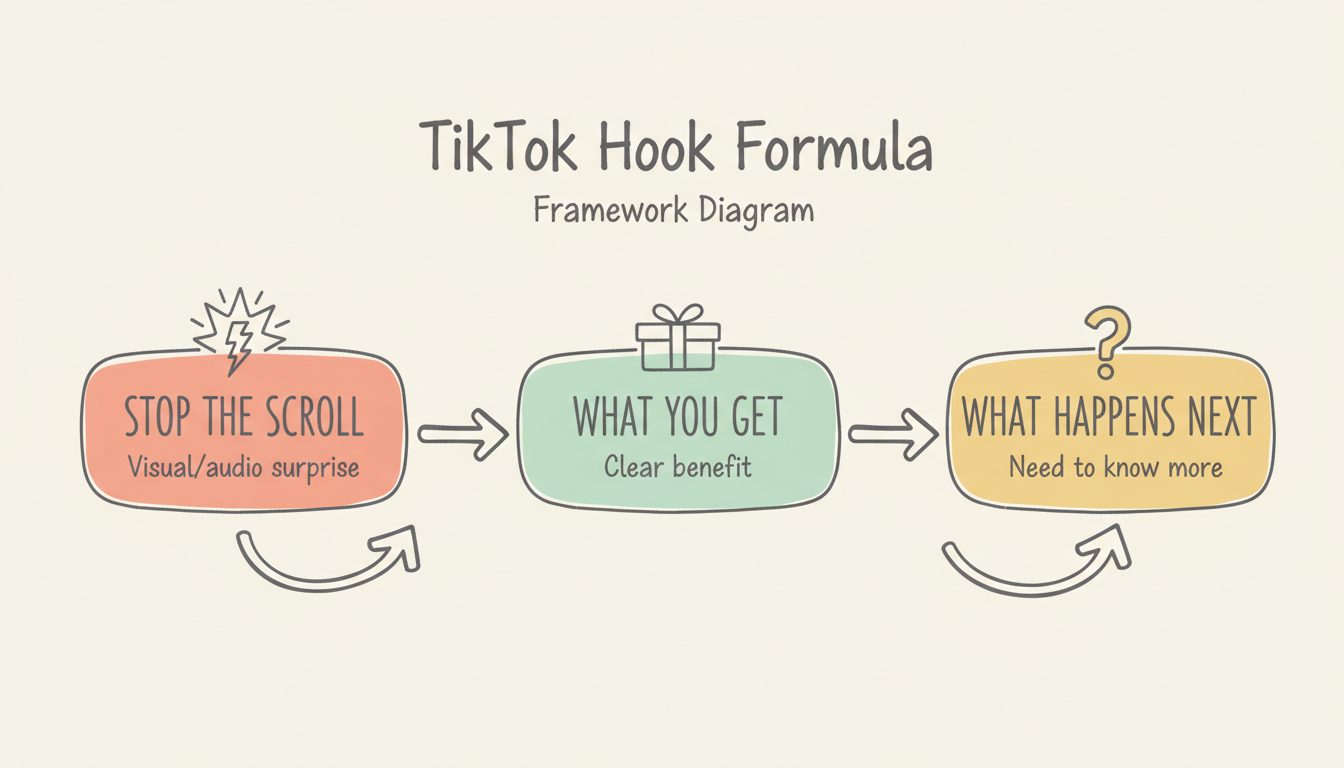
Hook framework:
[Pattern interrupt] + [Value promise] + [Curiosity gap]Example: "This $5 product [pattern interrupt] replaced my $200 routine [value promise]... here's what happened [curiosity gap]"
Face-To-Camera Advantage
Human connection stops scrolls more effectively than B-roll. Starting with a face looking directly at the camera creates immediate engagement that polished footage rarely matches.
Video Length Guidelines
Length should serve content, not arbitrary rules. Every second must earn its place.
Optimal Length by Format
Content Type | Recommended Length |
Ads (conversion focus) | 15-30 seconds |
Branded content (organic) | 60-90 seconds |
Tutorials | 30-60 seconds |
Entertainment | 15-30 seconds |
In-depth education | 60+ seconds |
Length by Audience
Different demographics prefer different lengths:
- Gen Z: 15-30 seconds
- Millennials: 30-60 seconds
- Mature audiences: 45-90 seconds
- Educational niches: 60+ seconds
The Watch Time Reality
The algorithm prioritizes watch time retention, not total watch time. A video that keeps 80% of viewers engaged for 20 seconds outperforms one keeping 50% for 40 seconds, even with higher total watch time.
This means:
- Shorter, tighter content often wins
- Cut ruthlessly-remove anything that doesn't add value
- Test shorter versions of longer content
Optimizing for Loops
Create content that rewards rewatching:
- Smooth end-to-beginning transitions
- Satisfying visual elements
- Content that reveals more on rewatch
- Natural loop points
Sound and Music
Audio is half the TikTok experience. Users engage with sound, and the algorithm notices.
Sound Strategy
Trending sounds: Using trending audio increases discoverability. Monitor the Creative Center for rising sounds and adapt quickly.
Original audio: Voice-over and original speech can work well, especially for educational or testimonial content.
Music selection: Match energy and tone to your message. Upbeat music for exciting content, softer tones for emotional moments.
Audio Best Practices
- Never post without audio-it's a core part of the experience
- Use 3-5 trending sounds weekly aligned with brand voice
- Ensure audio quality is clear and properly mixed
- Consider audio-off viewing with strong text overlays
TikTok Commercial Music Library
For ads, use TikTok's Commercial Music Library to ensure proper licensing. Using unlicensed trending sounds in ads can cause issues.
Text and Captions
Text serves multiple functions: stopping scrolls, reinforcing messages, and enabling sound-off viewing.
On-Screen Text
Placement:
- Keep text in the center-safe zone
- Avoid bottom 15% (covered by interface)
- Use bold, readable fonts
Styling:
- High contrast against backgrounds
- Large enough to read on mobile
- Consistent with brand (but not overly branded)
Caption Strategy
Put your main keyword in the first 30 caption characters for discoverability. Captions should:
- Preview value
- Include relevant keywords
- End with conversation starters
- Use 3-5 hashtags including one trending tag
Text Hook Examples
Effective text overlays that stop scrolls:
- "Watch until the end for [payoff]"
- "POV: [relatable scenario]"
- "[Number] things I wish I knew about [topic]"
- "This is your sign to [action]"
Testing Creative Variations
Creative testing separates top performers from average campaigns. Before launching tests, review current TikTok ads pricing to set appropriate testing budgets.
What to Test
Hook variations:
- Different opening lines
- Text vs. visual vs. audio hooks
- Various pattern interrupts
Length variations:
- Test 20, 40, and 60-second versions monthly
- Track completion rates at each length
Creative elements:
- Music and sound choices
- Text placement and styling
- Presenter vs. product focus
- UGC vs. brand-produced
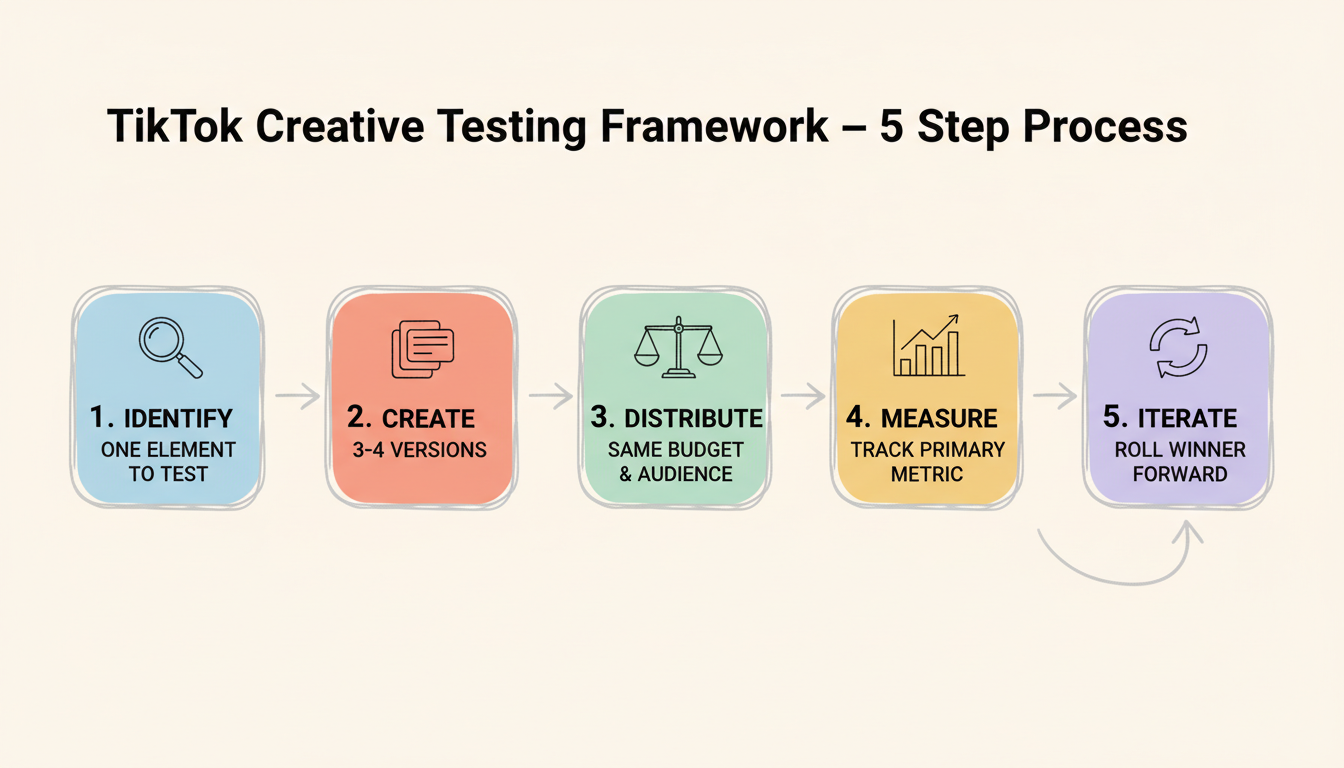
Testing Framework
- Identify variable: One element to test per batch
- Create variations: 3-4 versions changing only that element
- Run equal distribution: Same budget and audience per variation
- Measure: Primary metric (CTR, watch time, conversions)
- Iterate: Roll winner forward, test next variable
Refresh Cadence
TikTok audiences scroll fast and fatigue quickly. Plan for creative refresh:
- Minor refresh: Every 2-3 weeks
- Major refresh: Monthly
- New concepts: Quarterly
Monitor frequency metrics-when engagement drops despite stable targeting, creative fatigue is likely. Understanding TikTok ROAS benchmarks helps determine when creative fatigue is affecting campaign profitability.
Related: our TikTok Symphony guide.
When you run automated campaigns, strong creative still matters. Our TikTok Smart+ campaigns guide explains how to feed Smart+ the varied assets it needs.
Frequently Asked Questions
How Long Should TikTok Ads Be?
The optimal length for TikTok ads is 15-30 seconds for conversion-focused campaigns. This range balances attention retention with message delivery. Longer content (60+ seconds) can work for educational or brand-building objectives, but every second must earn its place.
What Makes a Good TikTok Ad Hook?
Effective TikTok ad hooks combine pattern interrupts with value promises. The best hooks use bold claims, questions, surprising facts, or curiosity gaps delivered in the first 2-3 seconds. Face-to-camera delivery often outperforms B-roll. Text overlays reinforce hooks for sound-off viewers.
How Often Should I Refresh TikTok Ad Creative?
Plan for minor creative refreshes every 2-3 weeks and major refreshes monthly. Watch for declining engagement rates despite stable targeting-this signals creative fatigue. Having a backlog of variations ready enables quick swaps when performance drops.
Scaling Winners Without Breaking Them
Finding a winning TikTok creative is only half the battle. The instinct to pour budget into a single proven video usually backfires, because audiences saturate and the algorithm exhausts the reachable pool. Scaling on TikTok means multiplying the angle, not the spend behind one asset.
When a creative wins, resist the urge to simply raise its budget. Instead, produce three to five adjacent variants that keep the hook and the core message but change the presenter, the setting, or the visual treatment. This extends the life of the winning concept while giving the algorithm fresh inventory to distribute. A single insight should spawn a small family of creatives, not a single hero video.
Budget scaling should follow creative scaling. Increase spend in 20 to 30 percent steps, watching frequency and CPA at each step. If frequency climbs above four and CPA rises with it, you have hit creative fatigue and need new variants before more budget will help. The levers are connected: more spend without more creative simply accelerates exhaustion.
- Cap daily budget increases so the algorithm re-learns rather than spikes and stalls.
- Keep a perpetually testing 20 percent of spend on net-new concepts to replenish the pipeline.
- Pause, do not delete, fatigued winners so you can revive the concept with a fresh cut later.