
Effective TikTok advertising depends on reaching the right audience. TikTok offers sophisticated targeting options that let you connect with users based on demographics, interests, behaviors, and your existing customer data. This guide covers every targeting option available and how to use them effectively.
Targeting Options Overview
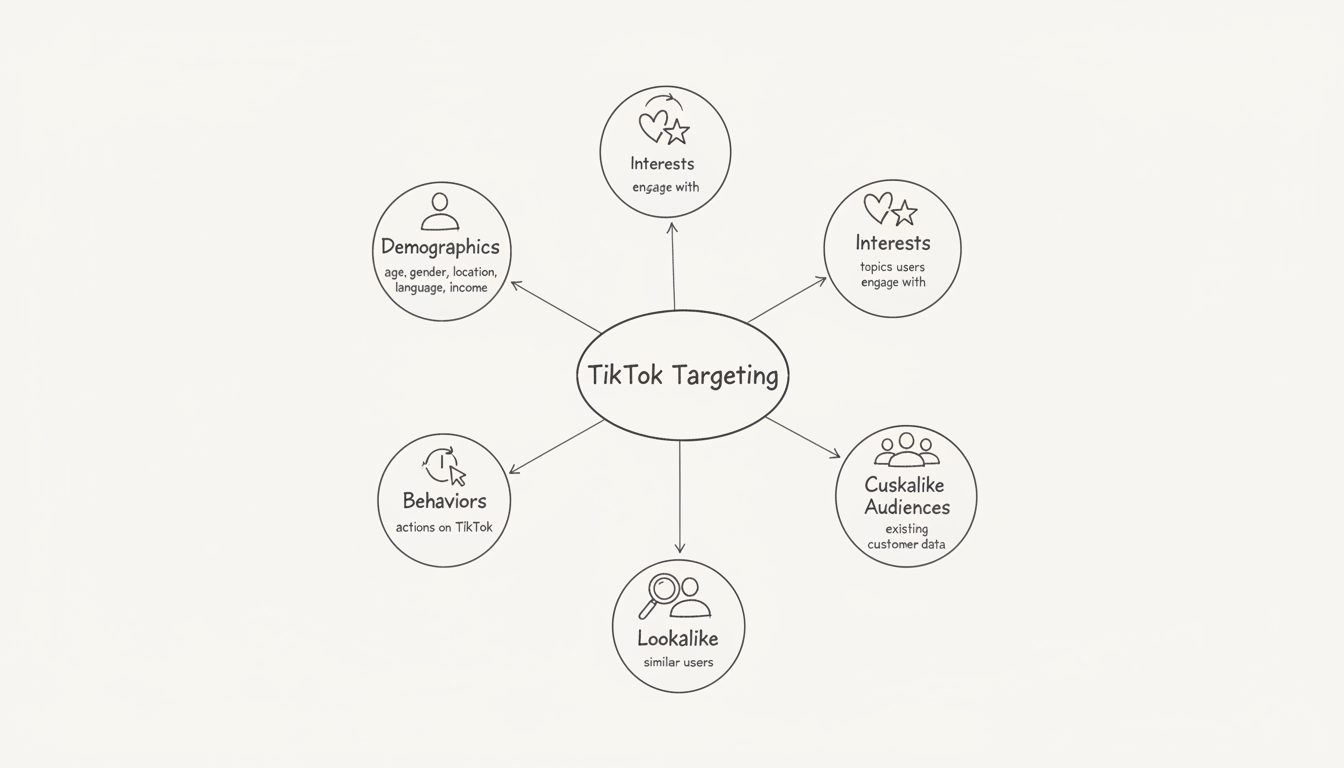
TikTok provides five main categories of targeting, which can be combined to create precise audience segments.
Targeting Categories
Category | What It Targets | Best For |
Demographics | Age, gender, location, language | Broad audience definition |
Interests | Topics users engage with | Prospecting new audiences |
Behaviors | Actions users take on TikTok | Intent-based targeting |
Custom Audiences | Your existing customer data | Retargeting, exclusions |
Lookalike Audiences | Users similar to your customers | Scaling acquisition |
According to TikTok advertising guides, the more specific your target audience, the higher your ad costs—but also potentially the higher your conversion rates. Finding the right balance is key.
The Algorithm Factor
One important consideration: TikTok's algorithm often finds your ideal audience better than manual targeting alone. According to industry analysis, starting broad and letting TikTok optimize based on performance data frequently outperforms highly specific targeting from the start.
Demographic Targeting
Demographics form the foundation of most TikTok targeting strategies. These options define the basic characteristics of who sees your ads.
Age Targeting
TikTok provides age brackets rather than specific ages:
- 13-17 (limited ad categories allowed)
- 18-24
- 25-34
- 35-44
- 45-54
- 55+
Key insight: According to demographic research, the 25-34 age group represents the largest segment of TikTok users (around 40%), not the 18-24 group as many assume. The platform has aged up significantly.
Gender Targeting
Options include:
- Male
- Female
- All genders
TikTok's user base is approximately 54.6% male and 45.4% female, a shift from its earlier female-skewed demographics.
Location Targeting
Location options vary by market but typically include:
Level | Availability | Example |
Country | All markets | United States |
State/Region | Most markets | California |
City | Major markets | Los Angeles |
Radius | Select markets | 25 miles from downtown |
Language Targeting
Target users based on their app language settings. This is particularly useful for:
- Multilingual markets
- Regional campaigns
- Language-specific offers
Income and Spending Power
TikTok offers household income and spending power targeting in some markets:
- Household income brackets
- Spending power indicators
This helps luxury brands and high-ticket sellers reach appropriate audiences.
Interest Targeting
Interest targeting connects your ads with users who engage with specific content categories on TikTok.
Interest Categories
TikTok offers 20+ interest categories including:
Category | Sub-Interests Available |
Beauty & Personal Care | Skincare, Makeup, Haircare |
Fashion & Accessories | Streetwear, Luxury, Accessories |
Food & Beverage | Cooking, Restaurants, Recipes |
Travel | Destinations, Hotels, Adventures |
Technology | Gadgets, Apps, Gaming |
Business & Finance | Entrepreneurship, Investing |
Fitness & Sports | Workout routines, Sports, Health |
Entertainment | Movies, Music, TV Shows |
How Interest Targeting Works
TikTok determines user interests based on:
- Videos they watch and engage with
- Accounts they follow
- Content they create
- Hashtags they interact with
- Search behavior
Interest Targeting Best Practices
- Layer multiple interests: Combine related interests for more precise targeting
- Test broadly first: Start with broader categories, then narrow based on data
- Consider adjacent interests: Users interested in fitness may also engage with nutrition content
- Avoid over-narrowing: Too many interest restrictions limits delivery
Behavior Targeting
Behavior targeting reaches users based on specific actions they've taken on TikTok. For campaigns focused on driving specific outcomes, combining behavioral signals with demographic filters creates powerful audience segments that complement strategies used in TikTok advertising case studies for app installs.
Video Interactions
Target users who have:
- Watched specific content types: Users who watched similar videos to yours
- Completed videos: Users who watch videos to completion
- Engaged with videos: Users who liked, commented, or shared content
Creator Interactions
Target users who have:
- Followed specific types of accounts
- Engaged with creator content in your niche
- Interacted with competitor or complementary brand content
Hashtag Interactions
Target users who have:
- Searched for specific hashtags
- Engaged with hashtag content
- Used hashtags in their own content
Purchase Intent
TikTok identifies users showing purchase intent through:
- Product research behavior
- Add-to-cart actions on TikTok Shop
- Engagement with shopping content
- Price comparison behavior
This makes behavior targeting particularly powerful for e-commerce advertisers, especially when implementing TikTok ads for dropshipping in 2026.
Custom Audiences
Custom audiences let you target users based on your existing customer data and pixel tracking.
Custom Audience Sources
Source | Description | Minimum Size |
Customer file | Upload email/phone lists | ~1,000 users |
Website traffic | TikTok Pixel visitors | ~1,000 users |
App activity | Users of your mobile app | ~1,000 users |
Engagement | Users who engaged with TikTok content | ~1,000 users |
Lead generation | Users who submitted lead forms | ~1,000 users |
Shop activity | TikTok Shop interactions | ~1,000 users |
According to B2B targeting guidance, TikTok requires approximately 1,000 matched users for stable custom audience targeting.
Website Custom Audiences
With the TikTok Pixel installed, create audiences based on:
- All website visitors
- Specific page visitors
- Event completions (add to cart, purchase, etc.)
- Time-on-site thresholds
Understanding proper pixel configuration is essential for accurate custom audience creation, which is why following a comprehensive TikTok Pixel setup guide for 2026 ensures your tracking foundation is solid.
Engagement Custom Audiences
Target users who:
- Viewed your videos (25%, 50%, 75%, 100% completion)
- Liked your content
- Shared your content
- Commented on your posts
- Visited your profile
- Followed your account
Customer List Audiences
Upload lists containing:
- Email addresses
- Phone numbers
- Mobile advertising IDs
TikTok matches these against its user database. Match rates typically range from 30-70% depending on list quality.
Lookalike Audiences
Lookalike audiences find new users who share characteristics with your best customers. When properly configured, these audiences can significantly expand your reach while maintaining relevance—a critical component detailed in TikTok lookalike audiences guides.
Creating Lookalike Audiences
- Select a source audience: Custom audience with at least 1,000 users
- Choose audience size: Narrow (1-2%), Balanced (3-5%), or Broad (6-10%)
- Define location: Lookalikes must be in specific regions
Lookalike Size Trade-Offs
Size | Reach | Similarity | Best For |
Narrow (1-2%) | Lower | Highest | High-ticket products |
Balanced (3-5%) | Medium | Medium | Most campaigns |
Broad (6-10%) | Higher | Lower | Awareness campaigns |
Lookalike Best Practices
Quality over quantity: According to targeting experts, a clean list of closed-won customers typically outperforms a larger list of low-intent leads as a lookalike source.
Segment your sources: Create separate lookalikes from:
- Purchasers
- High-value customers
- Engaged but non-converting users
Test multiple sizes: Run the same creative against narrow, balanced, and broad lookalikes to find your optimal audience size.
Targeting Best Practices
Follow these strategies to maximize your TikTok targeting effectiveness.
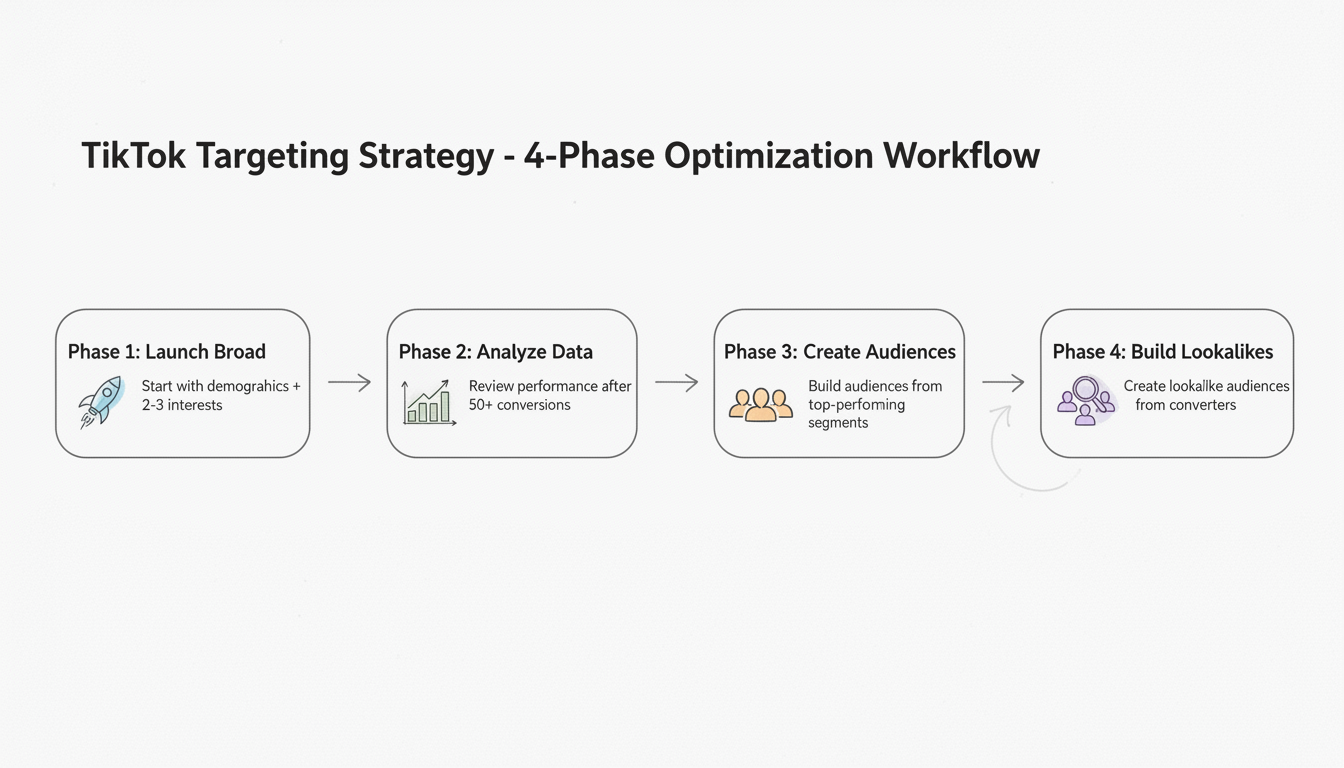
Start Broad, Then Narrow
- Phase 1: Launch with broad targeting (demographics + 2-3 interests)
- Phase 2: Analyze performance data after 50+ conversions
- Phase 3: Create audiences from top-performing segments
- Phase 4: Build lookalikes from converters
Use Smart Targeting
TikTok's Smart Targeting feature suggests interests and behaviors based on your:
- Campaign objective
- Creative content
- Historical performance
It can also automatically expand your audience when delivery is limited. If your campaigns aren't getting traction, combining Smart Targeting with troubleshooting steps from guides on TikTok ads not spending can help identify and resolve delivery issues.
Combine Targeting Types
Layer targeting options strategically:
| Goal | Targeting Combination | | --- | --- | --- | | Prospecting | Demographics + Interests + Behaviors | | Retargeting | Custom audience (website visitors) | | Scaling | Lookalike + Interest overlap | | Exclusion | Custom audience (purchasers) excluded |
Monitor Audience Overlap
Avoid competing against yourself by checking audience overlap between ad groups. High overlap means you're bidding against your own campaigns.
Frequently Asked Questions
What'S the Minimum Audience Size for TikTok Ads?
TikTok recommends a minimum of 1,000 users for custom audiences and lookalikes to function effectively. For general targeting, broader audiences typically perform better as TikTok's algorithm needs data volume to optimize delivery.
Should I Use Narrow or Broad Targeting on TikTok?
Start broad. TikTok's algorithm often finds your ideal audience better than manual targeting. Begin with basic demographics and 2-3 interests, let the campaign run, then narrow based on performance data rather than assumptions.
How Do I Target Competitors' Audiences on TikTok?
Use interest targeting for your competitors' product categories and behavior targeting for users who engage with similar content. You can also target users who follow accounts in your competitive space through creator interaction behaviors.
Can I Target B2B Audiences on TikTok?
Yes, though B2B targeting is less granular than LinkedIn. Use interest categories like "Business & Finance" and "Technology," target users showing professional content engagement, and create custom audiences from your CRM data with business emails.