
Choosing between TikTok ads and Facebook ads is one of the most common decisions marketers face in 2026. Both platforms offer powerful advertising capabilities, but they serve different audiences and objectives. This comprehensive comparison breaks down everything you need to know to make the right choice for your business.
Platform Overview Comparison
Understanding the fundamental differences between TikTok and Facebook helps set the stage for a meaningful comparison.
TikTok at a Glance
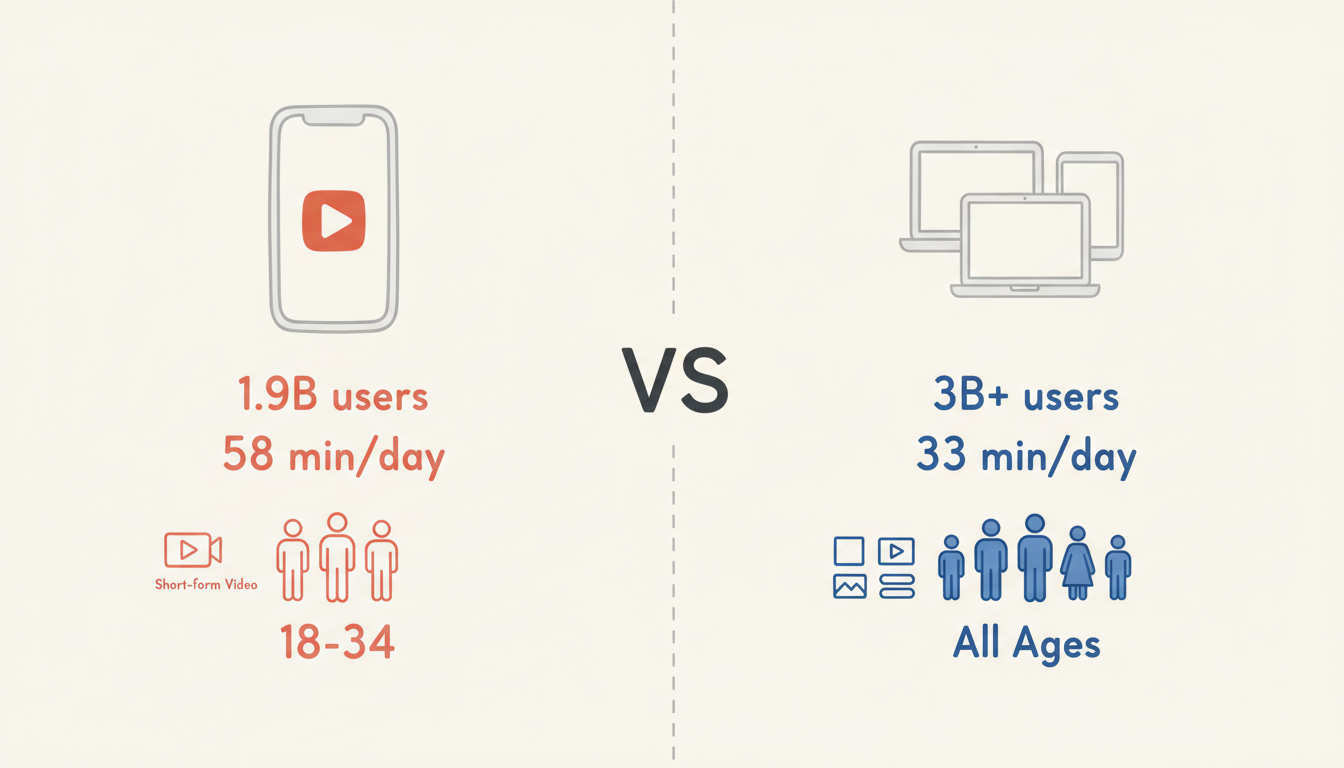
TikTok has evolved from a Gen Z entertainment app to a full-fledged advertising powerhouse. Key platform stats for 2026:
- Monthly active users: 1.9+ billion globally
- Average daily time spent: 58 minutes per user
- Primary content format: Short-form vertical video
- Ad platform: TikTok Ads Manager (self-serve + managed)
TikTok's algorithm prioritizes content discovery over social connections, meaning even new advertisers can achieve significant reach quickly. This approach contrasts with traditional social media platforms and creates unique opportunities for brands to gain visibility, especially when working with experienced professionals who understand how to choose a TikTok ad agency in 2026.
Facebook at a Glance
Facebook remains the largest social media advertising platform despite facing increased competition:
- Monthly active users: 3+ billion globally
- Average daily time spent: 33 minutes per user
- Content formats: Feed posts, Stories, Reels, Marketplace
- Ad platform: Meta Ads Manager (shared with Instagram)
Facebook's strength lies in its mature advertising infrastructure, detailed targeting options, and extensive conversion tracking capabilities.
Audience Demographics
The demographic differences between TikTok and Facebook should heavily influence your platform choice.
TikTok User Demographics
According to Exploding Topics, TikTok's user base in 2025-2026 breaks down as:
Age Group | Percentage of Users |
18-24 | 30.7% |
25-34 | 35.3% |
35-44 | 16.4% |
45-54 | 9.2% |
55+ | 8.4% |
Key insight: While TikTok is often perceived as a Gen Z platform, users aged 25-34 actually make up the largest segment. The platform is aging up as older demographics join.
Facebook User Demographics
Facebook skews older than TikTok:
Age Group | Percentage of Users |
18-24 | 18% |
25-34 | 24% |
35-44 | 19% |
45-54 | 17% |
55+ | 22% |
Key insight: Facebook provides better access to users over 35, making it essential for brands targeting older demographics or B2B audiences.
Gender Distribution
- TikTok: Slightly female-skewed (54% female, 46% male)
- Facebook: More balanced (44% female, 56% male)
Ad Formats Comparison
Both platforms offer diverse ad formats, but their approaches differ significantly.
TikTok Ad Formats
Format | Description | Best For |
In-Feed Ads | Native video ads in For You feed | Awareness, traffic, conversions |
Spark Ads | Boost organic content as ads | Authenticity, engagement |
TopView | First ad users see when opening app | Mass awareness campaigns |
Branded Hashtag Challenge | Sponsored challenge with branded hashtag | Viral campaigns, UGC |
Branded Effects | Custom AR filters and stickers | Brand engagement, awareness |
TikTok's formats prioritize full-screen, immersive video experiences. Understanding TikTok ad creative best practices in 2026 is essential for maximizing the effectiveness of these formats.
Facebook Ad Formats
Format | Description | Best For |
Image Ads | Static images in feed | Simple messages, retargeting |
Video Ads | Video content in various placements | Storytelling, demonstrations |
Carousel Ads | Multiple images/videos in one ad | Product catalogs, features |
Collection Ads | Product catalog with cover video | E-commerce |
Lead Ads | In-platform lead capture forms | B2B lead generation |
Messenger Ads | Ads that open conversations | Customer service, sales |
Facebook's format variety supports diverse objectives from awareness to direct conversions.
Cost Comparison
Cost efficiency varies significantly between platforms based on your objectives and audience. Understanding TikTok CPM benchmarks in 2026 helps you set realistic budget expectations.
Average CPM Comparison
According to the Global Ad Cost Index 2026:
Platform | Global Average CPM |
TikTok | $3.50 |
Meta (Facebook/Instagram) | $6.59 |
TikTok delivers nearly 47% lower CPM than Meta on average. In emerging markets, TikTok CPMs can drop below $1.00.
Average CPC Comparison
Based on industry benchmarks:
Platform | Average CPC |
TikTok | $0.50-$1.50 |
$0.62 |
While Facebook's average CPC appears lower, TikTok's range varies more by campaign type:
- Traffic campaigns: $0.40-$1.20
- Conversion campaigns: $1.00-$2.50
Minimum Budget Requirements
Platform | Minimum Daily Budget | Minimum Campaign Budget |
TikTok | $20/ad group | $50/campaign |
$1/day | No minimum |
Facebook's lower minimums make it more accessible for testing with small budgets.
Cost Summary
Choose TikTok for: Lower CPMs, better reach efficiency, emerging market arbitrage
Choose Facebook for: Lower entry barriers, more predictable CPC, small budget testing
Performance Benchmarks
Raw costs don't tell the whole story. Performance metrics reveal which platform delivers better results. For comprehensive performance data, consult the latest TikTok advertising statistics for 2026.
Click-Through Rate (CTR)
Platform | Average CTR |
TikTok | 1.5-3.0% |
0.90-1.60% |
TikTok consistently delivers higher CTRs due to its engaging, full-screen format. According to Focus Digital, Facebook's average CTR varies by industry from 0.47% to 1.61%.
Engagement Rate
Platform | Average Engagement Rate |
TikTok | 4-6% |
0.13% (industry average) |
TikTok's algorithm-driven content discovery and interactive features drive significantly higher engagement.
Return on Ad Spend (ROAS)
ROAS varies significantly by industry and campaign optimization:
- TikTok: Reports suggest 96% higher ROAS compared to TV advertising
- Facebook: More consistent, predictable ROAS due to mature optimization
Important caveat: Some advertisers report that TikTok generates higher CPA and lower ROAS than Meta for direct response campaigns. This varies significantly by vertical and creative quality. Review real-world examples in our TikTok advertising case study for app installs to see how different strategies perform.
Video Completion Rates
- TikTok: 40-60% for 15-second ads
- Facebook: 65% for 15-second ads (due to in-feed autoplay)
Best Use Cases for Each Platform
Understanding where each platform excels helps optimize your media mix. For a broader perspective, explore our comparison of TikTok vs YouTube ads in 2026.
When to Choose TikTok
TikTok excels for:
- Brand awareness campaigns - Lower CPMs deliver more reach per dollar
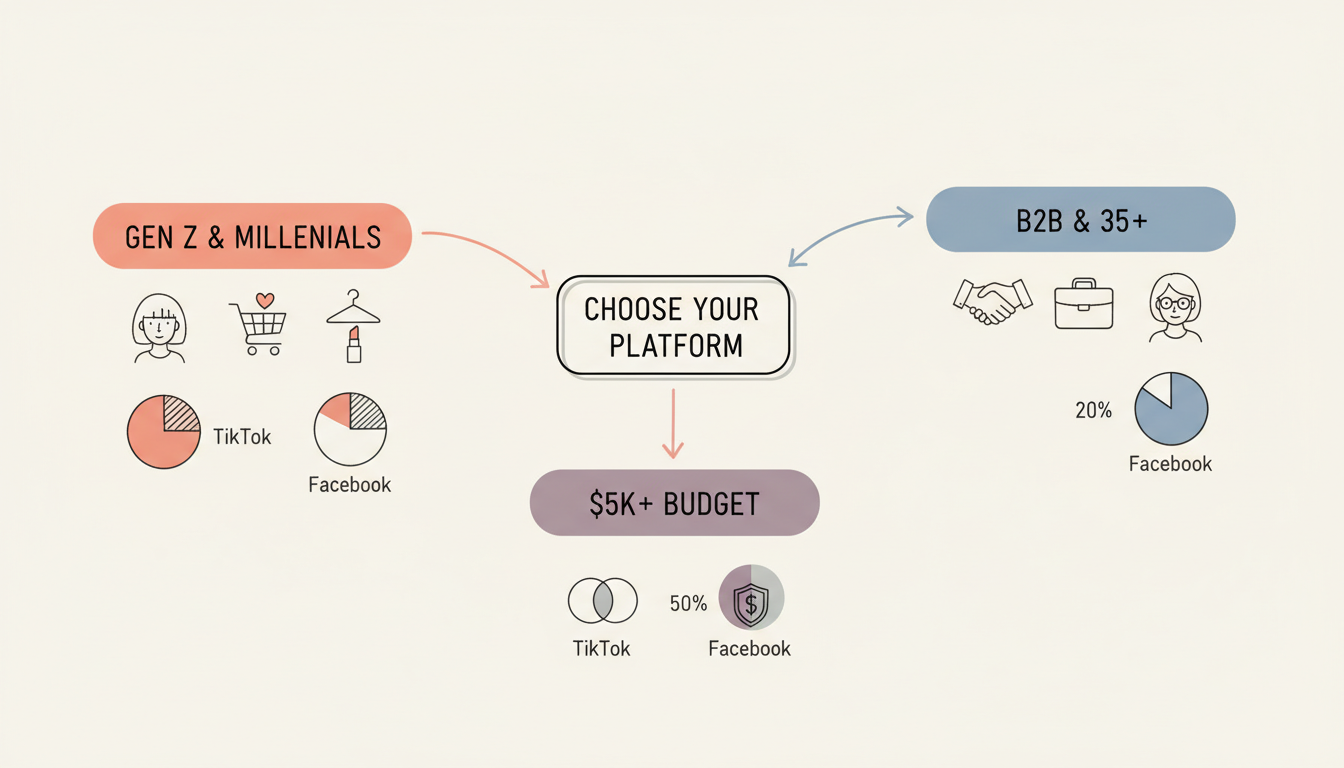
- Gen Z and Millennial targeting - 66% of users are under 35
- Product discovery - TikTok users actively seek product recommendations
- Viral potential - Algorithm can amplify content beyond paid reach
- E-commerce with TikTok Shop - Native shopping integration
- Authentic, creator-driven content - Spark Ads leverage organic creators
Industries that thrive on TikTok:
- Beauty and cosmetics
- Fashion and apparel
- Food and beverage
- Entertainment and gaming
- D2C e-commerce
Brands in the beauty sector should explore our guide on TikTok advertising for beauty brands for industry-specific strategies.
When to Choose Facebook
Facebook excels for:
- Older demographics - Best reach for 35+ audiences
- B2B marketing - Professional audience segments
- Local business advertising - Strong geographic targeting
- Retargeting campaigns - Mature pixel and custom audience tools
- Lead generation - Native lead forms reduce friction
- Complex conversion funnels - Advanced attribution modeling
Industries that thrive on Facebook:
- Real estate
- Financial services
- Healthcare
- Professional services
- Local retail
When to Use Both Platforms
The most effective strategies often incorporate both platforms strategically.
Multi-Platform Strategy Benefits
According to industry research, 30-55% of medium to large advertisers run Facebook, TikTok, and Google ads together. Here's why:
- Broader reach: Cover different demographic segments
- Cross-platform attribution: Understand the full customer journey
- Creative testing: What works on one platform may inform the other
- Reduced platform risk: Don't depend on a single algorithm
For a detailed comparison with another major platform, see our analysis of TikTok vs Google Ads.
Recommended Budget Split by Goal
Business Goal | TikTok | |
Brand awareness | 60% | 40% |
E-commerce (under 35 audience) | 70% | 30% |
E-commerce (35+ audience) | 30% | 70% |
B2B lead generation | 20% | 80% |
Local business | 30% | 70% |
App installs | 50% | 50% |
If you're focused on mobile growth, review our guide on TikTok advertising for apps and user acquisition for platform-specific tactics.
Implementation Tips
- Test sequentially first: Master one platform before adding another
- Use consistent tracking: Implement both pixels and use a unified attribution tool
- Adapt creative: Don't just repurpose - native content performs better
- Compare fairly: Ensure attribution windows match when comparing performance
To optimize your tracking and measurement, leverage the insights in our TikTok ads reporting and analytics guide.
Verdict: Which Is Right for You?
There's no universal winner. The best platform depends on your specific situation.
Choose TikTok If:
- Your target audience is primarily under 35
- You have strong video creative capabilities
- Your product benefits from demonstration or lifestyle content
- You're focused on brand building and awareness
- You sell products in beauty, fashion, or lifestyle categories
- You want to leverage creator partnerships
Choose Facebook If:
- Your target audience includes significant 35+ segments
- You need sophisticated targeting and retargeting
- You're running B2B or lead generation campaigns
- You have limited video production resources
- You need predictable, consistent performance
- You're advertising local services
Choose Both If:
- You have sufficient budget ($5,000+/month in total ad spend)
- You're targeting multiple demographic segments
- You want to reduce platform dependency
- You're ready to create platform-native content for each
If you're considering building expertise in this space, learn about how to start a TikTok ad agency in 2026 to capitalize on growing demand.
Frequently Asked Questions
Is TikTok Advertising Cheaper Than Facebook?
Yes, TikTok generally offers lower CPMs ($3.50 average) compared to Facebook ($6.59 average). However, Facebook often delivers lower CPCs for certain campaign types. The "cheaper" platform depends on your specific goals and how you measure cost efficiency.
Which Platform Has Better Targeting Options?
Facebook currently offers more sophisticated targeting options, including detailed demographics, behaviors, life events, and extensive custom audience capabilities. TikTok's targeting is improving but remains less granular, though its algorithm often finds relevant users effectively without detailed targeting.
Can I Run the Same Ads on Both Platforms?
Technically yes, but you shouldn't. TikTok requires native, vertical video content that feels organic to the platform. Facebook supports more diverse formats. Repurposed content typically underperforms compared to platform-native creative.
Which Platform Is Better for E-Commerce?
It depends on your audience. TikTok with TikTok Shop integration is powerful for products targeting under-35 consumers, especially in beauty, fashion, and lifestyle. For detailed tactics on leveraging TikTok's commerce features, see our TikTok Shop marketing strategy for 2026. Facebook remains stronger for older demographics and offers more mature catalog advertising tools.
How Do I Track Results Across Both Platforms?
Use UTM parameters on all destination URLs, implement both the TikTok Pixel and Meta Pixel, and consider a third-party attribution tool like Triple Whale, Northbeam, or Rockerbox for unified reporting across platforms.