
Choosing between TikTok ads and Instagram ads is one of the most common decisions facing digital marketers in 2026. Both platforms offer massive reach and sophisticated advertising tools, but they serve different audiences and require distinct creative approaches.
This comprehensive comparison breaks down everything you need to know to decide which platform—or combination of platforms—will deliver the best results for your business.
TikTok vs Instagram: Key Differences
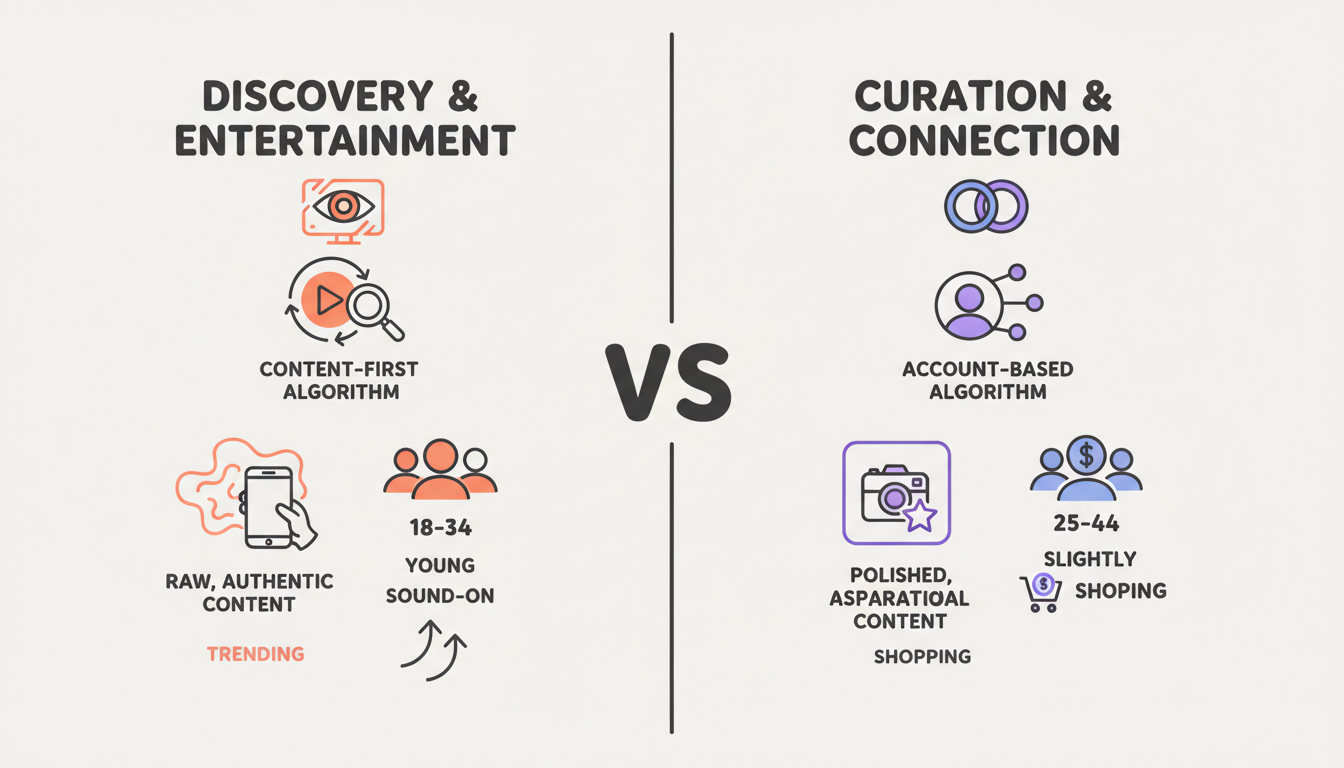
Before diving into specifics, here’s the fundamental difference: TikTok prioritizes discovery and entertainment, while Instagram prioritizes curation and connection. This core distinction shapes everything from algorithm behavior to creative requirements.
Factor | TikTok | |
Primary User Behavior | Discovery, entertainment | Curation, social connection |
Content Style | Raw, authentic, trending | Polished, aspirational, branded |
Algorithm Focus | Content-first (can go viral from zero followers) | Account-based (followers see your content first) |
Commerce Integration | TikTok Shop, growing rapidly | Instagram Shopping, mature infrastructure |
Ad Maturity | Newer but sophisticated | Mature, extensive targeting |
According to TikTok for Business, 56% of users open TikTok specifically to discover something new—a fundamentally different mindset than Instagram browsing.
Audience Comparison
Understanding where your target audience spends time is crucial for platform selection. When developing your TikTok marketing strategy 2026, demographic insights should inform both platform choice and creative direction.
TikTok Audience Demographics
TikTok has reached over 1.59 billion global users as of 2025, with a user base that’s rapidly aging up:
Age Group | Percentage of TikTok Users (18+) |
18-24 | 30.7% |
25-34 | 35.3% |
35-44 | 16.4% |
45-54 | 9.2% |
55+ | 8.4% |
Key insight: The 25-34 age group is now TikTok’s largest demographic, making it increasingly viable for brands targeting millennials, not just Gen Z.
TikTok users spend an average of 58 minutes per day on the platform—the highest engagement time of any social media app.
Instagram Audience Demographics
Instagram has over 2 billion monthly active users in 2026, with a slightly older demographic:
Age Group | Percentage of Instagram Users |
18-24 | 26.8% |
25-34 | 32.2% |
35-44 | 18.5% |
45-54 | 12.1% |
55+ | 10.4% |
Key insight: Instagram skews slightly older with a larger share in the 35+ demographics. The platform remains preferred by millennials and is stronger for B2B contexts. Gen X (45-54) represents 9.2% of TikTok and 12.1% of Instagram users—a growing segment for both platforms often overlooked in platform comparisons.
Audience Overlap
According to Shopify research, 99.9% of Instagram users also use other social platforms. This means most target audiences exist on both platforms—but their behavior and expectations differ significantly. Understanding these differences is essential when determining is TikTok advertising worth it 2026 for your specific business goals.
Ad Format Differences
Both platforms offer diverse ad formats, but each has unique options that play to platform strengths.
TikTok Ad Formats
Format | Description | Best For |
In-Feed Ads | Native video ads in For You Page | Brand awareness, conversions |
TopView Ads | First ad users see when opening app | Maximum reach, product launches |
Spark Ads | Boost organic content as ads | Authenticity, leveraging UGC |
Branded Hashtag Challenges | Sponsored challenges with branded hashtag | Engagement, user-generated content |
Branded Effects | Custom AR filters and effects | Interactivity, brand awareness |
TikTok Shop Ads | Product-focused shopping ads | Direct commerce, e-commerce |
All TikTok ad formats are managed via TikTok Ads Manager, which supports campaign, ad group, and ad-level creative controls. Spark Ads allow brands to boost organic content (yours or creators’) as paid ads, maintaining authenticity while scaling reach. For more details on these formats, see our guide on how to run TikTok ads 2026.
Instagram Ad Formats
Format | Description | Best For |
Reels Ads | Video ads in Reels tab | Reach, video engagement |
Stories Ads | Full-screen vertical ads | Immediate action, swipe-ups |
Feed Ads | Photo/video ads in main feed | Brand building, consideration |
Explore Ads | Ads in Explore tab | Discovery, new audiences |
Shopping Ads | Product catalog ads | E-commerce, direct purchase |
Carousel Ads | Multi-image/video swipeable ads | Product showcase, storytelling |
Advantage+ Shopping Campaigns | AI-driven automated campaign type | E-commerce, large product catalogs |
Instagram ads are managed via Meta Ads Manager (also called Facebook Ad Manager), which provides a unified interface for Instagram and Facebook placements. Advantage+ Shopping Campaigns have become Meta’s dominant AI-driven campaign type for Instagram ad delivery in 2026, automating audience targeting and creative optimization. Instagram’s advantage remains its more mature shopping infrastructure with seamless Shopify integration and established checkout features.
Cost Analysis
Understanding cost differences helps optimize budget allocation across platforms. For small businesses evaluating budget constraints, comparing TikTok advertising cost per month against Instagram spending is critical.
TikTok Advertising Costs (2026)
According to industry benchmarks:
Metric | TikTok Average |
CPM | $3.20-$10 |
CPC | $0.50-$1.50 |
CTR | 0.84% average |
Minimum Campaign Budget | $500 |
Minimum Daily Budget | $50 |
Recent data shows TikTok CPCs averaging around $0.50—significantly lower than Instagram. For a deeper TikTok ads cost 2026 pricing breakdown, see our dedicated analysis.
Instagram Advertising Costs (2026)
Metric | Instagram Average |
CPM | $6-$15 |
CPC | $3-$5 |
CTR | 0.40-0.70% average |
Minimum Daily Budget | $1 |
Average Daily Spend | Flexible |
Instagram typically has higher CPCs at around $3.50 compared to TikTok’s $0.50.
Cost Comparison Summary
Metric | TikTok | Winner | |
Average CPC | $0.50-$1.50 | $3-$5 | TikTok |
Average CPM | $3.20-$10 | $6-$15 | TikTok |
Average CTR | 0.84% | 0.40-0.70% | TikTok |
Average CPA | $10-$25 | $20-$50 | TikTok |
Average CVR | 1-3% | 1-2% | TikTok |
Minimum Budget | $500 campaign | $1/day | |
Cost Efficiency | Lower | Higher | TikTok |
Bottom line: TikTok generally offers lower costs, but Instagram’s lower minimum budget makes it more accessible for testing. See full TikTok ads benchmarks 2026 for industry-specific data. For detailed pricing breakdowns, consult our TikTok ads pricing 2026 analysis.
Tracking & Attribution Setup
Accurate conversion tracking is the foundation of any meaningful TikTok vs Instagram comparison. Without proper attribution, cost and performance data is unreliable.
TikTok Pixel vs Meta Pixel
Both platforms rely on client-side pixels for basic event tracking. The TikTok Pixel tracks page views, add-to-cart, and purchase events on your site, while the Meta Pixel does the same for Instagram campaigns. Both pixels face limitations from iOS 14.5+ App Tracking Transparency—making server-side tracking essential.
Server-Side Tracking (CAPI)
In 2026, Conversions API (CAPI) is mandatory for both platforms. TikTok’s Events API and Meta’s Conversions API send event data directly from your server, bypassing browser-based restrictions. Setup typically involves deploying server-side tags through Google Tag Manager (Server-Side) on Shopify or custom sites. Without CAPI, expect 20-40% underreporting of conversions on both platforms.
GA4 as the Cross-Platform Source of Truth
Use GA4 with consistent UTM parameters as your neutral attribution layer. Tag all TikTok and Instagram campaigns with platform-specific UTMs (e.g., utm_source=tiktok vs utm_source=instagram) to compare performance apples-to-apples outside each platform’s self-reported dashboards.
Tracking Comparison
Feature | TikTok Pixel | Meta Pixel | GA4 |
Client-Side Events | Yes | Yes | Yes |
Server-Side (CAPI) | Events API | Conversions API | Measurement Protocol |
Attribution Window | 7-day click, 1-day view | 7-day click, 1-day view | Data-driven attribution |
Cross-Platform Comparison | No | No | Yes |
Creative Requirements
The creative approach differs significantly between platforms—what works on Instagram often fails on TikTok and vice versa. Mastering TikTok ad creative best practices 2026 is essential for maximizing campaign performance.
TikTok Creative Best Practices
TikTok demands authentic, native-feeling content:
- Less polished is better: Raw, authentic content outperforms studio-quality ads
- Hook in first second: Users scroll instantly if not engaged
- Sound on by default: 93% of users watch with sound on
- Trend integration: Leverage trending sounds, effects, and formats
- Creator collaboration: Content from creators outperforms brand content
- Optimal length: 21-34 seconds for best performance
As noted by Shopify experts: “The stuff that’ll perform really well on Instagram will be the opposite of what is on TikTok and vice versa.” If you’re using creator content, explore the TikTok Creator Marketplace guide for collaboration strategies.
Instagram Creative Best Practices
Instagram rewards curated, aspirational content:
- Higher production value: Professional photography and video perform well
- Brand consistency: Visual cohesion matters more than on TikTok
- Multiple formats: Optimize for feed, Stories, and Reels separately
- Sound optional: Many users browse with sound off
- Carousel storytelling: Use multiple images for deeper engagement
- Clear CTAs: Direct response messaging works effectively
Creative Testing Framework
Systematic creative testing is critical on both platforms, but the cadence differs. TikTok creatives fatigue faster (days to weeks) compared to Instagram (weeks to months), so TikTok campaigns need a higher volume of test variants.
A recommended test matrix: run 3-5 hook variants crossed with 2 CTA variants per platform. Evaluate winners using CTR (click-through rate), CVR (conversion rate), and CPA (cost per acquisition) as your primary metrics. Use frequency capping to control ad fatigue during test windows—when frequency exceeds 3-4 impressions per user, creative performance typically degrades.
Allocate roughly 20% of your total ad spend to testing new creative, rotating fresh variants weekly on TikTok and bi-weekly on Instagram. Use the TikTok Creative Center guide to discover trending hooks and formats for your next round of tests.
Creative Resource Comparison
Factor | TikTok | |
Production Cost | Lower (authentic preferred) | Higher (polished preferred) |
Content Volume Needed | High (trends change quickly) | Moderate |
Creative Lifespan | Short (days to weeks) | Longer (weeks to months) |
UGC Effectiveness | Very high | Moderate |
Understanding TikTok UGC ads strategy can help brands reduce production costs while maintaining authenticity.
Performance Metrics
How do the platforms compare on actual results? For data-driven insights, review TikTok advertising statistics 2026 alongside Instagram benchmarks.
Engagement Rates
According to industry data, organic engagement is declining across both platforms:
- Instagram engagement down ~16% year-over-year
- TikTok engagement down ~34% year-over-year
However, TikTok still maintains higher overall engagement rates due to its algorithm prioritizing content discovery. Both platforms support interest-based targeting, but TikTok’s algorithm-driven discovery often outperforms manual TikTok ad targeting options for cold audiences.
Conversion Performance
Metric | TikTok | |
Average CVR | 1-3% | 1-2% |
Reels Conversion to Site | N/A | 4.5% |
Influencer ROI Lift | 32% higher | Baseline |
E-commerce Engagement | Growing fast | Mature infrastructure |
ROAS Comparison
TikTok reports 96% higher ROAS compared to other digital channels, though this varies significantly by industry and campaign type. For deeper performance data, see our TikTok ads ROI analysis.
Key consideration: Instagram’s mature shopping features may deliver better direct-response performance for e-commerce, while TikTok excels at awareness and discovery. Running coordinated cross-channel campaigns on both TikTok and Instagram allows advertisers to sequence messaging—awareness on TikTok, retargeting on Instagram. Tracking performance requires robust TikTok ads reporting analytics guide processes.
Which Platform Wins?
The answer depends on your specific goals, audience, and resources.
Choose TikTok Ads If:
- Your target audience is under 35: TikTok’s strength in the 18-34 demographic is unmatched
- You’re optimizing for awareness: TikTok’s discovery algorithm amplifies reach
- Budget is limited: Lower CPCs and CPMs stretch your budget further
- You can create authentic content: Platform rewards raw, genuine content
- You’re launching new products: Discovery-oriented users are receptive to new brands
- Influencer marketing is a priority: Creator ecosystem is highly developed
Choose Instagram Ads If:
- Your audience is 35+: Instagram’s millennial and older demographics are stronger
- E-commerce is your priority: Mature shopping infrastructure drives direct sales
- Brand consistency matters: Platform rewards polished, cohesive visuals
- You have existing followers: Algorithm favors account relationships
- B2B context: Professional audience more established on Instagram
- Cross-platform with Facebook: Unified Meta Ads Manager simplifies management
For brands that prefer managed services, working with an Instagram ads agency can accelerate results.
Use Both Platforms If:
- Budget allows diversification: Most brands benefit from presence on both
- Audience exists on both: With 99.9% cross-platform usage, most do
- Testing different creative approaches: Each platform teaches different lessons
- Full-funnel strategy: TikTok for awareness, Instagram for conversion
For DTC brands, TikTok’s lower CPA and discovery algorithm make it the preferred top-of-funnel platform, while Instagram’s shopping infrastructure closes the conversion loop.
For businesses evaluating platform selection, comparing TikTok vs Google Ads alongside Instagram can provide additional strategic context.
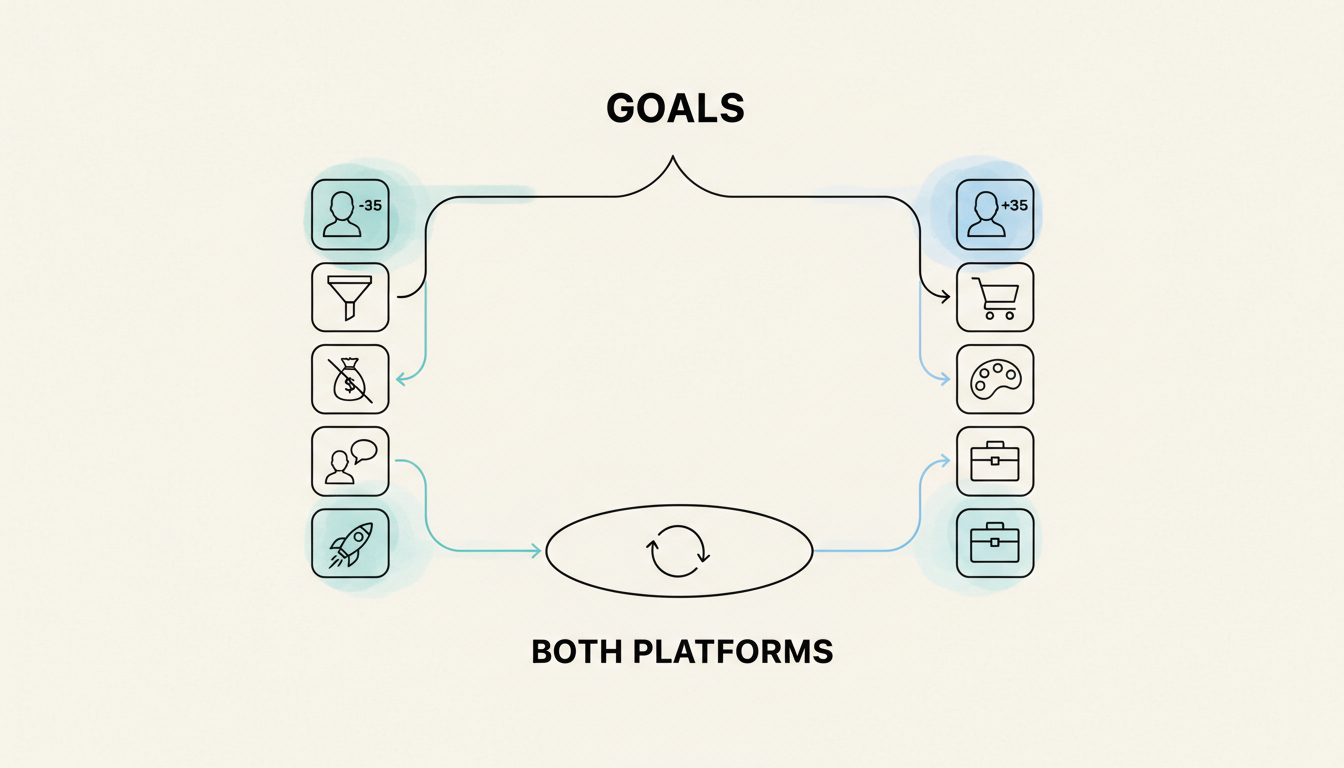
Platform Selection Framework
Goal | Recommended Platform |
Brand awareness | TikTok |
Direct response/sales | |
Influencer campaigns | TikTok |
Retargeting | Instagram (Meta) |
Product launches | TikTok |
Established brand building | |
Gen Z targeting | TikTok |
Millennial targeting | Both |
B2B |
Budget Allocation Model
Knowing which platform to use is only half the equation—you also need a framework for splitting spend between them. Here are recommended budget splits by goal:
Goal | TikTok | |
Awareness-first | 60% | 40% |
Conversion-first | 40% | 60% |
DTC brand launch | 70% | 30% |
Use CAC (customer acquisition cost) and MER (marketing efficiency ratio) as your primary metrics to evaluate allocation effectiveness—not just ROAS in isolation. MER measures total revenue divided by total marketing spend across all channels, giving a holistic view of paid media budget allocation efficiency.
Rebalance quarterly based on new-to-brand conversion rates. If TikTok is driving a higher share of first-time buyers at lower CPA, shift more budget there. If Instagram’s retargeting is closing more repeat purchases, increase its share. For a deeper Meta comparison beyond Instagram, see our TikTok ads vs Facebook ads breakdown.
Frequently Asked Questions
Which Is Cheaper: TikTok Ads or Instagram Ads?
TikTok ads are generally cheaper, with average CPCs around $0.50-$1.50 compared to Instagram’s $3-$5. TikTok’s CPMs also run lower at $3.20-$10 versus Instagram’s $6-$15. However, Instagram has a lower minimum daily budget ($1 vs. $50), making it more accessible for small tests. For small businesses, see our TikTok ads for small business 2026 cost analysis.
Can I Use the Same Creative for TikTok and Instagram?
Using identical creative across platforms typically underperforms. TikTok rewards authentic, less-polished content that feels native to the platform, while Instagram performs better with higher production value and brand consistency. The content “that’ll perform really well on Instagram will be the opposite of what is on TikTok,” according to marketing experts.
Which Platform Is Better for E-Commerce?
Both platforms work for e-commerce, but they excel at different stages. TikTok is stronger for product discovery and brand awareness, with 15% of all product discoveries happening on the platform. Instagram has more mature shopping infrastructure with seamless Shopify integration and established checkout features, making it better for direct conversions. Learn more about TikTok catalog ads guide for product-focused campaigns.
Is TikTok Better Than Instagram for Reaching Younger Audiences?
Yes, TikTok has stronger penetration among younger users, with 30.7% of users aged 18-24. However, TikTok’s fastest-growing segment is now 25-34 (35.3% of users), making the age gap less pronounced than commonly assumed. Instagram’s audience skews slightly older with stronger presence in the 35+ demographics.
How Do I Track Conversions Across TikTok and Instagram Ads?
Install TikTok Pixel and Meta Pixel on your site, then set up Conversions API (CAPI) for server-side tracking on both platforms. Use GA4 with consistent UTM parameters as your cross-platform source of truth. This ensures accurate attribution even with browser privacy restrictions blocking client-side cookies.
Are TikTok Ads or Instagram Ads Better for Small Businesses?
For small businesses with limited budgets, Instagram’s $1/day minimum makes it easier to start testing. However, TikTok’s lower CPCs ($0.50-$1.50 vs $3-$5) mean your budget goes further once you commit. Start with Instagram to validate messaging, then scale winners to TikTok for broader reach at lower cost.
What Is Advantage+ and How Does It Compare to Tiktok’s Smart Performance Campaigns?
Advantage+ is Meta’s AI-powered campaign type that automates audience targeting, creative optimization, and budget allocation for Instagram ads. TikTok’s equivalent is Smart Performance Campaigns. Both reduce manual setup but limit granular control. Advantage+ tends to perform best for e-commerce with large product catalogs; TikTok’s automation excels at video-first awareness campaigns.
How Should I Split My Ad Budget Between TikTok and Instagram?
Start with a 50/50 split for the first 2-4 weeks, then reallocate based on CPA and ROAS performance. For awareness goals, shift to 60/40 favoring TikTok. For direct-response and e-commerce conversions, shift to 60/40 favoring Instagram. Rebalance quarterly using MER (Marketing Efficiency Ratio) as your north-star metric.