
TikTok Advertising for Apps: User Acquisition Guide
TikTok advertising apps user acquisition has become one of the most powerful growth channels for mobile teams. With its highly engaged user base and advanced targeting capabilities, TikTok ads for apps consistently deliver strong install volumes at competitive costs. According to industry reports, TikTok's global ad revenue is projected to reach $34.8 billion in 2026, with app install campaigns representing a major share of that spend.
This guide covers everything you need to run successful TikTok advertising apps user acquisition campaigns—from initial setup to optimization strategies that drive quality installs.
App Advertising on TikTok
TikTok offers several advantages for mobile app marketers:
Why TikTok Works for App Install Campaigns
TikTok offers structural advantages for app marketers that legacy platforms cannot match.
Advantage | Benefit for App Marketers |
Highly engaged audience | Users actively discover and try new apps |
Full-screen video format | Showcases app features effectively |
Algorithm-driven discovery | Reaches users likely to install |
Young demographic skew | Ideal for gaming, social, and lifestyle apps |
Lower CPIs than Meta (often) | Competitive acquisition costs |
TikTok's unique content environment means users are already in discovery mode. Unlike platforms where ads interrupt the experience, TikTok ads that feel native often perform exceptionally well. TikTok's For You Page (FYP) algorithm surfaces content based on user behavior rather than social connections, making it uniquely effective at reaching high-intent users who are likely to discover and install new apps.
TikTok's algorithm-driven discovery means your app can reach millions of high-intent users without requiring an existing audience — a fundamental advantage over follower-dependent platforms.
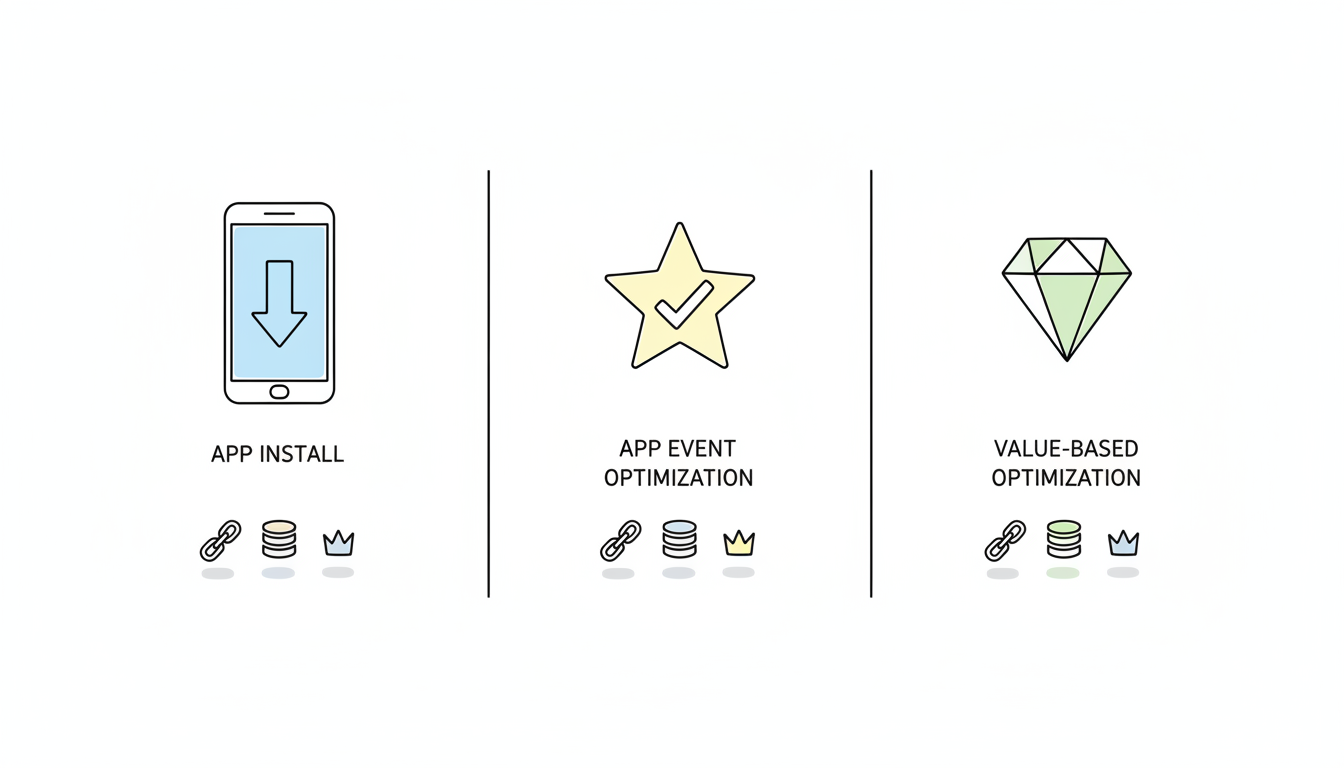
App Install Campaign Types
TikTok Ads Manager offers dedicated campaign objectives for app promotion:
App Install Objective
- Optimizes delivery toward users most likely to install
- Supports both iOS and Android apps
- Integrates with MMPs for accurate attribution
App Event Optimization (AEO)
- Optimizes beyond installs to in-app actions
- Targets users likely to complete specific events (purchase, registration, level complete)
- Requires sufficient conversion data for machine learning
Value-Based Optimization (VBO)
- Targets users predicted to generate highest lifetime value
- Best for apps with clear monetization events
- Requires robust event tracking and history
Spark Ads and Additional Ad Formats
Beyond standard in-feed app install ads, TikTok offers several ad formats that can significantly boost app user acquisition:
Spark Ads
Spark Ads let advertisers boost existing organic TikTok posts—either their own or a creator's (with permission)—as paid ads. This format consistently outperforms standard in-feed ads for app installs because the content retains its native look, including likes, comments, and shares. Spark Ads also accumulate engagement on the original post, creating a compounding effect. To use Spark Ads for app installs, the creator generates an authorization code that you enter in TikTok Ads Manager when setting up the ad.
TopView Ads
TopView Ads appear as the first video users see when opening TikTok, delivering up to 60 seconds of full-screen, sound-on exposure. With a minimum spend around $65,000 per day, TopView is best suited for large-scale app launches where maximum reach matters. The format delivers some of the highest view-through rates on the platform.
Branded Hashtag Challenges
Branded Hashtag Challenges sponsor a hashtag on TikTok's Discover page, encouraging users to create content around a theme. While budgets can reach $500,000 or more, this format drives massive organic reach and user-generated content that amplifies brand awareness and app downloads simultaneously.
Brand Takeover Ads
Brand Takeover ads display a full-screen static or video ad immediately when a user opens TikTok. Limited to one advertiser per category per day, these ads guarantee high visibility but require significant budget commitments.
Automated Campaign Types and Account Structure
TikTok has introduced automated campaign types that simplify setup and leverage machine learning for optimization:
Smart Performance Campaign (SPC)
- Fully automated campaign type optimized for Android app installs
- TikTok handles targeting, bidding, and creative optimization automatically
- Often delivers results comparable to or better than manual campaigns with significantly less setup time
Advanced Dedicated Campaign (ADC)
- TikTok's automated campaign solution designed specifically for iOS
- Accounts for ATT and SKAN limitations in its optimization approach
- Recommended for advertisers who want automated optimization on iOS without manual SKAN configuration
App Profile Pages (APP)
- Creates a mini app store listing within TikTok itself
- Users can view screenshots, ratings, and descriptions without leaving the TikTok app
- Provides high-intent signals because users who click through from the App Profile Page have already evaluated the app
For account structure, follow the KISS principle: consolidate campaigns rather than fragmenting spend across dozens of ad groups. Use clear naming conventions (e.g., [Platform]_[Objective]_[Targeting]_[Date]) so you can quickly identify what each campaign does. Fewer, broader campaigns give TikTok's algorithm more data to optimize against.
App Install Campaign Setup
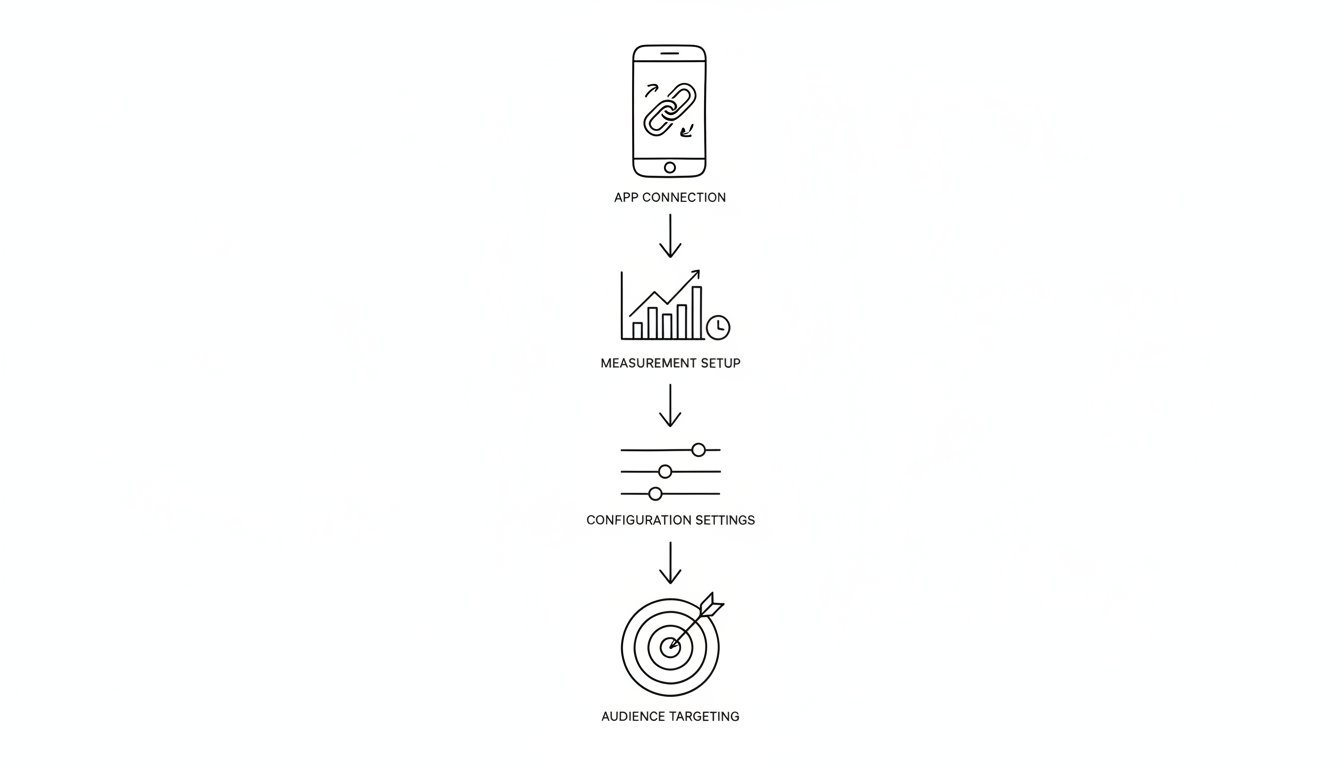
Setting up a TikTok advertising apps user acquisition campaign requires careful configuration across several areas.
Step 1: Connect Your App
Before launching campaigns, connect your app to TikTok Ads Manager:
- Navigate to Assets > Events > App Events
- Click Manage and select Create App
- Enter your app store URL (iOS App Store or Google Play)
- Generate your TikTok App ID—this unique identifier links your app to TikTok's tracking system
Step 2: Set Up Tracking
Accurate attribution is critical for app campaigns. You have three options:
Option A: Mobile Measurement Partner (MMP)
Most app marketers use an MMP like AppsFlyer, Adjust, Branch, Singular, or Kochava. Benefits include:
- Cross-platform attribution
- Unified reporting across channels
- Fraud detection
- SKAdNetwork (SKAN) support for iOS
To connect your MMP:
- In TikTok Ads Manager, go to Assets > Events > App Events
- Select Partner Setup and choose your MMP
- Enter your TikTok App ID in your MMP dashboard
- Map in-app events you want to track
Option B: TikTok App Events SDK
TikTok's native SDK offers direct integration without an MMP. The SDK now supports hybrid setup alongside MMPs.
Option C: Events API (eAPI)
Server-side integration for advanced setups requiring custom implementation.
Step 3: Configure Campaign Settings
Configure these core settings before launching your TikTok app install campaign.
Setting | Recommendation |
Campaign objective | App Installs (start here) |
Campaign budget | Minimum $500 campaign level |
Ad group budget | Minimum $50/day |
Optimization goal | App Install initially; AEO after data accumulates |
Bid strategy | Cost Cap recommended for cost control |
TikTok's algorithm needs data to optimize. Campaigns should achieve at least 50 conversions before scaling significantly.
Step 4: Targeting Setup
For app install campaigns, consider these targeting approaches:
Broad Targeting (Recommended for New Campaigns)
- Let TikTok's algorithm find your best users
- Works well with compelling creative
- Often delivers lowest CPIs at scale
Interest/Behavior Targeting
- Layer relevant interests (gaming, productivity, etc.)
- Use behavior signals like "app installers"
- Good for niche apps
Custom Audiences
- Upload existing user lists for suppression
- Create lookalike audiences from high-value users
- Retarget users who viewed but didn't install
Pangle (TikTok Audience Network)
Pangle extends your TikTok app install ads to over 100,000 partner apps at often lower CPIs.
When you enable Pangle as a placement, your ads appear in third-party apps within TikTok's network, increasing reach significantly.
However, Pangle traffic behaves differently from TikTok feed traffic. Best practices for using Pangle effectively:
- Always run Pangle in a separate ad group or campaign from your TikTok feed placements—this prevents Pangle's lower-cost impressions from skewing your TikTok performance data
- Monitor post-install quality closely, as Pangle users may show different retention and monetization patterns compared to TikTok users
- Start with Pangle disabled and add it only after your TikTok campaigns are stable and you want to scale volume
- Use separate CPI targets for Pangle, as costs are typically 20-40% lower but user quality may vary
Creative Best Practices
TikTok advertising apps user acquisition success hinges on creative quality. App install ad creative makes or breaks your campaign. Understanding TikTok ad creative best practices is essential for maximizing your install campaigns' performance. TikTok's native format demands content that feels organic.
The 3 Second Rule on TikTok
The hook is the single most critical element of any TikTok app install ad.
According to TikTok marketing research, the first three seconds determine whether users engage or scroll. Hooks that immediately communicate value drive significantly higher watch-through rates and lower CPIs.
Effective Hook Strategies for Apps:
- Show the app in action solving a problem
- Lead with a surprising result or transformation
- Ask a question your target audience relates to
- Use trending sounds or formats with your app featured
Creative Specifications
All TikTok app install ads must meet these technical requirements.
Element | Requirement |
Aspect ratio | 9:16 (vertical, full-screen) |
Resolution | 720p minimum, 1080p recommended |
Duration | 15-60 seconds (21-34 seconds optimal) |
File size | Up to 500MB |
Sound | Essential—most users watch with sound on |
TikTok also supports carousel and image ad formats beyond video. Carousel ads let you showcase multiple app screenshots or features in a swipeable format, and they can be effective for repurposing static creative from other channels like Meta.
UGC-Style Content Wins
Leveraging TikTok UGC ads consistently outperforms polished brand creative on TikTok. Consider:
- Screen recordings showing app functionality
- Creator partnerships demonstrating real use cases
- Before/after transformations enabled by the app
- Tutorial-style content teaching how to use key features
Testing Framework
Test these elements systematically:
- Hooks: Test 3-5 different opening approaches
- Value propositions: Which benefits resonate most?
- CTAs: "Download now," "Try free," "Get started"
- Social proof: Ratings, reviews, download numbers
- Length: Test 15s, 30s, and 45s versions
Playable and Interactive Ads
Playable ads let users interact with a lightweight version of your app directly within the TikTok ad experience. Users can tap, swipe, or play a mini-game before deciding to download, resulting in higher-intent installs and better post-install retention.
Playable ads are especially effective for gaming apps, where a 15-30 second playable demo of core gameplay can dramatically reduce CPI while improving D1 retention. Non-gaming apps can also benefit by creating interactive product tours or feature previews that let users experience the app's value before committing to download.
Key considerations for playable ads:
- Keep the interactive experience under 30 seconds to maintain engagement
- Showcase the most compelling feature or moment of your app
- Include a clear call-to-action at the end of the playable experience
- Test playable ads against standard video ads to measure incremental lift in install quality
TikTok Creative Programs (TTCC and TTCX)
TikTok offers two programs to help advertisers source high-quality ad creative at scale:
TikTok Creative Challenge (TTCC)
- Submit an ad brief and TikTok's vetted creator pool produces ad content for you
- Requires a minimum ad spend of $10,000
- Can generate up to 40 unique ad variations per week, solving the creative fatigue problem
- You only pay for ads that meet your approval—no upfront creator fees
TikTok Creative Exchange (TTCX)
- Connects advertisers with professional creative agencies for free ad production
- Requires a minimum monthly ad spend of $30,000
- Agencies produce TikTok-native content tailored to your app's goals
- Useful for brands that need polished creative but want to maintain a native TikTok feel
Both programs are particularly valuable for app marketers who need a constant pipeline of fresh creative to combat ad fatigue.
Tracking and Attribution
Accurate tracking enables TikTok advertising apps user acquisition optimization. Without proper attribution, you're flying blind. Setting up your TikTok Pixel correctly ensures you capture all conversion data for optimization.
iOS Attribution (Post-ATT)
Apple's App Tracking Transparency significantly impacted iOS measurement. To maximize data:
- Enable SKAdNetwork (SKAN): Configure conversion value schemas in your MMP
- Use probabilistic modeling: Most MMPs provide modeled attribution
- Implement SKAN 4.0: Latest version offers improved measurement
Key Events to Track
Track these in-app events to optimize TikTok campaigns beyond raw install volume.
Event | Purpose |
Install | Primary optimization event |
Registration | Quality signal for AEO |
Tutorial complete | Engagement indicator |
First purchase | Revenue optimization |
Subscription start | LTV signal |
Attribution Windows
TikTok default attribution windows:
- Click-through: 7 days
- View-through: 1 day
Consider adjusting based on your app's typical user journey. Games with immediate monetization might use shorter windows; B2B apps with longer consideration periods might extend them.
Optimizing for Installs
Continuous optimization of your TikTok advertising apps user acquisition campaigns improves install efficiency and reduces wasted spend.
Once your TikTok advertising apps user acquisition campaigns are running, continuous optimization improves efficiency. If your campaigns aren't delivering expected results, understanding why TikTok ads aren't spending can help you diagnose and fix delivery issues. Stackmatix's mobile app growth services also offer hands-on campaign management for teams that want expert support.
Monitor Key Metrics
Track these metrics weekly to identify optimization opportunities in your TikTok campaigns.
Metric | Benchmark Range | Action if Off Target |
CPI (Cost per Install) | $1.50-$4.00 (varies by vertical) | Test new creative, adjust targeting |
CTR | 0.5-2.0% | Improve hook and creative |
CVR | 10-25% (click to install) | Optimize store listing |
Retention D1 | 25-40% | Review targeting quality |
Budget Planning and CPM Benchmarks
TikTok's CPM (cost per 1,000 impressions) typically ranges from $1 to $5, making it roughly one-tenth the cost of Facebook/Meta for comparable audiences. This cost advantage means app marketers can generate significantly more impression volume for the same budget.
To calculate your recommended daily budget, use this formula: multiply your target CPA (cost per acquisition) by 50, then divide by 7. For example, if your target CPI is $3.00, your recommended daily budget would be ($3.00 x 50) / 7 = approximately $21.43 per day per ad group. This ensures the algorithm receives enough conversion data within a week to exit the learning phase.
Cost Metric | TikTok Average | Meta/Facebook Average |
CPM | $1-$5 | $10-$30 |
CPI (Gaming) | $1.50-$3.00 | $2.00-$5.00 |
CPI (Non-Gaming) | $2.00-$5.00 | $3.00-$8.00 |
CPA (In-App Event) | $5-$20 | $10-$40 |
Optimization Strategies
Creative Refresh TikTok creative fatigues quickly. Plan to refresh every 2-4 weeks with new concepts and variations.
Audience Expansion Once you find winning creative, expand targeting gradually. Increase budgets by 20-30% every few days to maintain algorithm stability.
Bid Optimization If using Cost Cap bidding, adjust bids based on results:
- CPI consistently below cap: Lower bid to reduce costs
- Delivery struggling: Raise bid to compete in auction
Dayparting Analyze when your best users install. Consider scheduling ads during peak engagement periods for your audience.
Organic-To-Paid Strategy
One of the most effective approaches to TikTok app marketing is validating creative organically before scaling with paid spend. Post content to your brand's TikTok account first, monitor engagement metrics (watch time, shares, comments), and identify which videos resonate most with your target audience.
Once you find organic content that performs well, amplify it using Spark Ads. This approach reduces creative risk because you already know the content engages users before investing ad budget behind it. Many successful app marketers maintain a ratio of 3-5 organic posts per week, then promote the top 1-2 performers as Spark Ads.
Why This Matters for App Marketers
TikTok helps reactivate churned users through retargeting that surfaces your app to lapsed installers who last engaged 30, 60, or 90 days ago. Achieving stronger retention with lower uninstall rates is possible because TikTok’s algorithm matches ads to high-intent users already predisposed to engage with your app category.
The full journey from discovery to installs is where TikTok outperforms expectations, delivering superior cost efficiency across the entire acquisition funnel. Lower CPMs compound into dramatically reduced blended CPAs, making every dollar work harder than on legacy platforms.
App Install Case Studies
Real-world TikTok advertising apps user acquisition examples demonstrate how brands have successfully scaled on the platform:
Gymshark: Hashtag Challenge Driving App Downloads
Gymshark's #Gymshark66 Branded Hashtag Challenge drove a significant surge in app downloads by tying user content to a specific 66-day fitness commitment.
Fitness app Gymshark launched the #Gymshark66 Branded Hashtag Challenge, encouraging users to commit to a fitness goal for 66 days and share their progress on TikTok. The campaign generated millions of video views and user-generated content, driving a significant surge in app downloads. The key insight was tying the challenge to a specific, achievable goal that aligned with the app's core value proposition—tracking and completing fitness routines.
Beatstar: Gameplay Creative at Scale
Beatstar achieved CPIs well below Meta benchmarks by pairing recognizable song hooks with gameplay footage—content that felt native to TikTok's music-driven audience.
Beatstar, a music rhythm mobile game, leveraged TikTok's native format by creating ads featuring popular licensed songs combined with gameplay footage. Because TikTok users are already engaged with music content, the ads felt native to the platform. Beatstar's formula was simple: show 3-5 seconds of a recognizable song hook, then cut to gameplay of a user tapping along. This approach delivered CPIs well below their Meta benchmarks while attracting users with higher D7 retention rates.
Subscription App: TikTok vs. Meta Cost Comparison
A language learning app found TikTok delivered CPIs 35% lower than Meta with comparable trial-to-subscription conversion rates, eventually making TikTok its primary acquisition channel.
A language learning subscription app ran parallel campaigns on TikTok and Meta to compare user acquisition costs. TikTok delivered CPIs 35% lower than Meta ($2.10 vs. $3.25) with comparable trial-to-subscription conversion rates. The app found that UGC-style creator content featuring "day in my life learning a language" formats performed best, achieving 2.3x higher CTR than polished brand videos. After three months, TikTok became the app's primary paid acquisition channel, accounting for 40% of new subscriber volume.
Key Takeaways
The most important insights from this guide to TikTok advertising apps user acquisition.
- TikTok CPMs range from $1 to $5—roughly one-tenth of Meta—giving app marketers dramatically more impression volume per dollar.
- Use broad targeting first and let TikTok’s algorithm find your best users before layering audience restrictions.
- Creative is the largest performance lever: refresh every 2–4 weeks and validate concepts organically before paying to amplify.
- Always run Pangle in a separate campaign to isolate its performance from your core TikTok feed data.
- Aim for 50+ conversions before exiting the learning phase or making significant bid and targeting changes.
Frequently Asked Questions
Common questions about TikTok advertising apps user acquisition, from CPI benchmarks and tracking to creative formats and budget planning.
What Is a Good CPI on TikTok for App Installs?
In TikTok advertising apps user acquisition, a good CPI is $1.50–$3.00 for gaming apps and $2.00–$5.00 for utility apps—though retention and LTV matter more than raw install cost.
CPI varies significantly by app category, geography, and targeting. Generally, gaming apps see CPIs of $1.50-$3.00, while utility apps range from $2.00-$5.00. Social and entertainment apps often achieve $1.00-$2.50. Focus on quality metrics (retention, LTV) rather than CPI alone—a $3.00 CPI with strong retention beats a $1.00 CPI with 90% churn.
How Long Should I Run a TikTok App Install Campaign Before Judging Results?
Allow at least 7-14 days and 50+ conversions before making significant changes. TikTok's algorithm needs time to learn which users convert. Campaigns typically exit the "learning phase" after achieving this conversion threshold, at which point optimization stabilizes.
Should I Use TikTok SDK or an MMP for Tracking?
Most app marketers use an MMP (AppsFlyer, Adjust, etc.) because it provides cross-platform attribution, fraud detection, and unified reporting. TikTok's SDK can work alongside MMPs in a hybrid setup. If you're only running TikTok campaigns and want simplicity, the native SDK works well.
How Much Do TikTok Ads Cost per 1,000 Views (CPM)?
TikTok CPMs typically range from $1 to $5 for app install campaigns in the United States, making it one of the most cost-efficient platforms for generating impressions. By comparison, Meta/Facebook CPMs often run $10-$30 for similar audiences.
Actual CPMs vary based on targeting, seasonality, competition, and ad quality—broader targeting and high-engagement creative tend to achieve lower CPMs.
What Are Spark Ads on TikTok and How Do They Work for App Installs?
Spark Ads allow advertisers to boost organic TikTok posts (their own or a creator's) as paid advertisements while retaining all native engagement features like likes, comments, and shares.
For app installs, Spark Ads typically outperform standard in-feed ads because they look and feel like organic content. To run a Spark Ad, the creator generates an authorization code in TikTok, and you use that code when setting up your app install campaign in Ads Manager.
What Is Pangle and Should I Use It for App Install Campaigns?
Pangle is TikTok's audience network that extends your ads to over 100,000 third-party apps. It can increase reach and often delivers lower CPIs than TikTok feed placements.
However, always run Pangle in a separate campaign from your TikTok placements so you can independently measure user quality. Start with TikTok-only campaigns first, then add Pangle once your core campaigns are stable and you want to scale volume.
What Budget Do I Need to Start TikTok App Install Campaigns?
TikTok advertising apps user acquisition requires a minimum of $500 at the campaign level and $50 per day at the ad group level.
For effective optimization, use the formula: target CPA x 50 / 7 = recommended daily ad group budget. This ensures TikTok's algorithm gets enough conversions within a week to exit the learning phase. For most app categories, plan to spend at least $1,500-$3,000 in the first two weeks to generate sufficient data for optimization.
Who Owns 80% of TikTok and Does It Affect Advertising?
ByteDance, the Chinese parent company, owns the majority stake in TikTok. Ownership structure doesn’t affect advertisers directly—TikTok operates independently in most markets—but it has prompted regulatory scrutiny in the US and EU. App advertisers should monitor policy changes, though the platform continues to operate globally for paid campaigns.
What Apps Are TikTok Users Going to Use?
TikTok users skew heavily toward gaming, entertainment, social, lifestyle, and utility apps. Top-performing app categories on TikTok include casual games, music and video apps, fitness trackers, language learning apps, and e-commerce platforms.
Understanding where your app fits in the TikTok ecosystem helps you tailor creative and targeting for maximum install volume.