
Understanding TikTok ROAS benchmarks is essential for evaluating your advertising performance and setting realistic campaign goals. According to TikTok performance data, the platform delivers 96% higher ROAS compared to other digital channels—but what does "good" actually look like for your business?
This guide breaks down TikTok ROAS by industry, helps you set appropriate targets, and shows you how to improve your return on ad spend.
What Is ROAS?
Return on Ad Spend (ROAS) measures the revenue generated for every dollar spent on advertising. It's calculated as:
ROAS = Revenue from Ads / Cost of Ads
For example, if you spend $1,000 on TikTok ads and generate $4,000 in revenue, your ROAS is 4:1 (or 400%).
ROAS vs ROI
While often confused, ROAS and ROI measure different things:
Metric | What It Measures | Formula |
ROAS | Revenue generated per ad dollar | Revenue / Ad Spend |
ROI | Profit generated per total dollar invested | (Profit - Total Cost) / Total Cost |
ROAS focuses specifically on ad spend efficiency. ROI accounts for all costs including product costs, overhead, and operations.
Example:
- Ad spend: $10,000
- Revenue: $40,000 (ROAS = 4:1)
- Product costs: $16,000
- Gross profit: $24,000
- ROI: ($24,000 - $10,000) / $10,000 = 140%
A 4:1 ROAS sounds great, but actual profitability depends on your margins.
Average TikTok ROAS by Industry
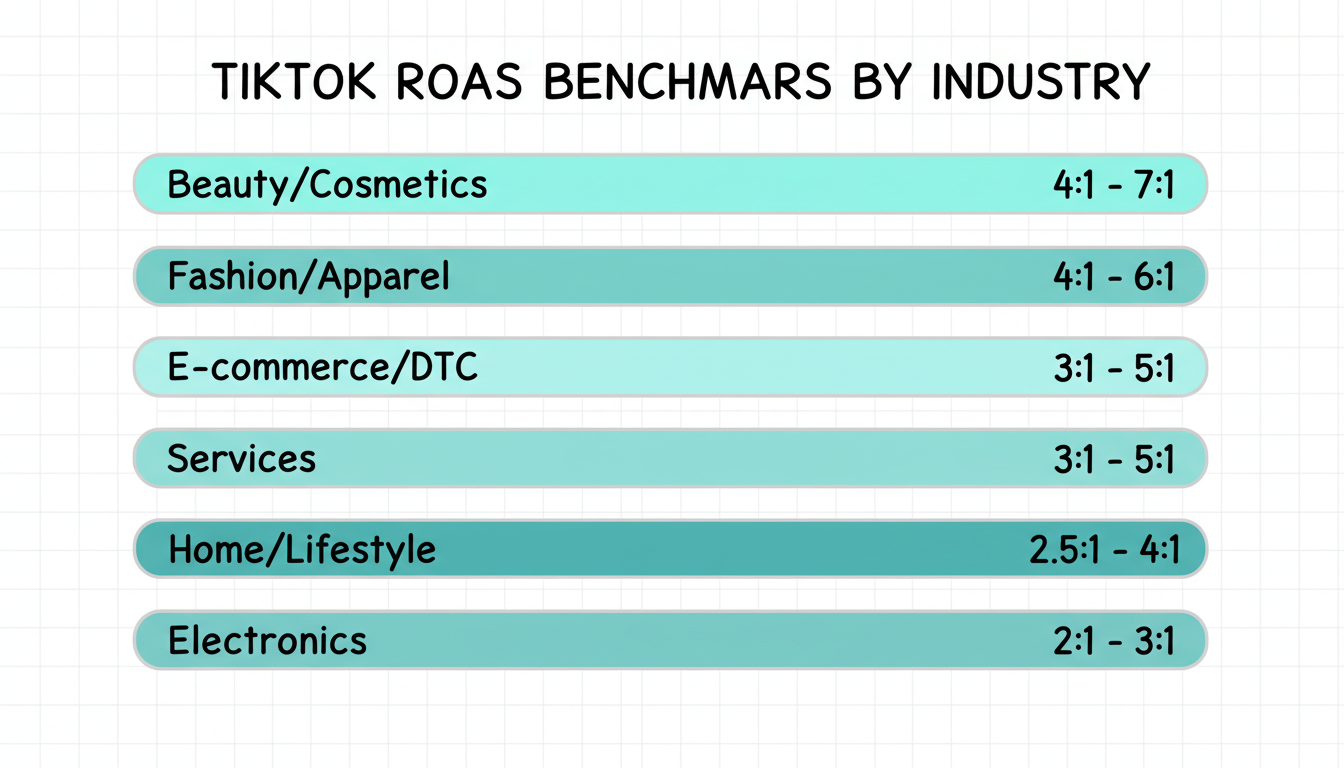
ROAS benchmarks vary significantly by industry. According to industry data, here are typical TikTok ROAS ranges in 2026:
Industry | Typical ROAS Range | Notes |
Beauty/Cosmetics | 4:1 - 7:1 | TikTok's strongest vertical |
Fashion/Apparel | 4:1 - 6:1 | Visual products perform well |
E-commerce/DTC | 3:1 - 5:1 | Broad benchmark for online retail |
Services | 3:1 - 5:1 | Depends on service value |
Home/Lifestyle | 2.5:1 - 4:1 | Higher consideration products |
Electronics | 2:1 - 3:1 | Higher price points, longer cycles |
Why Some Industries Perform Better
TikTok's strength in beauty and fashion isn't coincidental. The platform's visual format excels at demonstrating products that show results on camera, similar to how TikTok advertising beauty brands has become a dominant strategy:
- Visual demonstration: Products that show results in video perform better
- Impulse pricing: Lower price points convert faster
- Creator ecosystem: Beauty and fashion creators dominate TikTok
- Discovery behavior: Users actively seek product recommendations
Short-Term vs Long-Term ROAS
Shopify research reveals an important distinction:
Timeframe | Typical ROAS |
Short-term (immediate) | 4:1 - 12:1 |
Long-term (30+ days) | 3:1 - 5:1 |
TikTok's 2025 study with Dentsu found Nordic brands achieved an average short-term ROI of 11.8 and long-term ROI of 4.5.
This gap exists because TikTok's algorithm creates viral peaks that drive immediate conversions, but the effects diminish over time. Plan your attribution window accordingly.
Setting ROAS Goals
A "good" ROAS depends entirely on your profit margins and business model.
The Margin-Based Framework
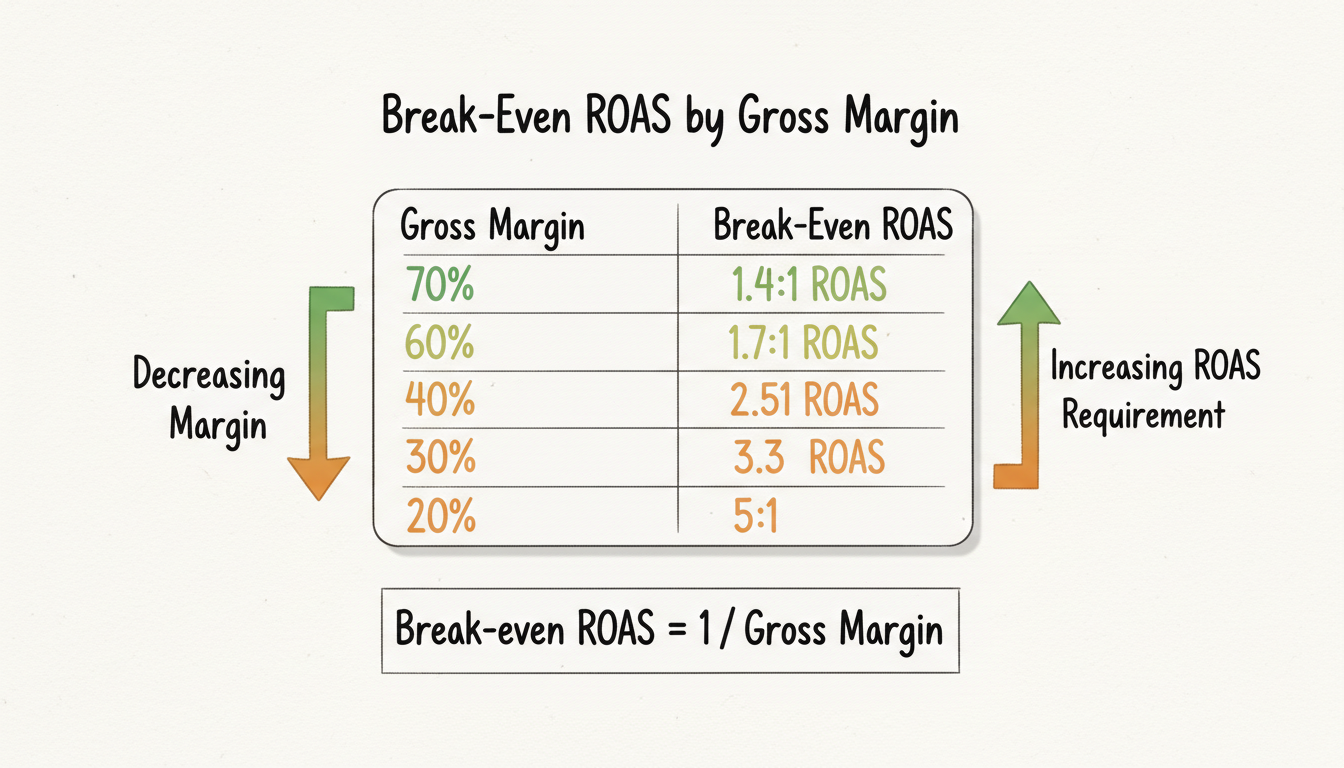
To determine your minimum profitable ROAS, use this formula:
Break-even ROAS = 1 / Gross Margin
Gross Margin | Break-even ROAS | Target ROAS (profitable) |
70% | 1.4:1 | 2:1+ |
60% | 1.7:1 | 2.5:1+ |
50% | 2:1 | 3:1+ |
40% | 2.5:1 | 3.5:1+ |
30% | 3.3:1 | 4.5:1+ |
20% | 5:1 | 7:1+ |
Example calculations from industry experts:
DTC Beauty Brand:
- Monthly ad spend: $50,000
- ROAS: 4.5:1
- Revenue generated: $225,000
- Profit (40% margins): $90,000
- Net profit after ad spend: $40,000
E-commerce Fashion:
- Monthly ad spend: $100,000
- ROAS: 3.2:1
- Revenue generated: $320,000
- Profit (35% margins): $112,000
- Net profit after ad spend: $12,000
The fashion brand has lower ROAS but still generates meaningful profit because of higher volume, particularly when following TikTok ads for ecommerce 2026 best practices.
Account for Customer Lifetime Value
For subscription businesses or products with high repeat purchase rates, ROAS calculations should factor in LTV:
- Single purchase products: Use immediate ROAS
- Repeat purchase products: Can accept lower initial ROAS
- Subscription models: Can accept acquisition ROAS below break-even
A supplement brand might profitably acquire customers at 1.5:1 ROAS if average LTV is 4x the first purchase.
Improving Your ROAS
If your ROAS falls below targets, focus on these optimization areas:
1. Creative Optimization
Creative is the biggest ROAS lever on TikTok. According to ecommerce experts, the best ads don't just sell—they tell stories. Understanding TikTok ad creative best practices 2026 is essential for maximizing your return.
High-ROAS creative patterns:
- Start with a problem your customer faces
- Show the product as the solution
- End with transformation or emotional payoff
- Use authentic, relatable characters
Creative refresh cadence: TikTok creative fatigues faster than other platforms. Plan for new variations every 1-2 weeks when scaling.
2. Audience Targeting
Targeting Strategy | Typical ROAS Impact |
Broad (let algorithm learn) | Baseline |
Interest-based | +10-20% initial ROAS |
Lookalike audiences | +20-40% for established brands |
Retargeting | +50-100% (highest ROAS) |
According to retargeting specialists, retargeting campaigns often deliver the highest ROAS because you're reaching people already familiar with your product. Leveraging TikTok ads targeting options guide strategies can help you identify the right audience segments.
3. Landing Page Optimization
Your TikTok ad can be perfect, but a slow or confusing landing page kills conversions:
- Mobile-first design: 100% of TikTok traffic is mobile
- Load time under 3 seconds: Each second of delay drops conversion 7%
- Message match: Landing page should reflect ad content
- Simple checkout: Minimize steps to purchase
4. Bid Strategy Adjustment
Bid Strategy | Best For | ROAS Impact |
Lowest Cost | Learning phase | Variable |
Cost Cap | Mature campaigns | More consistent |
ROAS Target | Established products | Direct control |
Start with Lowest Cost to gather data, then move to Cost Cap or ROAS Target bidding once you have conversion history.
5. Spark Ads Utilization
Spark Ads (boosted organic content) typically outperform traditional ads because they maintain authenticity. TikTok Shop case studies show creator-led shop content can deliver 96% higher ROAS.
ROAS Tracking Best Practices
Accurate ROAS measurement requires proper setup and realistic expectations.
Attribution Windows
TikTok offers multiple attribution windows:
Window | When to Use |
1-day click | Conservative, immediate-conversion products |
7-day click | Standard for most ecommerce |
28-day click | High-consideration products |
View-through | Awareness campaigns |
Longer windows capture more conversions but may over-attribute to TikTok.
Cross-Platform Considerations
TikTok often influences purchases that happen elsewhere. A user might discover your product on TikTok but convert via Google search. Consider:
- Multi-touch attribution models: Give partial credit across touchpoints
- Post-purchase surveys: Ask "How did you hear about us?"
- Incrementality testing: Measure lift from TikTok vs control groups
What Metrics Matter Beyond ROAS
According to analytics experts, focus on these supporting metrics:
Metric | Why It Matters |
Conversion rate | Indicates offer/audience fit |
Average order value | Impacts revenue per conversion |
Click-through rate | Shows creative effectiveness |
Cost per acquisition | Absolute cost control |
New customer rate | Growth vs. retargeting balance |
Frequently Asked Questions
What Is a Good ROAS for TikTok Ads?
A "good" TikTok ROAS depends on your profit margins. Industry benchmarks show beauty/cosmetics averaging 4:1-7:1, fashion 4:1-6:1, and general ecommerce 3:1-5:1. However, a business with 60% margins can be profitable at 2:1 ROAS, while a business with 30% margins needs 4:1+ to make money. Calculate your break-even ROAS using: 1 / gross margin.
Why Is My TikTok ROAS Lower Than Expected?
Common causes of low ROAS include: creative that doesn't resonate with TikTok's authentic style, targeting that's too narrow for TikTok's algorithm to optimize, landing pages that don't convert mobile traffic, and attribution windows that don't capture delayed conversions. Start with creative testing, as it's typically the biggest lever on TikTok.
How Long Does It Take to See Positive ROAS on TikTok?
Most campaigns require 3-7 days of learning phase before ROAS stabilizes. During this time, TikTok's algorithm tests your ads with different audience segments. Avoid making major changes during learning, as this resets the process. Budget at least $2,000-$5,000 for meaningful testing before evaluating ROAS performance.