
Google's AI Overviews now appear in approximately 47% of search results, fundamentally changing how brands measure search visibility. Traditional ranking metrics no longer capture the full picture-you need specialized tools and metrics to understand your presence in AI-generated responses.
This guide covers the essential tools and metrics for tracking AI Overview performance in 2026.
Why Traditional SEO Metrics Fall Short
Conventional search metrics weren't designed for AI-generated results. Position tracking tools that report "rank #3" miss whether your brand appears in the AI Overview above all organic results.
According to NoGood's future of search analysis, 60% of searches now end without a click-between AI Overviews dominating Google's SERPs, featured snippets answering questions immediately, and LLM responses providing comprehensive answers.
The measurement gap:
Traditional Metric | AI Overview Limitation |
Organic rank position | Doesn't capture AI Overview citations |
Click-through rate | AI Overviews reduce clicks overall |
Impressions | Doesn't distinguish AI vs organic |
Keyword rankings | AI synthesizes across queries |
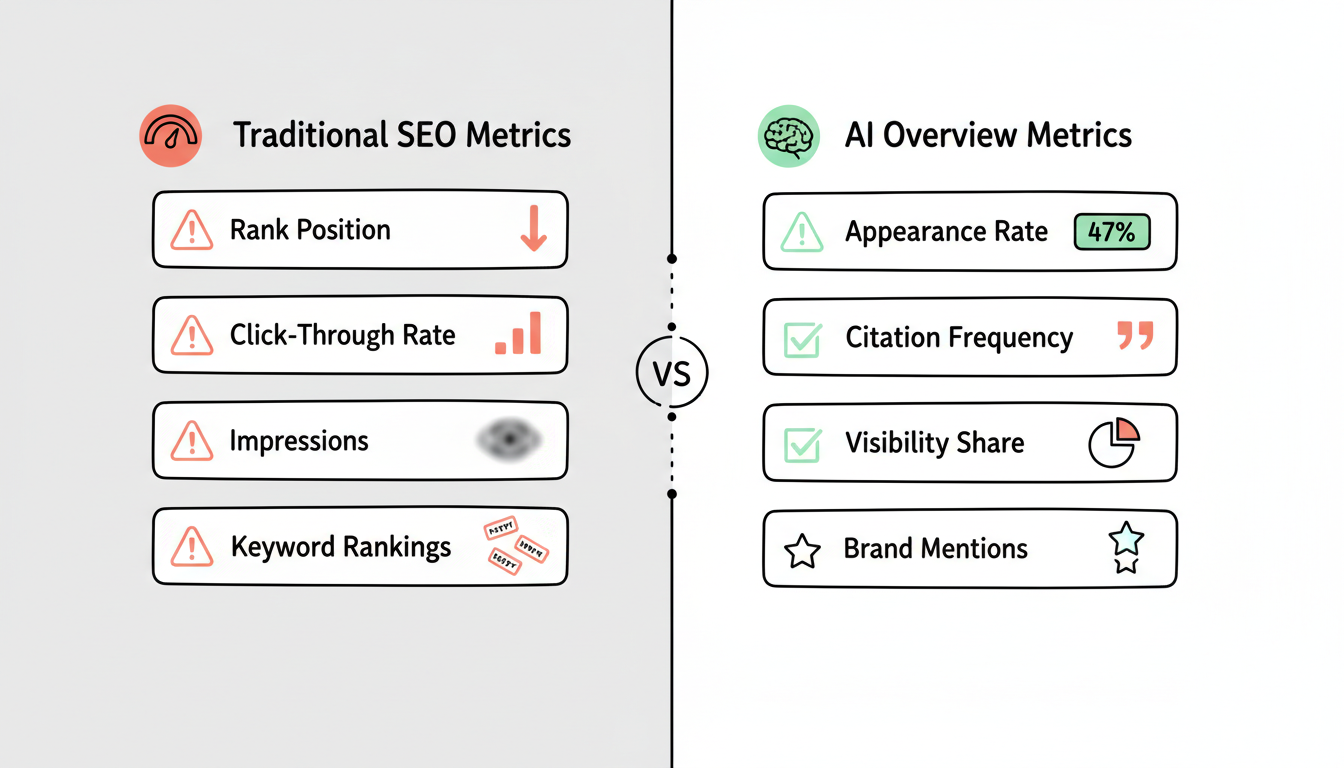
This gap requires new tracking approaches built specifically for generative search.
Key Metrics for AI Overview Tracking
Focus on these metrics to measure AI Overview performance effectively.
AI Overview Appearance Rate
How often do AI Overviews appear for your target keywords? This baseline metric tells you where AI visibility optimization matters most.
According to Semrush's AI Overviews study, AI Overviews appear most frequently for informational and educational queries. Track appearance rates across your keyword portfolio to prioritize optimization efforts.
Tracking approach:
- Monitor 50-100 representative queries per product line
- Segment by query intent (informational, navigational, transactional)
- Track trends over time-appearance rates are expanding
Citation Frequency
When AI Overviews appear, how often does your content get cited? Citation frequency directly measures your visibility within AI-generated responses.
Citation metrics to track:
- Total citations per time period
- Citation rate (citations AI Overview appearances)
- Citation position (primary source vs. supporting reference)
- Citations by content type (which pages get cited most)
Brand Visibility Share
What percentage of relevant AI Overviews mention your brand versus competitors? This share-of-voice metric reveals competitive positioning in AI search.
According to Adventure Digital's AI SEO research, the volatility in AI search citations is significant-40-60% of cited domains change month to month. Regular tracking captures these shifts.
Click Attribution from AI Overviews
While AI Overviews reduce overall clicks, citations still generate traffic. Track which AI Overview citations drive clicks to your site.
Attribution challenges:
- Google Analytics doesn't distinguish AI Overview referrals
- UTM parameters don't work for AI-generated citations
- Correlational analysis required (ranking changes vs. traffic changes)
AI Overview Tracking Tools (2026)
Several tools now offer AI Overview tracking capabilities.
Enterprise-Level Tools
Semrush Enterprise AIO Semrush's AI visibility tracking provides comprehensive AI Overview monitoring. According to their documentation, the platform tracks citation frequency, appearance rates, and competitive share of voice across AI-generated results, similar to how schema markup validators help verify structured data for optimal AI search performance.
Key features:
- AI Overview appearance tracking
- Citation monitoring and alerts
- Competitive visibility comparison
- Historical trend analysis
seoClarity seoClarity offers enterprise AI visibility tracking with custom dashboards and API access for integration with existing analytics stacks.
BrightEdge BrightEdge includes AI search tracking in its enterprise platform, focusing on citation attribution and visibility trends.
Mid-Market Tools
SE Ranking According to SE Ranking's AI Overviews tracker documentation, their tool tracks which domains and URLs appear in AI Overviews, monitors historical trends, and integrates with existing keyword rank tracking.
Profound Profound specializes in AI search visibility, tracking both Google AI Overviews and LLM citations across platforms like ChatGPT and Perplexity. This comprehensive approach is essential for understanding llm-optimization-best-practices across different AI platforms.
Surfer SEO AI Tracker Surfer SEO has added AI visibility features to complement its content optimization tools, tracking AI Overview appearances for target keywords.
Specialized AI Tracking Tools
Otterly.AI Otterly.AI focuses specifically on AI search visibility tracking. According to GrowthSEO's AI visibility guide, Otterly provides monitoring for ChatGPT mentions and Google AI Overviews starting at $29/month for 100 tracked prompts.
Key capabilities:
- Cross-platform AI visibility (Google, ChatGPT, Perplexity)
- Citation tracking and alerts
- Competitive monitoring
- Prompt-based tracking
Peec.ai Peec.ai offers AI search visibility monitoring with focus on enterprise brands tracking large keyword portfolios.
Rankscale.ai Rankscale provides AI visibility tracking alongside traditional rank monitoring, useful for teams transitioning from pure SEO metrics.
Free and Manual Methods
Google Search Console GSC doesn't directly report AI Overview data, but you can infer impact through:
- Click-through rate changes for queries where AI Overviews appear
- Impression trends for informational queries
- Traffic pattern analysis
Manual Spot Checking For limited budgets, manual tracking provides baseline visibility data:
- Search priority keywords in incognito mode
- Document AI Overview appearance and citations
- Track changes weekly or bi-weekly
- Use spreadsheets to log observations
Building Your Tracking Framework
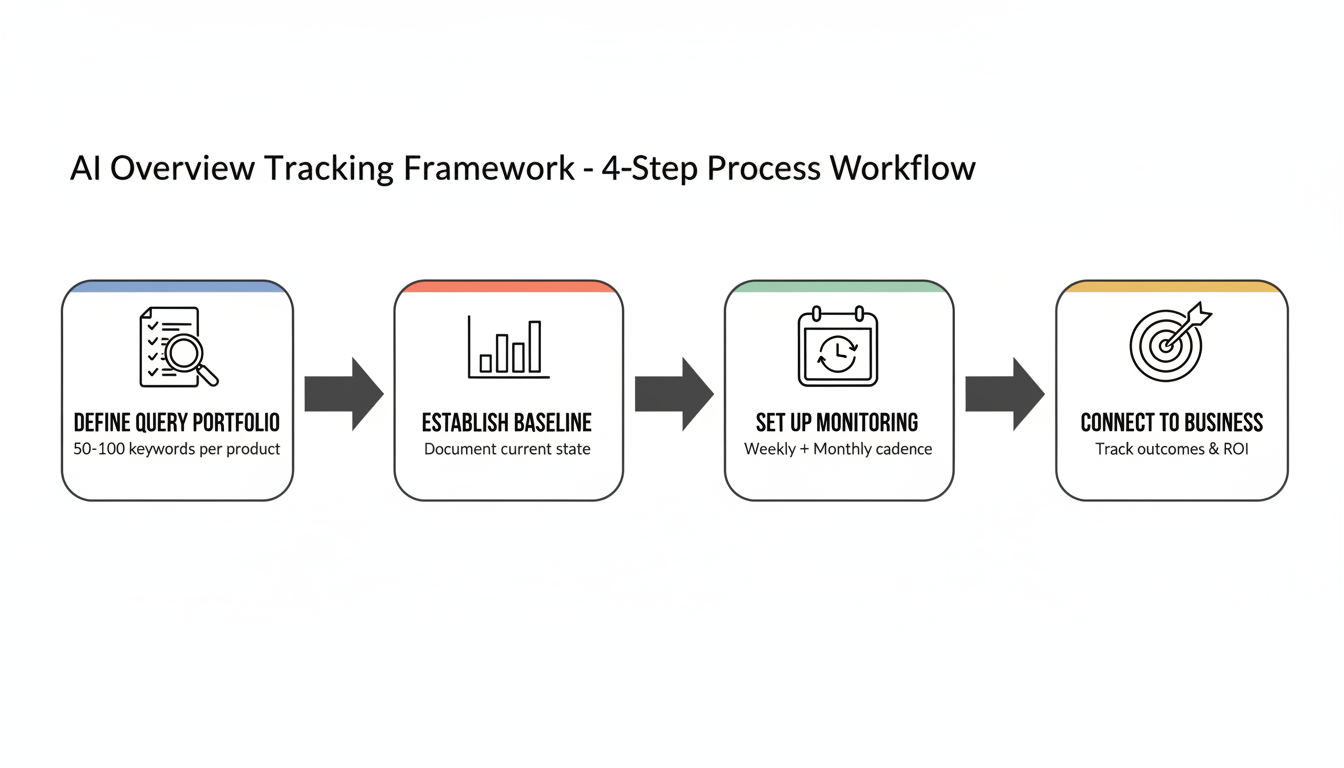
Step 1: Define Query Portfolio
Start with queries that matter most to your business.
Selection criteria:
- High business value keywords
- Mix of intent types (informational, commercial, transactional)
- Queries where AI Overviews appear consistently
- Competitive keywords where citation matters
According to industry best practices, tracking 50-100 prompts per product line provides a representative sample without overwhelming resources.
Step 2: Establish Baseline Metrics
Before optimization, document current state:
- Current AI Overview appearance rates for target queries
- Existing citation frequency (if any)
- Competitor citation rates for comparison
- Traffic patterns for related keywords
Step 3: Set Up Regular Monitoring
Consistency matters more than frequency for AI visibility tracking. Understanding google-ai-overview-ranking-factors helps you identify which metrics matter most for your content strategy.
Recommended cadence:
- Weekly: Priority keywords spot check
- Monthly: Full portfolio analysis
- Quarterly: Competitive visibility report
- Ongoing: Automated alerts for significant changes
Step 4: Connect to Business Outcomes
AI Overview visibility should connect to business metrics:
- Brand search volume trends
- Direct traffic changes
- Lead quality from organic channels
- Revenue attribution (where possible)
Challenges in AI Overview Measurement
Volatility
AI-generated results change more frequently than traditional organic rankings. According to research on AI search dynamics, 40-60% of cited domains in AI Overviews change month to month. Don't overreact to short-term fluctuations.
Attribution Complexity
Connecting AI Overview citations to conversions remains difficult. Multi-touch attribution helps, but direct measurement isn't available in most analytics platforms. Organizations implementing aeo-for-saas-companies strategies need specialized tracking to demonstrate ROI.
Tool Maturity
AI visibility tracking tools are evolving rapidly. Features that don't exist today may launch next month. Evaluate tools quarterly and stay current with platform updates.
Key Takeaways
Tracking AI Overview performance requires new approaches beyond traditional SEO metrics:
- Traditional metrics miss AI visibility - Rank tracking alone doesn't capture AI Overview citations-you need specialized measurement
- Focus on citation metrics - Appearance rate, citation frequency, and visibility share matter most for AI search performance
- Tools exist at every level - From enterprise platforms (Semrush, seoClarity) to specialized trackers (Otterly.AI) to manual methods
- Expect volatility - AI citation rates fluctuate more than organic rankings-track trends, not individual data points
- Connect to business outcomes - AI visibility metrics should ultimately tie to brand awareness, traffic, and conversions
The measurement landscape for AI search is maturing rapidly. Establishing tracking foundations now positions you to adapt as tools and best practices evolve.
Setting Up a Citation Tracking Dashboard
You do not need enterprise software to start. Stand up a lightweight dashboard in a spreadsheet with four columns: prompt category, target query, cited or not, and which AI surface returned it. Run 20 to 30 representative prompts weekly across ChatGPT, Gemini, and Perplexity, and log results. Within a month you will see which topics your brand owns and which competitors dominate.
Layer in a sentiment and position column - was the mention positive, and did it appear in the top three answers or the long tail? Prioritize defending queries where you already rank and attacking the two or three highest-volume gaps. For teams with budget, connect an automated tracker's API to the same sheet so manual checks become spot audits rather than the primary method. The goal is a single source of truth your whole marketing team can read in five minutes.