
Search has split. In 2020, over 92% of searches happened on Google, and optimizing for one algorithm meant winning visibility. In 2026, users distribute searches across traditional engines, AI platforms like ChatGPT and Perplexity, AI-enhanced search like Google AI Overviews, and social discovery platforms.
Traditional SEO alone no longer captures the full picture. But abandoning SEO fundamentals guarantees failure in AI search too. Understanding how these approaches differ-and connect-shapes effective 2026 strategy.
How Search Changed
The traditional model worked like this: users had problems, searched for answers, evaluated options, and made decisions. Search engines acted as directories where users browsed options.
That model no longer holds universally. AI platforms don't show options-they deliver answers. Users receive synthesized responses without clicking through to websites. Being listed isn't enough; being selected as the answer determines visibility.
Search Era | User Behavior | Winning Strategy |
2015-2020 | Browse options, compare, click | Rank higher than competitors |
2021-2024 | Mix of browsing and direct answers | Rank + win featured snippets |
2025-2026 | Ask and receive answers | Rank + get cited in AI responses |
The opportunity isn't choosing between traditional SEO and AI optimization. It's understanding how they work together.
Traditional SEO: The Foundation
Traditional SEO optimizes for rankings in search engine results pages. You target keywords, build authority through backlinks, and earn clicks from users who browse search results.
What traditional SEO targets:
- Blue-link rankings on Google, Bing, and other search engines
- Click-through rates from search result pages
- Organic traffic from keyword searches
- Visibility in traditional search features
Success metrics:
- Ranking positions for target keywords
- Organic traffic volume
- Click-through rates
- Conversions from organic search
Traditional SEO remains essential. Search engines still drive most web traffic-roughly 96% of total traffic volume comes from traditional search in 2026. This number will decline, but traditional search isn't disappearing.
More importantly, traditional SEO provides the foundation that AI optimization builds upon.
AI Search Optimization: The New Layer
AI search optimization-including aeo-seo-geo-focuses on visibility within AI-generated responses. Instead of ranking pages, you optimize to become a cited source when AI systems answer questions.
What AI optimization targets:
- Citations in ChatGPT, Perplexity, Claude, and other AI platforms
- Inclusion in Google AI Overviews
- Being referenced in conversational AI responses
- Visibility when users ask rather than search
Success metrics:
- Citation frequency in AI responses
- Share of voice in AI-generated answers
- Brand mentions across AI platforms
- Influence on AI-generated recommendations
AI optimization doesn't replace traditional SEO-it extends reach into new channels where increasing numbers of users discover information.
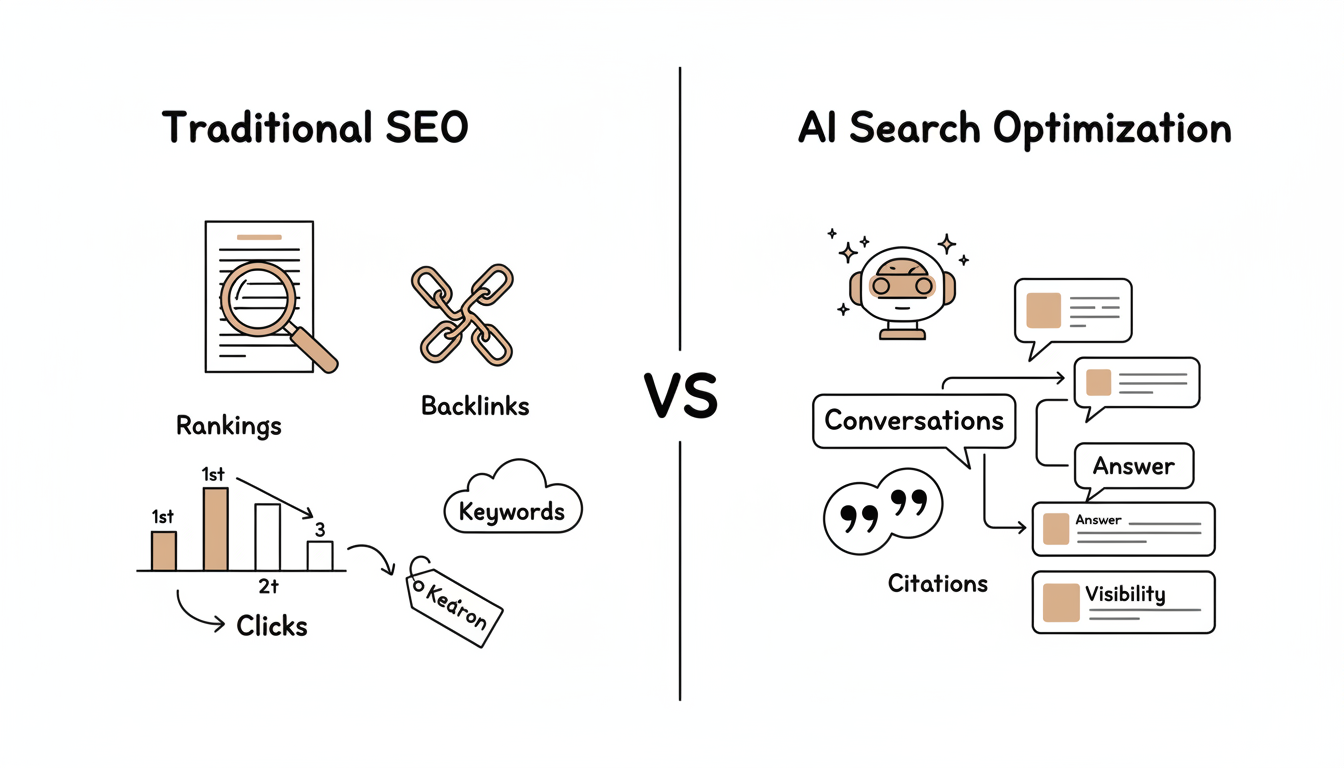
Key Differences Between Approaches
Content Structure
Traditional SEO: Rewards comprehensive, in-depth content that covers topics thoroughly. Long-form content with proper headings, internal linking, and keyword optimization performs well.
AI Optimization: Rewards clear, extractable answers positioned early in content. Q&A structure, concise paragraphs, and answer-first formatting improve citation probability. AI systems look for concepts, not just keywords. Understanding paragraph featured snippets in ai search can help optimize content for both traditional and AI-driven results.
Success Measurement
Traditional SEO: Rankings, traffic, clicks, and conversions provide clear metrics. Tools like Google Search Console and rank trackers deliver reliable data.
AI Optimization: Measurement is more challenging. Citation tracking requires specialized AEO tools, and AI responses can vary based on user context, conversation history, and model versions.
Competitive Dynamics
Traditional SEO: Competition for finite ranking positions. Only one site ranks #1, and the top 10 dominate clicks.
AI Optimization: Multiple sources can be cited in a single AI response. Competition is for answer inclusion rather than exclusive positions.
Time to Results
Traditional SEO: Results typically take months as search engines evaluate authority signals and content quality over time.
AI Optimization: Can move faster. Answer engines pick up new content more quickly than traditional search, though building sustained citation authority still requires time.
Why You Need Both
Neither approach works alone in 2026. They serve complementary functions.
Traditional SEO Enables AI Visibility
AI systems rely on search engine infrastructure to discover and evaluate content. Without strong SEO fundamentals-crawlability, indexing, authority signals-answer engines won't find or trust your content.
Content that ranks well in traditional search typically performs better in AI citations. The foundation matters.
AI Optimization Extends Reach
Traditional SEO captures users who browse and compare. AI optimization captures users who want quick answers without clicking. Ignoring AI optimization means invisibility to an expanding user segment.
As AI search grows, the gap widens between brands optimizing for both and those stuck in traditional-only approaches.
Shared Foundations
Good news: the approaches share common foundations. Both need authoritative content, structured data, and expertise signals. Improvements in one area often boost performance in the other.
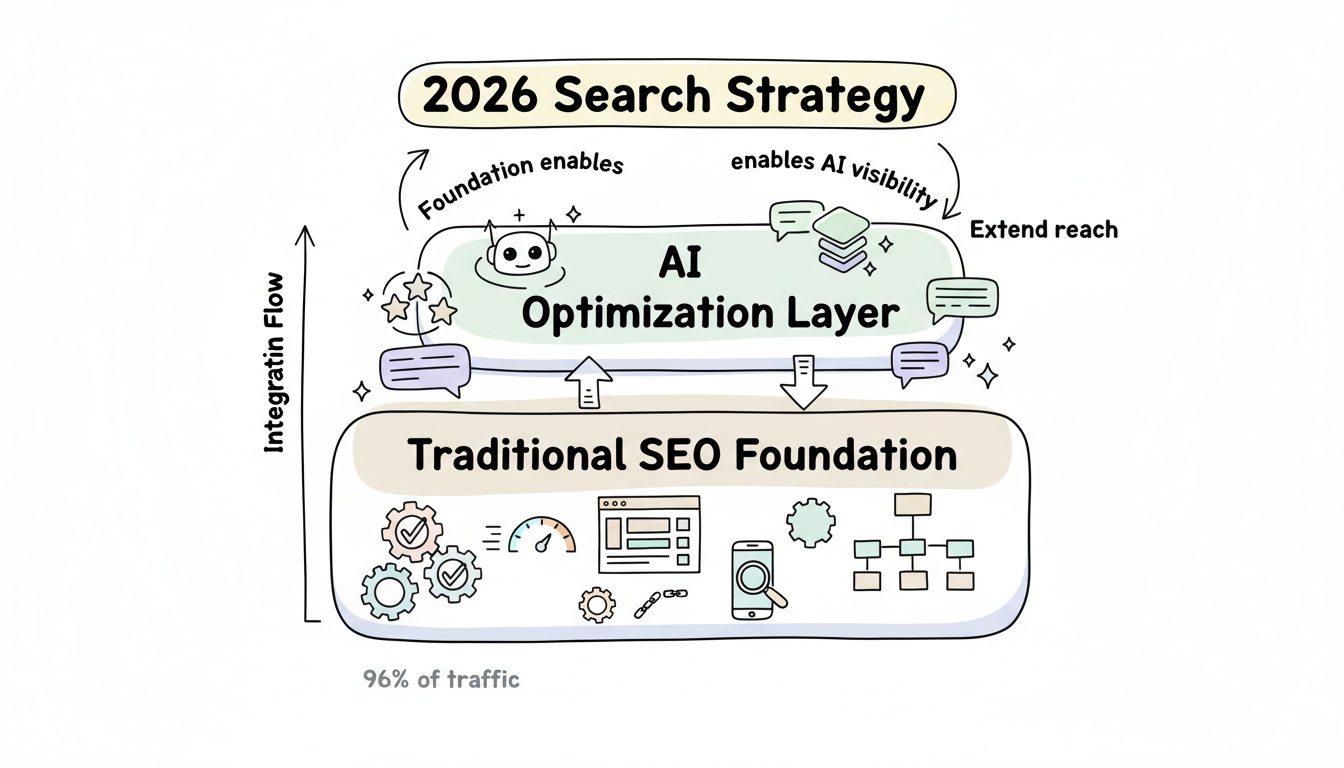
This overlap creates efficiency. You're not building two separate strategies-you're layering AI optimization onto traditional SEO fundamentals.
Practical Integration Strategy
Foundation First
If your technical SEO is broken-slow site, poor mobile experience, weak link profile-fix fundamentals first. AI systems won't cite poorly optimized content.
Foundation checklist:
- Site loads under 3 seconds
- Mobile-friendly design
- Clean site architecture
- Proper indexing and crawlability
- Quality backlink profile
Layer AI Optimization
Once fundamentals are solid, incorporate AI optimization:
Content structure: Add answer-first formatting, Q&A sections, and clear headings that match how users ask questions. For WordPress sites, implementing wordpress aeo optimization techniques can streamline this process.
Structured data: Implement schema markup that helps AI systems understand content meaning and relationships.
Freshness: Update content within the 13-week window that AI systems favor. Stale content loses citation probability.
Authority signals: Build third-party mentions, expert citations, and consistent information across web properties.
Optimize New Content for Both
For new content, optimize for both traditional search and AI citations simultaneously:
- Target relevant keywords (traditional SEO)
- Structure content with extractable answers (AI optimization)
- Include authoritative data and sources (both)
- Implement proper schema markup (both)
- Write in clear, conversational language (AI optimization)
- Build internal and external links (traditional SEO)
Common Mistakes to Avoid
Ignoring AI search entirely: Competitors are already optimizing. By the time AI search feels mainstream, you'll be playing catch-up against brands with years of citation authority.
Abandoning traditional SEO: It's still the foundation. Every marketer succeeding in AI search built strong traditional SEO first.
Using outdated metrics: Rankings and clicks tell an incomplete story in 2026. Update dashboards to include AI visibility metrics.
Treating them as separate strategies: The most effective approach integrates both, leveraging shared foundations while adding platform-specific tactics. Implementing effective chatgpt search optimization aeo requires understanding how traditional SEO principles apply to conversational AI platforms.
FAQs
Is Traditional SEO Still Worth Investing In?
Yes. Traditional search still drives approximately 96% of web traffic. That percentage will decline, but traditional SEO remains the foundation that AI optimization builds upon. Skipping SEO fundamentals undermines AI visibility.
Which Should I Prioritize: SEO or AI Optimization?
Start with SEO if fundamentals are weak. Add AI optimization once your foundation is solid. Most businesses benefit from optimizing both simultaneously since many best practices overlap.
How Do I Measure AI Search Visibility?
Specialized AEO tools like SE Visible, Otterly AI, and Semrush AI Toolkit track citations across AI platforms. Manual testing-querying AI platforms with relevant prompts-supplements automated monitoring.
A Unified Optimization Checklist
Rather than treating SEO and AI optimization as separate projects, run one combined checklist per page. Start with a clear, question-style H2 that matches how users actually phrase queries, then answer it in the first 40 to 60 words with a direct, extractable statement. Add structured data so both search engines and AI systems can parse entities, prices, and authorship.
Next, earn citations by publishing original data, statistics, or research that other pages reference - AI engines favor sources that are themselves cited. Maintain fast page speed, mobile usability, and clean internal linking so crawlers can build your entity graph. Finally, monitor both traditional rankings and AI citations monthly, and invest extra effort in pages that appear in both surfaces, since they compound visibility across the funnel.