
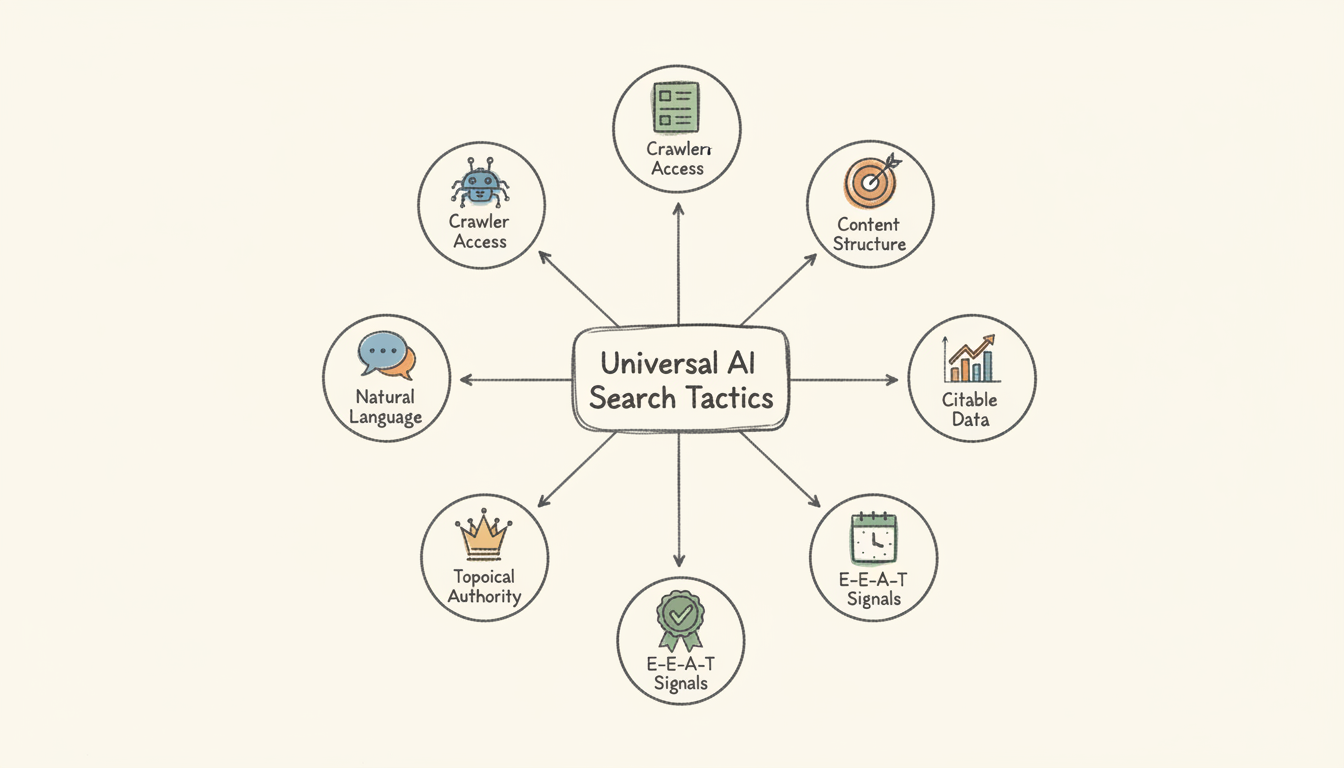
While each AI search platform has unique characteristics, certain optimization tactics work universally across ChatGPT, Google AI Overviews, Perplexity, Microsoft Copilot, and Claude. These fundamental techniques improve your content's likelihood of being cited regardless of which AI system processes it. Master these universal tactics before investing in platform-specific optimizations.
Why Universal Tactics Matter
AI search platforms share core mechanisms despite their differences.
What all AI search platforms have in common:
Shared Element | Why It Matters |
Web crawlers | All need to access and index your content |
Language model processing | All interpret content for relevance |
Citation requirements | All need to attribute claims to sources |
Quality signals | All evaluate authority and trustworthiness |
User intent matching | All try to answer the actual question |
These shared foundations mean one set of tactics provides benefits across every platform simultaneously.
Tactic 1: Guarantee Crawler Access
If AI systems can't crawl your content, nothing else matters.
Universal crawler access checklist:
Crawler Access Requirements:
 robots.txt allows AI crawlers
    GPTBot (ChatGPT)
    Googlebot (Google AI)
    Bingbot (Copilot)
    PerplexityBot
    ClaudeBot (Anthropic)

 No crawler-blocking barriers
    No login walls on target content
    No aggressive rate limiting
    No JavaScript-only content loading

 Fast response times
     <3 second server response
Quick audit:
- Check robots.txt for AI crawler directives
- Test pages in browser with JavaScript disabled
- Verify pages load without authentication
- Monitor server response times
Tactic 2: Structure Content for Extraction
AI systems extract information more reliably from well-structured content.
Universal structure patterns:
Structure Element | Implementation | Platform Benefit |
Clear headings (H2/H3) | One topic per section | All platforms parse structure |
Definition format | "X is Y that Z" | Directly extractable answers |
Numbered lists | Steps, rankings, comparisons | Clean data extraction |
Tables | Structured data presentation | Comparison queries |
FAQ format | Q: / A: explicit structure | Direct question matching |
Example definition format:
Weak: "SEO involves many factors including keywords, links, and technical elements."

Strong: "Search engine optimization (SEO) is the practice of improving website visibility
in search results through technical improvements, content optimization, and authority building."
The strong version provides a complete, extractable definition AI systems can quote directly. This structured approach also supports your broader AEO strategy framework, ensuring content performs well across traditional and AI-powered search channels.
Tactic 3: Provide Direct Answers Early
All AI systems prefer content that answers questions immediately.
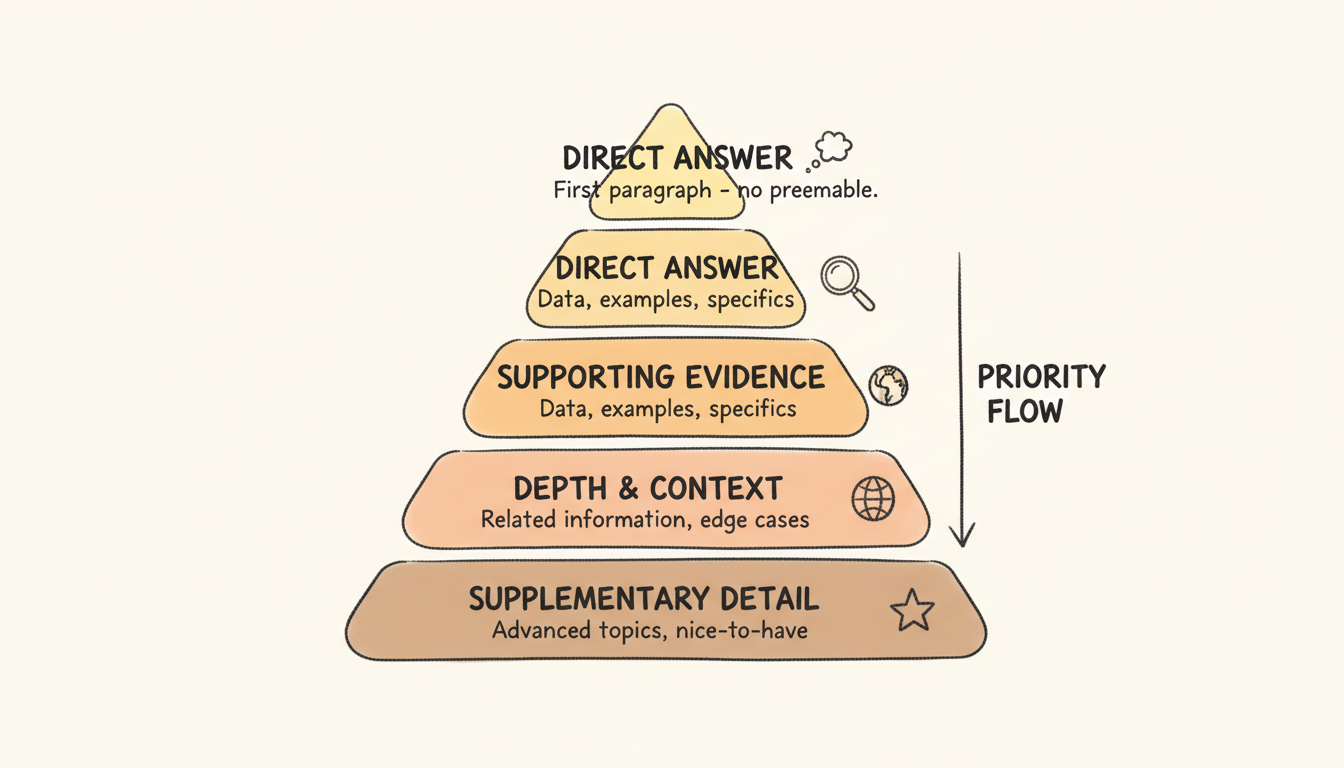
The inverted pyramid for AI:
Content Structure for AI Extraction:
 First paragraph: Direct answer to the query
    No preamble, background, or buildup

 Second section: Supporting evidence
    Data, examples, specifics

 Middle sections: Depth and context
    Related information, edge cases

 Final sections: Supplementary detail
     Nice-to-have, advanced topics
Practical application:
Query Type | First Sentence Should: |
"What is X?" | Define X immediately |
"How to X?" | State the first step |
"Best X for Y?" | Name the recommendation |
"X vs Y?" | State the key difference |
"Cost of X?" | Provide the number/range |
Users-and AI systems-want answers, not introductions about why the topic matters.
Tactic 4: Include Citable Data Points
AI systems cite content that contains specific, attributable information.
What triggers citations:
Content Type | Citation Likelihood | Example |
Specific statistics | High | "73% of marketers report..." |
Named entities | Medium-high | "According to Forrester..." |
Unique research | High | "Our analysis of 500 campaigns..." |
Expert quotes | Medium-high | "As Jane Smith, CMO, notes..." |
Process steps | Medium | "Step 1: Configure settings..." |
Generic claims | Low | "Many businesses struggle with..." |
Making content citable:
Weak (uncitable): "Social media marketing is important for businesses."

Strong (citable): "Social media marketing drives 23% of e-commerce traffic
globally, with Instagram generating the highest conversion rate at 1.85%
compared to Facebook's 1.21% (2026 benchmark data)."
The strong version contains specific data that AI systems can attribute to your source.
Tactic 5: Demonstrate E-E-A-T Signals
Experience, Expertise, Authoritativeness, and Trustworthiness signals influence all AI platforms.
Universal E-E-A-T implementation:
Signal | Implementation |
Experience | Case studies, "we tested," methodology details |
Expertise | Author credentials, industry-specific terminology, depth |
Authoritativeness | Citations from other sources, backlinks, brand mentions |
Trustworthiness | Clear attribution, balanced perspectives, transparency |
On-page E-E-A-T elements:
E-E-A-T Content Elements:
 Author byline with credentials
    "By [Name], [Role], [Company]"

 Publication/update dates
    Current date demonstrates freshness

 Methodology transparency
    "This analysis reviewed 200 campaigns..."

 Source citations
    Link to original data sources

 About/credentials page
     Linked from author byline
AI systems prefer current information, especially for rapidly evolving topics. When implementing search engine optimization using AI, freshness becomes even more critical as AI models prioritize recent, accurate information.
Freshness signals that matter:
Signal | Implementation |
Visible date | Publication and "last updated" dates |
Current year references | "In 2026, the landscape..." |
Recent data | Statistics from within past 12 months |
Updated examples | Current tools, platforms, practices |
Timely context | References to recent developments |
Freshness maintenance schedule:
Content Update Cadence:
 High-change topics (AI, tech)
    Quarterly reviews, update as needed

 Medium-change topics (marketing tactics)
    Bi-annual reviews

 Low-change topics (fundamentals)
    Annual reviews

 Always update
     Broken links
     Outdated statistics
     Changed product names/features
AI systems recognize when domains demonstrate comprehensive expertise.
Building topical coverage:
Approach | Benefit |
Pillar content | Establishes main topic authority |
Cluster articles | Demonstrates depth across subtopics |
Internal linking | Shows content relationships |
Consistent terminology | Reinforces topical association |
Content cluster structure:
Topic Authority Structure:
 Pillar: "Complete Guide to X"
    Comprehensive overview (3000+ words)

 Cluster 1: "X for [Use Case A]"
    Specific application

 Cluster 2: "X vs [Alternative]"
    Comparison content

 Cluster 3: "How to Implement X"
    Practical guide

 Supporting: "X [Specific Detail]"
     Targeted depth pieces
This structure signals to AI systems that your domain has comprehensive expertise on the topic. For SaaS companies specifically, implementing AEO for SaaS companies within this cluster framework maximizes visibility across AI platforms.
Tactic 8: Optimize for Natural Language Queries
AI search users phrase queries conversationally. Understanding the differences between platforms-such as ChatGPT vs Perplexity comparison-helps you optimize for the natural language patterns each platform favors.
Query pattern optimization:
Traditional SEO | AI Search Optimization |
"best CRM software" | "What's the best CRM for small businesses?" |
"CRM pricing" | "How much does CRM software cost?" |
"CRM features" | "What features should I look for in a CRM?" |
Implementation:
- Use complete questions as H2 headings
- Answer questions in natural, conversational language
- Include common question variations
- Structure FAQ sections with actual user phrasing
Key Takeaways
Universal tactics that work across all AI search platforms:
- Crawler access is foundational - Allow GPTBot, Bingbot, PerplexityBot, and ClaudeBot in robots.txt
- Structure enables extraction - Clear headings, lists, tables, and definition formats
- Direct answers win - Lead with the answer, support with detail
- Citable data triggers attribution - Specific statistics, named sources, unique research
- E-E-A-T applies universally - Experience, expertise, authority, and trust signals matter everywhere
- Freshness signals matter - Current dates, recent data, updated examples
- Topical authority compounds - Comprehensive coverage builds domain recognition
- Natural language matches AI queries - Conversational phrasing aligns with how users ask AI
These universal tactics provide the foundation for AI search visibility. Once implemented, platform-specific optimizations can build on this baseline for incremental gains.
Tactic 6 in Practice: Building Topical Authority at Scale
Topical authority is the tactic most teams underinvest in, yet it is what separates content that gets cited occasionally from content that becomes the default source an AI returns. Start by mapping the full question space around your core topic: every "what is," "how to," "vs," and "best" query a buyer might ask. Then publish that cluster with consistent terminology and tight internal linking so the model sees one coherent body of expertise rather than disconnected pages. Refresh the cluster on the cadence described earlier, and prune or merge pages that overlap, because thin, duplicated pages dilute the authority signal instead of building it.
Practical implementation looks like a quarterly audit: identify the subtopics where you have no or weak coverage, fill them with genuinely useful content, and link each new piece to the pillar and to its sibling cluster articles. Over several quarters this compounds, and AI systems begin treating your domain as the authoritative answer for the category rather than one of many candidates.
Tactic 7 and Beyond: Avoiding the Common Failure Modes
The single most common failure is treating these tactics as a one-time checklist. Crawler access drifts when a site migration adds a robots rule, freshness decays the moment you stop updating, and natural-language optimization goes stale as query phrasing evolves. Assign ownership for each tactic-the technical team for crawlers and speed, content for structure and data, and editorial for freshness and E-E-A-T-so none silently degrades. The second failure is over-optimizing for the citation and forgetting the human reader; content that reads like a machine extraction gets cited less over time, not more, because real users bounce and the engagement signals weaken.
Used together, these eight tactics form a durable foundation. They are not a replacement for platform-specific work-once the baseline is solid, layering ChatGPT-, Google-, or Perplexity-specific tuning on top produces incremental gains without rebuilding from scratch. The compounding advantage goes to the teams that maintain the baseline consistently rather than the ones that optimize hard for a quarter and then stop.