
Answer Engine Optimization (AEO) is the practice of structuring and publishing content so AI-powered answer engines -- ChatGPT, Perplexity, Google AI Overviews, Copilot, and voice assistants -- cite and recommend it when users ask questions. Where SEO optimizes for a ranked list of links, AEO optimizes for inclusion inside a synthesized answer that names your brand.
Key Takeaways
- AEO earns your content a place inside AI-generated answers, not just a position on a search results page.
- The core shift is from keyword-targeted pages to question-led, directly-answerable, extractable content.
- 60% or more of searches now end without a click, so visibility must be measured in citations, not just rank.
- AEO extends SEO, content, paid, social, and PR -- it does not replace any of them.
- Freshness matters: content updated within the last 13 weeks is roughly 50% more likely to be cited.
- Start by auditing your current AI visibility, then fix structure and schema before scaling output.
What Is Answer Engine Optimization?
Answer Engine Optimization is the discipline of making your content a trusted source that AI systems pull from when they generate answers to user questions. It combines content structure, technical markup, and authority signals so that when an answer engine synthesizes a response, your brand is among the sources it credits. AEO is the natural evolution of search visibility as user behavior moves from clicking ten blue links to asking a single question and reading one synthesized answer.
To understand why structure matters so much, consider how an answer engine actually works. When a user asks a question, the system retrieves a set of candidate sources, reads them, and generates a response that may quote or summarize only a sentence or two from each. Your job in AEO is to make the citable sentence obvious, accurate, and self-contained, so the model does not have to infer your position from a longer argument. The pages that win are the ones where the answer is already written the way a human would quote it.
The platforms AEO targets are the systems that now mediate discovery for millions of users:
- ChatGPT and ChatGPT Search
- Perplexity AI
- Google AI Overviews
- Microsoft Copilot
- Voice assistants (Siri, Google Assistant, Alexa)
Each of these systems reads the open web, evaluates which sources are trustworthy, and stitches together a response. AEO is the work of making sure your content is one of those trusted sources rather than a page that gets summarized away or never considered. The distinction between a cited source and an uncited one is rarely luck -- it is usually a function of structure, freshness, and demonstrated expertise.
How Does AEO Differ from Traditional SEO?
AEO and SEO share the same foundation of crawlable, high-quality content, but they optimize for different outputs: SEO targets a ranked list of links, while AEO targets inclusion inside a generated answer. The practical differences show up in what each discipline rewards. SEO historically leaned on keyword density, backlink volume, and domain authority. AEO leans on answer clarity, content freshness, question-based structure, and multi-platform authority.
Consider a concrete example. A traditional SEO page might target "best CRM software" with a keyword-dense comparison designed to rank. An AEO-oriented page targets "What is the best CRM software for a 10-person team?" with a direct answer in the first sentence, a comparison table, and structured data that an AI can parse. Both can coexist on the same URL, but the AEO version is far more likely to be quoted verbatim in an AI Overview, because the model can lift a clean, self-contained sentence instead of inferring intent from a wall of keywords.
The tradeoff is real. Answer-first writing can feel less persuasive than a long-form narrative pitched to a human reader, and some teams worry it flattens brand voice. The fix is to put the direct answer up top for the machine and the narrative, proof points, and differentiation below it for the human who clicks through. You are not choosing between the two audiences -- you are serving both in one document.
The relationship is complementary rather than competitive. Technical SEO still gets your content discovered and crawled. AEO layers answer-first structure and entity clarity on top. Marketers who understand the nuances between SEO vs AEO vs GEO can allocate budget where it earns the most visibility across both channels.
Why Does AEO Matter for Digital Marketing in 2026?
AEO matters because the channels where your buyers research solutions have changed, and a large share of that research now happens inside answer engines rather than on search results pages. Three forces make AEO urgent for founders and growth leads at venture-backed startups, where every marketing dollar must defend its return and early brand positioning compounds.
The Search Landscape Has Changed
Traditional search still exists, but AI-powered search has captured significant user attention. ChatGPT alone reached 800 million weekly active users by late 2025. Many users now ask AI assistants questions they would have previously typed into Google, which means a top organic ranking no longer guarantees exposure at the moment of intent. For a startup, that is the dangerous part: you can hold a number-one ranking and still be absent from the answer a buyer actually reads.
Zero-Click Dominates
Research shows 60% or more of searches now end without a click to any website. Users get their answers directly from AI-generated responses or featured snippets. A startup relying solely on click-based strategies is invisible to the majority of information-seeking behavior, even when its pages rank well. The metric that matters shifts from click-through rate to citation rate -- whether your brand appears inside the answer at all.
Competitor Advantage
Most digital marketing teams have not yet developed AEO capabilities. Early adoption creates differentiation while competitors focus exclusively on traditional channels, and being cited in AI answers puts your brand into consideration early in the buyer journey -- often before a prospect is ready to click an ad or visit a site. At the pre-seed and Series A stage, that early consideration is disproportionately valuable because you are still building category awareness.
How Does AEO Fit into the Marketing Stack?
AEO does not replace existing marketing disciplines -- it extends each of them by adding an answer-engine visibility layer. The same assets you already produce become more valuable when restructured for citation.
AEO + Content Marketing
Quality content serves both purposes. The comprehensive, well-researched articles that perform well in traditional search can earn AI citations when properly structured. AEO adds structural requirements -- question-based headings, direct answers -- that content teams fold into existing workflows without doubling production.
AEO + SEO
SEO and AEO share foundations. Technical SEO helps AI systems discover and crawl your content, and content quality serves both ranking and citation. The difference is emphasis: AEO prioritizes structure over keyword density, freshness over backlink quantity, and multi-platform presence over site authority alone.
AEO + Paid Media
AEO complements paid advertising by building organic brand visibility. When AI systems recommend your brand, it reinforces paid messaging. Some marketers report that a strong AEO presence improves paid conversion rates because users see brand mentions in AI responses before they click ads.
AEO + Social Media
Social signals -- particularly Reddit engagement and LinkedIn activity -- influence how AI systems perceive expertise. Active participation in relevant communities supports AEO goals while also generating organic reach that does not depend on search rank.
AEO + PR
Press coverage and media placements build the authority signals AI platforms evaluate. PR efforts that earn citations from recognized publications directly improve AEO performance, because AI systems weight coverage from established sources when deciding what to cite.
What Does an AEO Content Structure Look Like?
An AEO-ready page is built around the questions your audience actually asks, with each question answered directly before any elaboration. The pattern is consistent: a question-format heading, an answer-first opening sentence, then supporting detail, examples, and steps. This structure lets an answer engine extract a clean, accurate snippet without guessing at your intent.
A practical structural checklist for any page you want cited:
- Lead every major section with a question heading that ends in "?".
- Answer that question in the first one or two sentences, in plain language.
- Use tables for comparisons and ordered lists for procedures so machines can parse them.
- Add FAQ schema and Article schema so the page's structure is explicit to crawlers.
- Keep answers self-contained -- an extract should make sense without the surrounding page.
Here is a worked example of the before and after on a single section. Before, a startup might write a heading like "Our Approach to Data Security" followed by three paragraphs of prose. An answer engine has to infer the actual answer. After, the heading becomes "How Do You Keep Customer Data Secure?" and the first sentence reads: "We encrypt data at rest and in transit using AES-256 and TLS 1.3, and we are SOC 2 Type II certified." That single sentence is now directly citable, and the prose underneath still satisfies the human reader who wants the full story.
The tradeoff to watch is over-structuring. If every paragraph becomes a question and a one-liner, the page reads like a FAQ and loses the narrative depth that converts. The right balance is question headings for the major sections and normal prose for transitions and nuance. Think of the questions as signposts, not as a replacement for writing.
This approach aligns with proven generative engine optimization strategies that prioritize depth and clarity over keyword repetition.
Which Technical Requirements Does AEO Demand?
AEO demands the same technical health as SEO plus explicit structured data that tells answer engines what your content is and who stands behind it. The goal is to remove every barrier between your content and accurate machine interpretation.
Schema Markup
Implement comprehensive structured data -- FAQ, Article, Organization, and Person schema -- to help AI systems understand your content and attribute it correctly. Person schema tied to a credentialed author is especially valuable, because answer engines weigh author expertise when deciding what to cite. A common mistake is adding schema that contradicts the visible text; keep the two in sync or the trust signal backfires.
Clear Metadata
Ensure proper date display (published and updated), author information, and page organization signals are present and machine-readable. Stale or missing dates hurt you, since freshness is a known citation factor. Set your CMS to surface both the original publish date and a "last updated" date so crawlers can see the content is maintained.
Technical Health
Site speed, mobile optimization, and crawlability matter for both traditional SEO and AI discoverability. A page that is slow or blocked from crawling will never be evaluated for citation regardless of its quality. Use a crawl simulator and a mobile render check as part of every content launch, the same way you would for a paid landing page.
Decision Criteria for What to Mark Up
Not every page needs every schema type. Use this simple prioritization: pages with explicit questions get FAQ schema; pages built around a named author get Person schema; cornerstone pages get Article and Organization schema. Spending engineering time on schema for thin, low-traffic pages is a poor use of a startup's limited resources -- mark up the pages you most want cited first.
How Should You Measure AEO Performance?
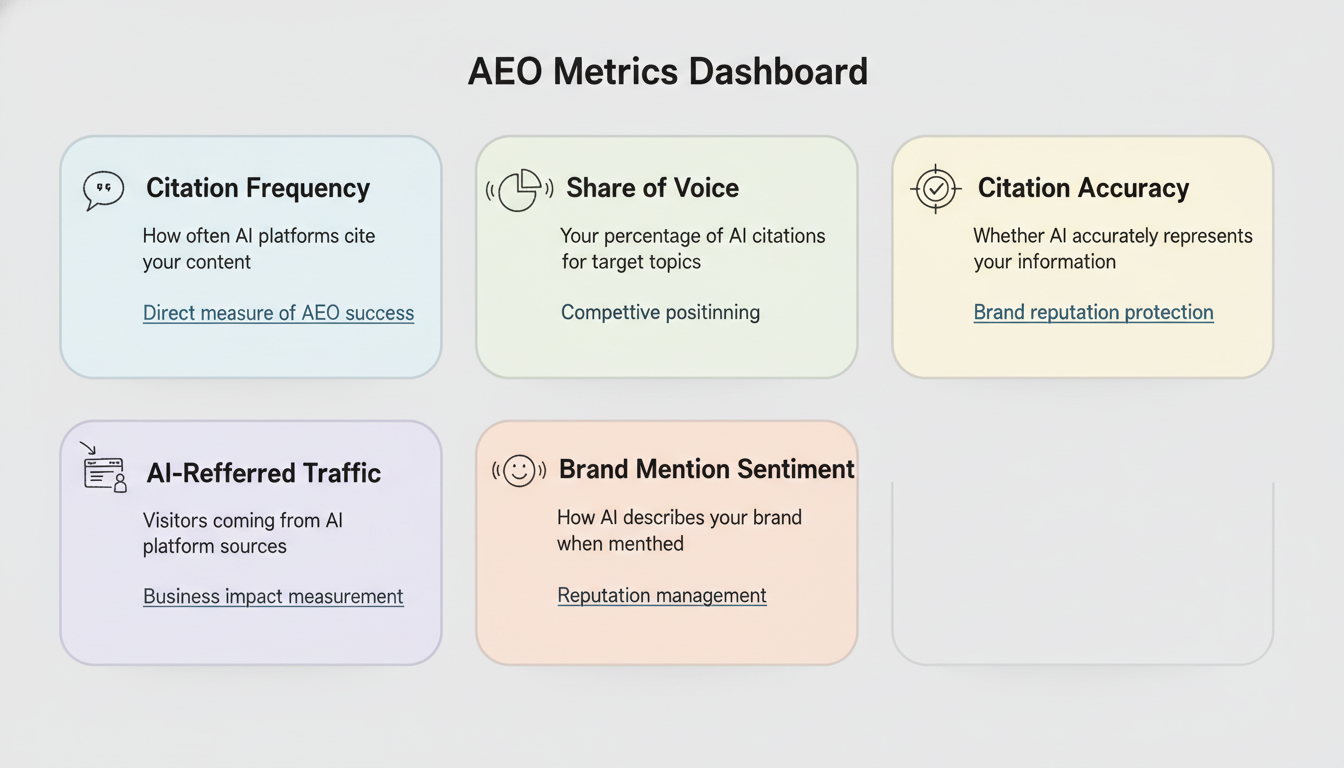
You measure AEO with citation and visibility metrics rather than rankings and clicks, because the win is being quoted inside an answer, not appearing in a list. Traditional analytics capture traffic but miss the moments your brand is named inside an AI response without a visit.
Metric | Description | Why It Matters |
Citation frequency | How often AI platforms cite your content | Direct measure of AEO success |
Share of voice | Your percentage of AI citations for target topics | Competitive positioning |
Citation accuracy | Whether AI accurately represents your information | Brand reputation protection |
AI-referred traffic | Visitors coming from AI platform sources | Business impact measurement |
Brand mention sentiment | How AI describes your brand when mentioned | Reputation management |
Several tools now offer these capabilities, including free AEO tools that provide basic monitoring alongside premium platforms like Rankscale, Otterly, Peec AI, and Ahrefs Brand Radar. Pair AI visibility tracking with traditional analytics so you can see both the citations and the clicks.
What Are the Most Common AEO Mistakes?
The most common AEO mistakes are treating it as separate from SEO, ignoring answer-first structure, neglecting freshness, thinking only about your own website, and expecting instant results. Each of these quietly sinks citation performance even when the underlying content is strong.
- Treating AEO as separate from SEO: They share foundations. Integrate rather than isolate.
- Ignoring content structure: Content optimized for keywords but not questions misses AEO requirements.
- Neglecting freshness: Outdated content loses citation priority regardless of other quality signals.
- Website-only thinking: AI systems evaluate authority across platforms, not just your site.
- Expecting instant results: AEO builds over time like SEO. Consistency compounds.
The freshest example of the freshness trap: research shows content published or updated within the last 13 weeks is approximately 50% more likely to earn AI citations. A page that was excellent in 2023 but untouched since then is competing with one refreshed last month, and the refreshed one usually wins the citation. The practical fix is a quarterly refresh calendar: every cornerstone page gets a dated update pass four times a year, even if the change is only a sentence confirming the guidance still holds.
A subtler mistake is writing answers too narrowly for one engine. A response phrased only in the language of Perplexity may not match how ChatGPT frames the same question. The durable approach is to answer the underlying question plainly and let the structure -- not the phrasing -- do the work, because the engines normalize question intent before they decide what to cite.
How Do You Build Authority for AEO?
You build AEO authority by establishing your brand and people as credible sources wherever answer engines look for expertise, not only on your own domain. Authority in an AI-driven world is distributed: the model weighs signals from many platforms, then decides which to trust when synthesizing an answer.
Multi-Platform Presence
Establish visibility where AI systems find authoritative information -- Reddit, LinkedIn, industry publications, and structured databases. A startup that appears only on its own blog is easy to overlook; one that also shows up in practitioner discussions and reputable roundups looks like a consensus choice to a model weighing sources.
Expert Positioning
Associate content with credentialed authors and implement Person schema with clear expertise indicators -- relevant roles, certifications, and a consistent author profile across pages. Answer engines are more willing to cite a named expert than an anonymous corporate voice, because attribution reduces the risk of surfacing low-quality or unaccountable information.
External Validation
Pursue PR coverage, industry mentions, and authoritative citations that strengthen expertise signals. A single mention in a recognized publication often carries more weight than a dozen self-published posts, because the model treats independent confirmation as stronger evidence of trustworthiness. For a startup, this means treating PR not as a nice-to-have but as a direct input to how often your category expertise gets cited.
How Do You Get Started with AEO?
You get started with AEO by establishing a baseline of your current AI visibility, fixing the structure and technical fundamentals of your highest-value pages, and then setting up ongoing measurement. The sequence below is the same one we use with early-stage teams and takes most startups a few focused weeks to stand up.
- Audit current AI visibility: Search your brand and key topics in ChatGPT, Perplexity, and Google AI Overviews. Document your baseline.
- Review content structure: Evaluate whether existing content provides clear, extractable answers with proper organization.
- Prioritize high-value content: Identify your most important pages and optimize those first.
- Implement technical requirements: Add schema markup, update publication dates, ensure proper metadata.
- Establish monitoring: Set up tracking for AI search analytics alongside traditional analytics.
After the first pass, fold AEO into your content brief template so every new post ships answer-ready instead of being retrofitted later. That is where the compounding advantage comes from.
Frequently Asked Questions
Is AEO a Replacement for SEO?
No. AEO extends SEO rather than replacing it. Technical SEO still gets content crawled and indexed, and content quality serves both ranking and citation. AEO adds answer-first structure and entity clarity on top of those foundations.
How Long Does It Take to See AEO Results?
AEO builds over time, much like SEO. Most teams begin to see measurable citation changes within a few months of consistent structure and freshness work, but the advantage compounds as more of your pages become answer-ready.
Do I Need Schema Markup for AEO?
Schema markup is strongly recommended. FAQ, Article, Organization, and Person structured data make it far easier for answer engines to parse and attribute your content, and author expertise signals improve the odds of being cited.
Which Platforms Should I Optimize for First?
Start with the engines your buyers actually use. For most B2B startups that means ChatGPT, Perplexity, and Google AI Overviews, with voice assistants as a secondary channel depending on whether your product is used hands-free.
Can Small Startups Compete with Larger Brands in AEO?
Yes. Because AEO weights answer clarity, freshness, and structure alongside raw domain authority, a tightly-focused startup can out-cite a larger competitor on its core topics by publishing better-structured, more current answers.
What Is the Single Highest-Leverage AEO Fix?
Restructuring existing high-value pages around question headings with direct, extractable answers is the highest-leverage move. It requires no new tools, improves both AI citation and human readability, and can be done to your top pages in a single sprint.
What Is the Bottom Line on AEO?
AEO has become essential to digital marketing in 2026 because AI assistants now mediate a growing share of information discovery, and optimizing for AI citation determines whether your brand reaches audiences through those channels. The good news for founders is that AEO builds directly on marketing fundamentals you already practice. Quality content, genuine expertise, and audience value remain the foundation -- AEO simply ensures those assets earn visibility where your audience increasingly looks for answers.