
Search is transforming. Users no longer want ten blue links to sift through - they want direct answers to their questions. Answer engines deliver exactly that: AI-powered systems that synthesize information and respond conversationally instead of returning a list of web pages.
Here's what answer engines are, how they work, and why they matter for content visibility in 2026.
Answer Engine Definition
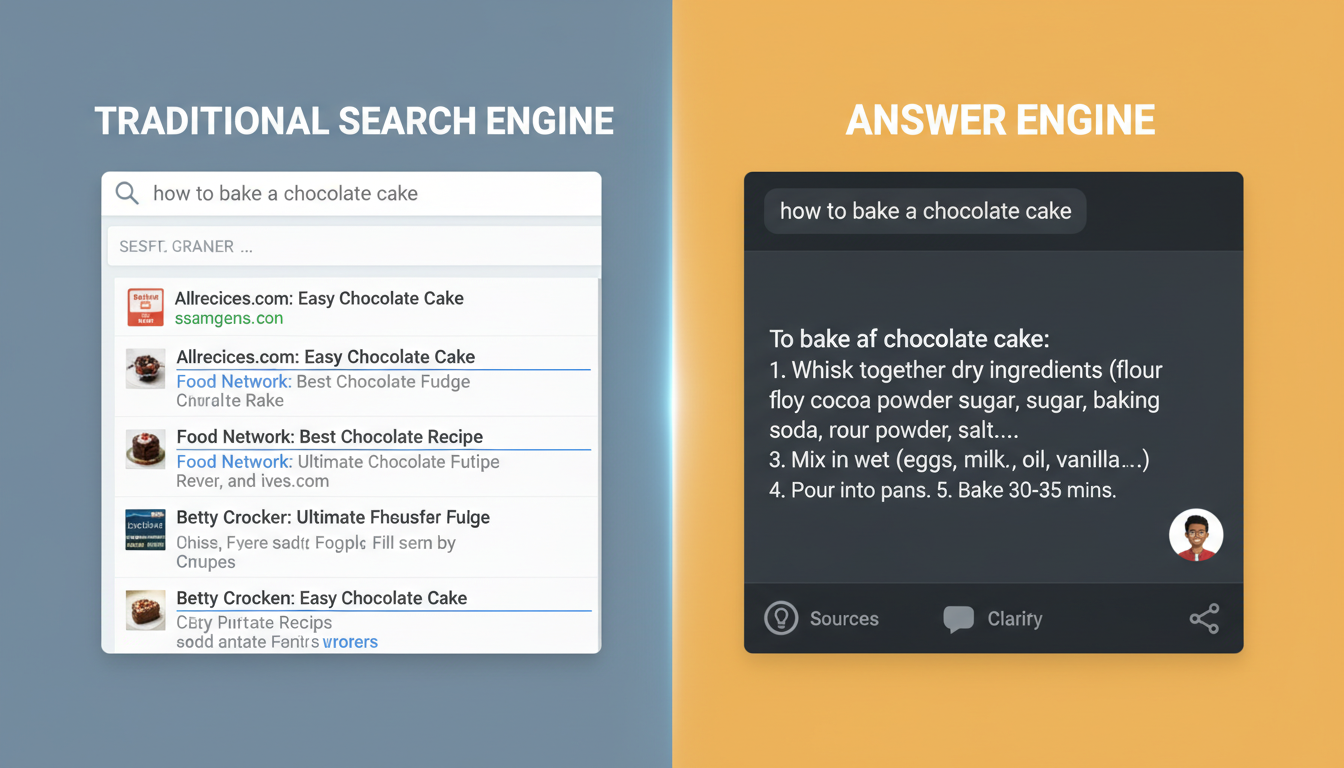
According to SEO Optimizers' analysis of answer engines, an answer engine is a system designed to interpret user queries and provide answers directly. Unlike traditional search, which lists pages, answer engines aim to provide answers immediately using natural language processing and large language models.
Core answer engine components:
- Natural language processing (NLP)
- Machine learning algorithms
- Large language models (LLMs)
- Entity recognition and knowledge graph connections
Answer engines analyze context, not just keywords, to determine user intent and return concise answers. They represent a fundamental shift from retrieving documents to generating responses.
How Answer Engines Differ from Search Engines
According to Micky Weis' AEO guide, the distinction is clear: SEO wants users to click through to your website, while answer engines want your content to be the answer itself.
Search engines vs. answer engines:
Characteristic | Traditional Search Engine | Answer Engine |
Output | List of ranked links | Direct conversational answer |
User action | Click through to websites | Get answer without clicking |
Ranking focus | Page authority, keywords | Answer quality, accuracy |
Technology | Index matching | LLM-generated synthesis |
Query handling | Keyword-based | Natural language understanding |
According to AIML API's AI search comparison, the market has crystallized into two categories: AI-native "answer engines" built for conversational Q&A, and AI-enhanced traditional giants integrating generative layers atop classic search.
How Answer Engines Work
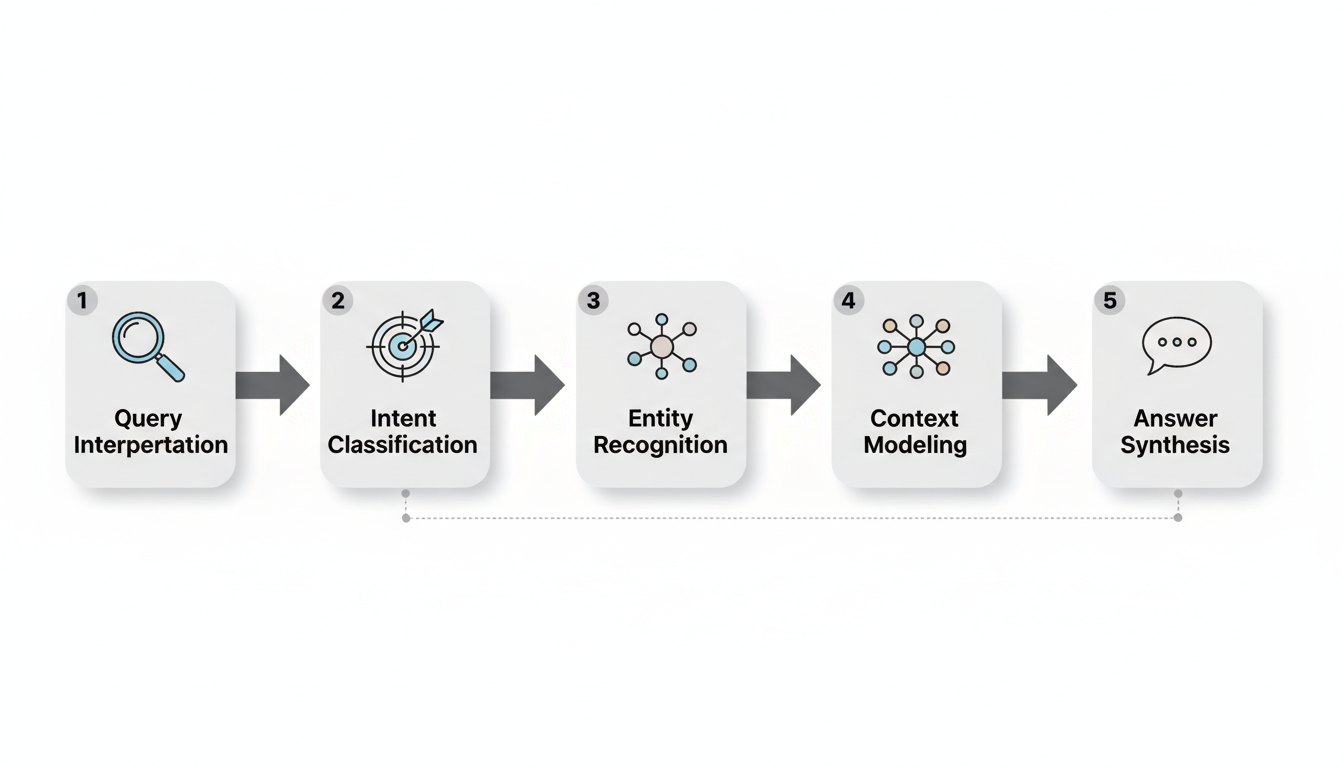
According to SEO Optimizers, answer engines process queries through natural language processing and machine learning. They identify meaning, context, and relationships between terms rather than relying on exact keyword matches.
Answer generation process:
- Query interpretation - Understanding what the user actually means
- Intent classification - Categorizing the type of information needed
- Entity recognition - Identifying people, places, concepts mentioned
- Context modeling - Understanding relationships between terms
- Answer synthesis - Generating a coherent, accurate response
According to Tailored Tactiqs' LLM optimization guide, these AI-driven platforms generate conversational, authoritative answers that go beyond keyword matching, focusing on semantic relevance, topical authority, and trustworthiness. Understanding these fundamentals is critical for developing an effective AEO marketing plan.
Examples of Answer Engines
According to Copy.ai's AEO guide, answer engines include ChatGPT, Perplexity AI, and Microsoft Copilot. Unlike traditional search engines that provide a list of links, these platforms synthesize information from multiple sources to deliver a single, conversational answer.
Major answer engine platforms:
Platform | Type | Key Feature |
ChatGPT | Standalone AI | Conversational interface with web search |
Perplexity | AI-native search | Real-time citations and sources |
Google AI Overviews | Hybrid | AI layer on traditional search |
Microsoft Copilot | Integrated AI | Built into Windows, Edge, Office |
Claude | Standalone AI | Long-context understanding |
Gemini | Google AI | Multimodal capabilities |
According to Profound's AEO playbook, ChatGPT has over 300 million weekly users, and Perplexity serves over 100 million queries per week - demonstrating massive adoption of answer-first search behavior. For a detailed breakdown of how these two platforms compare, see our ChatGPT vs Perplexity comparison.
The Technical Foundation: Retrieval-Augmented Generation
According to AIML API, answer engines rely on Retrieval-Augmented Generation (RAG). This process involves parsing user intent, fetching relevant data via real-time search or a vector database, and using the LLM to summarize this into a coherent response.
RAG process:
- User submits natural language query
- System retrieves relevant information from web or knowledge base
- LLM synthesizes retrieved data into answer
- Citations link back to source content
This agent-like process improves answer accuracy by grounding responses in external data rather than relying solely on training knowledge.
Why Answer Engines Matter for Content Visibility
According to Connect Media Agency's AEO guide, over 400 million weekly ChatGPT users and 60% of searches ending without clicks demonstrate the shift toward answer-first behavior. Content visibility increasingly depends on being cited in AI-generated responses.
Visibility implications:
- Ranking position matters less than citation potential
- Structured, clear answers get selected over comprehensive pages
- AI systems prefer authoritative, updated content
- Citations drive traffic rather than rankings alone
According to Shopify's AEO analysis, within generative answers, brand mentions won't lead directly to clicks. Answer engines aim to satisfy queries within the platform, making citations essential for earning traffic. Organizations should consider tracking these metrics using Google Analytics 4 for AI search tracking.
Auto Mode vs. Search Mode
According to Conductor's answer engine tracking guide, platforms like ChatGPT operate in two modes that affect visibility differently.
Mode differences:
Mode | Data Source | Visibility Opportunity |
Auto mode | Training data (static) | Requires comprehensive, authoritative content |
Search mode | Real-time web results | Requires up-to-date, citeable content |
Understanding both modes helps you optimize content for different visibility opportunities across AI platforms.
Building an Answer-Engine-Ready Content Workflow
Treating answer engines as a publishing constraint, not an afterthought, changes how you brief writers. A practical workflow starts with the query: identify the exact question a buyer asks an AI, then write the answer as the first paragraph in plain language before any preamble. Follow with structured support - definitions, steps, and comparison tables - so the model has extractable material rather than prose it must interpret.
Close the loop with measurement. Track which of your pages get cited in ChatGPT, Perplexity, and Google AI Overviews using AEO tracking tools, then prune or expand based on what actually earns references. Over a quarter, the pages that surface as citations become the backbone of your visibility, and the workflow sharpens around them instead of around rankings you no longer control.
Answer Engines and the Future of Organic Traffic
The shift toward answer-first behavior does not eliminate organic traffic; it redistributes it. Clicks that once went to the top blue link now sometimes go to a cited source inside an AI answer, and that cited source is often a page the model trusts for clarity and structure. Brands that optimize for citation - precise answers, strong schema, consistent entity definitions - can capture traffic they could never win on a classic results page.
The strategic move is to stop measuring success only as position one and start measuring it as presence in the answer. A page that is quoted inside an overview, even without a click, builds brand recall and earns the eventual visit when the user drills deeper. Answer engines reward the same fundamentals as good SEO - useful, accurate, well-structured content - just evaluated by a model instead of a crawler.
Answer Engine Optimization for Startups
Startups have an unusual advantage in answer-engine optimization: they can define their category terms from scratch. When you coin or shape a new concept, publishing the clearest definition and the most-cited explanation makes your domain the source the models learn to reference. That first-mover position is harder to win in established keyword spaces where incumbents already own the citations.
The execution is disciplined and cheap. Build a small set of answer-first pages around your core terms, mark them up with Article and FAQ schema, and earn a few authoritative mentions from industry publications. Because answer engines reward clarity over link volume, a focused startup can out-cite a larger competitor on the exact queries that matter to its niche.
Key Takeaways
Answer engines represent the future of information retrieval:
- Direct answers, not links - Answer engines synthesize responses rather than listing pages
- LLM-powered - Large language models enable natural language understanding and generation
- Major platforms - ChatGPT, Perplexity, Google AI Overviews, and Copilot lead the market
- RAG technology - Retrieval-Augmented Generation combines search with synthesis
- Citation-based visibility - Being cited matters more than ranking position
- Context over keywords - Semantic understanding replaces keyword matching
- Dual optimization needed - Content must work for both training data and real-time search
Understanding what answer engines are - and how they differ from traditional search - is the first step toward optimizing content for AI-driven visibility. To dive deeper into practical implementation, explore our comprehensive AEO optimization guide.