
The SEO landscape has been transformed by artificial intelligence. Tools that once required manual analysis now process billions of data points in real time, identifying intent shifts, SERP changes, and ranking signals faster than any human could. Whether you're optimizing for traditional search or AI-powered answer engines, the right AI SEO tools make the difference between guessing and knowing what works.
This guide covers the complete AI SEO tool ecosystem—from content optimization to technical audits to AI visibility tracking—helping you build a stack that matches your needs and budget.
What Are AI Search Engine Optimization Tools?
AI SEO tools are software platforms that use machine learning, natural language processing (NLP), and other AI technologies to automate and enhance search optimization tasks. Unlike traditional SEO tools that simply report data, AI-powered tools:
- Predict ranking potential before content goes live
- Generate optimization recommendations based on SERP analysis
- Automate repetitive tasks like meta tag optimization and internal linking
- Track AI visibility across platforms like ChatGPT and Perplexity
- Create content that aligns with search intent and ranking factors
These capabilities transform SEO from reactive analysis to proactive optimization.
Categories of AI SEO Tools
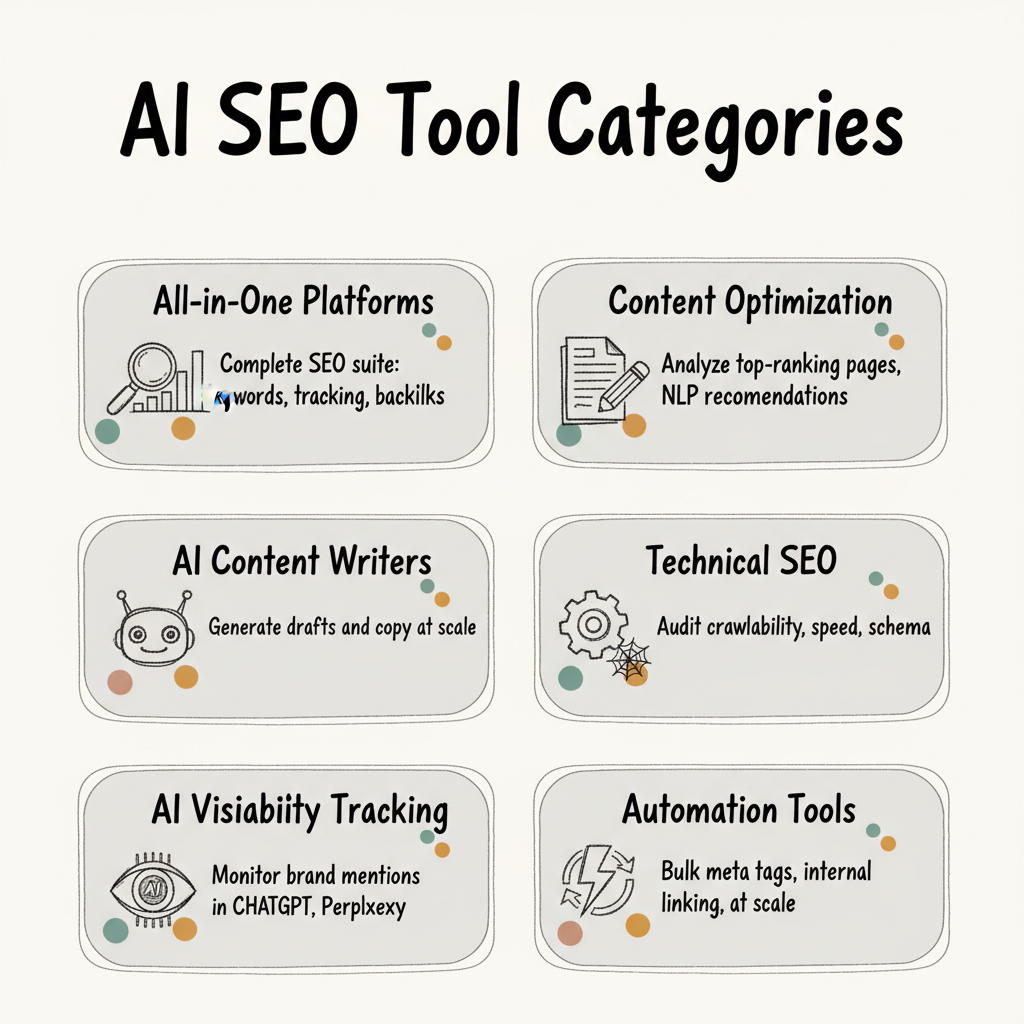
AI SEO tools fall into distinct categories based on their primary function.
All-In-One SEO Platforms
Comprehensive suites covering keyword research, rank tracking, backlink analysis, and content optimization. Best for teams wanting a single platform for most SEO needs.
Content Optimization Tools
Focused on analyzing top-ranking content and providing specific recommendations to improve your pages. Essential for content teams creating search-optimized articles.
AI Content Writers
Generate drafts, outlines, and copy using large language models. Useful for scaling content production with AI assistance.
Technical SEO Tools
Audit sites for crawlability, speed, schema implementation, and other technical factors. Critical for maintaining site health.
AI Visibility Tracking
Monitor brand mentions and citations in AI-generated responses across ChatGPT, Perplexity, Google AI Overviews, and other platforms. Emerging category essential for GEO/AEO strategies.
Automation Tools
Handle repetitive optimization tasks at scale, including meta tag updates, internal linking, and bulk changes across large sites.
Emerging AI SEO Capabilities to Watch in 2026
The AI SEO landscape is evolving beyond traditional optimization. Several emerging capabilities are reshaping how teams approach search visibility, and understanding them is critical for selecting the right tools. For teams finding the complexity overwhelming, working with an AI SEO agency services provider can accelerate adoption of these new strategies.
GEO (Generative Engine Optimization)
GEO represents a fundamental shift from optimizing for blue-link rankings to optimizing for AI-generated search responses. While traditional SEO targets Google's organic results and answer engine optimization focuses on featured snippets and knowledge panels, GEO specifically targets generative AI platforms like Google AI Overviews, ChatGPT search, and Perplexity. Tools like Rankability, SE Visible, and Frase now include dedicated GEO features that analyze how content performs in generative contexts, prioritizing citation authority, structured data clarity, and topical comprehensiveness.
Agentic SEO and AI Agents
The industry is shifting from AI-assisted SEO to AI-autonomous SEO. Agentic SEO describes AI agents that autonomously execute optimization tasks—generating content briefs, implementing technical fixes, conducting link building outreach, and refreshing stale content—without requiring manual intervention at each step. Frase now positions itself as an "agentic SEO platform" with autonomous content workflows, while Search Atlas's OTTO automation engine handles technical SEO changes site-wide. This shift means teams can focus on strategy while agents handle execution.
Prompt Tracking and Citation Authority
Brands now need to monitor which prompts trigger their mentions in LLM responses. Citation tracking measures how frequently AI models cite a source and in what context—whether as a primary recommendation, supporting reference, or competitor comparison. Share of voice in AI search is becoming the competitive metric that matters most in this space, tracking what percentage of relevant AI-generated responses reference your brand versus competitors.
Keyword Clustering and Programmatic SEO
AI-powered keyword clustering groups keywords by intent and semantic similarity, eliminating the guesswork in content planning. Rather than creating separate pages for closely related queries, clustering reveals which keywords belong together on a single page. This capability also enables programmatic SEO—using AI tools to generate optimized pages at scale for long-tail keyword clusters, a strategy particularly effective for e-commerce and directory sites.
Content Decay Monitoring
AI tools now detect when published content loses relevance or rankings over time. Content decay monitoring uses machine learning to identify early signals of declining performance—such as dropping click-through rates, rising competitor content, or outdated statistics—and triggers automated refresh alerts before significant traffic loss occurs. This NLP-based topic research methodology ensures content stays competitive without requiring manual auditing of every page.
Top Tools by Category
All-In-One Platforms
Semrush ($165.17+/month | 14-day free trial) The most complete all-in-one platform for 2026. Semrush now includes AI Mode tracking alongside traditional SEO features. Best for agencies and in-house teams needing comprehensive data.
Key features:
- Keyword research with AI-powered suggestions
- Competitor analysis and gap identification
- Content optimization recommendations
- Rank tracking across locations and devices
- Backlink analysis and monitoring
- AI visibility tracking (newer feature)
Ahrefs ($129+/month | $1 trial available) Renowned for backlink data quality and keyword research depth. Slightly less AI-focused than Semrush but excellent for link building and competitive research.
Key features:
- Industry-leading backlink database
- Content Explorer for topic research
- Accurate keyword difficulty scores
- Site audit capabilities
- Rank tracking
SE Ranking ($119+/month | 14-day free trial) Best value option for agencies and SMBs wanting professional features without enterprise pricing. Combines traditional SEO tools with AI-driven analysis.
Key features:
- Scalable pricing for agencies
- AI content optimization
- White-label reporting
- Comprehensive keyword research
- Local SEO features
Keyword Research & Clustering Tools
The rise of semantic search and AI-generated results makes keyword research strategies more important than ever. These tools go beyond basic keyword discovery to cluster, map, and automate content planning at scale.
Search Atlas ($99/month | 7-day free trial) An all-in-one platform gaining traction as a comprehensive alternative to established players. Its standout feature is the OTTO SEO automation engine, which autonomously identifies and implements technical fixes across your site without manual intervention. The AI Content Assistant drafts optimized content using live SERP data, and the Site Explorer rivals Ahrefs for competitive research depth.
Keyword Insights ($58-299/month | free trial available) Purpose-built for keyword discovery, intent-based clustering, and AI content brief generation. Feed it thousands of keywords and it automatically groups them by semantic similarity and search intent, revealing which topics to consolidate onto single pages and which deserve standalone content. Particularly valuable for large content operations managing hundreds of target keywords.
Keywordly ($14/month) Budget-friendly keyword clustering with GEO and LLM visibility features, plus Reddit research capability for discovering real user questions and pain points. An excellent entry point for freelancers and small teams wanting clustering intelligence without enterprise pricing.
WriterZen ($19-99/month | free trial available) Connects directly to Google's keyword database for research, then layers on NLP-powered competitor analysis. Its automated keyword clustering and topic mapping features help teams visualize content gaps and plan topical authority strategies efficiently.
Content Optimization
Surfer SEO ($89+/month | 7-day money-back guarantee) The industry standard for content optimization. Analyzes top-ranking pages and provides specific term recommendations, structure guidance, and real-time scoring. Surfer uses an A-F content scoring methodology that grades content in real time as you write, making it immediately clear how well-optimized each piece is.
Key features:
- Real-time content scoring
- NLP-based term suggestions
- Content brief generation
- AI writing assistant (Surfer AI)
- SERP analyzer
Clearscope ($170+/month | demo available) Preferred by enterprise teams for its cleaner interface and "Topical Map" approach. Focuses on comprehensive coverage rather than keyword stuffing.
Key features:
- Content grading and recommendations
- Topic clustering
- Integration with Google Docs and WordPress
- Team collaboration features
- Competitive content analysis
MarketMuse (Custom pricing | free plan available) AI-driven content planning and gap analysis. Best for large content operations needing topic strategy, not just page optimization.
Key features:
- Content inventory analysis
- Topic authority scoring
- Content brief automation
- Competitive content gaps
- ROI prioritization
NeuronWriter ($29+/month | free plan available) Budget-friendly alternative with similar optimization features to Surfer. Excellent for freelancers and smaller teams.
Key features:
- Content optimization scoring
- NLP recommendations
- Competitor analysis
- AI writing assistance
- Affordable pricing tiers
AI-Powered Content Optimization & Writing
These tools bridge the gap between content optimization and AI writing, combining SERP analysis with generative AI to produce search-optimized content from the ground up. For teams looking to refine their approach further, content optimization best practices provide a solid foundation.
Frase ($45-98/month | 5-day free trial) An agentic SEO and GEO platform that combines SERP research, content brief generation, and AI writing in a single workflow. Frase pulls data from the top 20 search results to inform its AI-generated drafts, then scores content with an A-F grading system that evaluates topical comprehensiveness. Its unique positioning as both optimizer and writer eliminates the need to switch between separate tools for research and production.
Writesonic ($16-49/month | free plan available) Enterprise-grade AI content creation backed by real-time SERP analysis. Integrates data from Ahrefs and Semrush to produce keyword-informed drafts that align with current ranking signals. Its affordability relative to feature depth makes it accessible for growing teams that need quality AI writing without enterprise budgets.
Scalenut ($39-49/month | 7-day free trial) Known for its "Cruise Mode" that generates full-length AI drafts with built-in SEO optimization in a single pass. Includes topic cluster planning, live SEO scoring as you edit, and NLP-based term recommendations that ensure comprehensive coverage. Particularly effective for teams producing high volumes of search-optimized content.
Rankability ($124-199/month | free trial available) Blends IBM Watson and Google NLU for content optimization that goes deeper than keyword matching. Live content scoring, AI briefs that incorporate NLP entity analysis, and GEO-oriented optimization features distinguish it from lighter-weight alternatives. Notably ranks #3 organically for the primary keyword "AI SEO tools," which speaks to the effectiveness of its own methodology.
AI Content Generation
ChatGPT ($20/month for Plus) The most versatile AI for SEO tasks. Use for outlines, drafts, meta descriptions, FAQ content, and ideation. Requires human editing but accelerates production significantly.
Claude ($20/month for Pro) Strong alternative to ChatGPT with nuanced, thoughtful outputs. Often preferred for longer-form content and complex analysis.
Jasper ($49+/month) Purpose-built for marketing content with templates for SEO articles, ad copy, and social posts. Includes brand voice training.
Technical SEO
Screaming Frog (Free up to 500 URLs / $259/year) Essential crawler for technical audits. The free version handles most small sites; paid version adds advanced features and integrations.
Key features:
- Comprehensive site crawling
- Broken link detection
- Redirect chain analysis
- Schema validation
- Custom extraction
Sitebulb ($35+/month) Visual site auditing with AI-powered prioritization. Makes technical issues easier to understand and communicate to stakeholders.
Alli AI ($299+/month) Automates technical SEO fixes at scale. Particularly useful for large sites where manual implementation is impractical.
Key features:
- Automated meta tag optimization
- Bulk header adjustments
- Internal linking automation
- Schema implementation
- Rule-based optimization
AI Visibility Tracking
Profound (Enterprise pricing) The most comprehensive AI visibility platform, purpose-built for monitoring brand presence in AI-generated responses across multiple platforms.
Key features:
- Multi-LLM tracking (ChatGPT, Perplexity, Claude, Google AI)
- Citation analysis and overlap research
- Sentiment analysis in AI responses—scoring whether LLMs present your brand positively, negatively, or neutrally
- Prompt-level tracking to monitor which specific queries trigger brand mentions
- Citation authority measurement across AI platforms
- Real prompt data
- Enterprise controls
- Competitive benchmarking
Conductor (Custom pricing) Enterprise SEO platform with integrated AI visibility features. Best for organizations already using Conductor for traditional SEO.
Otterly.AI (Contact for pricing) Integrates with Semrush workflows for teams wanting AI tracking within their existing platform.
Peec AI (Contact for pricing) Focused specifically on answer engine optimization with competitive visibility analysis.
AI Visibility & Monitoring Tools
Beyond the established platforms above, a growing wave of specialized tools focuses on AI visibility tracking strategies for brands that need granular insight into their presence across AI search.
SE Visible ($189/month | demo available) A dedicated AI visibility tracking product from SE Ranking. SE Visible tracks brand presence across AI Overviews, AI Mode, ChatGPT, Perplexity, and Gemini in a single dashboard. Its standout capability is sentiment analysis in AI responses—scoring whether LLMs present your brand positively, negatively, or neutrally. Share of voice metrics for AI search give teams a clear competitive benchmark that traditional rank tracking cannot provide.
Atomic AGI ($20/month | free tier available) Budget-friendly AI visibility monitoring with SEO automation via AI agents. Tracks citations across major LLMs with prompt monitoring capabilities, making it a strong entry point for teams new to AI visibility tracking without committing to enterprise pricing. Its agent-driven automation handles repetitive monitoring tasks autonomously.
Indexly ($14-49/month | free plan available) Focuses on instant indexing and LLM indexability tracking. Its auto-indexing feature speeds up Google discovery of new and updated content, while LLM indexability checks ensure your pages are accessible to AI crawlers. A useful complement to visibility tracking tools that ensures content is discoverable before you start measuring AI mentions.
It is worth noting that MCP (Model Context Protocol) connections are emerging as an integration pattern that tools like SE Ranking are adopting to connect directly with LLMs for richer data exchange, signaling a future where SEO platforms and AI models communicate bidirectionally.
Tool Comparison Matrix
Tool | Best For | Starting Price | AI Features |
Semrush | All-in-one SEO | $165.17/mo | AI Mode tracking, content optimization |
Ahrefs | Backlinks & keywords | $129/mo | AI-assisted insights |
SE Ranking | Budget-conscious teams | $119/mo | AI content scoring |
Surfer SEO | Content optimization | $89/mo | NLP optimization, AI writer |
Clearscope | Enterprise content | $170/mo | Topical mapping, content grading |
MarketMuse | Content strategy | Custom | Topic authority, gap analysis |
NeuronWriter | Budget optimization | $29/mo | NLP recommendations |
ChatGPT | All-purpose AI | $20/mo | Content generation, analysis |
Screaming Frog | Technical audits | Free/$259/yr | Custom extraction |
Alli AI | Technical automation | $299/mo | Bulk optimization |
Profound | AI visibility | Enterprise | Multi-LLM tracking |
Frase | Agentic content optimization | $45/mo | SERP research, AI writing, GEO |
Search Atlas | All-in-one with automation | $99/mo | OTTO engine, AI content |
SE Visible | AI visibility tracking | $189/mo | Sentiment analysis, share of voice |
Keyword Insights | Keyword clustering | $58/mo | Intent clustering, AI briefs |
Integration and Workflow Setup
Building an effective AI SEO stack requires tools that work together.
Content Production Workflow
- Keyword Research: Semrush or Ahrefs for topic identification
- Content Brief: Surfer SEO or Clearscope for optimization guidelines
- Draft Creation: ChatGPT or Claude for initial content
- Optimization: Surfer or Clearscope for term optimization
- Publication: WordPress or CMS integration
- Tracking: Rank tracking + AI visibility monitoring
Technical SEO Workflow
- Audit: Screaming Frog or Sitebulb crawl
- Prioritization: AI-powered issue ranking
- Implementation: Alli AI for bulk changes or manual fixes, or use a technical SEO audit checklist for systematic review
- Verification: Re-crawl to confirm fixes
- Monitoring: Ongoing crawl scheduling
Key Integrations to Consider
- Google Search Console: Essential for all tools
- Google Analytics: Traffic and conversion tracking
- WordPress plugins: Direct CMS optimization
- Google Docs: Content workflow integrations
- Slack/Teams: Alert and reporting notifications
Pricing and ROI Analysis
AI SEO tools vary dramatically in cost. Here's how to think about ROI.
Budget Breakdown by Team Size
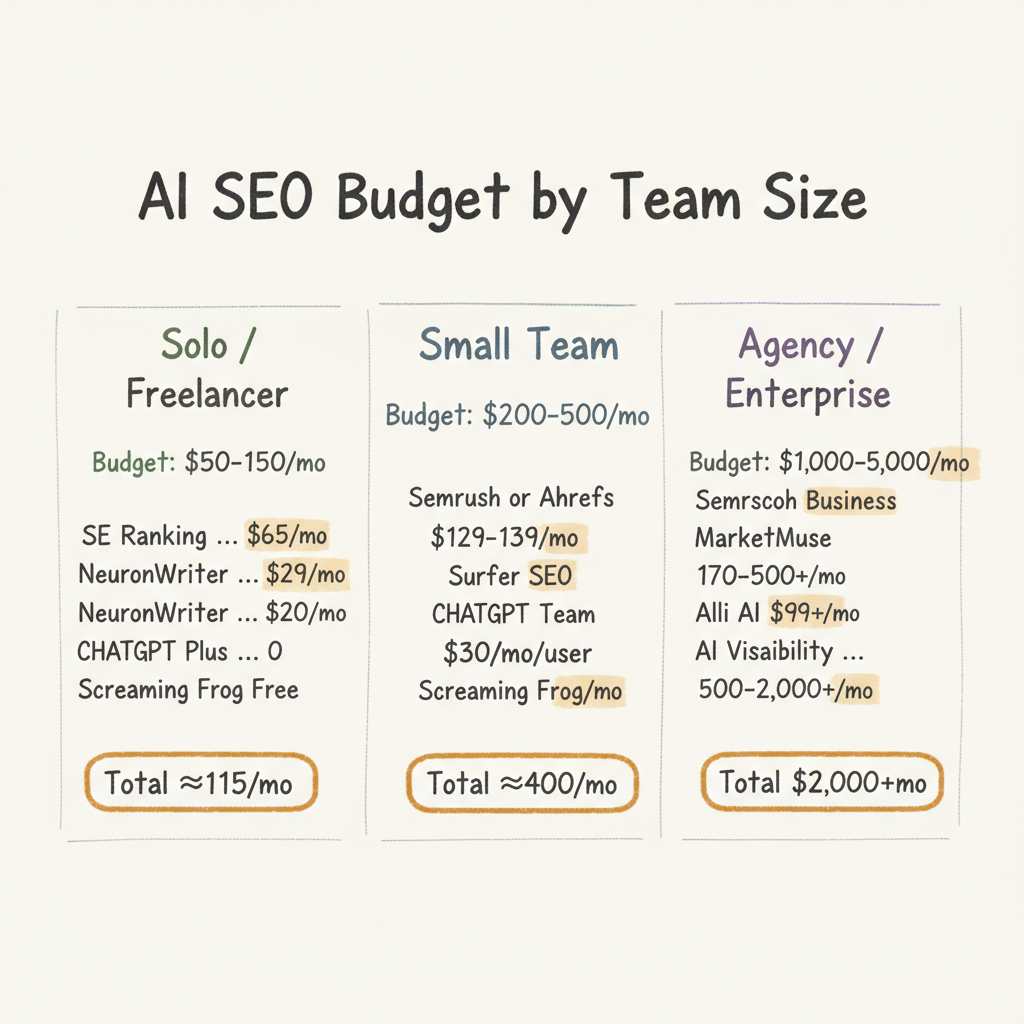
Solo/Freelancer ($50-150/month)
- SE Ranking or similar all-in-one: $65/mo
- NeuronWriter for content: $29/mo
- ChatGPT Plus: $20/mo
- Screaming Frog Free: $0
Small Team ($200-500/month)
- Semrush or Ahrefs: $129-139/mo
- Surfer SEO: $89/mo
- ChatGPT Team: $30/mo/user
- Screaming Frog paid: ~$22/mo
Agency/Enterprise ($1,000-5,000+/month)
- Semrush Business: $499/mo
- Clearscope or MarketMuse: $170-500+/mo
- Alli AI: $299+/mo
- AI visibility tracking: $500-2,000+/mo
ROI Considerations
Calculate tool ROI by measuring:
- Time saved: Hours of manual work automated
- Traffic gained: Ranking improvements from optimization
- Content efficiency: Faster production with AI assistance
- Competitive advantage: Insights competitors don't have
A $500/month tool stack that saves 20 hours of work monthly at $50/hour effective rate pays for itself through time savings alone—before counting traffic gains.
Enterprise vs SMB Tool Recommendations
For Small Businesses and Startups
Essential Stack:
- Google Search Console (free)
- SE Ranking ($65/mo) or Semrush entry tier
- NeuronWriter ($29/mo) for content optimization
- ChatGPT Plus ($20/mo)
Total: ~$115-175/month
Focus on fundamentals: keyword research, basic rank tracking, and content optimization. Add AI visibility tracking once you've established traditional search presence.
For Growing Companies (10-50 Employees)
Recommended Stack:
- Semrush ($139-249/mo)
- Surfer SEO ($89/mo)
- Screaming Frog paid ($22/mo)
- ChatGPT Team ($30/mo/user)
- Basic AI visibility tool ($100-300/mo)
Total: ~$400-700/month
Invest in content optimization and technical health. Begin tracking AI visibility as the channel grows.
For Enterprises
Enterprise Stack:
- Semrush Business or Conductor (custom)
- Clearscope or MarketMuse (custom)
- Alli AI ($299+/mo)
- Profound or enterprise AI visibility (custom)
- Custom integrations and reporting
Total: $2,000-10,000+/month
Enterprise needs justify enterprise tools. Prioritize integration, team collaboration, and comprehensive AI visibility tracking.
Frequently Asked Questions
What Is the Best AI Tool for SEO?
There's no single best tool—it depends on your needs. For all-in-one capability, Semrush leads in 2026. For content optimization specifically, Surfer SEO is the industry standard. For AI visibility tracking, Profound offers the most comprehensive coverage.
Are Free AI SEO Tools Worth Using?
Yes, especially for beginners and small sites. Google Search Console provides essential data directly from Google. The free version of Screaming Frog handles sites up to 500 URLs. Free ChatGPT or Google Gemini work well for ideation and drafting. Most paid tools also offer free trials—Frase, SE Ranking, Search Atlas, and Scalenut all offer 5-14 day trials so you can test before committing.
How Much Should I Spend on AI SEO Tools?
Budget 1-3% of your marketing spend on tools. Solopreneurs can start with $100-150/month. Growing teams typically invest $400-800/month. Enterprises may spend $2,000-10,000+ monthly on comprehensive stacks.
Do I Need Separate Tools for GEO/AEO?
For now, yes. Traditional SEO tools are adding AI visibility features, but dedicated platforms like Profound offer more comprehensive AI search tracking. This category is evolving rapidly—expect better integration in the coming years.
Can AI Tools Replace SEO Professionals?
No. AI tools automate tasks and surface insights, but strategy, creativity, and judgment still require human expertise. The best results come from SEO professionals augmented by AI tools, not replaced by them.
What Is GEO and How Is It Different from Traditional SEO?
GEO (Generative Engine Optimization) focuses specifically on optimizing content to appear in AI-generated search responses from platforms like Google AI Overviews, ChatGPT, and Perplexity. Unlike traditional SEO that targets blue-link rankings, GEO prioritizes citation authority, structured data clarity, and topical comprehensiveness. Dedicated GEO tools like Rankability, SE Visible, and Frase now include features purpose-built for this emerging channel.
What Is Agentic SEO and Which Tools Support It?
Agentic SEO uses autonomous AI agents to execute optimization tasks without manual intervention—from generating content briefs to implementing technical fixes. Frase positions itself as an agentic SEO platform with autonomous content workflows. Search Atlas's OTTO engine automates technical SEO changes site-wide. Atomic AGI and AirOps also offer agent-driven automation for content and SEO tasks.
How Do I Track My Brand'S Visibility in AI Search Results?
Use dedicated AI visibility tools that monitor prompts across major LLMs. Profound tracks citations across ChatGPT, Perplexity, Claude, and Google AI. SE Visible monitors AI Overviews and AI Mode with sentiment analysis scoring. Key metrics include share of voice in AI search, citation frequency, and brand sentiment. Start by tracking 10-20 high-intent prompts relevant to your business.
What Is Keyword Clustering and Why Does It Matter for AI SEO?
Keyword clustering uses AI to group semantically related keywords by search intent, eliminating guesswork in content planning. Instead of creating separate pages for similar queries, clustering reveals which keywords to target together. Tools like Keyword Insights, WriterZen, and Keywordly automate this process. Clustering also supports programmatic SEO, where AI generates optimized pages at scale for long-tail keyword groups.
Looking for expert help implementing AI SEO tools? Learn about AI SEO Agency Services or explore specific tool reviews like our Search Atlas Review for deeper analysis.