
Digital Advertising for Beauty Brands: Meta, Instagram, and TikTok Strategy Guide
Most beauty brands burn through ad budgets on platforms that reward commodity products, not aspirational storytelling. You launch a campaign with polished creative, watch CPMs climb past $15, and wonder why your cost per acquisition keeps rising while competitors seem to scale effortlessly. The problem is not your product -- it is your beauty brand digital advertising strategy, or lack of one built for how these platforms actually work in 2026.
This guide breaks down why beauty advertising demands a different playbook, how to build a cross-platform strategy from scratch, which platforms deliver the best returns for specific beauty verticals, and the trends reshaping paid media for beauty and cosmetics brands this year.
Why Beauty Advertising Demands a Different Approach
Beauty brands compete in a category where purchase decisions are deeply personal, visually driven, and heavily influenced by social proof. That combination creates advertising dynamics you will not find in SaaS, e-commerce apparel, or consumer electronics.
Visual-first decision making means your ad creative carries more weight than your targeting. A skincare buyer scrolling Instagram does not read ad copy first -- they evaluate the image, the texture, the skin result. Your creative is your targeting.
High consideration, low price point creates a paradox. A $38 serum is not an impulse buy for most consumers, but it is not expensive enough to justify a lengthy sales funnel. You need creative that builds trust and desire within a single scroll-stop moment.
Influencer saturation has trained beauty consumers to distrust polished brand content. They have seen thousands of sponsored posts and can identify an inauthentic recommendation instantly. Your paid media must feel native to the platform without looking like every other brand partnership.
Shade and texture complexity means one hero image rarely serves your full audience. A foundation brand needs to show diverse skin tones. A lipstick line needs to demonstrate texture on different complexions. This multiplies your creative needs by 3-5x compared to most DTC categories.
These factors mean beauty brands cannot simply copy the Meta Ads playbook that works for a luggage company or a pet food brand. You need a strategy built around high-volume creative testing, platform-native formats, and trust-building content sequences.
How to Build a Beauty Ad Strategy Across Meta, Instagram, and TikTok
A cross-platform beauty advertising strategy starts with creative architecture, not audience targeting. Here is the step-by-step framework that produces consistent results for beauty brands scaling from $10K to $500K monthly ad spend.
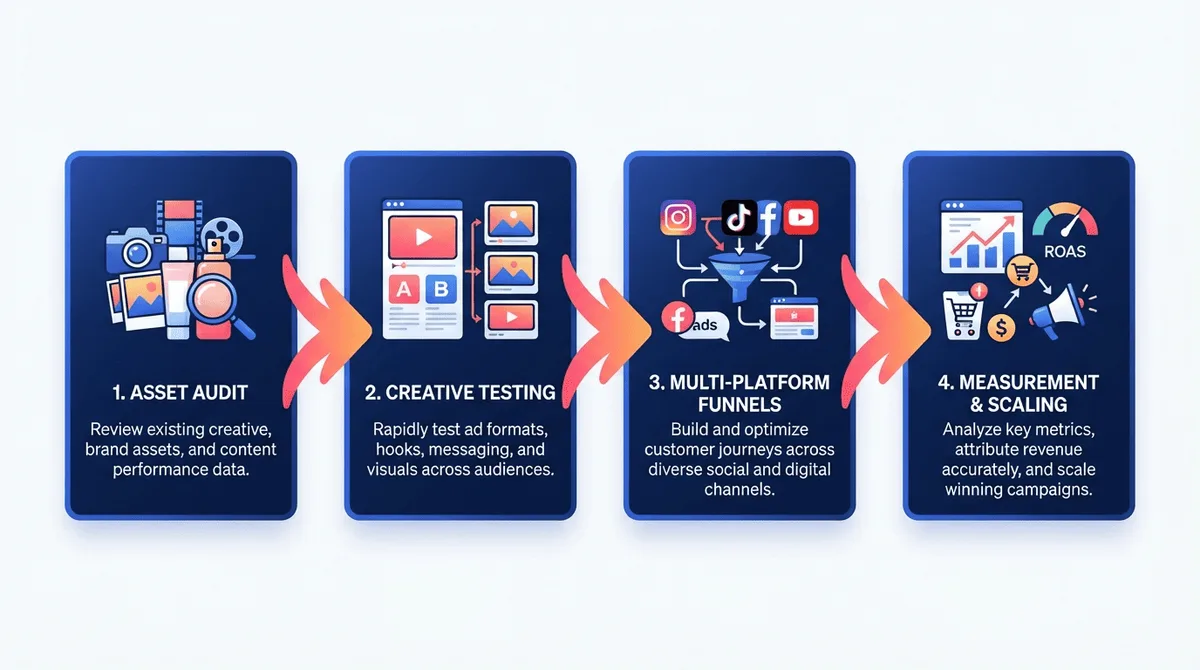
Step 1: Audit Your Creative Assets
Before touching Ads Manager, inventory every piece of content you have: product photography, UGC clips, influencer content, behind-the-scenes footage, customer testimonials, tutorial videos, and before-and-after imagery. Categorize each asset by format (static, video, carousel), platform fit (vertical vs. square vs. landscape), and funnel stage (awareness, consideration, conversion).
Most beauty brands discover they have an abundance of polished brand photography and almost no raw, authentic content. That gap is your first priority.
Step 2: Define Your Creative Testing Framework
Allocate 20-30% of your monthly budget to creative testing. Structure tests around these variables, one at a time:
- Hook type: Problem statement vs. transformation reveal vs. texture closeup vs. social proof
- Format: Static image vs. short-form video vs. carousel vs. collection ad
- Talent: Brand model vs. influencer vs. real customer vs. no talent (product only)
- Platform native style: Polished editorial vs. UGC aesthetic vs. tutorial format
Run each test with a minimum of $50/day per variant and let it accumulate at least 1,000 impressions before evaluating. For a detailed breakdown of how video and image ads compare in beauty advertising, see our dedicated performance analysis.
Step 3: Build Platform-Specific Funnels
Meta (Facebook + Instagram combined): Use Advantage+ Shopping Campaigns for your core prospecting. Feed them 10-15 creative variants per ad set. Let Meta's algorithm identify which creative-audience combinations perform. Layer in a retargeting campaign using dynamic product ads for visitors who viewed specific products.
Instagram (standalone placements): Reels and Stories dominate engagement for beauty. Prioritize vertical video (9:16) that demonstrates product application in the first 3 seconds. Instagram's discovery-driven audience responds best to transformation content and texture closeups. Explore the full range of Instagram and Facebook ad formats for fashion and beauty brands to maximize reach.
TikTok: The platform rewards authenticity over production value. Your best-performing TikTok ads will likely be the ones that look least like ads. Use trending sounds, fast cuts, and creator-style narration. TikTok's algorithm is uniquely powerful for reaching new audiences -- use it as your top-of-funnel engine.
Step 4: Set Up Measurement Infrastructure
Install the Meta Pixel, TikTok Pixel, and Conversions API on your site before launching. Configure standard events: ViewContent, AddToCart, InitiateCheckout, Purchase. Set up UTM parameters for every campaign to track in Google Analytics. Use a 7-day click, 1-day view attribution window on Meta. On TikTok, use 7-day click attribution.
Without proper measurement, you are optimizing blind. This is where most beauty brands waste their first $10K-$20K in ad spend.
Platform Comparison: Meta vs. Instagram vs. TikTok for Beauty Brands
Each platform serves a different role in your beauty advertising ecosystem. Here is how they compare across the metrics that matter most.
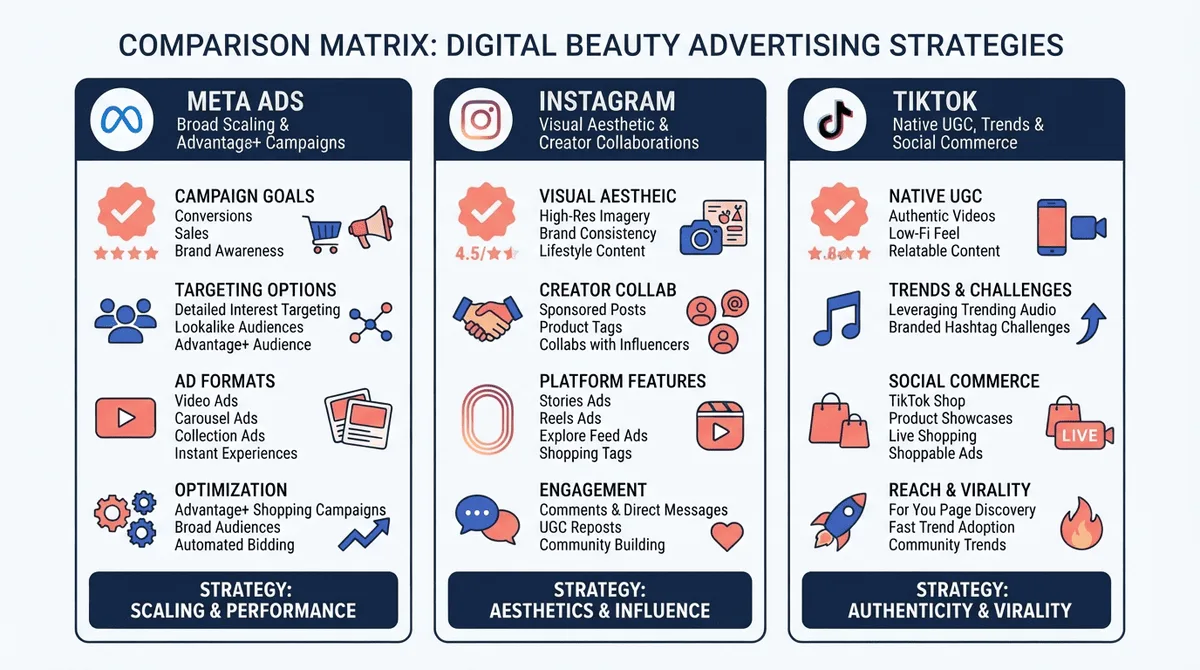
| Factor | Meta (Facebook) | TikTok | |
|---|---|---|---|
| Best for | Retargeting, broad reach, 35+ demographic | Discovery, brand building, 18-44 demographic | Top-of-funnel awareness, 18-34 demographic |
| Average CPM (beauty) | $8-$14 | $10-$18 | $6-$12 |
| Top format | Collection ads, carousels | Reels, Stories | In-feed video, Spark Ads |
| Creative style | Can be more polished | Mix of editorial and UGC | Must feel native and raw |
| Conversion strength | Strongest for direct response | Strong with shopping features | Weaker for direct conversion, strong for awareness |
| Audience targeting | Most sophisticated | Shared with Meta | Interest-based, algorithm-driven |
| Creative fatigue rate | Moderate (7-14 days) | High (5-10 days) | Very high (3-7 days) |
The data tells a clear story: use TikTok to fill the top of your funnel, Instagram to build consideration and desire, and Meta's full platform for conversion-optimized campaigns. Beauty brands that try to force one platform to do everything end up overpaying for results on all three.
For brands specifically focused on Meta's ecosystem, our guide to cosmetics Meta ads best practices covers creative, targeting, and budget optimization in detail.
Trends Reshaping Beauty Advertising in 2026
The beauty advertising landscape shifts faster than most categories. Here are the trends driving results right now.
AI-Generated Creative at Scale
Beauty brands are using generative AI to produce shade-matched product imagery, virtual try-on ad experiences, and personalized creative variants at a fraction of traditional production costs. The brands winning are not replacing human creative directors -- they are using AI to multiply the output of small creative teams from 10 variants per month to 100+.
Short-Form Video Dominance
The 6-15 second ad is now the workhorse format across all three platforms. Longer tutorials and reviews still have a place in retargeting, but your prospecting creative needs to communicate product value in under 10 seconds. This is a fundamental shift from the 30-60 second brand videos that dominated beauty advertising even two years ago. Track what is working right now with our analysis of beauty ads on Meta Ads Library trends.
Creator-Led Performance Marketing
The line between influencer marketing and paid media has dissolved. Spark Ads on TikTok and Partnership Ads on Meta let you run creator content as paid ads with the creator's handle attached. This combines the trust of influencer content with the targeting precision of paid media. Beauty brands allocating 30-40% of their ad budget to creator-led paid content are seeing 25-40% lower CPAs compared to brand-produced creative.
First-Party Data Strategies
With third-party cookies deprecated and platform targeting becoming broader, beauty brands that own their customer data have a structural advantage. Email lists, quiz results, loyalty program data, and purchase history feed better custom audiences and lookalikes than any interest-based targeting Meta or TikTok can offer.
Common Mistakes Beauty Brands Make with Digital Advertising
Avoiding these pitfalls will save you months of wasted spend and frustration.
Mistake 1: One Creative for All Platforms
A polished 16:9 product video does not work on TikTok. A raw selfie-style UGC clip feels out of place in a Facebook feed ad. Each platform has its own visual language, and your creative must speak it. Budget for platform-specific creative from day one.
Mistake 2: Over-Targeting at Launch
Narrow interest targeting (e.g., "women aged 25-34 who like Sephora and watch beauty tutorials") feels precise but starves the algorithm of data. Start broad and let the platform's machine learning find your buyers. Narrow targeting is for retargeting, not prospecting.
Mistake 3: Ignoring Post-Click Experience
Your ad can have a 3% CTR and still produce zero sales if the landing page does not match the creative. If your ad shows a serum texture closeup, the landing page should lead with that same visual and immediately reinforce the promise. Every disconnect between ad and landing page bleeds conversion rate.
Mistake 4: Treating Ad Spend as a Fixed Cost
Beauty advertising has seasonal rhythms. Q4 CPMs spike 40-60% across all platforms. Summer drives suncare and body product demand. New product launches need concentrated spend windows. Your budget should flex monthly based on competitive dynamics and product calendar, not sit at a flat daily rate year-round.
Mistake 5: Neglecting Creative Refresh
Beauty ads fatigue faster than most categories because the audience is highly engaged and sees more ads per session. Plan to refresh your top-performing creative every 2-3 weeks with new hooks, new talent, or new angles on the same product benefit. Luxury segments can explore how top brands handle this through luxury handbag Meta ad examples, and niche service brands can learn from tattoo studio Meta ads creative strategies.
Frequently Asked Questions
How Much Should a Beauty Brand Spend on Meta and Instagram Ads to See Results?
Most beauty brands need a minimum of $3,000-$5,000 per month per platform to generate enough data for optimization. Below that threshold, you cannot test enough creative variants or accumulate sufficient conversion events for the algorithm to learn. Brands scaling past $50K/month typically see their best efficiency because they can run 15-20 creative tests simultaneously.
Which Ad Format Converts Best for Beauty Products on Meta?
Collection ads and carousel ads consistently outperform single image ads for beauty products on Meta, with collection ads showing 20-35% higher ROAS in most tests. Collection ads let you pair a hero video or image with a product catalog below, which mirrors how beauty consumers browse -- they want to see the range, not just one SKU. For deeper analysis, see our guide on static image ads for beauty brands on Meta.
Should Beauty Brands Advertise on TikTok or Meta First?
Start with Meta if your primary goal is direct sales and you have a proven product with strong reviews. Meta's conversion optimization is more mature, and you can build a profitable baseline faster. Add TikTok once you have a steady stream of creator content and want to expand your top-of-funnel reach. If you are a new brand building awareness from scratch, TikTok's lower CPMs and discovery algorithm can build initial traction more cost-effectively.
How Do You Measure the ROI of Beauty Advertising Across Multiple Platforms?
Use a combination of platform-reported ROAS (with appropriate attribution windows), blended ROAS (total revenue divided by total ad spend across all platforms), and incrementality testing. Blended ROAS is the most honest metric because it accounts for cross-platform influence -- a consumer might discover you on TikTok and convert through a Meta retargeting ad. Run monthly media mix analyses to understand each platform's true contribution.
How Fast Do Beauty Ad Creatives Lose Performance Across Platforms?
Beauty creatives fatigue faster than most categories because audiences are highly engaged and see many ads per session. Meta creative typically lasts 7-14 days, Instagram 5-10 days, and TikTok only 3-7 days. Plan to refresh top-performing creative every 2-3 weeks with new hooks, talent, or angles to protect conversion rates as fatigue sets in.
What Is the Best Way to Test Beauty Ad Creative on a Limited Budget?
Allocate 20-30% of your monthly budget to structured creative testing and run each variant at $50/day minimum until it reaches 1,000 impressions. Test one variable at a time: hook type, format, talent, or platform-native style. This disciplined approach lets small teams learn which creative-audience combinations drive results without overspending on unproven assets.
Why Is Raw and Authentic Content Important for Beauty Paid Media?
Influencer saturation has trained beauty consumers to distrust polished brand content, and they spot inauthentic posts instantly. Paid media must feel native to each platform to build trust within a single scroll-stop moment. Most brands have plenty of polished photography but lack raw content, so prioritizing authentic creator-style assets is usually the fastest path to better engagement and lower acquisition costs.
How Should Beauty Brands Handle Seasonal Changes in Ad Costs?
Beauty advertising has clear seasonal rhythms, with Q4 CPMs spiking 40-60% across all platforms and summer driving suncare demand. Treat ad spend as flexible, not a fixed cost, and concentrate budget around launches and peak demand windows. A flat daily rate year-round leaves money on the table during low-CPM periods and wastes it when competition is most intense.
Key Takeaways
- Beauty advertising requires a visual-first, platform-native creative strategy -- not a one-size-fits-all approach across Meta, Instagram, and TikTok.
- Allocate 20-30% of your monthly ad budget to structured creative testing, rotating hooks, formats, and talent types systematically.
- Use TikTok for top-of-funnel awareness, Instagram for discovery and desire, and Meta for conversion-optimized direct response campaigns.
- Refresh your best-performing creative every 2-3 weeks to combat the accelerated ad fatigue unique to beauty audiences.
- Install conversion tracking infrastructure (pixels, Conversions API, UTMs) before spending your first dollar on ads.
- Build first-party data assets through email capture, quizzes, and loyalty programs to reduce dependence on platform targeting as third-party signals decline.