
Google Ads has no fixed price. Most advertisers pay per click through a real-time auction, with typical costs per click ranging from a couple of dollars in broad consumer segments to tens of dollars in competitive business niches, before any agency or management fees. Your real cost is set by auction pressure, targeting, Quality Score, and the value of the conversion you are buying, so model it from your own expected CPC and conversion rate instead of trusting a published benchmark.
Key Takeaways
- Google Ads is an auction, not a rate card: you bid for clicks or impressions and the clearing price moves with competition.
- Most advertisers pay per click (CPC), but Search and Display also support CPM and target CPA buying.
- Cost per click is driven by industry competition, keyword intent, audience targeting, and your Quality Score above all else.
- A realistic startup budget is built backwards from target conversions and acceptable cost per acquisition, not from a platform minimum.
- You lower cost by raising Quality Score and tightening targeting before you cut bids, which protects volume.
How Is Google Ads Actually Priced?
Every time a user searches or a page loads an ad slot, Google runs a sealed auction among eligible advertisers. You do not pay your bid; you pay just enough to beat the next advertiser, adjusted by Quality Score. That mechanic is why two businesses in the same auction can pay very different prices for the same click: the one with the stronger, more relevant ad and landing page gets a discount.
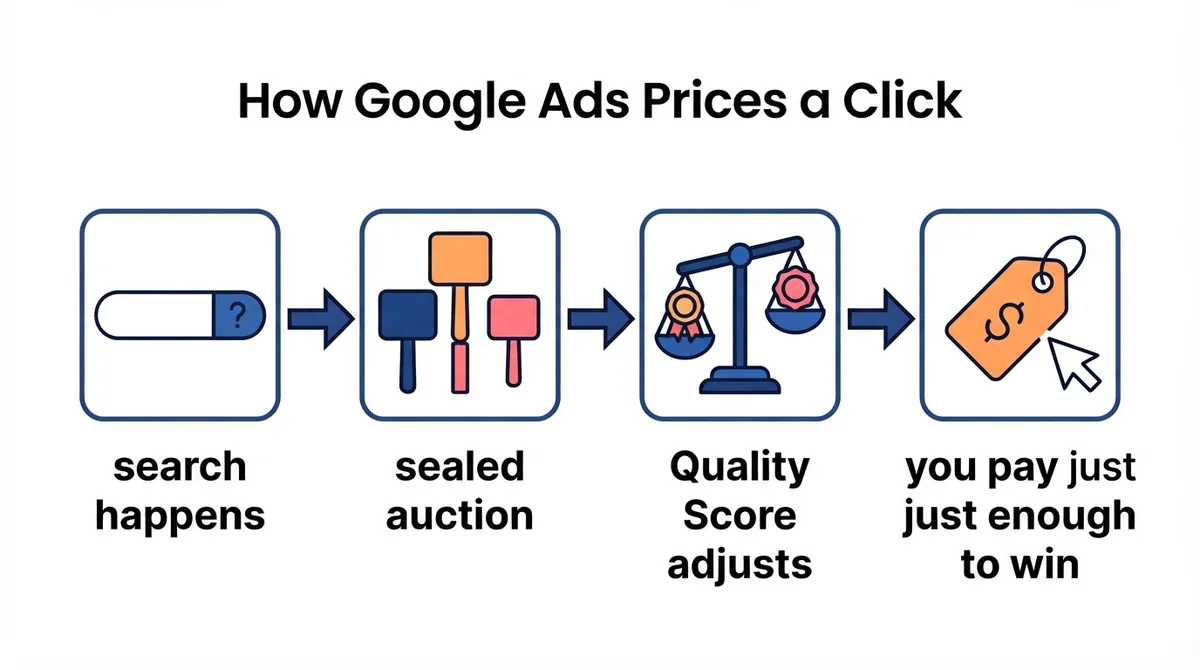
The three core buying models you will encounter:
- Cost per click (CPC). You pay only when someone clicks. This is the default for Search and the most common model for performance advertisers.
- Cost per mille (CPM). You pay per thousand impressions. This dominates Display and YouTube, where the goal is reach and frequency rather than an immediate click.
- Target CPA and target ROAS. You set a goal and Google's bidder manages the auction to hit it, charging per conversion or per sale. You trade some control for automation.
Because the unit of purchase varies, comparing "Google Ads cost" to a fixed number is misleading. The honest question is what a conversion costs you, which is why our cost per acquisition formula is the better planning tool than any headline CPC.
What Drives Your Cost per Click?
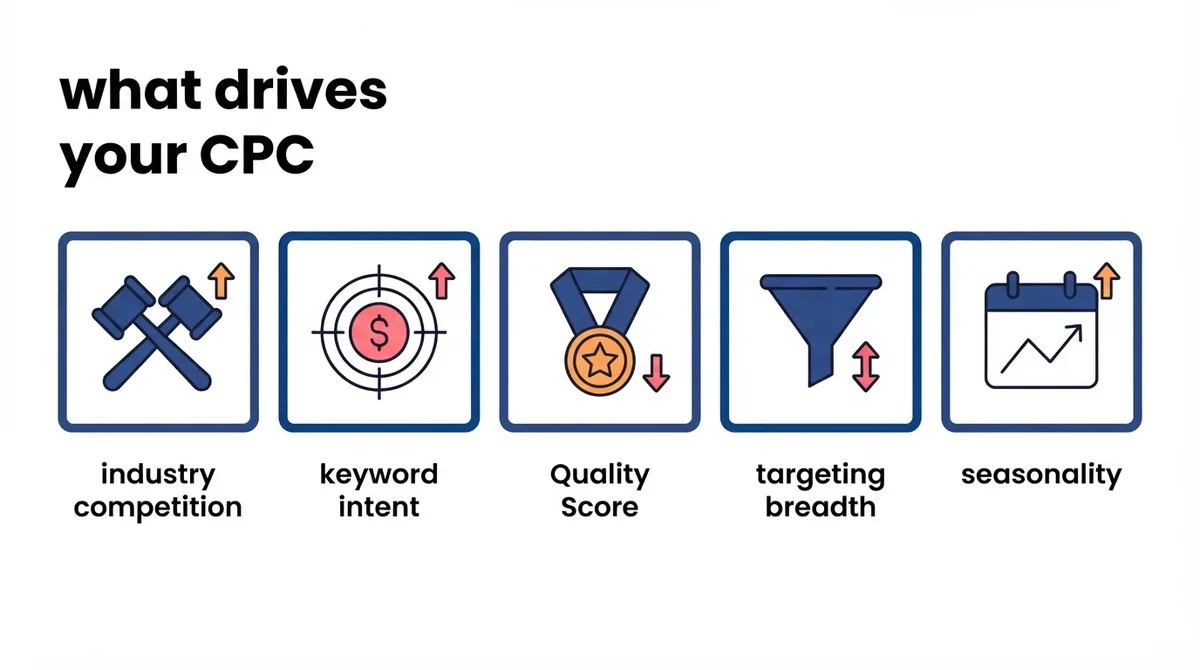
Five levers decide almost everything about what you pay:
| Lever | Direction | What to do about it |
|---|---|---|
| Industry competition | High-intent commercial niches cost more | Expect legal, finance, insurance, and SaaS keywords to clear at a premium. |
| Keyword intent | Bottom-funnel terms cost more | "Buy" and "pricing" queries cost more than "what is" queries; balance them. |
| Quality Score | Higher score lowers price | Improve ad relevance, expected CTR, and landing-page experience first. |
| Targeting breadth | Narrow can raise or lower | Tight audiences reduce waste but can spike CPC if they shrink eligible inventory. |
| Seasonality | Peak periods raise price | Q4 and category peaks are the most expensive windows of the year. |
Of these, Quality Score is the one you control most directly and the one with the largest compounding effect. A one-point lift across a large account can cut effective CPC by a meaningful fraction without changing a single bid. The operational setup that feeds it is covered in our Google Ads account structure guide.
What Is a Realistic Google Ads Budget for a Startup?
There is no universal minimum that produces a result, but you can build one from math. Start with the number of conversions you need per month, divide by your expected conversion rate to get required clicks, multiply by your expected CPC to get media cost, then add management. If you need 50 demos a month at a 2 percent landing conversion rate, that is 2,500 clicks; at a $6 CPC that is $15,000 in media before any overhead. The startup budget calculator walks this exact path.
A common failure is setting the budget from cash on hand rather than from the math, then judging the channel on too little data. Give a campaign enough spend to clear the learning phase and reach statistical relevance, or you will read noise as a verdict. Our budget planning guide and scaling strategy cover how to raise spend without breaking efficiency.
How Do Google Ads Costs Compare Across Channels?
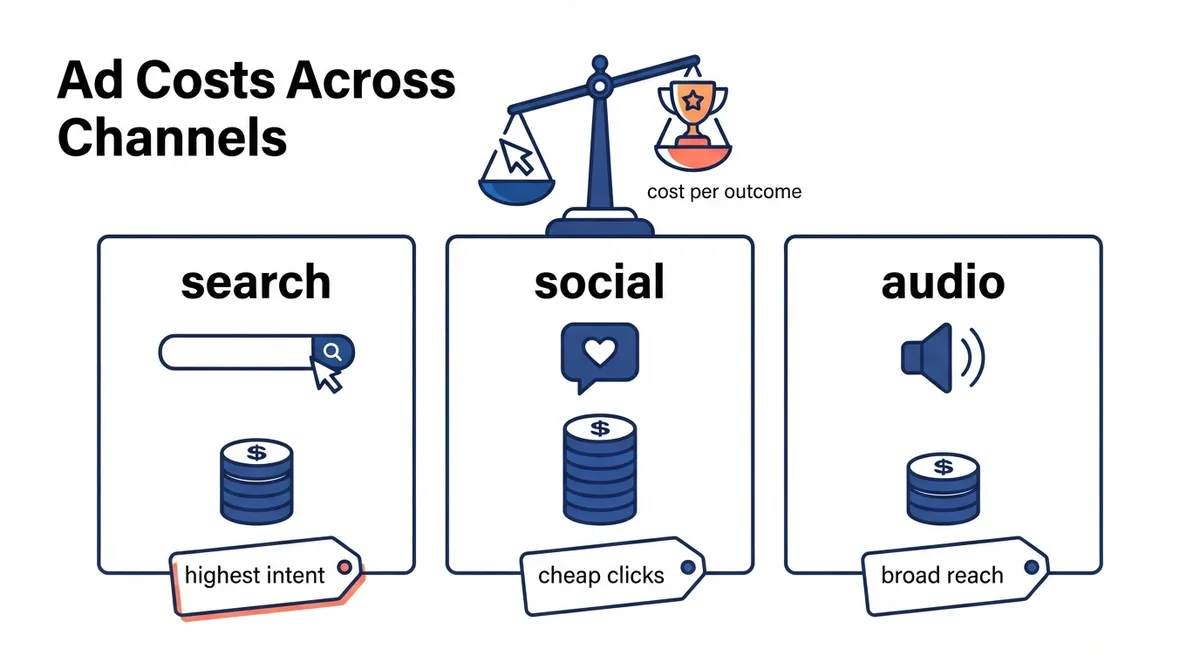
Google is rarely the cheapest click, but it is often the highest-intent click because the user typed the need. Compared with social and audio channels, the cost unit differs, so the fair comparison is cost per outcome, not cost per click. For side-by-side anchors, see what LinkedIn ads cost, how Facebook compares to Google on cost, and how Reddit stacks up against Google. The broader picture is in our ad cost comparison across platforms, and our advertising platforms for startups guide picks where spend first
How Do You Lower Google Ads Cost Without Losing Volume?
Cutting bids is the laziest lever and the most damaging to volume. The order that protects results:
- Raise Quality Score first. Better relevance and landing pages earn cheaper clicks and better positions simultaneously.
- Tighten to intent, not to size. Pause terms that spend without conversions; keep broad match where it converts. This protects volume while removing waste.
- Use negative keywords aggressively. Each irrelevant query you block is spend returned to terms that work.
- Move mature campaigns to target CPA or target ROAS. The bidder finds cheaper conversions at scale than manual rules usually can.
None of this works if you cannot see which clicks become customers. Reliable conversion tracking is the precondition, so set up conversion tracking for startups before you optimize on cost alone.
When Should You Outsource Google Ads Management?
Managing Google Ads well is a part-time job once spend is meaningful, and the cost of mistakes compounds. The build-it-yourself path suits very early stages with tiny budgets; the agency path suits teams where the founder's hour is better spent on product. Either way, judge the engagement on cost per acquisition, not on activity. The startup-specific budget math is in our Google Ads cost for startups guide.
Frequently Asked Questions
What Is the Average Cost per Click on Google Ads?
Reported averages span roughly $2 to $4 across all industries, but the figure is nearly useless without context. Competitive business niches regularly clear $10 to $50 per click, while broad consumer terms can sit under $1. Model your own from expected conversion rate and target acquisition cost rather than quoting a blended average.
Is Google Ads CPC or CPM?
Most advertisers buy on CPC for Search and on CPM for Display and YouTube. You can also use target CPA or target ROAS, where Google's bidder manages the auction to hit a conversion or revenue goal. The model you pick changes what you are actually paying for.
Why Is My Google Ads Cost Higher Than Benchmarks?
The usual causes are a low Quality Score, overly narrow targeting that shrinks eligible inventory, bidding on high-competition commercial keywords, and running during peak season. Each of these raises the clearing price in the auction. Fix relevance and landing-page experience before cutting bids.
How Much Should a Startup Budget for Google Ads?
Budget backwards from required conversions: conversions divided by conversion rate gives needed clicks, multiplied by expected CPC gives media cost, plus management. A small absolute budget is fine for learning, but it must be large enough to clear the learning phase and produce a statistically meaningful read on cost per acquisition.
How Do You Measure Google Ads ROI?
Track revenue per conversion and compare it to total cost including management. Because Google is often an assisted, not last, click, pair platform reporting with a clean attribution view and, where possible, a geo holdout. The measurement foundation is in our conversion tracking setup guide.