
Choosing the wrong google ads keyword match types can burn through your budget before you ever reach a potential customer. In 2026, the three match types — broad, phrase, and exact — behave differently than they did just two years ago, largely because Google's AI has changed how queries map to keywords. If you're running paid search for a startup, understanding this distinction is non-negotiable. For the broader foundation you'll need before going deep on match types, see our complete guide to Google Ads for startups, which covers campaign structure, bidding strategy, and more.
How Google Ads Keyword Match Types Actually Work in 2026
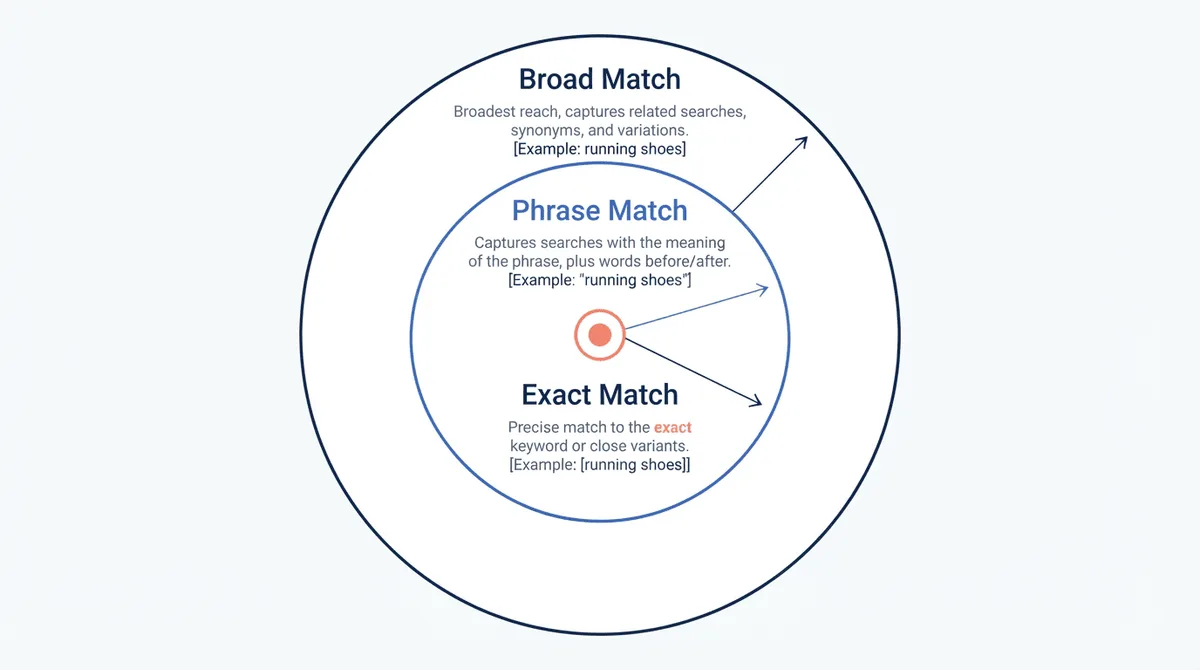
Keyword match types control which search queries trigger your ads. Each match type defines a different scope of relevance between a user's query and your keyword — from the widest (broad) to the most precise (exact).
Here's how each match type behaves today:
| Match Type | Syntax | Triggers Ads For |
|---|---|---|
| Broad Match | project management tool | Synonyms, related concepts, paraphrases — AI-determined |
| Phrase Match | "project management tool" | Queries containing the meaning of the phrase, in order |
| Exact Match | [project management tool] | Queries with the same meaning and intent, minimal variation |
Real query examples for the keyword "project management tool":
- Broad match may trigger: "team collaboration software," "task tracker for remote teams," "best apps to manage projects"
- Phrase match may trigger: "affordable project management tool for startups," "project management tool review" — but not "task management solutions"
- Exact match may trigger: "project management tool," "project management tools" — but not "best project management tool"
In 2026, both phrase match and exact match have expanded their matching behavior compared to their 2020 definitions. Google's Smart Bidding pairs with match types to optimize bids per auction, so the match type you select directly affects your cost-per-click and conversion volume.
Broad Match vs. Phrase Match vs. Exact Match: The Startup Decision Framework
Each match type serves a distinct purpose, and the right choice depends on your campaign goals, budget stage, and conversion data volume.
Broad Match works when you have enough conversion history for Smart Bidding to function effectively — typically 30–50 conversions per month per campaign — and a tightly managed negative keyword list. Broad match is increasingly powerful in 2026 when paired with Target CPA or Target ROAS bidding.
Phrase Match is the middle ground. It gives Google room to match adjacent intent while keeping your ads anchored to the core meaning of your keyword. For most early-stage startups, phrase match is the right default starting point.
Exact Match delivers the highest relevance and the lowest waste. Use it for your highest-value, highest-intent keywords — the queries where conversion rates are proven. Exact match also helps when improving Quality Score through better keyword relevance, because tighter match types typically produce higher CTRs and more relevant landing page experiences.
| Goal | Recommended Match Type |
|---|---|
| Scale reach during testing | Broad + Smart Bidding |
| Capture specific intent without over-restriction | Phrase |
| Maximize conversion rate on proven keywords | Exact |
| Niche B2B terminology with low search volume | Exact or Phrase |
For B2B products specifically, the approach differs: targeting B2B keywords with the right match types requires accounting for lower search volumes and higher CPCs, where exact match often protects margin better than the alternatives.
Building a Match Type Strategy That Balances Reach and Precision
A sound keyword targeting Google Ads approach isn't about picking one match type — it's about structuring campaigns to use all three deliberately.
A practical framework for startups:
- Start with phrase and exact. Launch with phrase match to discover query patterns and exact match on your known high-intent terms.
- Run a Search Terms report weekly. Identify which queries convert, then add top performers as exact match keywords - a step you can automate with Google Ads scripts.
- Add negatives continuously. Effective pairing match types with a strong negative keyword list is what separates efficient campaigns from ones that bleed spend on irrelevant traffic.
- Introduce broad after you have data. Once a campaign reaches 30+ conversions per month, test broad match in a separate campaign with automated bidding.
When allocating budget across match type campaigns, a common split for growth-stage startups looks like this: 50% to exact match (proven converters), 35% to phrase match (expansion), and 15% to broad match with Smart Bidding (discovery). Adjust as your data matures.
The Match Type Mistakes That Are Draining Your Ad Budget
Most startup ad accounts hemorrhage money through the same predictable match type errors.
- Running broad match without Smart Bidding. Broad match on manual CPC is the fastest way to exhaust a limited budget on irrelevant queries.
- Mixing match types in a single ad group. When broad, phrase, and exact versions of the same keyword share an ad group, they compete against each other and inflate CPCs.
- Skipping negative keywords entirely. Without negatives, even exact match — which now allows close variants — can trigger surprising queries.
- Never checking the Search Terms report. Match type behavior is dynamic. Actual query data shifts weekly.
- Assuming phrase match is "safe." In 2026, phrase match has absorbed much of what modified broad match used to do. It casts a wider net than most marketers expect.
You cannot optimize what you don't measure. Before adjusting your strategy, set up tracking which match types drive actual conversions — without conversion data segmented by match type, every optimization decision is a guess.
How AI-Powered Broad Match Is Reshaping Keyword Strategy in 2026
Google's AI fundamentally changed what broad match means. It now uses signals — your landing page content, existing keywords in the account, search context, and active bid strategy — to determine intent matching rather than relying on lexical overlap.
The result: broad match in 2026 is smarter and more dangerous in equal measure. Paired with Target CPA and a well-structured account, it finds converting queries you never would have thought to bid on explicitly. Used carelessly on manual CPC, it burns budget on queries with zero commercial intent.
The 2025-2026 trend across sophisticated Google Ads accounts is clear: more budget flowing to broad match, smaller keyword lists overall, and heavier reliance on Smart Bidding to handle the granularity that humans used to manage through exhaustive keyword lists. Google's own recommendations have shifted firmly in this direction. For a full walkthrough of how to run broad match without wasting budget, see our guide to Google Ads broad match, and for the tools that make this kind of automation practical, our comparison of PPC automation tools.
The right posture for startups: treat broad match as a graduate-level tool. Don't deploy it in your first 60 days of running a campaign. Build conversion data with phrase and exact match first, refine your negative keyword list, then run broad match as a controlled experiment with automated bidding and a defined budget cap.
FAQ
What is the difference between broad match and phrase match in Google Ads? Broad match triggers your ad for queries that share a related meaning or intent, including synonyms and paraphrases determined by Google's AI. Phrase match triggers your ad for queries that contain the meaning of your keyword, typically in a similar order, with less interpretive flexibility.
Does exact match mean only that exact query triggers my ad? No. In 2026, exact match includes close variants — misspellings, plurals, reordered words with the same intent, and paraphrases with equivalent meaning. It's more restrictive than phrase or broad, but it's not a rigid character-for-character lock.
Should startups use broad match keywords? Startups with limited budgets and low conversion volume should start with phrase and exact match. Broad match becomes effective once Smart Bidding has sufficient data — generally 30 or more conversions per month per campaign.
Can I run all three match types simultaneously? Yes, but structure them in separate campaigns or clearly separated ad groups. Mixing all three in one ad group creates auction conflicts and makes performance measurement by match type nearly impossible.
Key Takeaways
- Google Ads keyword match types — broad, phrase, and exact — control how broadly your keywords map to user search queries.
- Exact match delivers the highest precision and lowest wasted spend; reserve it for proven, high-intent keywords.
- Phrase match balances reach and relevance; it's the right default starting point for most startup campaigns.
- Broad match is more capable than ever in 2026, but only when paired with Smart Bidding and sufficient conversion data.
- Build your negative keyword list in parallel with any match type strategy — it's not optional, it's structural.
- Review your Search Terms report every week to understand which queries are actually triggering your ads.
- Start with phrase and exact match, accumulate conversion data, then expand carefully into broad match once the algorithm has enough signal to work with.
Gmail ads delivered through Demand Gen pair naturally with search; our Gmail ads guide covers the setup.
Related: for a deeper look, see our guide on broad match.