
Meta advertising policies on personal attributes forbid ad copy that asserts or implies knowledge of a person's protected characteristics. The personal attributes policy is the single rule that causes the most confusing Meta ad rejections, because it targets the words in your creative rather than your audience settings. Following it means rewriting second-person claims before you submit.
What Is Meta'S Personal Attributes Policy?
Meta's personal attributes policy is a content rule that prohibits ads from stating or suggesting that the advertiser knows something about an individual viewer's personal characteristics. In plain language, your ad cannot act as if it knows who the reader is. The protected categories the policy names are race, ethnicity, religion, beliefs, age, sexual orientation, gender identity, disability, medical or mental health condition, financial status, membership in a trade union, criminal record, and a person's name.
The key word is "attributes." It is not enough that an ad mentions a category in the abstract. The violation happens when the copy points at the reader and implies they belong to that category. That distinction is what makes the rule confusing, because the same topic can be compliant or non-compliant depending only on how the sentence is framed.
Why Does Meta Enforce This Policy?
Meta enforces the personal attributes policy because of how ads make people feel, not because of how advertisers target. The concern is user perception: when an ad says "you," the viewer can feel singled out or profiled, as if the platform handed the advertiser a dossier on them. That perception erodes trust in both the advertiser and the platform.
This is why the rule is about copy and not about your audience settings. You may legally and legitimately target any audience through Meta's ad manager. Targeting selects who sees the ad; the personal attributes policy governs what the ad says to them. An ad can be shown only to a narrow, relevant audience and still violate the policy because its wording implies knowledge of a protected trait. The fix is in the creative, not in the targeting controls.
What Actually Triggers a Rejection?
The practical test reviewers apply is the "you" test. If your copy in the second person implies the reader belongs to a protected category, it is at risk. The trigger is the combination of "you" (or an implied reader) plus a protected attribute. Copy that talks about the product, the brand, or a general group is usually fine; copy that assigns an attribute to the person reading it is not.
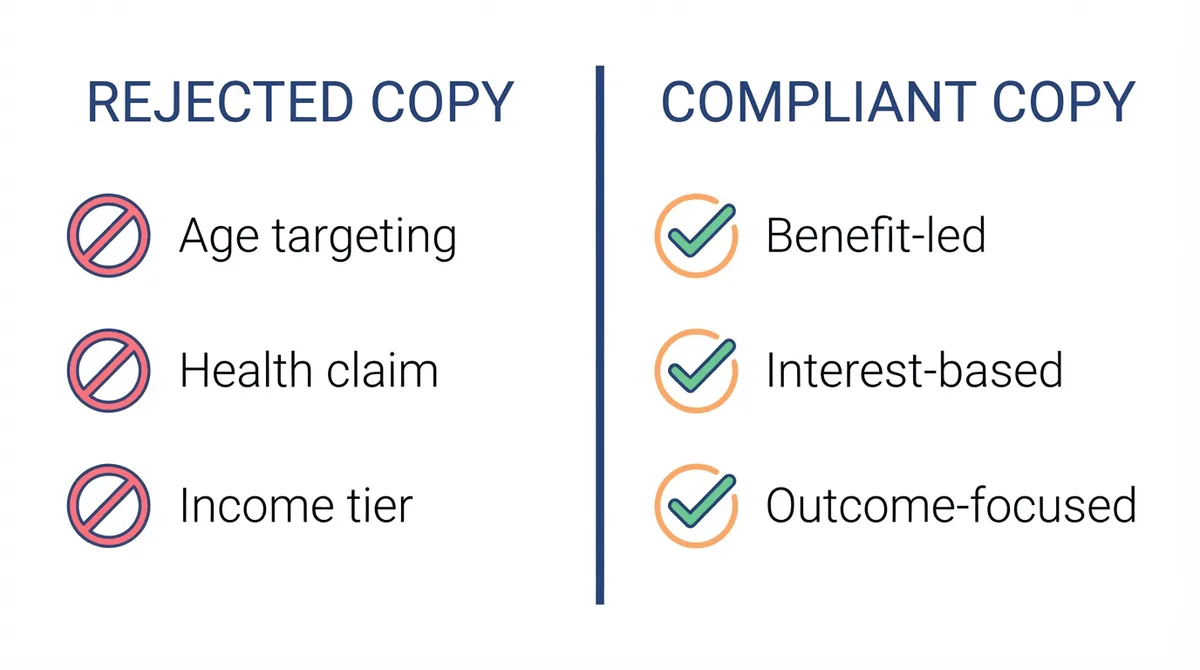
The table below shows how the same idea flips from rejected to compliant depending on framing. These are invented example lines, not real brand copy, written only to illustrate the pattern.
| Rejected phrasing | Why it implies an attribute | Compliant rewrite |
|---|---|---|
| "You have diabetes and need affordable care." | Second person asserts the reader has a medical condition. | "Our clinic offers affordable diabetes care programs." |
| "Are you on disability and struggling with bills?" | Implies the reader receives disability benefits and is in financial distress. | "Support services are available for people managing fixed incomes." |
| "You're over 55, so protect your savings now." | Asserts the reader's age and a related financial concern. | "Retirement savings protection is available for anyone planning ahead." |
| "You suffer from anxiety and can't sleep." | Assigns a mental health condition to the reader. | "We publish guided sleep routines for anyone dealing with stress." |
| "You're Catholic and want faith-based counseling." | Names the reader's religion and assumes belief. | "Faith-based counseling options are available across several traditions." |
| "You have a criminal record, so let us rebuild your credit." | Asserts a criminal record and a financial status problem. | "Credit rebuilding guidance is available for anyone with past setbacks." |
Notice that none of the compliant rewrites name the reader. They describe the offer or a broad group in the third person. The attribute is no longer pinned on the person holding the phone.
How Do You Rewrite Copy So It Still Converts?
You can keep performance while staying compliant by shifting the subject of the sentence. The goal is to describe what you offer and to whom it is for, without telling the reader who they are. Several reframing patterns work well in practice.
- Talk about the product or service, not the reader. "Our back-pain program" beats "your back pain."
- Use first person or third person for the offer. "We help people find..." or "Our team supports clients who..." avoids the "you" trap.
- Replace "you who are X" with "people who want X." Qualify on intent and interest, which is safe, rather than on a protected trait.
- Move qualification into the landing page or lead form. Let the user self-select on the destination page instead of the creative.
- Lead with the outcome, not the identity. "Get help managing chronic conditions" is stronger and safer than naming the condition as the reader's.
When you move sensitive qualification off the ad and onto the landing page, you preserve targeting relevance without implying knowledge of the viewer. The lead form can still ask the questions that matter; the creative just stops answering them on the reader's behalf.
What Is the Review-And-Rewrite Workflow for an Ads Team?
A repeatable process keeps personal attributes rejections from slipping through. Build these steps into your pre-launch checklist so the copy is clean before it ever reaches Meta's review.
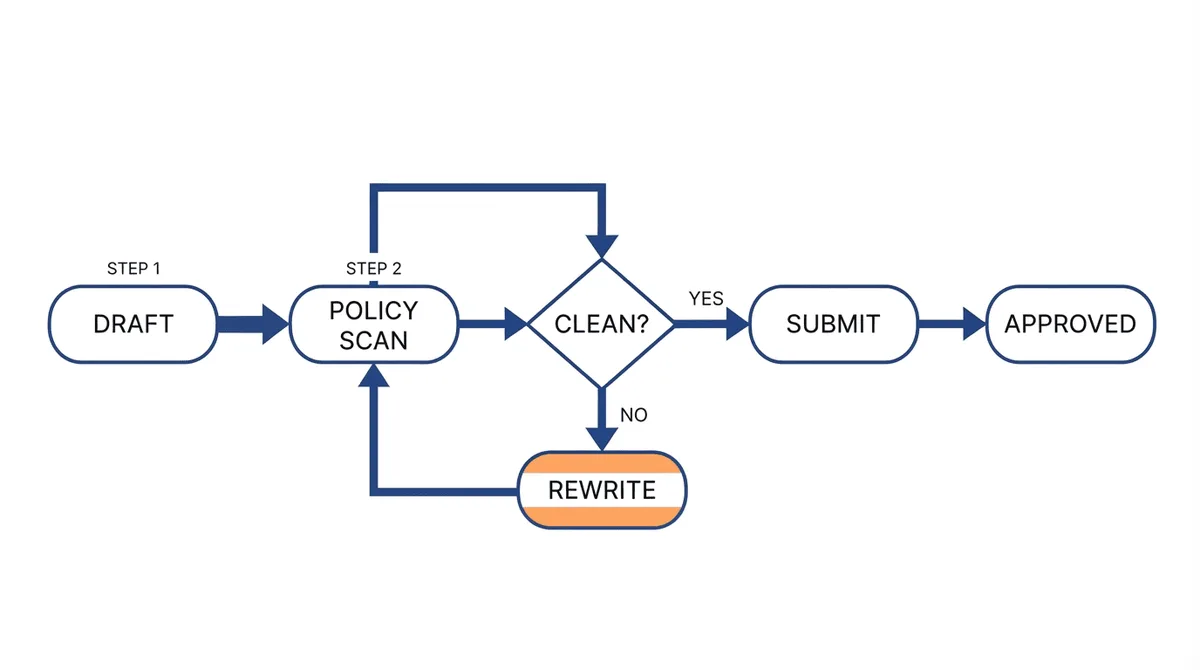
- Run a pre-flight copy review on every ad variant before submission, using a shared checklist.
- Flag any second-person claim that touches a protected category such as health, age, or financial status.
- Apply the rewrite pattern: move the subject to the product or to "people who want X" instead of "you who are X."
- Log the new variant with a note on what changed, so the compliant version is reusable.
- Submit the ad through the standard review flow and monitor for status changes.
- If rejected, read the specific policy cited in the notice rather than guessing at the reason.
- Either appeal with a clear explanation or rewrite using the flagged line as the example, then resubmit.
- Record the rejected pattern in a shared do-not-use list so the same mistake is not repeated across campaigns.
What Happens If You Keep Violating It?
A single rejection is a normal part of running ads and usually just requires a rewrite. Repeated or egregious violations, however, can affect your account. The progression tends to follow a pattern that gets more serious the more you ignore it.
- Individual ads are rejected and paused, which can delay launches and waste booked creative cycles.
- Account quality signals can worsen, which may slow future review times or increase scrutiny on new submissions.
- In persistent cases, Meta can apply restrictions that limit your ability to advertise certain categories or run certain accounts.
If you see repeat flags, treat them as a process failure rather than bad luck. Audit your shared copy library, update the do-not-use list, and train reviewers on the "you" test. The fastest path out of repeat rejections is to fix the source templates, not to keep appealing individual ads.
What Is Commonly Misunderstood About This Policy?
Several misunderstandings cause teams to rewrite the wrong things. Clearing these up prevents wasted effort and avoids the rejections that come from fixing targeting when the problem is copy.
- It is not about your targeting. Narrow audiences are allowed; the rule governs what the ad says.
- It applies to images and video text too, not just the written body copy of an ad.
- Landing pages can be reviewed. Moving a claim to the destination does not make an unsafe claim invisible forever.
- "Implied" is enough. You do not have to state an attribute outright; suggesting it through "you" triggers the same outcome.
- Name mentions count. Using a person's name to imply a relationship or trait is covered, not just the broad categories.
Because the policy is about perception, reviewers weigh how the ad reads to a reasonable viewer, which means borderline phrasing is judged on implication rather than literal wording.
For the broader set of rules beyond personal attributes, read our full Meta ads policy guide. If you are building paid social into a larger growth plan, our Facebook ads strategy for startups covers how compliant creative fits into campaign structure.
Related: if your ads imply income or earnings, also see our Meta ads income claims policy guide.
Frequently Asked Questions
What Counts as a Personal Attribute in Facebook Ads?
Personal attributes are the protected characteristics Meta lists in its policy: race, ethnicity, religion, beliefs, age, sexual orientation, gender identity, disability, medical or mental health condition, financial status, trade union membership, criminal record, and a person's name. The violation is not the topic itself but implying the viewer has one of these traits. You can discuss a category in the abstract or describe who your product is for, as long as you do not assign the trait to the reader through "you" language.
Does the Personal Attributes Policy Apply to My Targeting Settings?
No. The policy governs ad copy, images, and video text, not the audience you select in the ad manager. You can legally target a relevant, narrow audience and still comply, provided the creative does not assert knowledge of a protected trait. Many teams waste time loosening targeting when the real fix is rewriting the second-person claims in the ad. Keep your targeting; change the wording.
Can I Imply a Personal Attribute Without Stating It Directly?
Yes, and that is exactly what triggers most rejections. The policy covers implied knowledge, not just explicit statements. Copy like "you who can't work due to injury" implies a disability and a financial state without naming them outright. Reviewers judge how the ad reads to a reasonable viewer, so phrasing that points an attribute at the reader through context or "you" language is treated the same as a direct claim. Describe the offer instead.
Are Images and Videos Subject to the Personal Attributes Policy?
Yes. The rule applies to every part of the creative, including image overlays, on-screen text, and spoken words in video. A visual that singles out a viewer by age, health, or other trait carries the same risk as written copy. When you review an ad, check the thumbnail text, captions, and any graphic labels, not just the body. Keep the same "describe the product, not the reader" rule across all formats.
What Should I Do If My Ad Is Rejected Under This Policy?
Read the specific policy citation in the rejection notice, then either rewrite the flagged line using the reframing patterns or submit an appeal with a clear explanation. If you rewrite, move the qualification to the landing page or lead form and describe the offer in the third person. Log the rejected phrasing in a shared do-not-use list so the team does not repeat it. Repeated flags signal a template problem, so audit your copy library after any rejection.
Key Takeaways
- The personal attributes policy forbids copy that asserts or implies knowledge of a viewer's protected traits, including health, age, and financial status.
- The rule targets creative wording, not your audience targeting, so fix the "you" language rather than the targeting settings.
- Apply the "you" test and reframe copy around the product or "people who want X" to stay compliant and still convert.
- Repeat violations can affect account quality and lead to restrictions, so log rejected patterns in a shared do-not-use list.
- Policies change, so advertisers should check Meta's current policy documentation before launching sensitive campaigns.