
Meta ads policy governs what you can advertise across Facebook and Instagram, and in 2026 enforcement is AI-driven and proactive. The most common reasons ads get rejected are prohibited or restricted content, misleading or exaggerated claims, and personal-attributes violations. Ads that break the rules are disabled automatically, but you can appeal most rejections.
Understanding Meta's advertising policies is essential for running successful campaigns without disruption. In 2026, Meta has significantly tightened AI enforcement, moving from reactive content moderation to proactive risk assessment. Accounts are now disabled not just for obvious policy violations, but for operational behaviors that AI flags as high-risk.
This guide covers Meta's current policy landscape, the most common violations causing ad rejections, restricted content categories, and exactly how to appeal when things go wrong.
Policy Overview
Meta's advertising policies govern what you can and cannot promote across Facebook, Instagram, Messenger, and the Audience Network. These policies exist to protect users from harmful content while maintaining advertiser trust in the platform.
Key Policy Categories
Prohibited Content: Never allowed under any circumstances - includes illegal products, discrimination, weapons, and adult content.
Restricted Content: Allowed with additional requirements - includes alcohol, gambling, financial services, and health products. These require special authorization or targeting restrictions.
Advertising Standards: Rules about how ads must be presented - no misleading claims, no fake functionality, and accurate representations of products and services.
2026 AI Enforcement Changes
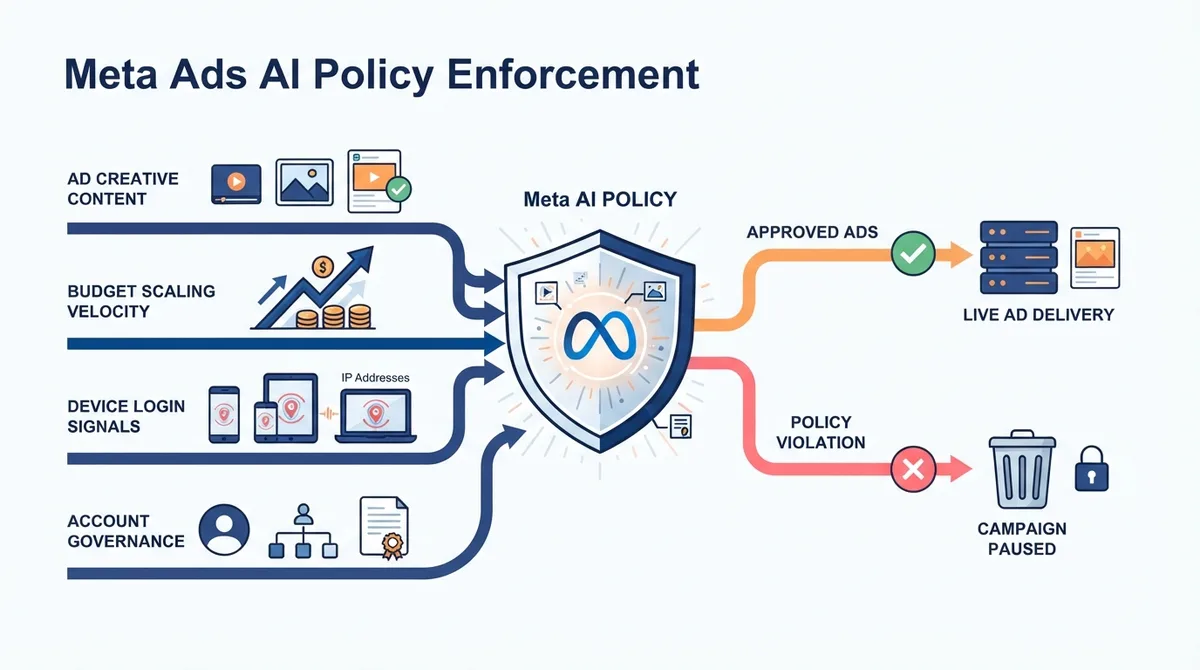
Meta's AI now monitors far more than ad content. The system evaluates:
- Spending patterns and budget stability
- Campaign scaling behavior (sudden increases trigger flags)
- Business Manager structure and governance
- Relationships between ad accounts, pages, and pixels
- Device and IP login data
- Payment behavior and funding sources
This means advertisers can face restrictions without changing any content - simply logging in from a new device or scaling budget too aggressively can trigger AI intervention.
Common Violations
Most ad rejections fall into predictable categories. Understanding these helps you avoid problems before they happen, whether you're learning how to run Facebook ads for the first time or managing established campaigns.
Prohibited Content Violations
According to industry experts tracking Facebook ad rejections, these items are never allowed:
Prohibited Category | Examples |
Illegal products/services | Unlicensed drugs, counterfeit goods |
Tobacco and vaping | E-cigarettes, vape products, tobacco accessories |
Weapons | Firearms, ammunition, explosives |
Discriminatory practices | Targeting or excluding based on protected characteristics |
Adult content | Sexual products or services, nudity |
Misleading claims | Fake news, unverified health claims |
Personal Attributes Policy
One of the most frequently violated policies. Ads cannot state or imply personal attributes about race, ethnicity, religion, age, sexual orientation, gender identity, health conditions, or financial status. The same protected categories constrain your Facebook ad targeting, since you cannot use them to include or exclude audiences in your ad sets.
Violation example: "Are you in your 70s and need mobility help?" Compliant alternative: "Mobility solutions for comfortable living."
Non-Functional Elements Policy
Ads cannot feature fake functionality. This includes:
- Images with fake play buttons
- Graphics mimicking notification badges
- Multiple choice options that don't work
- Fake checkboxes or interactive elements
Misleading Claims
Making promises your product can't deliver leads to immediate rejection. Common issues include:
- Unrealistic before/after images
- Income or results guarantees
- Unverified health or medical claims
- Exaggerated testimonials
Example: A collagen brand was disabled for the phrase "Helps improve skin in just 7 days" - AI classified this as an unverified medical claim despite the brand having FDA certification.
Operational Violations (New in 2026)
Beyond content, Meta now penalizes operational behaviors. These issues significantly impact how much to run ads on Facebook effectively:
- Aggressive scaling: Increasing spend too quickly (e.g., $80/day to $650/day in three days)
- Device switching: Logging in from multiple unfamiliar devices
- Account associations: Linking to Business Managers with past violations
- Payment irregularities: Unusual billing patterns or failed payments
Restricted Content Categories
These categories can be advertised but require additional compliance steps or targeting restrictions.
Alcohol
- Must comply with local legal drinking age requirements
- Cannot target minors
- Must follow country-specific alcohol advertising laws
- Requires age-gating on landing pages in many regions
Online Gambling and Gaming
2026 brought stricter gambling advertising rules. Meta now maintains a blacklist of prohibited countries, and advertisers bear full responsibility for local law compliance. Requirements include:
- Prior written permission from Meta
- Targeting only adults in permitted regions
- Displaying responsible gambling messaging
- Linking to licensed operators only
Financial Services
Strict requirements apply to ads promoting loans, credit products, investment opportunities, insurance products, and cryptocurrency (heavily restricted or prohibited depending on region). Finance and investment categories see 78% of accounts face restrictions according to agency data, making this one of the highest-risk sectors. Restricted verticals like these also shape how much Meta ads cost to run, since narrower targeting and added review tend to raise CPMs.
Health and Beauty
Health-related ads face intense scrutiny. To stay compliant:
- Avoid before/after images suggesting unrealistic results
- Don't make specific medical claims without approval
- Ensure supplements don't promise disease treatment
- Get proper certification where required
Supplements see 64% of accounts reviewed at least once in Q1 2026 - a 41% increase from the previous quarter.
Dating Services
Require prior approval and must:
- Target only adults
- Not promote infidelity or escort services
- Clearly represent the service offered
Political and Social Issues
Ads about elections, social issues, or political figures require:
- Identity verification
- "Paid for by" disclaimers
- Storage in Meta's Ad Library
- Compliance with local election laws
Appeal Process
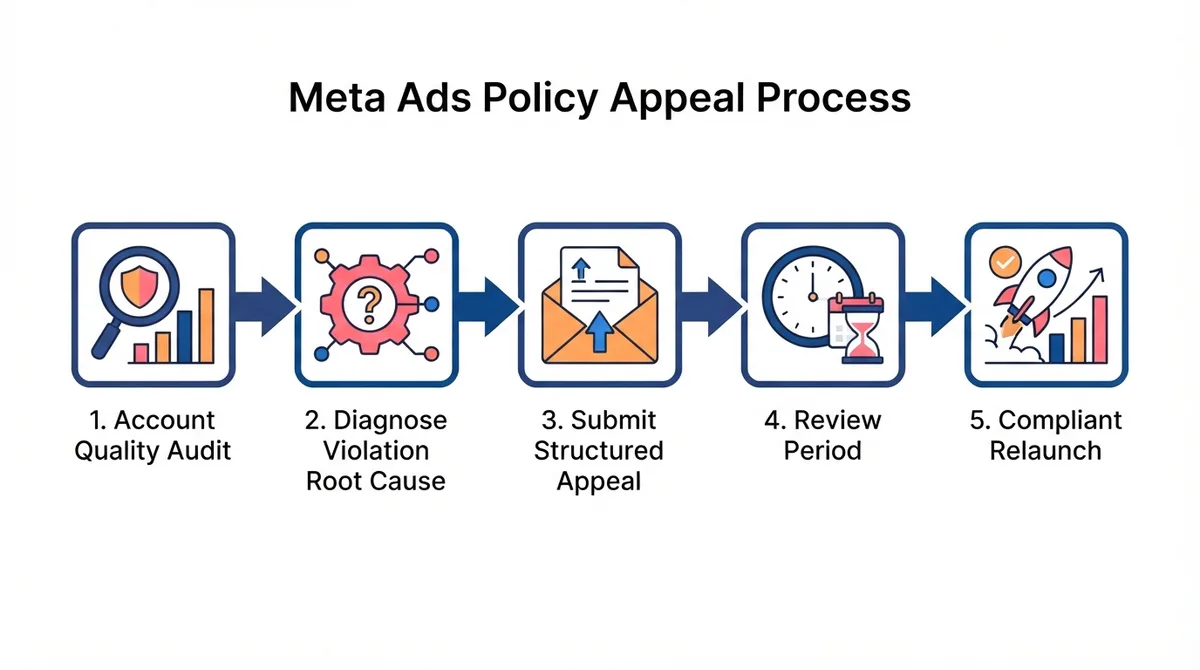
When ads are rejected or accounts are restricted, you have options - but success depends on following the right approach.
Step 1: Check Account Quality
Start in Account Quality within Ads Manager. This dashboard shows:
- Which ads were rejected and why
- Current account standing
- Any pending restrictions
- Appeal options available
Step 2: Understand the Violation
Before appealing, identify exactly what triggered the rejection. Common categories include:
- Specific ad content violation
- Landing page issues
- Account-level restriction
- Payment problems
Step 3: Submit Your Appeal
According to Facebook ad recovery specialists, effective appeals should:
- Be polite, concise, and honest
- Accept responsibility if a mistake was made
- Clearly explain what corrective steps you've taken
- Reference specific policies you now understand
- Request manual review calmly
Do not:
- Submit multiple appeals simultaneously
- Log in repeatedly while waiting
- Make changes to the account during review
- Use aggressive or demanding language
Step 4: Wait for Review
Appeals typically take 7-10 business days. During this time:
- Avoid logging in excessively
- Don't submit additional appeals
- Don't make account changes
- Document everything for reference
Step 5: If Appeal Fails
If your appeal is denied:
- Create a copy of the rejected ad
- Analyze all elements against policies
- Make necessary changes to achieve compliance
- Submit the revised version as a new ad
For account-level restrictions, you may need to start fresh with a new Business Manager, use gradual scaling (20-30% budget increases every 4-5 days), maintain clean device and login hygiene, and avoid linking to any previously restricted assets. Many advertisers find working with best Facebook ads agencies helpful for navigating complex account recovery scenarios.
Prevention Is Better Than Cure
Given Meta's AI enforcement strictness in 2026, focus on prevention:
- Review AI-generated copy variations before launching (especially in regulated industries)
- Scale budgets gradually - never more than 20-30% increases
- Maintain consistent login devices and locations
- Keep Business Manager governance clean
- Review all ad copy against current policies before submission
Related: our crypto advertising guide.
Frequently Asked Questions
Why Was My Facebook Ad Rejected Without Explanation?
Meta's AI may flag ads based on operational patterns rather than specific content. Aggressive budget scaling, new device logins, or associations with previously restricted accounts can trigger rejections. Check Account Quality for specific violations, and consider your recent account activity beyond just ad content.
How Long Do Facebook Ad Appeals Take?
Most appeals are reviewed within 7-10 business days. Complex cases involving account-level restrictions may take longer. Avoid submitting multiple appeals or making account changes during this period.
Can I Advertise Supplements on Facebook?
Yes, but with restrictions. Avoid making specific health claims, don't promise disease treatment or prevention, and ensure products comply with local regulations. Supplements face increased scrutiny in 2026, with over 64% of accounts in this category undergoing review.
Key Takeaways
- Meta's 2026 AI enforcement monitors operational behavior, not just ad content - scaling too fast or switching devices can trigger restrictions
- Prohibited content (illegal products, weapons, tobacco, discrimination) is never allowed; restricted content (alcohol, gambling, finance) requires special authorization
- Common violations include personal attributes claims, fake functionality, misleading promises, and unverified health claims
- Appeals require patience: submit politely, wait 7-10 days, avoid multiple submissions, and focus on specific corrective actions
If your ad account has already been shut off, our Facebook ad account disabled recovery guide walks through the appeal steps and how to avoid repeat disables.