
Price against a value metric - the single unit (seats, API calls, transactions) that grows as customers get more value - not against your costs or a competitor's list price. Before product-market fit, run willingness-to-pay interviews, set three good-better-best tiers, charge more than feels comfortable, and raise prices as you add value.
Pricing and packaging is one lever inside a much larger machine. If you have not mapped the whole motion yet, start with the pillar guide on go-to-market strategy for startups and treat this article as the deep dive on the "what do we charge, and how do we structure it" question.
What Is the Difference Between Pricing and Packaging?
They are two separate decisions that founders constantly collapse into one, and that confusion is why so many early pricing pages feel arbitrary.
- Pricing is the number and the model behind it: the value metric you charge against, the price per unit, and the price points on each plan.
- Packaging is what a customer actually receives at each level: the features, usage limits, seats, credits, support, and add-ons bundled into a plan.
Pricing answers "how much." Packaging answers "how much of what." You design them together, but you decide the value metric first, because every packaging choice downstream inherits from it. Get the metric right and the tiers almost draw themselves. Get it wrong and no amount of clever tier design will save the plan.
What Is a Value Metric and How Do You Choose One?
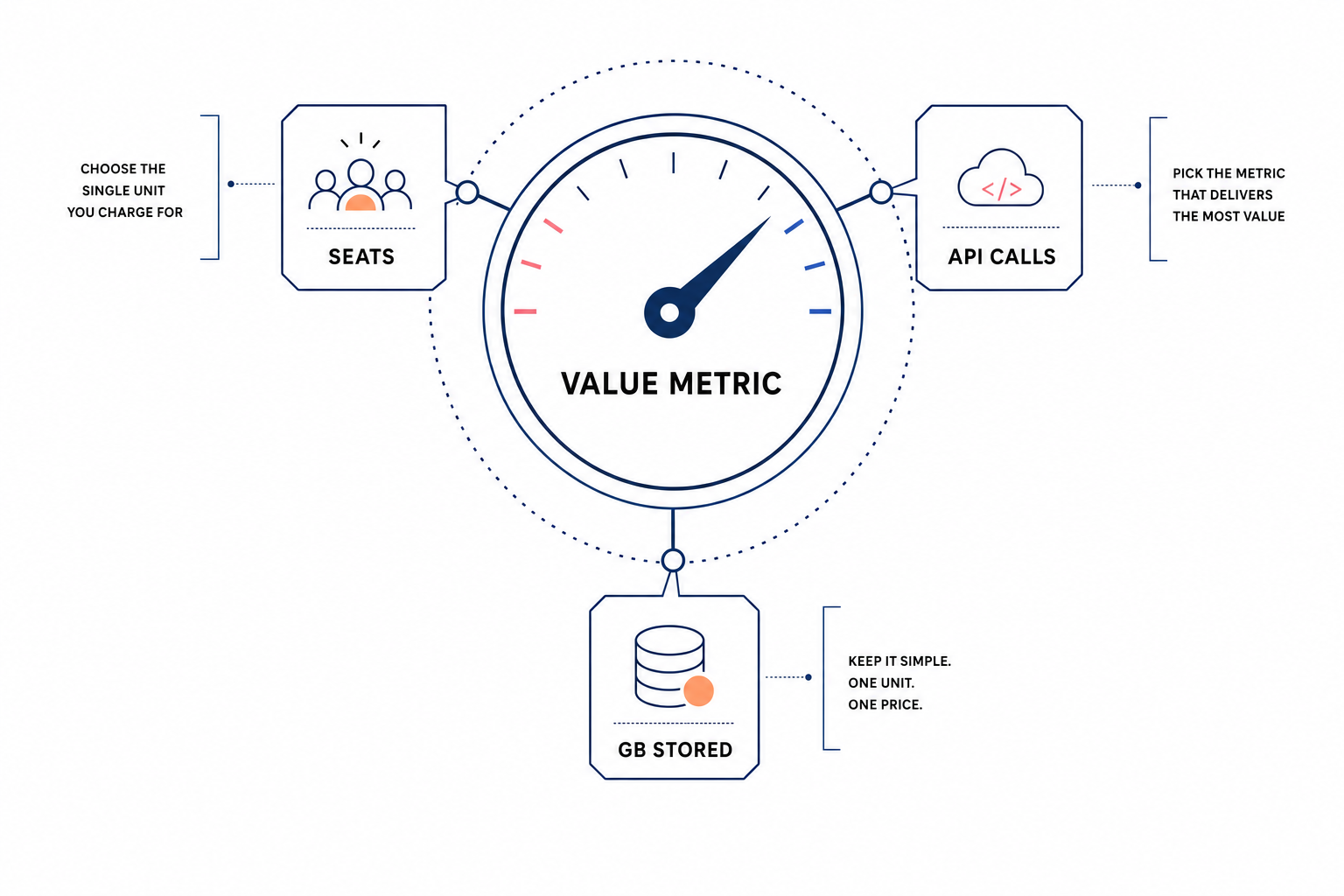
A value metric is the single unit your price scales with - the thing a customer buys more of as they get more value from your product. Slack charges per active user because collaboration value rises with headcount. Twilio charges per message because more messages means more communication delivered. Stripe charges per transaction because they win when you win.
The value metric is the highest-leverage decision in your entire pricing strategy. A good one has three properties:
- It tracks value. When the customer succeeds, the number goes up. When the metric rises, they feel it was fair, not punitive.
- It is easy to understand. The buyer can look at the invoice line and say "of course that went up - we sent more emails / added more seats / processed more orders."
- It is predictable enough to budget. A metric that swings wildly month to month makes buyers nervous and finance teams say no.
To find yours, ask: what does a customer do more of as they get more value? Here is how that maps across common business types.
| Business type | Natural value metric | Why it fits |
|---|---|---|
| Collaboration / team tool | Active seats | Value grows with the number of people using it |
| API / infrastructure | Calls, requests, compute | More usage means more of your service consumed |
| Payments / commerce | Transaction volume or GMV | You earn as your customer earns |
| Marketing / email | Contacts or sends | List size is a clean proxy for the value delivered |
| Analytics / data | Events tracked or rows stored | Scales with how much the product is relied on |
| AI / agent product | Credits, tokens, or actions run | Cost and value both rise with work performed |
Do not overthink perfection here. A "good enough" metric you can bill against today beats a theoretically perfect one you cannot instrument. You will refine it once you have real usage data.
How Do You Research Willingness to Pay with Almost No Customers?
You do not need a data science team or a thousand-response survey. Early-stage willingness-to-pay research is qualitative, cheap, and runs off the customer conversations you should already be having. Four methods, in rough order of when to use them:
- Value-anchored discovery questions. Never ask "would you pay $X?" - people are terrible at answering hypotheticals and will be polite. Instead ask what the problem costs them today: "What are you spending on this now, in tools or hours?" and "What would solving it be worth to you?" Their answer is the ceiling you can price a fraction of.
- The Van Westendorp four questions. Ask each prospect: at what price is this so cheap you'd doubt the quality; a bargain; getting expensive; too expensive to consider. Even 15 to 20 answers reveal an acceptable price band. It is the highest signal-per-effort method for a pre-revenue product.
- Gabor-Granger price testing. Present a specific price and watch the reaction. Instant yes usually means you priced too low. A thoughtful pause means you are in range. A hard no means too high - or a poor fit. Walk the number up and down to find the edge.
- Design-partner deals. Charge your first handful of customers real money, even if discounted. A signed contract is the only willingness-to-pay data that does not lie. Structure these deliberately - our guide on partner-led growth for startups covers how to turn early accounts into revenue and proof at once.
Run these against a real segment, not "everyone." A price that lands with mid-market ops teams will bounce off solo founders, so anchor your research to the specific buyer your channel strategy is built to reach.
How Should You Design Pricing Tiers (Good-Better-Best)?
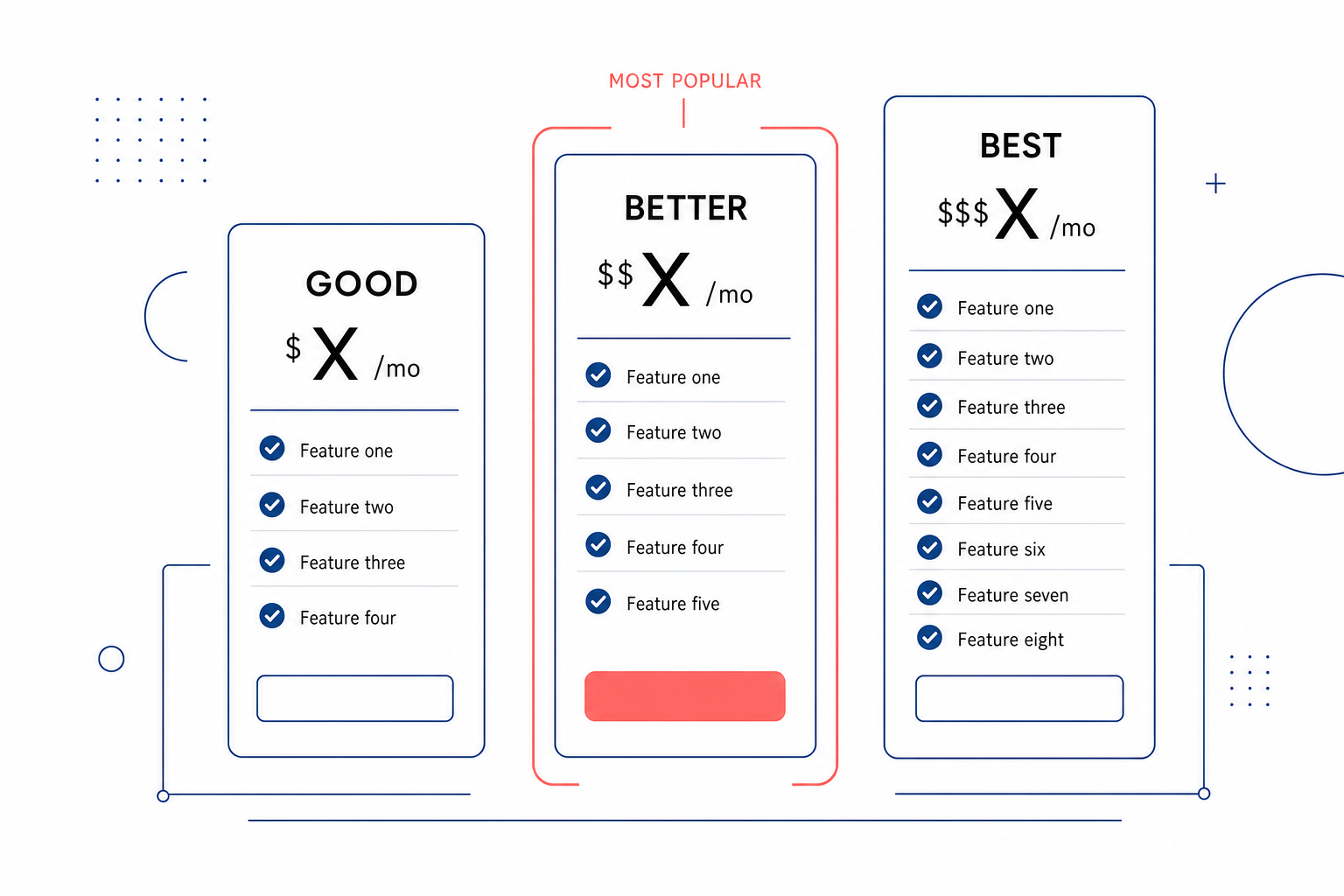
Three tiers is the strategic default for a reason. It gives you an accessible entry point, a clear hero plan for the majority, and a premium tier that captures your highest-value buyers - and it uses simple price anchoring so the middle plan looks like the obvious choice.
- Good (entry / Starter). Its job is not to be the popular plan - it is to lower the barrier to a yes and make the middle tier look reasonable by comparison.
- Better (hero / Growth). The plan you actually want most customers on. Design it so the majority of your target segment sees their must-have features here, and highlight it as recommended.
- Best (premium / Scale or Enterprise). The willingness-to-pay ceiling. It anchors the whole page upward and gives your largest customers a place to spend. Some buyers self-select here purely for the top-tier support and controls.
Differentiate tiers with clean, defensible axes - usage thresholds, seat counts, support level, integrations, or advanced controls (SSO, roles, audit logs). Avoid gating on a long checklist of tiny features; buyers cannot reason about it and it makes every tier feel like a nickel-and-dime. Map each tier to a real customer segment, not to a feature count. If you are still validating product-market fit, two tiers is perfectly fine - add the third once you know where the natural break points are.
Tier design and pricing-page layout are cousins but not the same job. Once your tiers are set, the mechanics of presenting them - anchoring, defaults, feature tables - live in our guide on SaaS pricing page optimization.
Should Early-Stage Startups Use Usage-Based, Seat-Based, or Flat Pricing?
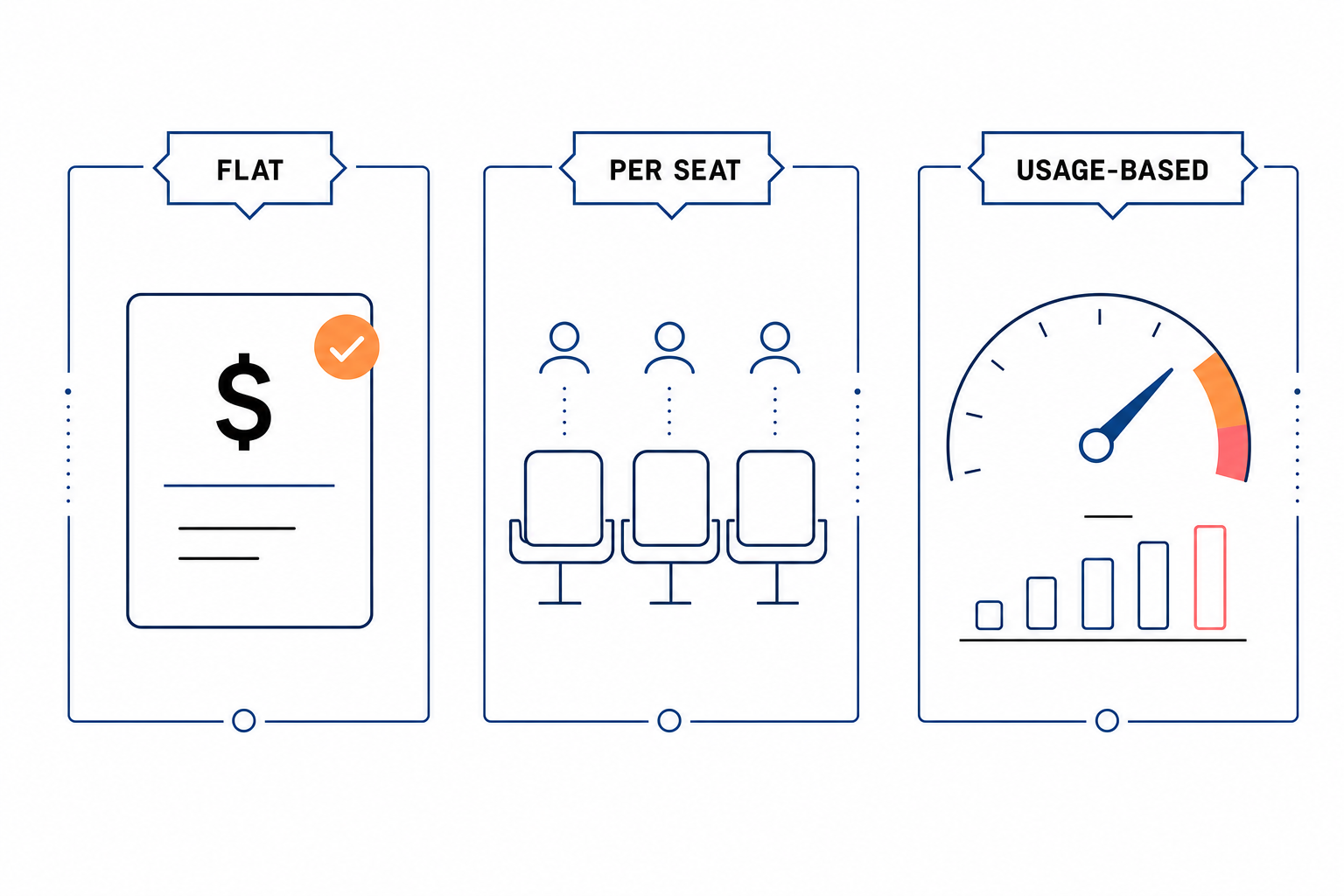
Match the model to how value actually accrues in your product. Here is the trade-off at a glance.
| Flat / simple | Seat-based | Usage-based | |
|---|---|---|---|
| Best when | Value is roughly constant per account; you want to learn fast | Value grows with the number of people using it | Value scales with volume (API, data, AI, transactions) |
| Buyer feels | Predictable, easy yes | Fair and familiar | Fair only if usage is visible and controllable |
| Revenue expands | Only on plan upgrades | As the team grows | Automatically as usage grows |
| Watch out for | Leaves money on the table with power users | Buyers sharing logins to dodge seats | Metering infrastructure and bill-shock churn |
| Early-stage verdict | Great default to launch and learn | Safe if you are a team tool | Only if usage varies a lot and you can meter it now |
For most pre-seed to Series A startups, flat-rate or simple tiered pricing wins first. The goal at this stage is to reduce friction and learn quickly, not to squeeze every dollar. Reach for usage-based pricing when your product has obvious usage variability and you already have the metering plumbing - retrofitting billing infrastructure mid-growth is painful. Many companies land on a hybrid: a base platform fee plus a usage component, which gives you predictable floor revenue and automatic expansion.
What Should You Charge Before Product-Market Fit?
Charge more than feels comfortable, and charge from day one. The two most common early-stage pricing mistakes are pricing too low and giving the product away for free to "get feedback." Both quietly cost you.
- Underpricing is not a growth hack. A price that is too low signals low value, attracts your least serious customers, starves your runway, and is far harder to correct upward later than a high price is to discount.
- Free users are not customers. People will happily accept free and tell you they love it. Only a credit card reveals real demand. Whether a free tier belongs in your model at all is a separate decision - see free trial vs freemium before you default to free.
Practical starting points before PMF:
- Anchor to value, not cost. Cost-plus pricing floors you at your expenses; value-based pricing ceilings you at the buyer's savings. Aim to capture 10 to 25 percent of the value you create.
- Use competitors as a sanity check, not a target. Know the going rate so you are not wildly off, but do not race to the bottom. Our guide on competitive pricing analysis covers how to track that intelligence without letting it dictate your number.
- Sell manually first. Price on live sales calls before you commit a number to a public page. Human conversations let you test, negotiate, and read hesitation - a self-serve self-serve purchase flow comes after you know the number holds up.
- Expect to be wrong. Your first price is a hypothesis. Treat the next two quarters as pricing experiments, not a permanent commitment.
When and How Do You Raise Prices?
Raise prices when you have added enough value that the current number no longer reflects it - and do it far more often than instinct suggests. Signals it is time:
- Prospects say yes too easily, with no negotiation.
- Sales cycles are short and win rates are high on price.
- You have shipped meaningful new value since you last set the price.
- Your best customers are getting outsized value relative to what they pay.
How to do it without triggering churn:
- Grandfather existing customers, at least for a defined window. Loyalty is cheaper to keep than to rebuy.
- Raise on new customers first. New price points are a low-risk experiment - if conversion holds, you were underpriced.
- Tie the increase to added value. "New price, and here is what shipped" lands very differently than a bare increase.
- Communicate early and directly to existing accounts. Surprises churn; notice retains.
Track the impact against your funnel so you can tell a healthy correction from real damage. Watch conversion rate, expansion revenue, and net revenue retention as you move the number - the GTM metrics that matter by stage tell you whether a change helped or hurt.
TL;DR
- Pick a value metric first. The unit your price scales with (seats, calls, transactions) is the single highest-leverage pricing decision.
- Research willingness to pay qualitatively. Value-anchored discovery, Van Westendorp, and paid design-partner deals beat any survey when you have few customers.
- Default to three good-better-best tiers, or two while you are still finding PMF, differentiated on clean usage or seat axes.
- Start flat or simply tiered; add usage-based pricing only when value scales with volume and you can meter it.
- Charge more than feels comfortable before PMF - underpricing signals low value and starves runway.
- Raise prices often, grandfather existing customers, and tie every increase to added value.
FAQ
What Is the Difference Between Pricing and Packaging?
Pricing is how much you charge - the value metric, the model, and the price points. Packaging is what a customer receives at each level - the features, usage limits, seats, and support bundled into a plan. Pricing answers "how much," packaging answers "how much of what." You design them together but choose the value metric first, since every packaging decision inherits from it.
How Many Pricing Tiers Should an Early-Stage Startup Have?
Three is the strategic default: an accessible entry plan, a hero plan for the majority, and a premium tier that anchors the page upward and captures high-value buyers. If you are still validating product-market fit, two tiers is perfectly fine. Add the third once real usage data shows you where the natural break points between customer segments actually are.
Is Usage-Based Pricing Better Than Seat-Based Pricing for Startups?
Not inherently - it depends on how value accrues. Seat-based fits team and collaboration tools where value grows with headcount. Usage-based fits products where value scales with volume, like APIs, data, or AI, but only if you can meter usage and avoid bill-shock churn. For most pre-seed to Series A startups, flat or simple tiered pricing wins first because it minimizes friction and helps you learn fast.
How Do I Figure Out Willingness to Pay Without Many Customers?
Use qualitative methods that run off customer conversations. Ask value-anchored questions about what the problem costs them today rather than "would you pay X." Run the Van Westendorp four-question test with 15 to 20 prospects to find an acceptable price band. Use Gabor-Granger to test specific numbers. Most reliably, charge early design partners real money - a signed contract is the only willingness-to-pay signal that never lies.
When Should a Startup Raise Its Prices?
Raise prices when prospects say yes too easily, win rates on price are high, and you have shipped meaningful new value since the last change - which is usually more often than founders expect. Reduce churn risk by grandfathering existing customers for a window, testing the new price on new customers first, tying the increase to added value, and communicating changes early and directly.