
Partner-led growth is a go-to-market motion where other companies - integration, co-sell, reseller, referral, or marketplace partners - drive your customer acquisition instead of your own ads or sales team. An early-stage startup should use it once it has product-market fit and a clear integration or audience overlap with a larger partner, not before.
Partnerships are one motion among several, so treat this as a companion to the pillar go-to-market strategy for startups guide rather than a replacement for it. Most early-stage teams run partnerships alongside founder-led sales and inbound content; the SaaS go-to-market motions breakdown shows where partner-led sits next to product-led and sales-led, and how the motions compound instead of compete.
What Is Partner-Led Growth (and What It Is Not)?
Partner-led growth means a third party leads a key stage of your customer journey - discovery, evaluation, or purchase - and gets rewarded for the outcome. A partner introduces you to buyers you could not reach cold, lends you credibility you have not yet earned, or bundles you into a workflow the customer already trusts. The revenue is real, repeatable, and cheaper to acquire than paid media because the trust transfer does the selling.
It is worth drawing three hard lines, because the term gets stretched:
- Not creator or influencer deals. Paying a creator to post is a paid-media channel with its own playbook - see the creator partnership framework. That is media buying, not a GTM partnership.
- Not design partners. A design partner co-develops your product at the 0-to-1 stage and gives feedback; a channel or integration partner takes your finished product to their market. Same word, opposite job.
- Not a logo swap. A press release announcing a "strategic partnership" with no shared incentive, no integration, and no pipeline is theater. A real partnership has a mechanism that produces customers.
The signal that a motion is genuinely partner-led, not just partner-flavored, is share of new revenue. When partners consistently source more than half of your new revenue, you are partner-led. Between 40 and 50 percent, partners are influencing but not leading. Below that, you have a direct motion with some partner help - which is a perfectly fine place for an early-stage startup to start.
What Are the Main Types of GTM Partnerships?
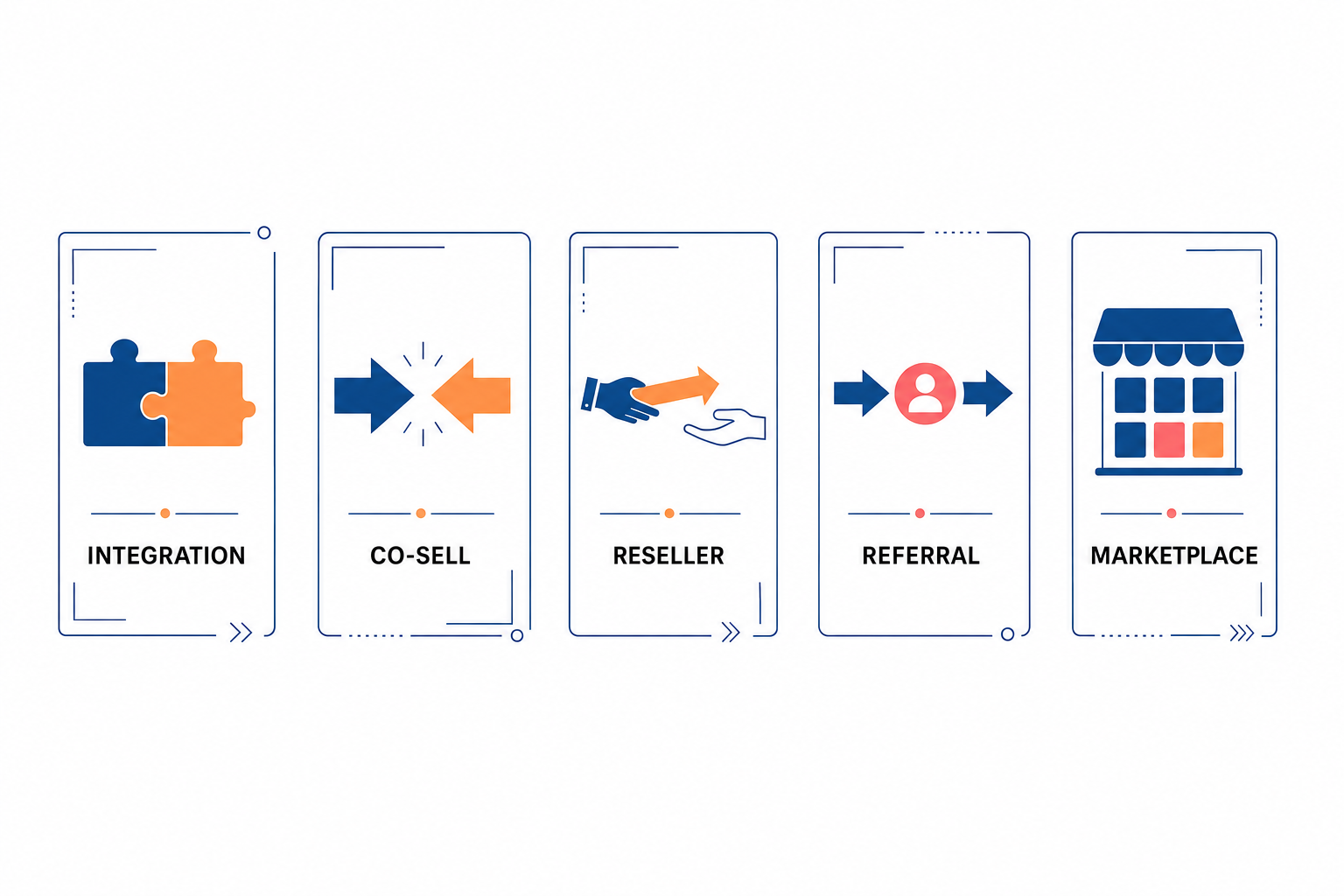
Founders lump every deal under "partnerships," then wonder why the playbook does not transfer. The types differ in effort, time-to-value, and who they fit - pick the one that matches your stage, not the one that sounds most impressive.
| Partnership type | What it is | Effort to launch | Time-to-value | Best fit |
|---|---|---|---|---|
| Integration / tech | Build a connector into a platform your buyers already use; get listed in its marketplace | Medium (eng time) | Medium (weeks to a listing, longer for volume) | Product with a clear "better together" story and an obvious anchor platform |
| Co-sell | Two sales teams work an overlapping account list and split the motion | High (needs sales on both sides) | Slow (relationship-dependent) | Higher-ACV products with a defined ICP and at least a light sales function |
| Reseller / channel | A partner sells your product to their customers for a margin or commission | High (enablement, pricing, support) | Slow (partners ramp before they produce) | Products with implementation needs and a partner ecosystem that services your buyer |
| Referral | A partner sends warm intros; you close and pay a bounty or revenue share | Low (a form and a payout) | Fast (first intros in days) | Almost any early-stage startup - the cheapest first motion |
| Marketplace / ecosystem | A directory or app store lists you; buyers discover you there | Low to medium | Medium (discovery compounds) | Products that plug into a dominant platform's ecosystem |
For most pre-seed to Series A startups the honest sequence is: start with referral (cheapest, fastest), earn an integration wedge (compounding, defensible), and only add co-sell or reseller once you have the ACV and the headcount to support partners who expect enablement. Layering a channel program onto a product with no repeatable direct sales just exports your confusion to other people's reps.
When Is Partner-Led Growth Right for an Early-Stage Startup (and When Is It Too Early)?
Partnerships feel attractive precisely when they are most dangerous: when direct traction is hard and a big-logo deal looks like a shortcut. It rarely is. A partnership amplifies a working motion; it does not create one.
You are ready when:
- You have product-market fit signals - customers who activate, stick, and can articulate the value without you in the room.
- You can name a platform or company whose customers are your customers, with a real "better together" reason to combine.
- You can close a warm intro yourself. If founder-led sales is converting, a partner intro will convert too.
It is too early when:
- You have no repeatable way to turn a qualified conversation into a customer - a partner intro will just die in your funnel.
- Your buyers prefer to evaluate directly and your product needs little implementation, so a partner adds friction, not trust.
- You are chasing a partnership to avoid doing your own channel prioritization work. Partnerships are a channel; they compete for the same founder hours as everything else.
Use GTM channel selection to sanity-check the trade before committing quarters of eng and founder time. The premature-partnership failure mode is quiet: you spend six months co-building an integration nobody adopts because the demand was never there to begin with.
How Do You Land Your First Partners with No Brand or Logos?
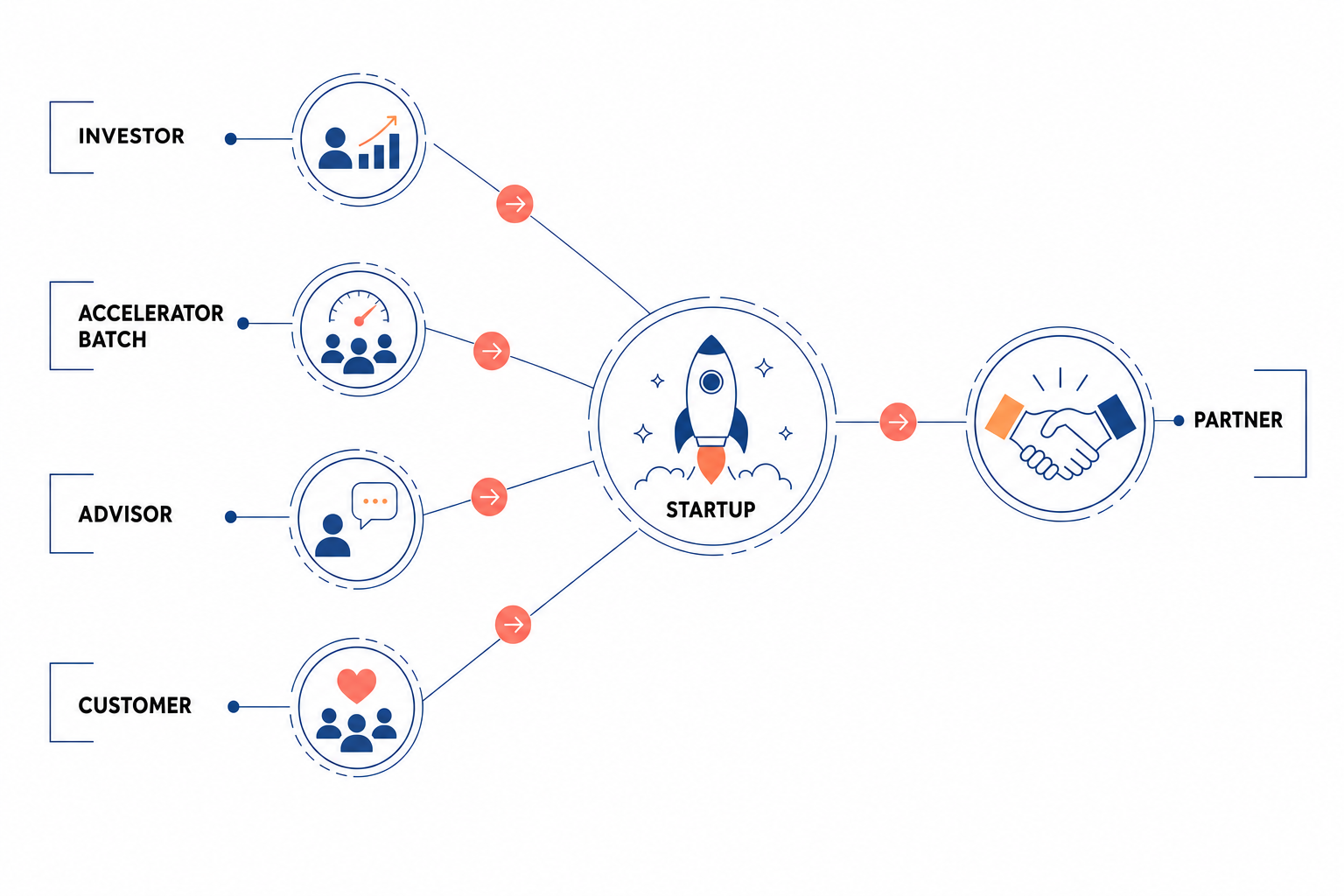
The hardest part of early partner-led growth is the asymmetry: you are asking a bigger, better-known company to spend attention on you. You win by being the low-lift, high-upside side of the deal, and by using the network you already have.
Start with warm intros, not cold BD. Your investors, your accelerator batch, and your advisors are a partnership engine most founders underuse. The accelerator network is full of complementary startups one intro away, plus program partners who already want to see their cohort succeed. A batchmate integration is the fastest first partnership you will ever ship.
Lead with an integration wedge. When you have no logos, the most credible thing you can offer a platform is to make their product more valuable. Build a genuinely useful connector, get listed in their marketplace, and let "works with [platform they trust]" carry the credibility you have not earned yet. Integrations compound: the listing keeps producing discovery long after the build.
Here is a first-partner outreach checklist you can run this week:
- List 10 "better together" candidates - platforms and companies whose customers are your ICP and who gain something when combined with you.
- Find the warm path to each - an investor, advisor, or batchmate intro beats cold outreach every time.
- Lead with their upside, not your ask - "our users keep asking to connect to you, and here's the demand we see" beats "will you promote us."
- Propose the smallest viable first step - a referral swap, a co-authored post, or a lightweight integration, not a co-sell agreement.
- Bring proof you can hold up your end - a working demo, early customer quotes, and a clear owner on your side.
- Make saying yes trivial - do the build, draft the copy, and set up the tracking so the partner spends near-zero effort.
How Do You Structure a Partnership So Both Sides Win?
A partnership survives only if both sides get paid in the currency they care about, and early on those currencies are asymmetric. The big partner wants stickier customers and a filled product gap; you want reach and credibility. Design around that mismatch instead of pretending it is a deal between equals.
Get four things explicit before you launch, ideally on one page:
- The mechanism. Exactly how a customer flows from partner to you - a marketplace listing, a referral form, a co-sell account list, a bundled offer.
- The economics. Referral bounty, revenue share, or reseller margin. For reseller and co-sell deals your pricing has to leave room for a partner's cut - work it out against your pricing and packaging strategy before you promise a number you cannot honor.
- Who does what. Enablement, support, and marketing ownership. The startup should carry the load early - assume you do the work.
- How you both know it worked. A shared metric and a review cadence, so the partnership is managed, not just announced.
Start narrow and time-boxed: one motion, a 60- to 90-day pilot, a single number that says continue or stop. A small partnership that produces three customers beats a sweeping MOU that produces a logo on a slide. Expand scope only after the pilot proves the mechanism.
How Do You Measure Partner-Sourced Pipeline?
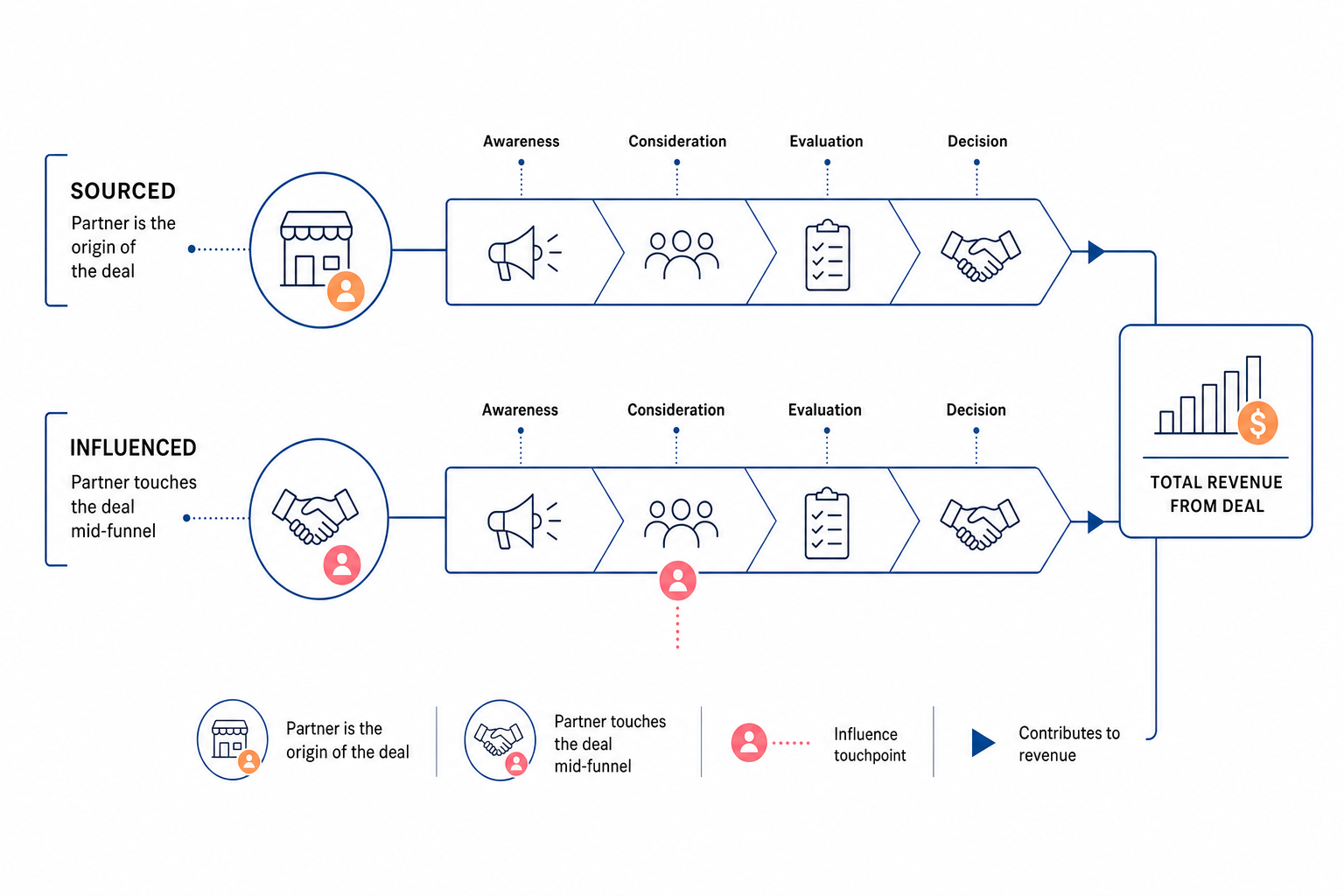
If you cannot attribute it, you cannot defend the time it costs, so instrument attribution from the first intro. Track two categories separately: partner-sourced pipeline originated with the partner - they made the intro or the buyer arrived through their listing - while partner-influenced pipeline would likely have found you anyway but moved faster because a partner vouched. Conflating the two is how founders overstate a program and keep pouring time into a channel that is quietly underperforming.
The metrics that actually tell you whether partner-led is working:
- Partner-sourced revenue as a share of new revenue - the top-line test of whether the motion is leading or just helping.
- Partner-sourced pipeline and win rate - partner deals often close faster and win more; watch whether yours do.
- Time-to-first-deal per partner - how long a signed partner takes to produce, so you can spot the ones who never will.
- Partner activation rate - the share of signed partners who actually send a single deal. Most programs die here, not at recruitment.
Review it on the same cadence as your other channels. Partner-led growth is one line in the portfolio you already manage in expansion and motion planning - hold it to the same bar as paid, content, and outbound, and cut it just as fast if it does not clear.
TL;DR
- Partner-led growth is a GTM motion where integration, co-sell, reseller, referral, or marketplace partners drive acquisition - trust transfer does the selling, so CAC drops.
- Sequence by stage: referral first (cheap, fast), integration wedge next (compounding), co-sell and reseller only once you have ACV and headcount to enable partners.
- It amplifies a working motion, it does not create one - if warm intros die in your funnel, you are too early.
- With no logos, use your network: investor, advisor, and accelerator-batch intros plus an integration wedge buy the credibility you have not earned yet.
- Structure for asymmetry: one page covering mechanism, economics, ownership, and a shared metric; pilot 60-90 days before expanding.
- Measure sourced vs influenced separately and hold the channel to the same bar as paid and content.
FAQ
What Is Partner-Led Growth?
Partner-led growth is a go-to-market motion in which external partners - integration, co-sell, reseller, referral, or marketplace partners - lead a key stage of your customer journey and earn a reward for the outcome. A motion is genuinely partner-led when partners consistently source more than half of new revenue; below that, partners are influencing a direct motion rather than leading it.
What Is the Difference Between a Design Partner and a Channel Partner?
A design partner co-develops your product at the 0-to-1 stage, giving feedback and early validation in exchange for influence over the roadmap. A channel or GTM partner takes your finished product to their own market to drive customers. Design partners help you build the right thing; channel partners help you sell it. They are different relationships that happen to share the word "partner."
When Is Partner-Led Growth Too Early for a Startup?
It is too early when you have no repeatable way to convert a qualified conversation into a customer, because a partner intro will simply die in a broken funnel. It is also premature when your buyers prefer to evaluate directly and your product needs little implementation, so a partner adds friction instead of trust. Partnerships amplify a working motion; they do not create one.
How Do You Find Your First Partner with No Brand?
Start with warm intros from the network you already have - investors, advisors, and your accelerator batch are full of complementary companies one introduction away. Lead with the partner's upside rather than your ask, and offer the smallest viable first step, such as a referral swap or a lightweight integration. An integration wedge is especially credible with no logos because it makes the partner's product more valuable rather than asking them for a favor.
How Do You Measure Partner-Sourced Pipeline?
Track partner-sourced pipeline (deals that originated with the partner) separately from partner-influenced pipeline (deals that would likely have found you anyway but moved faster because a partner vouched). The core metrics are partner-sourced revenue as a share of new revenue, partner win rate, time-to-first-deal per partner, and partner activation rate - the share of signed partners who actually send a single deal. Review it on the same cadence as your other channels.