
Founder-Led Sales for Early-Stage Startups (2026)
Founder-led sales for early-stage startups means the founder personally sources, qualifies, demos, and closes every deal instead of hiring a sales team. It is the fastest way to learn what buyers actually say, which objections kill deals, and what they will pay. Founders should lead sales until the motion is repeatable enough to hand off.
See also the AI SDR to scale founder-led outbound.Related reading: marketing for accelerator startups, post-accelerator growth, go-to-market strategy.
TL;DR: What Should Every Founder Know Before Leading Sales?
- Founder-led sales is the fastest way to find product-market fit. Every call teaches you the buyer's language, the real objection, and the feature they actually care about.
- Do not hire a rep until the motion is repeatable. If you cannot predict that X calls with Y buyer type produces Z closed deals, a rep will burn cash proving it is still broken.
- Run a simple five-stage pipeline in a spreadsheet. Contacted, call booked, discovery done, proposal sent, closed. Review it weekly and derive your ICP from real data.
- Discovery before pitch, always. Spend 70% of the call listening, 30% showing. Only demo the slice that maps to the pain they described.
- Name the price out loud and stay silent. Hiding the price wastes calls and teaches you nothing about willingness to pay.
- Capture the playbook before you hand off. Written ICP, discovery script, ranked objection list with responses, and a pricing sheet are the minimum handoff asset.
What Is Founder-Led Sales?
Founder-led sales means the founder is the salesperson. You source leads, book calls, run discovery, demo, quote a price, negotiate, and close -- end to end. Nobody hands you a script or a qualified pipeline. You build both while you sell.
It matters because early sales are not really about revenue. They are about learning. Every call teaches you the buyer's language, the objection that kills deals, and the one feature they actually care about. A hired rep cannot do that job because there is no proven playbook yet to hand them. You are writing the playbook one conversation at a time. This is a core part of getting your first customers and designing your go-to-market strategy, and it is the fastest way to learn who your buyer is, what they will pay, and why they say no.
Your first buyers overlap with your design partners -- the early customers who shape the product are usually the same people you are selling to first.
Why Should Founders Sell Early?
Because you cannot delegate a job that does not exist yet. Hiring reps before you have a repeatable motion burns cash and buries the signal you need. Here is what founder-led selling protects:
- Control of the message. You can change the pitch mid-call and test a new angle tomorrow. A rep needs a fixed script you have not written.
- Direct learning. Objections, pricing reactions, and ICP signals reach you unfiltered instead of through a rep's notes.
- Cost. A rep costs $80k-150k plus ramp time. Founder time is already sunk into the company.
- Credibility. Early buyers want to talk to the person building the thing, not a hire reading a deck.
- Speed of iteration. You can rewrite the product roadmap the same day a call reveals a gap.
Founder-led selling is also the cheapest growth channel you have at the start. Pairing it with founder-led marketing and the right marketing strategy for accelerator startups lets a Seed to Pre-IPO team build a full engine on founder time instead of headcount. For teams evaluating outside help, the broader landscape is covered in our comprehensive review of the top startup agencies and our startup branding guide.
| Dimension | Founder-led sales | Hiring reps too early |
|---|---|---|
| Control of message | Founder adapts live | Locked to a script that does not exist |
| Learning captured | Direct and unfiltered | Lost or second-hand |
| Cost per month | Founder time only | $7k-13k plus ramp |
| Scalability | Low -- caps at founder hours | High, but only if a playbook exists |
| Risk | Founder bandwidth | Wasted spend, false negatives on the market |
How Do Founders Find Early Customers?
Founders find early customers by going narrow and warm first, then layering in outbound once the pitch holds up. The goal is not volume -- it is 30-50 named accounts that match your rough ICP so you learn fast.
- Start with warm intros. Your investors, alumni network, and design partners are the highest-signal source. A referred call already trusts you enough to talk.
- Build a named target list. 30-50 specific accounts that look like your best existing customer. Names, not segments. Prioritize by lookalike fit.
- Layer in cold outbound. Use cold email outreach -- short, specific, one clear ask for a 20-minute call. Track the source so you know which channel produces the best conversations.
- Run discovery on every call. Spend the first discovery call learning, not pitching. Ask about their current process, the pain, what it costs them, and what they have tried.
- Disqualify fast. A clean no is worth more than a slow maybe. Write down your disqualification criteria so you sharpen it over time.
- Log the source. After each call, note where it came from. When 50%+ of closed deals trace to one channel, you know where to point the first rep.
Your first buyers overlap with your design partners -- the early customers who shape the product are usually the same people you sell to first. Treat them as both revenue and the raw material for your playbook.
How Do You Run a Founder-Led Sales Process Step by Step?
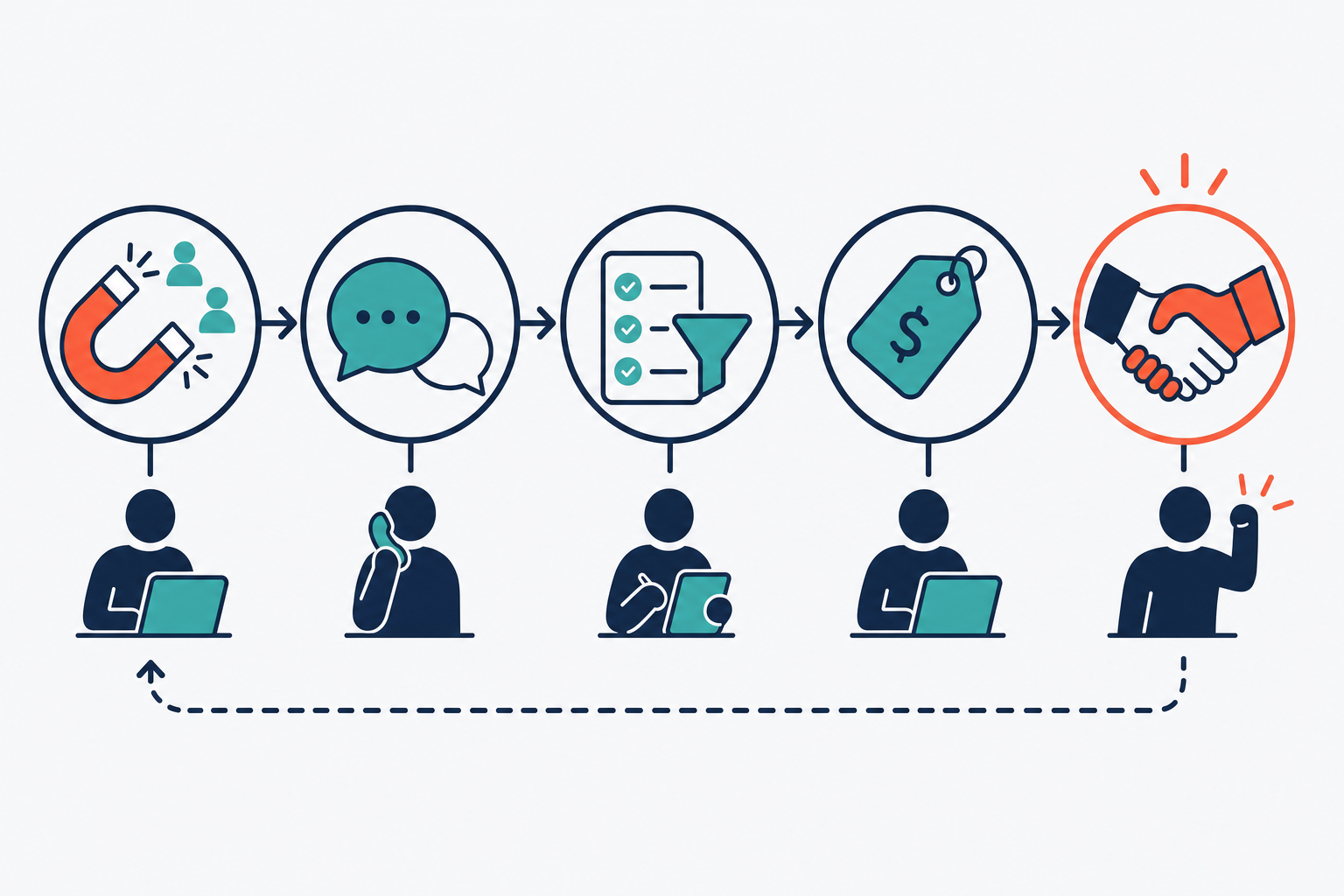
Keep it simple. You do not need a full sales stack -- you need a spreadsheet and discipline. Run this loop:
- Build a target list. 30-50 named accounts that match your rough ICP. Names, not segments. Prioritize by lookalike fit to your best existing customer.
- Generate pipeline. Warm intros first, then cold email outreach -- short, specific, one clear ask for a 20-minute call. Track the source so you know which channel produces the highest-quality conversations.
- Run discovery. Spend the first discovery call learning, not pitching. Ask about their current process, the pain, what it costs them, and what they have tried. Resist the urge to show product until you have heard their problem in their own words.
- Qualify. Confirm they have the problem, a budget, and the authority to buy. Disqualify fast -- a clean no is worth more than a slow maybe. Write down your disqualification criteria so you can sharpen it over time.
- Demo to the pain. Show only the part of the product that solves what they told you in discovery. Skip the full product tour. If they mentioned a specific workflow, show that workflow and nothing else.
- Quote and close. Name a price out loud, stay silent, and handle the objection that comes back. Do not apologize for the number. Do not offer a discount before they ask. The silence is the tool.
- Log everything. After each call, write the objection, the language they used, and why they moved or stalled. Review the log weekly alongside your pipeline.
Run your pipeline in a spreadsheet or a free CRM with five stages: Contacted -> Call booked -> Discovery done -> Proposal sent -> Closed. That is enough to see where deals die. The magic is not the tool -- it is that you review it weekly and derive your ICP and objection list from real calls, not guesses.
What to Capture from Every Call
- The exact words they used for the problem.
- The objection that slowed or killed the deal.
- What they compared you to (including doing nothing).
- Their reaction to the price -- flinch, shrug, or yes.
- Whether they matched your ICP or you were talking to the wrong buyer.
Sales Tools That Matter at the Founder Stage
You do not need a full revenue stack yet, but a few lightweight tools make the process repeatable faster:
| Category | Tool type | Why it matters |
|---|---|---|
| CRM | HubSpot (free), Pipedrive, or a spreadsheet | Track pipeline stages so you know where deals die |
| Sequencing | Apollo, Lemlist, or manual follow-ups | Automate outreach without losing the personal touch |
| Meeting recording | Gong (free tier), Fathom, or Otter | Capture exact buyer language for your ICP and objection bank |
| E-signature | DocuSign, PandaDoc, or HelloSign | Close deals without friction on paperwork |
| Calendar | Calendly or SavvyCal | Remove scheduling back-and-forth from the pipeline |
What Does a Founder-Led Sales Conversation Look Like?
It looks like a conversation, not a pitch. The founder talks less than the buyer. A good early call is roughly 70% them, 30% you. Here is a typical four-stage flow:
- Discovery (15-20 minutes). Open by framing the call: "I want to understand your current process before I show anything -- is that fair?" Then ask about the pain, what it costs them, and what they have tried. Do not show product yet.
- Demo (10-15 minutes). Show only the slice of the product that maps to the pain they described. Skip everything else. If they talked about a broken onboarding workflow, show onboarding. Do not show the dashboard, the analytics, or the integrations.
- Proposal (5 minutes). Recap what you heard, confirm the value, and state the price. Name it out loud and stop talking. The silence is where you learn whether the price is right.
- Close or next step (5 minutes). If they say yes, send the agreement immediately. If they hesitate, ask what feels off -- do not guess. If they say no, ask why and write it down verbatim. A clean no with a clear reason is a data point that sharpens your next call.
A short example of the discovery opening:
Founder: "Before I show anything, I want to understand how you handle your current process around [X]. What does it look like today?"
Buyer: "We do it manually in spreadsheets. It takes about four hours a week and errors slip through."
Founder: "What have you tried to fix it?"
Buyer: "We looked at [Tool Y] but it was too heavy. We need something lighter."
Founder: "Got it. Let me show you how we handle exactly that workflow -- light, specific, no extra features."
On pricing, do not hide it. State a number, then stop talking. Silence is a tool. If they flinch, ask what feels off -- that tells you whether it is the price, the packaging, or the value. Early on you are testing willingness to pay as much as closing, so quote real prices even when you feel unready. Discounting to your first ten logos is fine if you know why you are doing it and you write it down.
The goal of an early sales call is not to close. It is to leave knowing exactly why they will or will not buy -- and to be able to repeat that reason to the next twenty prospects.
How Do You Price and Discount as a Founder?
Pricing is where most founders fumble. You are building something new, you have no reference point, and you are afraid of scaring buyers away. But hiding the price or lowballing it teaches you nothing and sets a bad anchor for the future. Here is a practical framework for founder-led pricing:
- Quote a real price from call one. Even if you feel unready, even if you are terrified they will say no. A buyer who says no at $500/mo is giving you data. A buyer who says yes at $50/mo is giving you a false signal.
- Offer a limited-time launch discount. For your first 5-10 logos, a 20-30% discount for the first 12 months is fair. It acknowledges the product is early but is time-boxed. Write it into the contract: "Year 1: $X. Year 2: $Y." This protects your ARR later.
- Discount for learning, not for closing. If a buyer gives you deep product feedback, a case study, or a reference logo, a discount is a trade, not a concession. Call it an early-adopter or design-partner discount and make it contingent on their participation.
- Do not discount for name-brand logos unless they commit to a case study. A big logo on your website is worth a concession, but only if you can use it publicly. If they will not let you name them, charge full price.
- Record every discount and the reason. When you look back at your first 20 deals, you should know exactly why each one was discounted and what you got in return. If the answer is "I was scared they would say no," that is a pattern to fix.
If you repeatedly hear the same price objection from your ICP, the problem is the price. If you hear it from buyers outside your ICP, the problem is the targeting. Your pricing conversations are as much a qualification tool as a revenue tool.
When Should a Founder Hire the First Sales Rep?

Hire when the motion is repeatable, not when you are tired of selling. The test: you can predict, within reason, that a given input (X calls with Y type of buyer) produces Z closed deals. If you cannot write that down, a rep will not fix it -- they will just spend money proving it is still broken. This is the trigger point for a deliberate post-accelerator growth plan that goes beyond the founder-led motion.
| Stage | Customers | What the founder does |
|---|---|---|
| Prove it sells | First 1-10 | Every call, end to end. Pure learning. Write the playbook. |
| Find the pattern | 10-30 | Tighten ICP, standardize the pitch, document objections and pricing. |
| Hand off | 30+ / nearing ~1M ARR | Hire the first rep, sell alongside them, transfer the playbook, then step back. |
Signals That the Motion Is Repeatable
Before you hire rep one, you need objective evidence that the motion works without you. Track these metrics and hire when the pattern holds for at least two consecutive months:
- Win rate. If you close 20-30% or more of qualified discovery calls with your ICP, the pitch is working. Below 15%, you are still iterating on the message.
- Cycle time. If deals from discovery to close are predictable (for example, 14-21 days for a mid-market deal), the process is repeatable. If every deal takes a different path, you are still inventing.
- Deal size. If your last five deals landed within a tight range (not $5k, then $50k, then $500), you have found a repeatable deal size. Wide variance means the ICP is not tight.
- Source consistency. If 50%+ of closed deals come from the same pipeline source (for example, warm intros or cold email), you know where to point the rep. If deals come from everywhere, you have no repeatable pipeline.
| Phase | Ownership | Deal size | Cycle | Tools |
|---|---|---|---|---|
| Founder-led | Founder runs every call | Variable, testing pricing | Unpredictable, learning phase | Spreadsheet, calendar, email |
| First rep | Founder shadows, rep leads | Stable range emerging | Shortening as playbook matures | CRM, sequencing, call recording |
| Sales team | Reps own pipeline, founder steps back | Predictable and repeatable | Consistent, forecastable | Full revenue stack |
Before you hand off, the sales-learning must be captured as an asset: a written ICP, a discovery script, a ranked objection list with responses, a pricing sheet, and won/lost notes. Hand a rep that, and they ramp. Hand them nothing, and you have outsourced your core learning to someone who cannot do it. Choosing the motion you are handing off also matters -- see PLG vs sales-led growth and the broader map of SaaS go-to-market motions.
How Do You Build a Repeatable Sales Motion?
Repeatability is the moment founder-led sales can be handed off. It is not about call volume -- it is about a predictable input producing a predictable output. Build it in three layers:
- Document the playbook. Written ICP, discovery script, ranked objection list with responses, and a pricing sheet. If it is not written, it is not repeatable -- it is just you.
- Standardize the pipeline. Keep the five stages (Contacted, Call booked, Discovery done, Proposal sent, Closed) and review weekly. Predictability shows up as stable win rates, cycle times, and deal sizes across at least two consecutive months.
- Prove it without you. A rep should be able to run the same calls and hit the same numbers. When 50%+ of deals come from one consistent source and the last five deals land in a tight range, the motion is ready to scale.
This is the foundation of the broader go-to-market strategy for startups. Once a founder proves the motion, it becomes the blueprint for the first rep -- and the basis for a deliberate post-accelerator growth plan that scales beyond founder time.
What Are the Biggest Founder-Led Sales Mistakes?
- Pitching before discovering. Talking first means you sell the wrong thing to the wrong pain.
- Hiring reps too early. Delegating an unwritten playbook wastes cash and hides the signal.
- Not logging calls. If the learning lives only in your head, it dies there and cannot transfer.
- Chasing every lead. Refusing to disqualify clogs the pipeline and warps your ICP.
- Hiding the price. Dodging the number wastes calls and teaches you nothing about willingness to pay.
- Confusing being busy with being repeatable. Volume of calls is not a motion. A predictable input-to-output is.
Founder-led sales is one lever of the broader founder-led growth motion -- the system that integrates sales with content, community, and product-led signals so the founder is the growth channel until the playbook is repeatable. For accelerator-backed startups, pairing this with founder-led marketing and the right marketing strategy for accelerator startups creates a full go-to-market engine that runs on founder time, not headcount.
When a larger buyer asks to try before they buy, run it with discipline: our guide to the proof of concept in B2B SaaS sales covers success criteria, exit dates, and paid pilots.
Founder-Led Sales Playbook
A founder-led sales playbook is the set of written assets you build while selling so the motion can transfer to a rep. Without a written playbook, the learning dies in your head. Here is the minimum set of artifacts every founder should produce before hiring:
- ICP (ideal customer profile). A one-page description of who buys: company size, role, the trigger event that makes them search, and the budget range. Update it every five deals as real data replaces guesses.
- Discovery script. The five to seven questions you ask on every first call, in order, including the framing opener and the transition to the demo. Test variations but keep a baseline so you can compare what works.
- Objection bank. A ranked list of every objection you hear, with the exact buyer wording and your tested response. Update it weekly from call notes. When a rep joins, this is the first asset they study.
- Demo flow. The two or three workflows you show, each mapped to a specific pain surfaced in discovery. Never a full product tour -- only the slices that match what the buyer described.
- Pricing sheet. Your list price, discount rules, and the conditions for an early-adopter discount. Include the time-box that resets to full price so your ARR is not anchored low permanently.
- Pipeline stages. The five stages with exit criteria for each so a rep knows exactly when to move a deal forward: Contacted, Call booked, Discovery done, Proposal sent, Closed.
- Outbound templates. The three to four email sequences for cold outreach, follow-ups after silence, and post-call recaps. Include the subject lines that get opened so you are not guessing each time.
Review the playbook against real deal data every week. When a deal stalls at a stage, fix the playbook -- do not blame the buyer. A playbook that matches reality produces predictable win rates. One that does not produces excuses.
What Sales Metrics Should a Founder Track Weekly?
When you run founder-led sales, the dashboard is a simple spreadsheet reviewed every week -- not a BI tool. The four numbers that actually predict whether you can hand off are pipeline volume, discovery-to-close win rate, average cycle time, and deal-size spread. Track how many new qualified conversations you opened, how many turned into demos, and how many closed. A founder who reviews these numbers weekly spots drift early: a falling win rate means the pitch is slipping, a lengthening cycle means the buyer is unsure, and a widening deal-size spread means the ICP is loose. This weekly habit is the backbone of a credible go-to-market strategy for startups and pairs naturally with the playbook work in your post-accelerator growth plan. Do not wait for a board meeting -- the data is only useful if you act on it the same week you collect it. Log objections next to the numbers so the metric and the reason move together.
How to Handle Objections in Founder-Led Sales
Objections are the fastest signal you have. A buyer who says "it is too expensive" is telling you one of four things: the price is wrong, the value story is weak, they are not your ICP, or they are negotiating. Your job is to diagnose which one it is before you respond.
- Do not defend. When a buyer pushes back, say "tell me more about that" instead of jumping to a rebuttal. The first objection is rarely the real one -- let them unpack it.
- Diagnose the type. Is it a price objection (they cannot afford it), a value objection (they do not see the ROI), an authority objection (they cannot decide), or a timing objection (not now)? Each needs a different response, and guessing the wrong type wastes the call.
- Respond with their own words. Echo the exact language they used during discovery. "You told me your team spends four hours a week on this -- at your rates, our price pays back in the first month." A response anchored to their data beats a generic value prop every time.
- Ask a closing question. After you respond, ask "does that address your concern?" and stay silent. If they say yes, move to next steps. If they raise a new objection, repeat the loop.
- Log it for the playbook. After every call, write the objection verbatim, the type you diagnosed, your response, and whether it moved the deal. This builds your objection bank -- the asset that lets a rep handle the same pushback without you on the call.
The most common founder mistake is treating objections as rejection. They are not -- they are buying signals from someone still talking to you. A buyer who says nothing and disappears teaches you zero. A buyer who pushes back gives you the material for your next ten calls.
How to Write Cold Outreach That Gets Replies
Founder-led cold outreach works differently than a rep's sequenced campaigns. As the founder, your name alone gets the email opened -- use it. Here is the formula that earns replies:
- Lead with a specific observation, not a compliment. "I saw your post on [topic]" or "I noticed your team is hiring for [role]" -- something that proves you looked, not that you flattered.
- State the problem in their words. If you have done discovery with similar buyers, use the exact phrase one of them used. "One ops lead told us she spends Friday afternoons manually reconciling [X]." Ten times stronger than a generic pain statement.
- Ask for a 20-minute call, not a demo. "Would you be open to a 20-minute call to compare notes on [topic]?" Founders get higher reply rates on peer conversations than on pitches.
- Keep it under 100 words. If the email scrolls, it dies. Three short paragraphs: observation, problem, ask. No signature block longer than one line.
- Follow up once, then move on. Send one follow-up four to five days later with a single line: "Circling back on this -- totally understand if the timing is off." If they do not reply, they are not your buyer today. Log it and prioritize the ones who do.
Founder-led outreach converts better than rep-led outreach at the early stage because the buyer is talking to the person building the product. Do not waste that advantage by writing like a rep. Write like a founder -- short, specific, and honest about what you want to learn.
When Should a Founder Hand Off Sales to a Rep?
Hand off only when the motion is predictable, not when you are exhausted. The trigger is evidence: for at least two straight months, a known input (X calls with your ICP buyer) produces a stable output (Z closed deals) inside a known window. If you cannot write that equation, a rep will not rescue it -- they will burn cash proving it is still broken. The handoff itself is a project, not a calendar event. Write the ICP, a discovery script, a ranked objection list with responses, and a pricing sheet before you post the role. Then sell alongside the new rep for 30 to 60 days, transferring the unwritten instinct that lives only in your head. This is where founder-led marketing and the right marketing strategy for accelerator startups keep pipeline full while the rep ramps. Step back only once the rep hits your numbers without you on the call.
More reading for early-stage founders building a sales and marketing engine:
- Best Startup Marketing Agencies in 2026 (Ranked by Pricing, Fit and Services)
- Startup Branding: How to Build a Brand That Attracts Customers and Investors
- Go-to-Market Strategy for Startups: The Complete Framework
- Marketing for Accelerator Startups: YC and Techstars Playbook
- After Demo Day: Your Post-Accelerator Growth Plan
Wondering how to divide founder effort? Read startup marketing vs sales for splitting time between the two motions.
Founder-Led Sales: 30-Day Plan and Discovery Script
Before you hire a rep, the founder should personally close the first 10 customers. This 30-day plan builds the repeatable motion you will later hand off.
Days 1-10: Source and Qualify
- List 50 ideal buyers from your accelerator network, LinkedIn, and warm intros.
- Send 5 personalized outreach messages per day; book 2-3 discovery calls per week.
Days 11-20: Demo and Close
- Run discovery with this script: "What are you doing today for [problem]? What happens if it stays broken? What would better look like in 90 days?"
- Demo only after you can name the buyer's outcome; close on a small paid pilot.
Days 21-30: Systematize
- Write down every objection and the response that worked.
- Hand the playbook to a fractional CMO or agency to scale.
When you start hiring, keep sales and marketing as one system. Our startup sales and marketing alignment guide shows how to set shared definitions and an SLA.
Pilots that never close are the most common founder-sales leak -- see converting free pilots into paid contracts.
When founder-led deals reach a trial, follow the enterprise pilot to paid contract playbook to convert it.
Frequently Asked Questions
What Is Founder-Led Sales?
Founder-led sales means the founder personally owns the entire sales process -- sourcing, discovery, demos, negotiation, and closing -- instead of hiring reps. It is how early-stage startups learn their ICP, objections, and pricing before a repeatable playbook exists.
Why Should Founders Sell Early Instead of Hiring Reps?
Because you cannot delegate a job that does not exist yet. Hiring reps before the motion is repeatable burns cash and buries the buying signals you need. Founder-led selling keeps message control, learning, and speed of iteration in the founder's hands.
How Do Founders Find Early Customers?
Start with warm intros from investors and your network, then build a named target list of 30-50 accounts that look like your best customer. Layer in cold email outreach and disqualify fast so you learn from the right buyers instead of chasing everyone. For the outbound companion where the founder personally runs the sends, see our founder-led outbound guide.
When Should a Founder Hire the First Sales Rep?
Hire when the motion is repeatable, not when you are tired of selling -- usually after the first 10-30 customers or near ~1M ARR. The test is that you can predict a known input (X calls with Y buyer type) produces Z closed deals for at least two consecutive months.
How Do I Know If I Am Selling to the Right Buyer?
If the buyer has the problem you solve, the budget to pay for it, and the authority to say yes, you are in the right room. If they love the product but cannot buy, or have budget but no pain, you are selling to the wrong person. Disqualify and move on -- the pipeline is not a waiting room.
Before you run any sequence, make sure your list is right. Our startup sales prospecting guide shows how to find and qualify the accounts worth contacting.
Key Takeaways
- Founder-led sales means the founder sells end to end until the motion is repeatable.
- Early sales are for learning your ICP, objections, and pricing -- not just revenue.
- Run a simple five-stage pipeline in a spreadsheet and review it weekly.
- Discovery before pitch: aim for 70% them, 30% you, and always name the price.
- Hire your first rep only after you can predict deals from a known input, near ~1M ARR.
- Capture the playbook -- ICP, scripts, objections, pricing -- before you hand off.