
Marketing for Accelerator Startups: YC/Techstars (2026)
Marketing for accelerator startups is the discipline of compressing a 12-month go-to-market into a 90-day batch so that by demo day you show investors a repeatable acquisition loop and real traction, not a pitch. Validate one ICP, pick a single wedge channel, instrument analytics from week one, and let the founder drive distribution. Everything else waits until after you graduate.
This playbook walks the full accelerator journey - before the batch, during it, and after demo day - and shows exactly which marketing focus and which metric matter at each phase. For the demand-building work to do before your product goes live, see our pre-launch marketing strategy.
Marketing right after an accelerator means turning demo-day traction into a compounding engine. The first 90 days post-batch decide whether your raise converts to durable growth: scale the one wedge channel you proved, add a second measured channel, and tighten positioning while budget is fresh. The discipline that won the batch now becomes your scaling foundation.
Related reading: post-accelerator growth plan, go-to-market strategy, startup marketing agencies, and post-batch YC marketing.
TL;DR: What Should Accelerator Marketing Focus On?
- The batch is a forcing function, not a break. You have roughly 90 days to prove one acquisition loop works, so pick one ICP and one channel and go deep, not wide.
- Investors read growth rate, retention, CAC payback, and qualified pipeline - not followers, impressions, or signups. Instrument these before you spend a dollar.
- Founder-led distribution beats paid at this stage. Your unfair advantage is direct access to buyers; paid ads mostly buy noise you cannot yet interpret.
- Use the accelerator network deliberately - batchmates, alumni, mentors, and partner perks are leverage, but they are a supplement to your loop, never the loop itself.
- Demo day is a checkpoint, not the finish line. The real work of scaling the channel and adding a second one starts the week after you graduate.
What Makes Marketing for Accelerator Startups Different?
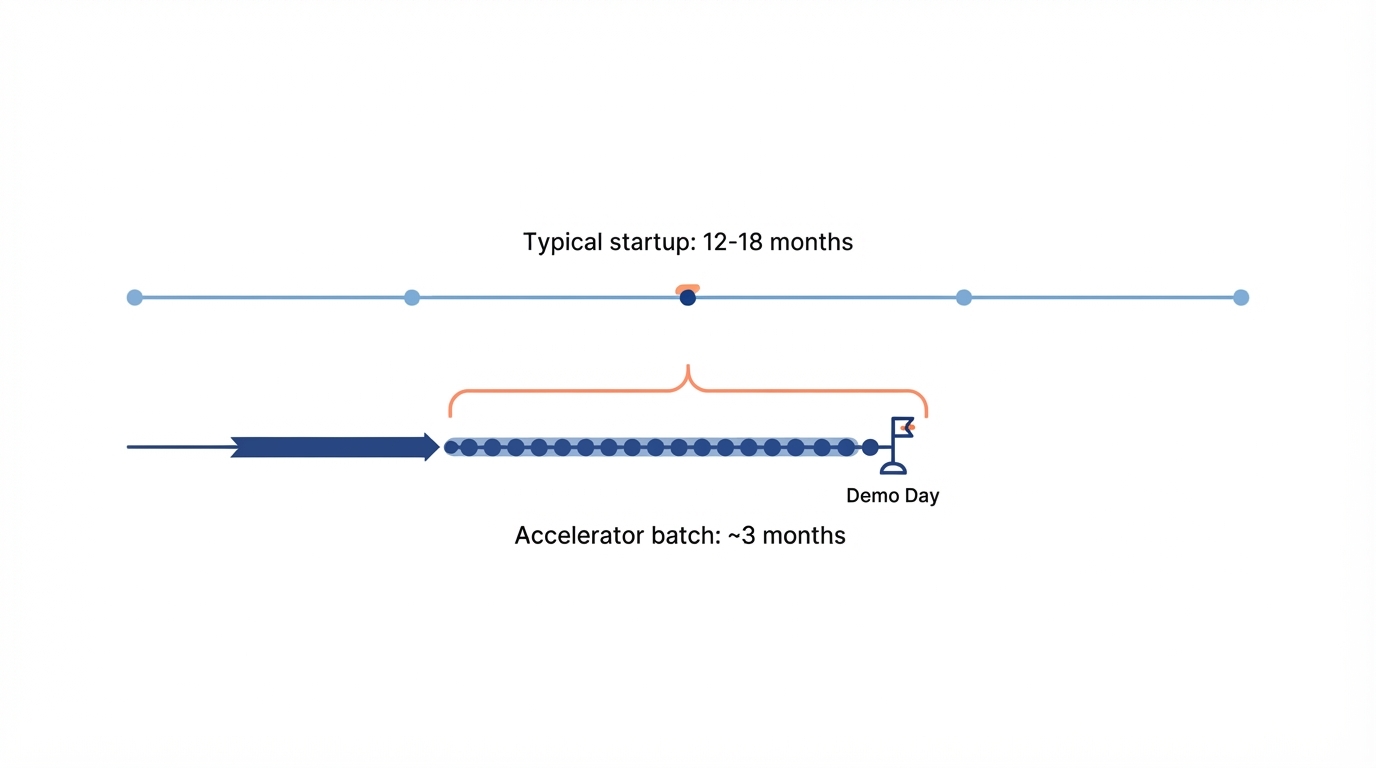
Accelerator marketing is different because the context is different: a fixed batch, a compressed timeline, a public demo day, and an investor audience watching your numbers. Generic startup-marketing advice assumes you have quarters to experiment. In a batch you have weeks. That changes what you should do and, more importantly, what you should ignore.
Earned media can amplify a demo-day moment, but it is a lever you orchestrate, not one you buy. If you are weighing outside help for press around your batch or raise, our guide to choosing a PR agency for startups covers what it costs, when it pays, and how it fits next to growth marketing.
Four constraints define the accelerator context.
- The batch cohort. You are one of dozens of companies moving on the same clock, sharing partners, mentors, and demo-day attention. Standing out is relative, not absolute.
- The compressed timeline. Y Combinator and Techstars both run roughly three-month programs. Anything with a payback horizon longer than the batch - broad SEO, brand campaigns, long-cycle partnerships - will not show results in time to matter for demo day.
- The demo-day forcing function. A hard, public deadline focuses the whole program. Every marketing decision should ladder up to one question: what will make the traction slide on demo day undeniable?
- The investor-facing audience. Your "customer" during the batch is partly the investor who will read your metrics. That means you optimize for the numbers investors trust, and you learn to narrate them.
Common Accelerator Marketing Mistakes
Three mistakes show up in most batches. Avoiding them is as important as executing the right plays.
- Running too many channels at once. Founders often activate paid, content, partnerships, and community simultaneously, then finish the batch with five half-signals and no story. In a three-month window, one channel pushed to a known conversion rate beats five channels with no data.
- Tracking vanity metrics instead of investor-grade numbers. Signups, followers, and impressions feel productive but tell investors nothing about whether growth will continue. Instrument your loop conversion rates, retention, and CAC payback instead - these are the numbers that survive diligence.
- Ignoring the batch timeline. Activities with a payback longer than the batch - broad SEO, long-cycle enterprise deals, brand campaigns - consume weeks you do not have. Map every marketing activity to the batch calendar and kill anything that cannot show a result before demo day.
The practical takeaway: subtract, do not add. Founders who try to run five channels in a batch finish with five half-signals and no story. Founders who run one channel finish with a loop they can describe, defend, and scale. If you want the broader stage-by-stage view of how this fits a fundraising arc, the venture-backed startup marketing playbook covers the investor lens in depth.
What Should You Do Before and During the Batch?
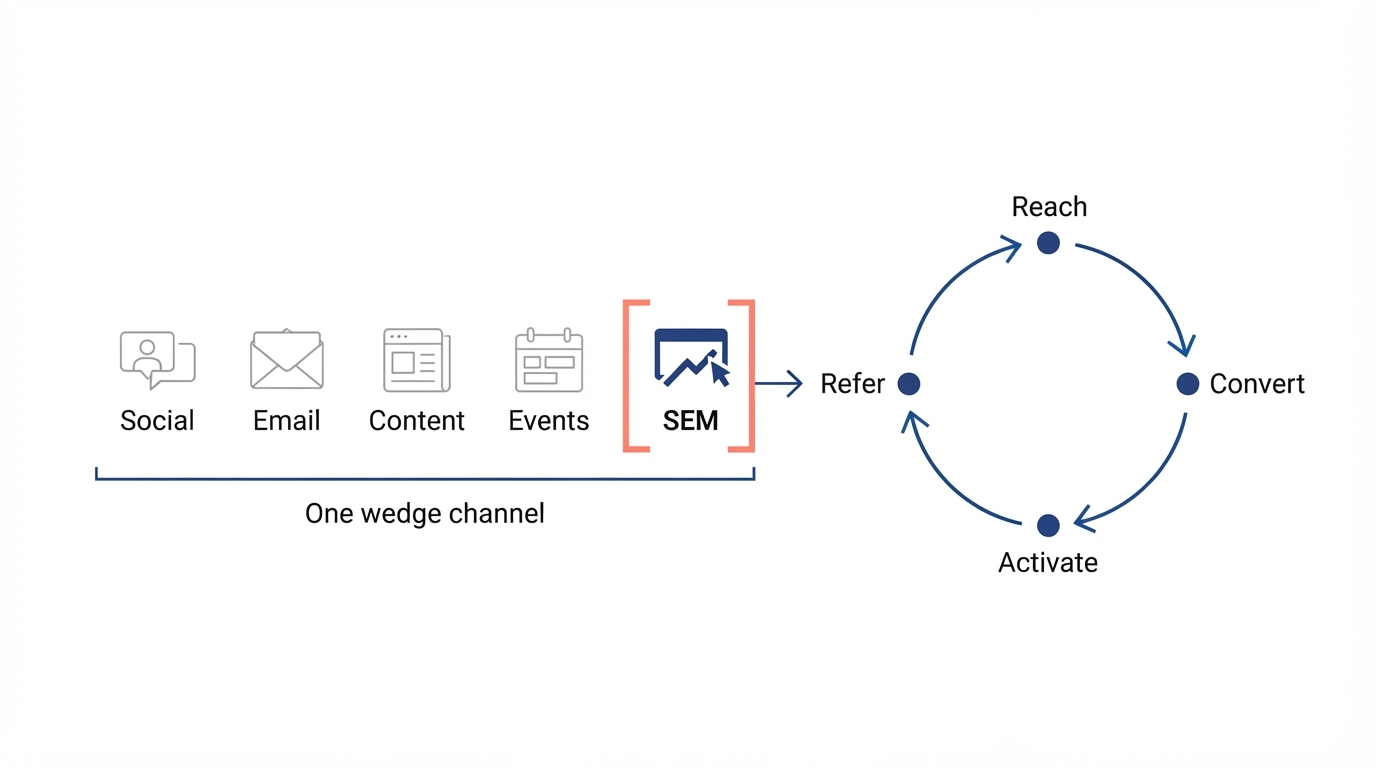
Before and during the batch, your job is to build one repeatable acquisition loop and the instrumentation to prove it works. That means validating your ICP, choosing a single wedge channel, wiring analytics early, and putting the founder on the front line of distribution. Do these four things well and demo day takes care of itself.
Validate Your ICP Before You Spend on Acquisition
An ideal customer profile is the specific, narrow segment that feels your problem most acutely and can buy fastest. Most pre-batch founders define their ICP too broadly ("SMBs," "developers") and then wonder why messaging does not land. Narrow it until you can name real companies and real titles. A typical seed-stage team can validate an ICP in the first two weeks of a batch by running 15 to 20 direct conversations and watching which segment converts talk into commitment.
Validation signals to look for: prospects who describe the problem in your words unprompted, who ask about price rather than concept, and who will introduce you to a peer. If those signals are missing, fix the ICP before you touch a channel.
Pick One Wedge Channel and Go Deep
A wedge channel is the single acquisition path where your specific ICP is reachable and your founder advantage is strongest. In a batch you do not have the time or data to run a portfolio. Pick one - founder outbound, a targeted community, a content niche, or a partnership motion - and commit to it for the batch. The goal is not coverage; it is a loop you can repeat and measure. For how to reason about which channel fits your model, see how to prioritize startup marketing channels. When the channel is founder-run rather than team-run, the playbook is different - founder-led marketing covers the full writing, publishing, and distribution discipline.
Build a Repeatable Acquisition Loop
A repeatable acquisition loop is a documented sequence - reach a prospect, convert to a conversation, convert to a customer, and generate a referral or expansion that feeds the top again - where each step has a known conversion rate. Repeatability is what separates traction from luck. When you can say "for every 100 outbound touches we book 12 calls, close 3, and 1 refers us," you have something an investor will fund. A one-off spike from a viral post is not a loop.
Document each stage's numbers weekly. The loop does not need to be big during the batch; it needs to be real and legible. A small loop that clearly compounds beats a large number you cannot explain.
Instrument Analytics from Week One
Instrumenting analytics means capturing the events and attribution you need to compute your loop's conversion rates before you scale spend, not after. This is the step founders skip and regret. Without event tracking, source attribution, and a basic funnel, you reach demo day with a headline number and no ability to answer "where did it come from and will it continue?" Set up product analytics, define your activation event, and tag every acquisition source from day one. A short guide to sequencing this by stage lives in the pre-seed to Series A marketing playbook.
Make the Founder the Distribution Engine
Founder-led distribution means the founder personally does outreach, publishes point of view, and talks to every early customer, rather than delegating it. At the batch stage this is your single biggest advantage over a larger company. Buyers respond to founders. Investors want to see that you can sell your own product. Do not hire a marketer to hide behind - the credibility, the learning, and the message-market fit all come from the founder being in the conversations. For the full sequencing of GTM motions around this, the go-to-market strategy for startups guide connects distribution to positioning and pricing. The specific outreach, qualification, and pipeline motions you run yourself - without a sales team - are documented in founder-led sales for early-stage startups.
How Do You Build Traction That Stands Up on Demo Day?
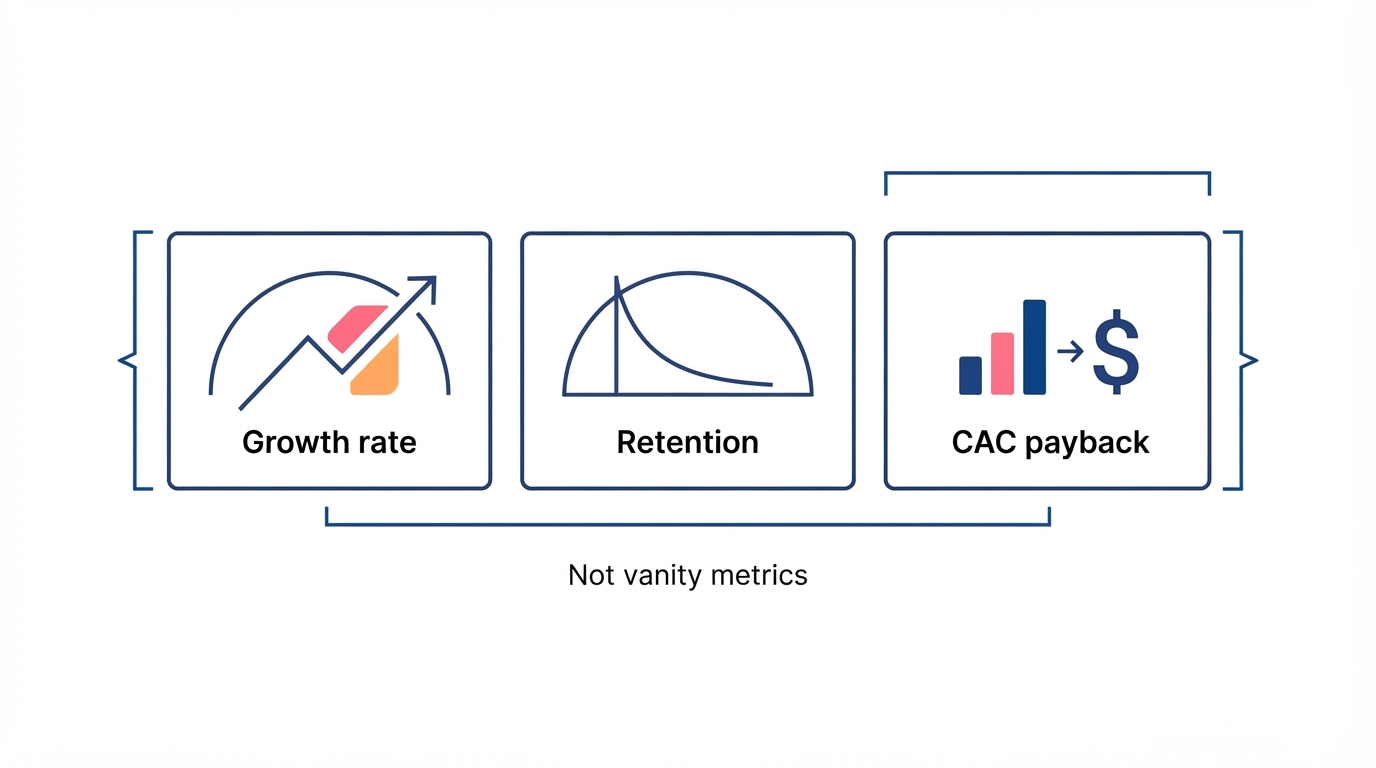
Traction that stands up on demo day is growth an investor can trust: a strong week-over-week growth rate, evidence of retention, a CAC payback they can model, and qualified pipeline they can extrapolate. Vanity metrics get skimmed; these four get diligence. Build your traction slide around them from the start.
Here is what sophisticated investors actually read, and what they discount.
- Week-over-week growth rate. A consistent 5 to 7 percent weekly growth over the batch tells a compounding story far better than a single big month-end number. Investors project this forward, so consistency and duration matter more than magnitude.
- Retention and engagement. Retention proves the growth is not a leaky bucket. Show a cohort retention curve that flattens - it signals real value, and it is the number that survives the most diligence scrutiny.
- CAC payback period. How long it takes to recover the cost of acquiring a customer. Even a rough, honest number from your wedge channel beats a polished one you cannot source. Short payback means you can scale efficiently after the raise.
- Qualified pipeline coverage. For B2B, near-term qualified opportunities with names and stages let investors extrapolate the next two quarters. Pipeline coverage means named accounts at defined stages with close dates, not a list of leads.
What to leave off: raw signup counts, social followers, impressions, press mentions, and "waitlist" numbers with no conversion behind them. They do not lie so much as they do not answer the investor's real question - will this keep growing efficiently after we fund it? Frame every metric against that question and your demo-day slide will do the work.
How Do You Use the Accelerator'S Network and Resources?
Use the network as leverage on top of your loop, never as a substitute for it. The batch, alumni base, mentors, and partner perks can accelerate a working motion, but they cannot create demand you have not validated. Treat them as force multipliers.
- Batchmates are your fastest source of honest feedback, referrals, and sometimes your first customers.
- Alumni open doors to buyers and later-stage advice - most accelerator alumni networks respond generously to a specific ask.
- Mentors are best used for narrow, high-leverage questions, not general strategy sessions.
- Partner perks (cloud credits, tooling, ad credits) extend your runway so more of your raise goes to growth.
This is a deep topic and it deserves its own treatment. For the full playbook on turning batch and alumni relationships into measurable traction, read how to use your accelerator network to build startup traction.
What Changes After the Program?
After demo day the constraints flip: the batch clock is gone, the raise (if it landed) gives you budget, and the goal shifts from proving one loop to scaling it and adding a second. The discipline that served you in the batch - one channel, tight instrumentation - now becomes the base you build on rather than the whole plan.
The first post-batch moves are to scale the proven wedge channel until its efficiency degrades, then layer a second channel using the analytics foundation you already built. This is a full topic in itself - the post-accelerator growth plan covers how to sequence hiring, budget, and channel expansion in the months after you graduate. Scaling also means your brand starts to matter beyond the founder's personal network - our startup branding guide walks through positioning and identity for the post-seed stage. If you decide to bring in outside help rather than build everything in-house, our review of top startup agencies gives an honest market map. For batch-specific help, our guide to a marketing agency for YC startups covers what founders should expect and how to pick one that ships demo-day traction.
How Do Marketing Focus and Primary Metrics Shift by Accelerator Phase?
Use this table to keep each phase honest. The focus and the metric change as you move through the journey - do not carry a batch-phase habit into the scale phase, or vice versa.
| Accelerator phase | Marketing focus | Primary metric |
|---|---|---|
| Before the batch | Validate a narrow ICP; sharpen positioning; line up first conversations | ICP validation signals (conversations that convert to commitment) |
| Early batch (weeks 1-4) | Pick one wedge channel; instrument analytics; founder-led outreach | Loop conversion rates (reach -> call -> close) |
| Mid batch (weeks 5-8) | Run the loop repeatedly; tighten messaging; document each stage | Week-over-week growth rate |
| Late batch / demo day | Package traction; build the metrics narrative; open pipeline | Retention curve + CAC payback + qualified pipeline |
| After the program | Scale the proven channel; add a second; hire against the loop | CAC payback at scale + blended growth efficiency |
Accelerator-Stage Marketing: What It Is and What to Do After Demo Day
The playbook above covers the batch itself. This section answers the questions founders ask the moment the batch ends, when the forcing function is gone and the real scaling work begins. For the full sequencing of distribution, positioning, and pricing around this transition, the go-to-market strategy for startups guide connects each motion to the others.
What Is Accelerator-Stage Marketing?
Accelerator-stage marketing is the specific discipline of building and scaling demand for a venture-backed company in the window right around and after a fixed program like Y Combinator or Techstars. It is narrower than general startup marketing: the timeline is compressed, the audience is investor-facing, and the success bar is a repeatable acquisition loop you can defend on demo day. The batch is the proving ground; accelerator-stage marketing is the practice of carrying that proof into the next 12 to 18 months without losing the discipline that created it. If you are comparing outside help for this phase, our review of the top startup agencies maps the market honestly.
What Should Founders Do First After Demo Day?
First, protect the loop you proved. Resist the urge to add three channels the week after the raise; instead, scale the single wedge channel until its efficiency starts to degrade, then document the unit economics at the new volume. Second, lock the narrative: your demo-day metrics story becomes your investor update and your hiring pitch, so keep it legible. Third, make your first non-founder hires against the loop, not above it - a first marketer or SDR extends the founder's distribution rather than replacing it. The hands-on outreach, qualification, and pipeline motions you keep running yourself are covered in founder-led sales for early-stage startups.
Which Channels Work Best Post-Accelerator?
The channels that work best are the ones already proven in the batch, scaled with measurement, plus a second channel layered on the analytics foundation you built. Founder outbound and community rarely disappear; they become the base while you test a paid or content motion with real attribution. Avoid launching broad brand campaigns or long-cycle SEO as your first post-batch bet - they still carry paybacks longer than your cash runway. The sequence for expanding budget and headcount across channels is in the post-accelerator growth plan, and the positioning work that makes those channels convert is in our startup branding guide.
How Do You Keep Momentum After the Batch?
Momentum after the batch comes from turning the forcing function into a system. Keep the weekly loop review you ran during the program - conversion rates, retention, CAC payback, and pipeline - as a standing ritual so the numbers never go dark. Convert batchmates and alumni from a one-time network into a recurring referral and feedback engine. And keep shipping founder-led point of view so your distribution does not depend on a single paid channel. The full post-batch operating rhythm, including when to add a second channel and when to hire, is sequenced in the post-accelerator growth plan.
If you are building a developer-first product out of the batch, pair this playbook with our developer tools marketing guide for the channels and metrics that actually move technical adoption.
During the batch, build recognition early with our startup brand awareness campaign plan.
Related reading: post-accelerator growth plan, founder-led sales for early-stage startups, go-to-market strategy for startups, marketing agency for YC startups, and startup paid media strategy.
What Should a Startup Market First After Demo Day?
After demo day the most common mistake is to treat the raise as a license to spend broadly. The right first move is to market the same wedge channel you already proved, only harder and with more budget, until its efficiency curve bends. That means protecting the loop, not reinventing it: keep the founder on distribution, keep the weekly loop review, and feed the new capital into the motion that already converts. A startup coming out of an accelerator should market proof, not potential, so the first 90 days post-batch are about deepening a known channel and documenting unit economics at higher volume. Bring in your first marketer or SDR to extend the founder rather than replace them, and resist adding channels until the core is scalable. For the full sequencing of hiring, budget, and channel expansion after you graduate, the post-accelerator growth plan lays out the months that follow. The hands-on outreach and qualification motions you keep running yourself are detailed in founder-led sales for early-stage startups, and the distribution-to-positioning-to-pricing logic that ties it together is in our go-to-market strategy for startups guide.
How Do You Build a Marketing Engine Post-Accelerator?
Building a marketing engine after the accelerator means converting the forcing function into a repeatable system. Start by keeping the weekly loop review you ran during the batch - conversion rates, retention, CAC payback, and pipeline - as a permanent ritual so the numbers never go dark once the demo-day deadline disappears. Next, turn batchmates and alumni from a one-time network into a recurring referral and feedback engine, and keep shipping founder-led point of view so distribution is not hostage to a single paid channel. Then scale the proven wedge and only then layer a second channel on the analytics foundation you built. If you bring in outside help for this transition, our guide to a marketing agency for YC startups covers what to expect, and the startup paid media strategy guide explains how to add paid once you have attribution to measure it. The full operating rhythm - when to add a channel, when to hire - is sequenced in the post-accelerator growth plan.
How to Hire Your First Marketer Post-Demo-Day
Hiring your first marketer after an accelerator is not about offloading distribution - it is about extending it. The founder should still own the voice, the ICP relationships, and the core loop. A first marketer amplifies what is already working rather than inventing it from scratch.
The right profile for this stage is a generalist who can execute, not a strategist who only plans. Look for someone who has carried a single channel end-to-end - ran outbound sequences, published content that converted, or managed a paid budget with attribution - and can show the numbers. Avoid the "VP Marketing" title too early; at post-seed scale you need a player-coach who writes, ships, and measures before they build a team. The best candidates often come from other venture-backed startups at a similar stage and understand the pace.
Structure the first 90 days around three goals: (1) take over one piece of the existing loop so the founder can focus on scaling the rest, (2) document and instrument that piece so it runs without heroics, and (3) begin scoping a second channel with a measurable test budget. Do not hire a marketer and immediately ask them to "do marketing" - give them a narrow, loop-shaped remit with a conversion rate to improve. For the broader sequence of hiring against growth milestones, the post-accelerator growth plan covers when to add headcount by channel. The hands-on motions they will extend are covered in founder-led sales for early-stage startups, and the positioning work that makes their output convert is in our go-to-market strategy for startups guide.
Marketing Priorities After a Startup Accelerator
The batch creates urgency. After it ends, that urgency must become a system. The priorities shift from proving a single loop to scaling it predictably, then layering on a second channel. Here is the sequence, ordered by what moves the numbers fastest.
- Scale the wedge channel to its efficiency limit. Pour the new capital into the one motion that already converts, and run it until CAC payback begins to degrade. This buys you the data to know your ceiling before you diversify.
- Document unit economics at the new volume. Your demo-day numbers were batch-scale. Investors and your own planning need post-raise economics - updated CAC, updated payback, updated retention - to guide the next hire and the next channel.
- Add a second channel, measured. Only after the wedge is at scale do you test a second acquisition path. Use the analytics foundation from the batch to attribute it cleanly so you know if it adds incrementally or just overlaps the first channel.
- Hire against the loop. Your first marketer or SDR extends a working motion rather than building one from scratch. Give them a narrow remit with a conversion rate target, not a blank "growth" mandate.
- Tighten positioning for scale. The messaging that worked for your first 20 customers may not generalize. As you add channels and audience segments, revisit positioning so each new campaign inherits a sharp, tested story.
This sequence - scale, measure, layer, hire, position - keeps post-accelerator marketing disciplined instead of scattered. Resist the urge to jump to step 3 before step 1 is complete. The full operating rhythm for the months after graduation is in the post-accelerator growth plan. If you decide to bring in outside help for any of these stages, our review of the top startup agencies maps the market by stage and budget.
More reading for early-stage founders building a marketing engine:
- Best Startup Marketing Agencies in 2026 (Ranked by Pricing, Fit and Services)
- Startup Branding: How to Build a Brand That Attracts Customers and Investors
- Go-to-Market Strategy for Startups: The Complete Framework
- Founder-Led Sales: How to Sell Before Hiring a Team
- After Demo Day: Your Post-Accelerator Growth Plan
For founder-led channels, our X (Twitter) marketing playbook for startups shows how to turn a personal account into a steady source of design partners and recruits.
If you are a founder wondering whether you are the right person to drive this motion, our guide to founder-market fit shows how to test it before you commit a runway.
If your batch is Techstars specifically, our Techstars startup marketing playbook breaks down Mentor Madness, Build Weeks, and Raise Weeks.
Batch programs also come with perks and credits worth planning around: see our guides to building a marketing stack on startup perks, AI startup credits, and co-marketing with your batchmates.
90-Day Batch Marketing Plan (Copy-Paste)
Most accelerator batches give you about 12 weeks between kickoff and demo day. This plan compresses a full go-to-market into that window so you show investors a repeatable motion, not just a story.
Weeks 1-3: Define the Wedge
- Run 15-20 customer discovery calls and write one outcome-based positioning statement.
- Pick a single beachhead segment and one primary channel. Do not split focus.
- Set a demo-day goal: a specific number of qualified meetings or pipeline dollars.
Weeks 4-8: Build Traction
- Execute the wedge channel daily and instrument tracking before spending on paid.
- Ship one content or community asset per week that proves your category point of view.
- Collect 3-5 reference conversations you can cite on stage.
Weeks 9-12: Demo-Day Ready
- Package traction into a one-page narrative: channel, CAC, activation, pipeline.
- Line up 10-20 investor intros through the accelerator network and your own.
- Hand the repeatable motion to your post-accelerator growth plan.
Use this alongside our accelerator vs incubator breakdown and AI marketing for startups playbook to sharpen the motion.
If you are preparing the YC or another accelerator application itself, our YC application guide walks through the form, demo, and video.
Before you pick channels, lock your model. Our B2B vs B2C marketing for startups breakdown shows which playbook fits how your buyer decides.
If you need to build demand before you even announce, our stealth startup marketing guide covers the pre-launch audience playbook.
Before each partner session, tighten the numbers you plan to present: see how to prep marketing metrics for accelerator office hours.
Batch directory listings are part of this too: see accelerator directory profile optimization for a field-by-field pass.
Enterprise-revenue teams should also read our Alchemist Accelerator guide, which covers the pilot-to-paid motion in detail.
Comparing specific programs? See our guides to Founder Institute, Plug and Play, and Berkeley SkyDeck.
Frequently Asked Questions
How Is Marketing for Accelerator Startups Different from Normal Startup Marketing?
The difference is the clock and the audience. A batch compresses go-to-market into roughly 90 days and points it at demo day, where investors judge your numbers. That forces you to drop anything with a payback longer than the batch, pick one channel, and instrument it tightly. Normal startup marketing can afford broad experimentation; accelerator marketing cannot.
What Marketing Should I Focus on During a YC or Techstars Batch?
Focus on one thing: building a repeatable acquisition loop through a single wedge channel, with analytics instrumented from week one and the founder doing the distribution. Validate your ICP first, then run and document the loop until each stage has a known conversion rate. Resist adding channels - depth on one beats shallow coverage of five in a three-month program.
Which Metrics Do Investors Actually Care About on Demo Day?
Growth rate, retention, CAC payback, and qualified pipeline. A consistent week-over-week growth rate is the headline; a flattening retention curve proves the growth sticks; CAC payback shows you can scale efficiently after the raise; and named qualified pipeline lets investors extrapolate. Vanity metrics like signups, followers, and impressions get discounted because they do not answer whether growth will continue.
Should Accelerator Startups Spend on Paid Ads During the Batch?
Usually not much. Early in a batch you lack the data to interpret paid results, and paid spend mostly buys noise that obscures your real signal. Founder-led distribution - direct outreach, community, and point-of-view content - generates cleaner learning and higher-intent conversations. Save meaningful paid budget for after the raise, once you have a proven loop and the analytics to measure incremental return.
What Should Change in My Marketing After Demo Day?
The goal shifts from proving one loop to scaling it and adding a second. With the batch clock gone and (ideally) fresh capital, you scale the proven wedge channel until its efficiency degrades, then layer a new channel on the analytics foundation you built during the batch. You also start hiring against the loop rather than doing everything founder-led. See the post-accelerator growth plan for the full sequence.
What Is Accelerator-Stage Marketing?
Accelerator-stage marketing is the discipline of building and scaling demand for a venture-backed company in the window around and after a fixed program like Y Combinator or Techstars. It is narrower than general startup marketing: the timeline is compressed, the audience is investor-facing, and the bar for success is a repeatable acquisition loop you can defend on demo day. The batch proves the loop; accelerator-stage marketing carries that proof into the next 12 to 18 months without losing the discipline that created it.
What Should Founders Do First After Demo Day?
First, protect the loop you proved - scale the single wedge channel until its efficiency degrades, then document unit economics at the new volume. Second, lock the narrative so your demo-day metrics story becomes your investor update and hiring pitch. Third, make your first non-founder hires against the loop rather than above it, extending founder distribution instead of replacing it.
Which Channels Work Best After an Accelerator?
The best channels are the ones proven in the batch, scaled with measurement, plus a second channel layered on the analytics foundation you already built. Founder outbound and community usually stay as the base while you test a paid or content motion with real attribution. Avoid broad brand campaigns or long-cycle SEO as first post-batch bets - their paybacks outrun your cash runway.
How Do You Keep Momentum After the Batch?
Turn the forcing function into a system. Keep the weekly loop review from the program - conversion rates, retention, CAC payback, and pipeline - so the numbers never go dark. Convert batchmates and alumni from a one-time network into a recurring referral and feedback engine, and keep shipping founder-led point of view so distribution does not depend on a single paid channel.
Key Takeaways
- Accelerator marketing is defined by four constraints - the batch cohort, the compressed timeline, the demo-day deadline, and an investor audience - so subtract activities rather than adding them.
- Before and during the batch, do exactly four things: validate a narrow ICP, pick one wedge channel, build a repeatable acquisition loop, and instrument analytics from week one.
- Founder-led distribution is your biggest edge at this stage; do not delegate the conversations that create message-market fit.
- Build your demo-day traction around growth rate, retention, CAC payback, and qualified pipeline - the metrics that survive investor diligence - and leave vanity numbers off the slide.
- Treat the accelerator network (batchmates, alumni, mentors, partner perks) as leverage on top of a working loop, never as the loop itself.
- After the program the constraints flip: scale the proven channel, add a second, and hire against the loop - the batch discipline becomes your foundation, not your ceiling.
Related Reading
- demo day marketing - how to build buzz before and after the pitch so batch momentum carries into the next quarter
- Reddit marketing for startups and LinkedIn marketing for startups - founder-led channel playbooks that fit the accelerator window
- Antler accelerator guide
- 500 Global accelerator guide
If you would rather buy the batch-window execution than build it, our guide to a marketing agency for accelerator startups covers what to look for and what it costs.