
After Demo Day: Your Post-Accelerator Growth Plan (2026)
A post-accelerator growth plan is the 90-day execution playbook that turns demo-day momentum into tracked pipeline and one repeatable acquisition channel before runway runs dry. It replaces the batch's structure with a founder-built cadence that sequences conversion, hardening, and proof ahead of the next fundraise.
After demo day, the program structure that carried you disappears and the runway clock becomes your loudest metric. Your first job is not more fundraising or more product - it is converting warm demo-day interest into pipeline and hardening one acquisition channel into something repeatable before the batch energy fades and your cash gets tight.
This post covers what actually changes the week after you graduate, what to focus on across your first 30, 60, and 90 days, how to hold momentum without the batch around you, and how to weigh growth against fundraising when both want all of your time.
Related reading: marketing for accelerator startups, founder-led sales, go-to-market strategy, and startup lifecycle marketing.
TL;DR
- Structure vanishes, runway does not. The support system that paced you is gone, so replace it with your own cadence before the "trough of sorrow" sets in.
- Days 1-30: convert warm interest. Every investor and customer who leaned in during demo day cools fast. Chase those conversations before you build anything new.
- Days 31-60: harden one channel. Pick the single acquisition motion with the best early signal and make it repeatable, not five half-built ones.
- Days 61-90: prove a trend, not a spike. Set up board and investor reporting that shows a compounding line, and decide whether the next quarter is a growth quarter or a raise quarter.
- Do not split yourself. Growth and fundraising both consume founder time - sequence them instead of running both at half effort.
What Is a Post-Accelerator Growth Plan?
A post-accelerator growth plan is the written, 90-day operating system a startup adopts the week after graduation. It is not a fundraising deck and not a product roadmap - it is the specific plan for turning demo-day momentum into tracked pipeline and a repeatable way to acquire customers before the cash runs out.
The plan has three fixed jobs. First, it converts the warm interest you already earned on demo day while that interest is still hot. Second, it hardens a single acquisition channel into a motion you can run every week without reinventing it. Third, it produces the reporting that proves a compounding trend to your board and investors. Everything else is secondary until those three are working.
This post is one piece of a larger accelerator playbook. The broader accelerator marketing playbook is the pillar it sits under, and a strong startup branding guide is what makes your demo-day story hold up once the batch energy is gone. Read those alongside this plan so the tactics below fit the wider system.
What Actually Changes After Demo Day?
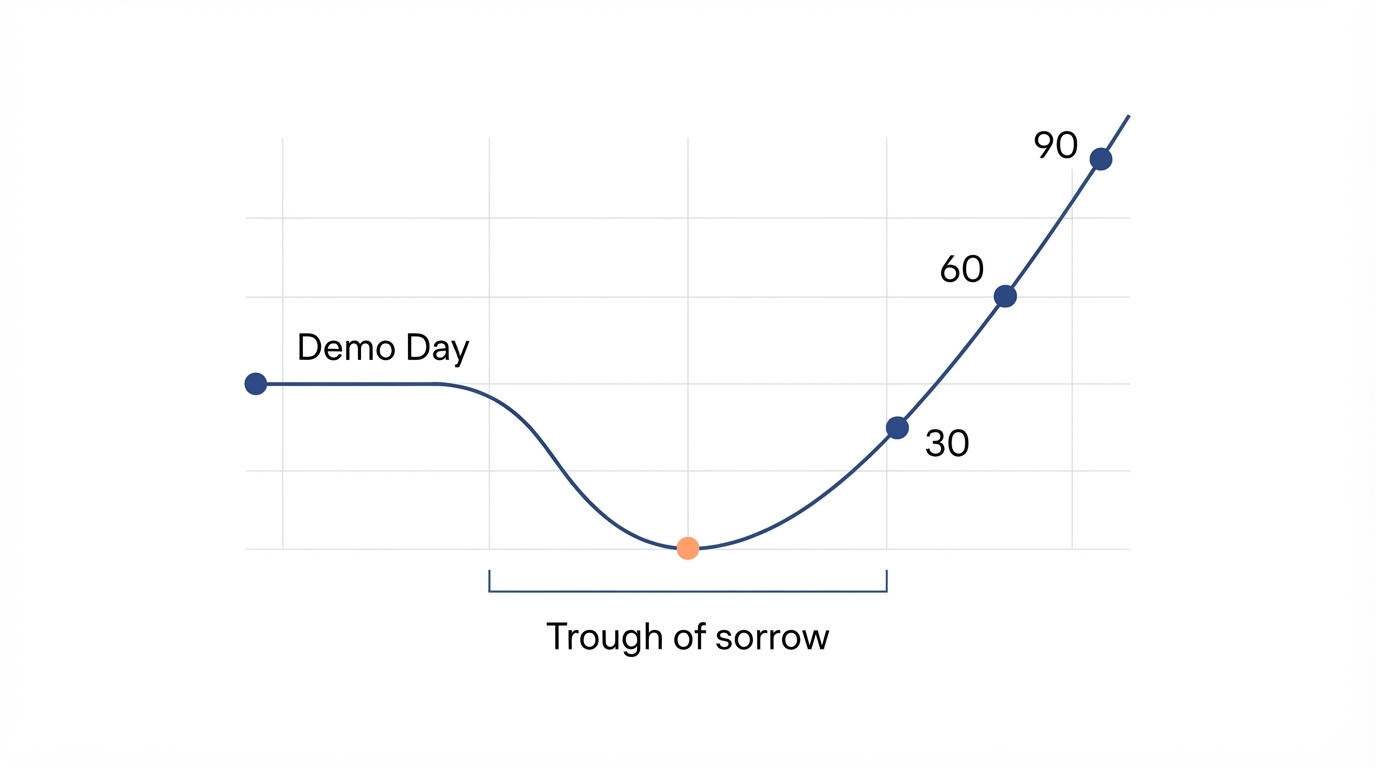
Demo day is a peak, and peaks are followed by a drop. The batch gave you weekly structure, peer accountability, partner office hours, and a deadline that organized everything. The Monday after graduation, all of that is gone at once, and most founders feel the loss before they feel the freedom.
Four things shift immediately:
- You lose external structure. No more office hours, standups, or batch deadlines forcing weekly progress. If you do not build your own cadence, weeks blur and momentum leaks.
- The trough of sorrow arrives. The initial excitement fades before real traction shows up. This dip is normal, predictable, and survivable - but only if you keep executing through it instead of waiting to feel motivated.
- The narrative-to-pipeline gap gets exposed. Your demo-day story sounded like a company at escape velocity. Your actual pipeline is thinner. Closing that gap - turning the promised trajectory into real, tracked pipeline - is the core work of the next 90 days.
- The runway clock starts ticking loudly. Whatever you raised on demo day is finite. Every week without a repeatable way to acquire customers is a week of runway spent buying learning, not growth.
None of this means the accelerator failed you. It means the accelerator did its job - gave you a springboard - and now the springboard is behind you. The founders who compound are the ones who treat graduation as the start of execution, not the finish line. For the full picture of how marketing fits an accelerator-stage company, the broader accelerator marketing playbook is the pillar this post sits under.
How Do You Build a 90-Day Growth Plan After an Accelerator?
The 90-day plan is built in three 30-day blocks, each with one primary job that the next block depends on. The discipline is sequencing, not simultaneity: you do not open five channels and a raise at once. You convert, then harden, then prove.
Start from your go-to-market strategy - the plan should be an execution schedule against it, not a new strategy. In the first 30 days the work is founder-led sales against warm demo-day contacts. In days 31-60 you double down on the single channel with the best early signal. By days 61-90 you document that channel so an outside agency or hire can run it without you.
The concrete template and the metrics to watch per phase are below. Keep the one-primary-goal-per-phase rule even as you add detail - breadth is the most common way a post-accelerator plan fails.
What Should Your First 30, 60, and 90 Days Focus On?
Resist the urge to do everything. The post-accelerator months reward sequencing, not simultaneity. Each 30-day block has one primary job, and the next block depends on the last one being done.
Days 1-30: Convert the Interest You Already Earned
Demo day generated a burst of warm attention - investors who took a follow-up meeting, customers who said "email me," partners who offered intros. That warmth has a short half-life. Before you build a single new campaign, work the list you already have.
- Follow up with every investor who engaged, within days, with a specific ask and a tight update - not a generic "just checking in."
- Turn "email me" customer conversations into booked calls, trials, or paid pilots. Warm inbound from demo day is the highest-converting pipeline you will have for months.
- Map which of these conversations actually fit your ideal customer profile so you are not chasing enthusiasm that will never close.
If your accelerator gave you access to a mentor and alumni network, mine it now - warm intros from that network convert far better than cold outreach. The mechanics of doing that well are covered in turning your accelerator network into startup traction.
Days 31-60: Harden One Acquisition Channel
By day 30 you should know which conversations converted and roughly why. Now pick one acquisition channel with the best early signal and make it repeatable. Repeatable means you can describe the motion, predict roughly what a dollar or an hour in returns, and run it again next week without reinventing it.
The mistake here is breadth. Founders fresh out of a batch often try paid search, content, outbound, events, and partnerships at once, and end up with five channels that each half-work. One channel that reliably produces qualified pipeline beats five that each produce noise. Depth first, then diversify once the first channel is stable.
Days 61-90: Set Up Reporting and Pick Your Next Quarter
By day 60 you have early channel data. Days 61-90 are about making that data legible to the people you answer to and deciding where the next quarter goes.
- Stand up a simple reporting rhythm for your board and investors: pipeline created, cost to acquire, conversion trend, and runway remaining. Investors want a compounding line, not a single good week.
- Decide whether the coming quarter is a growth quarter or a raise quarter (more on that below).
- Document the repeatable channel so a future hire or agency can run it without you.
What Should a Post-Accelerator 30/60/90 Plan Look Like?
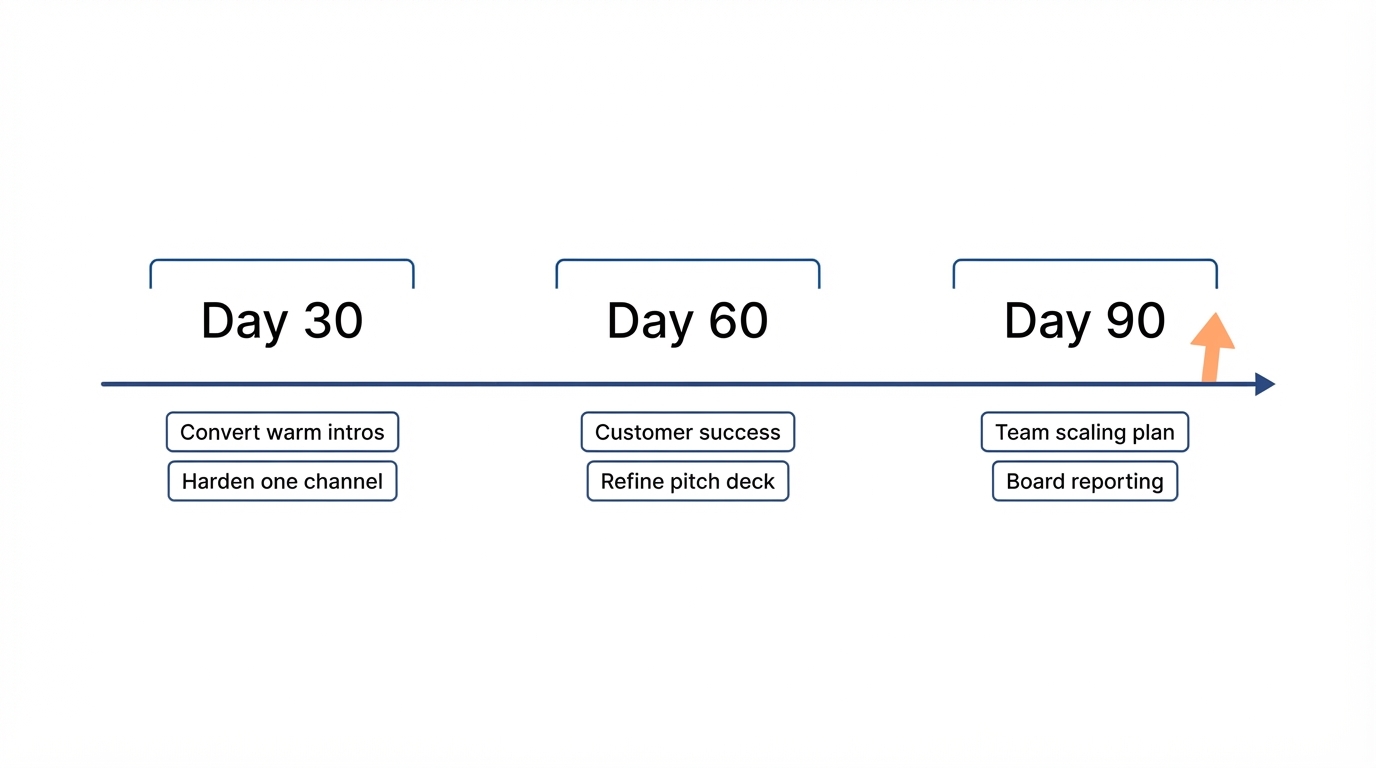
Here is a concrete template. Adapt the metrics to your model, but keep the one-primary-goal-per-phase discipline.
| Timeframe | Primary goal | Key actions | Metric to watch |
|---|---|---|---|
| Days 1-30 | Convert warm demo-day interest | Follow up with every engaged investor and customer; qualify against ICP; book pilots and trials from inbound | Qualified conversations converted to booked calls or pilots |
| Days 31-60 | Harden one acquisition channel | Pick the channel with best early signal; run it repeatedly; kill or park the rest; measure cost and conversion | Cost per qualified lead and repeatability of the motion |
| Days 61-90 | Prove a trend and choose the next quarter | Build board/investor reporting; document the channel; decide growth vs raise for next quarter | Month-over-month pipeline growth and runway months remaining |
Notice the metrics get more compounding as you go: from "did I convert warm leads" to "is my channel repeatable" to "is the line going up." That progression is exactly what investors expect to see when they look at a company that just graduated. For the deeper version of what your backers are grading, see what VC-backed startups owe their investors on marketing.
Which Metrics Matter Most Post-Accelerator?
The metrics that matter after an accelerator are the small set that tell you whether the company is compounding, not vanity totals. Track these weekly and review them together so you steer by data instead of mood.
- Qualified pipeline created. New qualified conversations or opportunities added each week. This is the leading indicator that the post-demo-day conversion work is landing.
- Cost per qualified lead (CPQL). What a dollar or an hour of effort returns in qualified pipeline. It is how you judge whether a channel is repeatable, not just active.
- Conversion rate through the funnel. Demo to call, call to pilot, pilot to paid. A rising rate means the motion is improving, not just that you are spending more.
- Month-over-month pipeline growth. The compounding line investors want to see. A flat or spiky line signals you are still depending on one-off events rather than a system.
- Runway months remaining. Cash left divided by burn. This is the constraint that decides whether the next quarter is a growth quarter or a raise quarter.
These five map directly to the "metric to watch" column in the 30/60/90 table above. For how these numbers evolve as your company matures, the startup lifecycle marketing view maps what to emphasize at each stage. The point is not to build a dashboard - it is to have the same handful of numbers reviewed on a fixed weekly cadence so the trough of sorrow does not silently eat your runway.
How Do You Keep Momentum Without the Batch?
The batch supplied three things you now have to manufacture yourself: accountability, cadence, and honest metrics reviews. Rebuild each deliberately.
- Accountability. Replace partner office hours with a standing external check-in - a weekly founder peer group, an alumni accountability pod, an advisor call, or an investor update on a fixed date. External eyes on a schedule force progress the way batch deadlines did.
- Cadence. Put a weekly operating rhythm on the calendar: Monday priorities, mid-week execution, Friday review of what moved. The specific structure matters less than the fact that it repeats without you deciding to run it each week.
- Metrics reviews. Once a week, look at the same handful of numbers - pipeline, conversion, cash - and ask what changed and why. This is where the trough of sorrow gets beaten: you keep steering by data instead of by mood.
A short weekly investor update note is one of the highest-leverage habits here. It doubles as accountability (you have to report progress), cadence (it happens every week), and relationship-building (your investors stay warm for the next raise). Consider a founder who commits to a five-line update every Friday - within a quarter, that habit alone keeps both momentum and investor confidence intact.
How Should You Prioritize Growth Versus Fundraising?
Growth and fundraising both demand deep, uninterrupted founder time, and they compete directly. A founder in full raise mode - building the deck, running the process, taking dozens of meetings - has very little left for hardening a channel or closing customers. Trying to do both at once usually means doing both at half effort, and half-effort fundraising is worse than none. Sequence them with this order:
- Nail one repeatable acquisition channel using the founder-led motion before the batch energy fully fades.
- Turn that channel into a short reporting cadence (pipeline created, cost to acquire, conversion) you can show investors.
- Use the traction numbers as the spine of your raise narrative, then go into fundraising mode from a position of momentum.
- After the round closes, bring in a hire or agency to scale the validated channel rather than starting discovery from scratch.
The cleaner approach is to sequence, guided by your runway:
- If you have 12+ months of runway: spend the post-accelerator months on growth. Traction is your best fundraising asset - a repeatable channel and a rising pipeline line raise your next round at better terms than a pitch alone ever will.
- If you have 6-9 months: use the first 60-90 days to build just enough traction proof to make the raise credible, then run a focused, time-boxed raise rather than an always-on one.
- If you are under 6 months: fundraising becomes urgent, but even then, one or two weeks spent sharpening your traction story pays for itself in the raise.
The through-line: traction reduces fundraising risk, so in most cases growth first, then raise from a position of strength. How that trade-off shifts as you move from pre-seed toward a priced round is laid out in the pre-seed to Series A marketing playbook.
How Do You Fund Post-Accelerator Growth?
Funding post-accelerator growth is not only about raising equity. The cheapest growth capital is the traction you create from a channel you already validated - it improves your next round's terms and delays dilution. The plan should treat founder time as the first budget line, because the early channel work cannot be outsourced yet.
When you do reach for outside help, be deliberate about the form. A premature full-time hire burns runway a tight post-accelerator balance sheet cannot spare, while focused agency or fractional support on one proven channel is leverage. The deeper go-to-market framing explains how to size that spend against the pipeline you expect the channel to return.
When Should You Bring in Help - Hire or Agency?
You do not need a marketing team on day one, and hiring one too early burns runway you cannot spare. A useful rule: bring in help only after you have found a channel with early signal, not before - and until then the founder-led marketing motion is what carries you. Paying someone to discover your channel from scratch is expensive; paying someone to scale a channel you have already validated is leverage.
- In-house hire when the motion is core to your business, needs deep product context, and will run for years - and when you can afford a full salary against your runway.
- Agency or fractional help when you need to move fast, want senior expertise without a full-time cost, or need to validate and scale a channel before committing to a permanent hire.
At the post-accelerator stage, most founders are better served by focused external help on one channel than by a premature full-time hire, precisely because runway is tight and the channel is not yet proven.
What Does a 90-Day Post-Accelerator Growth Plan Look Like?
A 90-day post-accelerator growth plan is a written execution schedule, not a new strategy. It sequences three fixed jobs across three 30-day blocks so that each phase sets up the next. Days 1-30 convert the warm demo-day interest you already earned before it cools. Days 31-60 harden one acquisition channel into a repeatable motion instead of spreading thin across five. Days 61-90 produce the reporting that proves a compounding trend to your board and investors. The discipline is sequencing, not simultaneity - you convert, then harden, then prove, rather than opening a raise and five channels at once. Tie the plan to your existing go-to-market strategy so the tactics fit the wider system, and lean on founder-led sales in the first block while the warm list is still hot. The founders who compound are the ones who treat graduation as the start of execution, not the finish line, and who keep the same handful of metrics on a fixed weekly cadence so the trough of sorrow never silently eats their runway.
How to Scale Spending After an Accelerator
Scaling spend post-accelerator is not about opening the budget - it is about matching spend to channel confidence. The rule is simple: spend aggressively only once one channel is repeatable, and keep burn low while you are still discovering. A channel is repeatable when you can predict roughly what a dollar returns in qualified pipeline and run the motion again next week without reinventing it.
Most founders waste the first post-accelerator dollars by spreading them across too many experiments. Instead, concentrate spend on the one channel with the best early signal until it produces a predictable cost-per-qualified-lead number. Only then widen scope. If you are still spending against multiple unproven channels at day 60, you are buying learning when you should be buying growth. A focused agency partner on that single validated channel can stretch your dollars further than hiring internally while the motion is still being hardened.
Growth Metrics to Instrument Post-Accelerator
Instrumentation is the wiring that makes the metrics in the table above real-time rather than retrospective guesswork. By day 30, you should have the following tracked reliably so your weekly review pulls data, not anecdotes:
- A CRM or lightweight pipeline tracker that records every qualified conversation from source to stage, with a date stamp on each movement. Demo-day contacts go in here first.
- A cost tracker that tags every dollar and founder hour spent against the channel it served, so CPQL is computed rather than estimated.
- A simple dashboard or spreadsheet that pulls pipeline created, conversion rate, and runway in one view - updated weekly, not monthly.
If you cannot answer "what did we spend and what pipeline did it return this week" after a 60-second look, your instrumentation is not good enough to steer by. Fix that before you add a second channel. The accelerator marketing playbook covers the broader measurement context this instrumentation feeds.
How to Transition from Founder-Led to Team-Led Growth
The founder-led motion - where you personally close early customers and run the channel - is the right starting point, but it does not scale. The handoff happens in stages, not in one big hire:
- Document the motion first. Write down the exact steps, scripts, and qualification criteria you used during days 1-60 so someone else can follow them.
- Hire for execution, not discovery. The first growth hire should scale a channel you have already validated, not find a new one. A hire brought in to discover a channel from scratch costs runway and delivers slowly.
- Fractional before full-time. At the post-accelerator stage, a fractional operator or specialist agency on the proven channel is lower risk than a full salary. Move to full-time only when the channel produces enough pipeline to cover the cost.
The broader go-to-market strategy framing explains how to size the team against the pipeline you expect, and founder-led sales covers what you must own before you hand anything off.
Two cheap growth levers after the batch: batchmate co-marketing and the discount programs covered in our startup perks marketing stack guide.
Post-Accelerator 90-Day Checklist
Demo day is the start, not the finish. This checklist turns momentum into tracked pipeline and one repeatable channel in the quarter after the program.
| Window | Focus | Exit criteria |
|---|---|---|
| Week 1-2 | Convert demo-day leads; stand up CRM and attribution | Every lead has an owner and a stage |
| Week 3-4 | Double down on the one channel that worked in-batch | Repeatable weekly qualified meetings |
| Week 5-8 | Add a second channel only after the first is systematic | Channel-level CAC below LTV threshold |
| Week 9-12 | Hire or partner to scale; protect founder time | Owner assigned to each channel |
Pair this with bootstrap marketing tactics if budget is tight, or weigh agency vs fractional CMO as you scale.
Choosing a program? Compare Plug and Play and Berkeley SkyDeck.
Frequently Asked Questions
What Is the Trough of Sorrow After Demo Day?
The trough of sorrow is the dip in energy and visible progress that follows the demo-day peak. The excitement fades before real traction appears, and founders often feel stuck. It is normal and predictable. You beat it by holding a weekly execution cadence and steering by metrics instead of waiting to feel motivated again.
What Should I Do in the First Week After Demo Day?
Work the warm list you already earned. Follow up with every investor and customer who engaged during demo day while the interest is still hot, qualify them against your ideal customer profile, and turn "email me" into booked calls or pilots. Do this before building any new campaign - warm demo-day inbound is your highest-converting pipeline for months.
Should I Focus on Growth or Fundraising After My Accelerator?
Sequence them by runway. With 12+ months of cash, prioritize growth - a repeatable channel and rising pipeline raise your next round at better terms than a pitch alone. With under 6-9 months, build just enough traction proof to make a focused, time-boxed raise credible. In most cases, growth first, then raise from strength.
When Should a Post-Accelerator Startup Hire Marketing Help?
After you find a channel with early signal, not before. Paying someone to discover your channel from scratch is expensive; paying them to scale a validated channel is leverage. At this stage, focused agency or fractional help on one channel usually beats a premature full-time hire, because runway is tight and the motion is not yet proven.
How Do I Keep Momentum Without the Accelerator'S Structure?
Manufacture the three things the batch gave you: accountability, cadence, and metrics reviews. Set a standing external check-in like a peer group or weekly investor update, put a repeating weekly operating rhythm on the calendar, and review the same core numbers - pipeline, conversion, cash - every week so you steer by data, not mood.
Key Takeaways
- Demo day is a peak; expect a trough. The support structure disappears and the runway clock gets loud, so replace external structure with your own cadence immediately.
- Days 1-30 are for converting warm demo-day interest - the highest-converting pipeline you will have for months - before you build anything new.
- Days 31-60 are for hardening one acquisition channel into a repeatable motion, not spreading thin across five that each half-work.
- Days 61-90 are for proving a compounding trend and setting up board/investor reporting that shows a line going up, not a single good week.
- Growth and fundraising compete for founder time - sequence them by runway rather than running both at half effort; traction first raises the next round from strength.
- Bring in a hire or agency only after you have found a channel with early signal; at this stage focused external help usually beats a premature full-time hire.