
To get your first customers, do things that do not scale: sell manually, founder-to-founder, instead of building funnels. Mine your own network and the communities where your buyers already gather, send personal outreach, and land three to five design partners who co-build with you. Treat your first 100 customers as a learning engine, not a growth channel, and let their behavior define your ICP.
Every founder wants a repeatable acquisition machine. At pre-seed, you do not have one yet, and chasing it wastes the months you should spend talking to humans. Your first customers are earned one conversation at a time. Your first 10 to 100 customers are your early adopters - the people who will use a buggy v1 and give candid feedback. This playbook walks the path from your first 10 to your first 100, the channels that actually work before product-market fit, and the mistakes that quietly kill early traction.
What Does Getting Your First Customers Actually Mean at Pre-Seed?
At pre-seed, "getting customers" does not mean revenue at scale. It means finding a handful of people with a problem so painful they will pay an unproven startup to solve it. The goal is evidence, not ARR. You are proving that a specific person, in a specific role, with a specific pain, will hand you money or serious commitment.
That reframing changes what you do all day. Instead of optimizing a signup flow, you are having 20 to 30 conversations a week. Instead of measuring conversion rate, you are measuring how many people say "I need this now" versus "that's neat." Your first customers are not a metric to grow. They are a research instrument that tells you who you are actually building for.
Concretely, your first customers give you three things:
- Proof of pain - someone paid or committed, which means the problem is real and urgent.
- An emerging ICP - the pattern across your first wins tells you which segment to double down on.
- Case studies and referrals - the raw material for every channel you build later.
Where Do Your First 10 Customers Actually Come From?
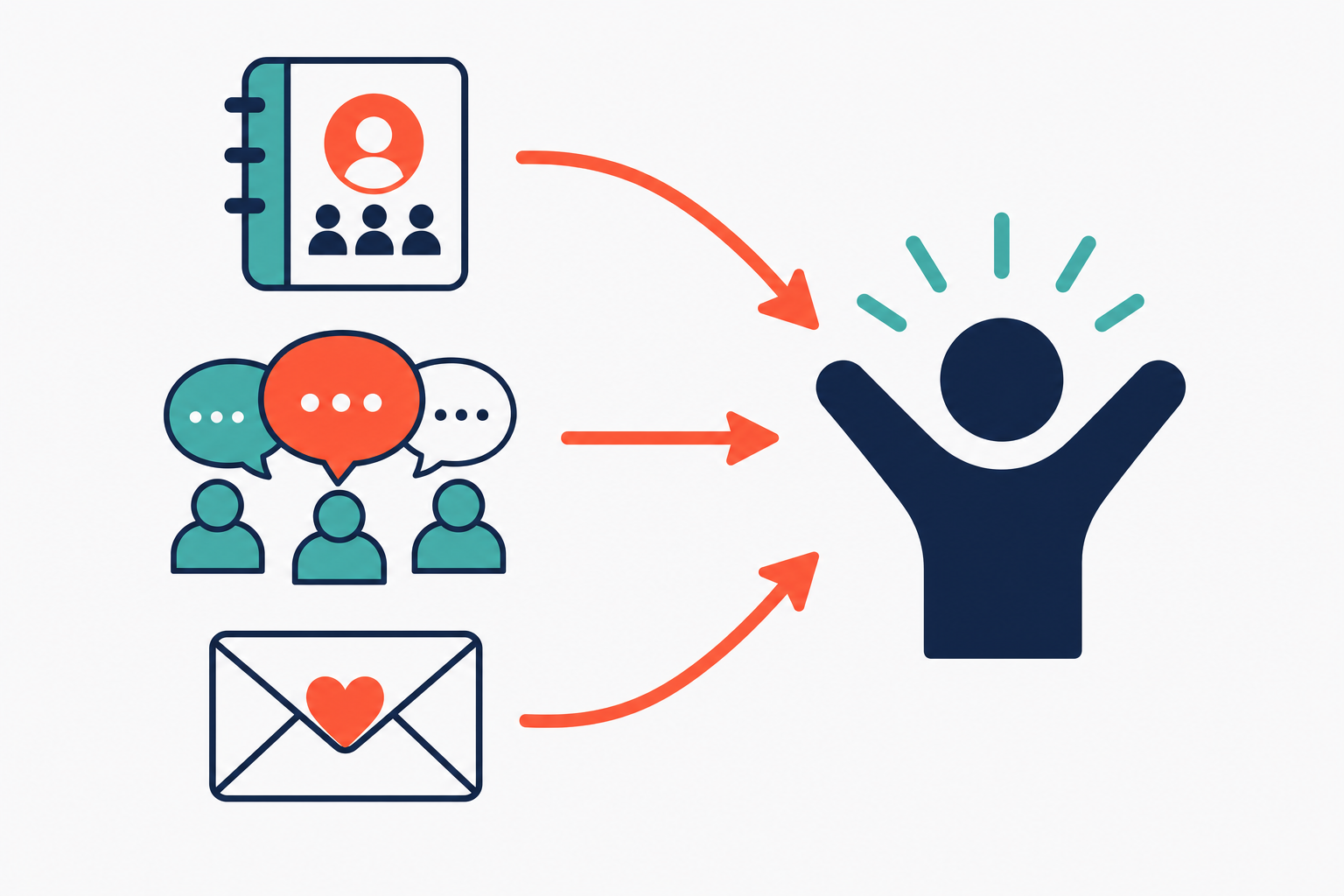
Your first 10 customers almost never come from ads, SEO, or cold funnels. They come from proximity: people who already know you, or who you can reach with a personal, specific message. Rank your sources by warmth and work them in order.
- Your direct network. Former colleagues, ex-managers, people you built with. Do not pitch broadly. Message individuals: "You dealt with X at your last company. We built something for exactly that. Fifteen minutes?"
- Warm intros. Ask your network to connect you to people who fit the pain. A referred conversation converts far better than any cold touch. Make the intro easy with a forwardable blurb.
- Founder communities. YC Bookface, accelerator Slack groups, niche Discords, and subreddits where your buyers hang out. Contribute first, sell second. Answer questions, then DM people who reveal the pain you solve.
- Targeted cold outreach. Not spray-and-pray. Pick 50 named accounts, find the one human who owns the problem, and send a two-sentence message referencing something specific about them.
- Design partners. Offer three to five early adopters deep access, a shaped roadmap, and a discount in exchange for real usage and feedback. This is the single highest-leverage move at this stage.
The mechanics of these conversations matter as much as the sourcing. This is founder-led sales, and the founder has to run it personally. On finding and structuring early adopters, see finding design partners. The muscle you are building here is manual pipeline creation, which is the foundation of demand generation from zero.
How Do You Get from Your First 10 to Your First 100 Customers?
Getting to 100 is not the same motion as getting to 10, but it is not automation either. It is deliberate repetition of what worked, plus the first systems to make it faster. You are still selling by hand, but now you know who to sell to.
The move is to mine your first 10 for a pattern. Look at which customers activated fastest, paid without haggling, and referred others. That cluster is your emerging ICP. Then go find 90 more people who look exactly like them.
Tactics that compound between 10 and 100:
- Manual onboarding, every time. Personally set up each customer. You will learn where they get stuck, and that feedback is worth more than the time it costs.
- Turn wins into referrals. After a customer sees value, ask directly: "Who else has this problem?" Warm intros from happy users are your best channel at this stage.
- Publish what you learn. Write the specific playbook your customers needed. Lightweight marketing for pre-seed startups is content that earns trust before you have a budget.
- Tighten the pitch. By customer 30 you should have a repeatable narrative: the pain, the before/after, the proof. Say it the same way until it stops working.
What Channels Work (and What to Ignore) Before Product-Market Fit?
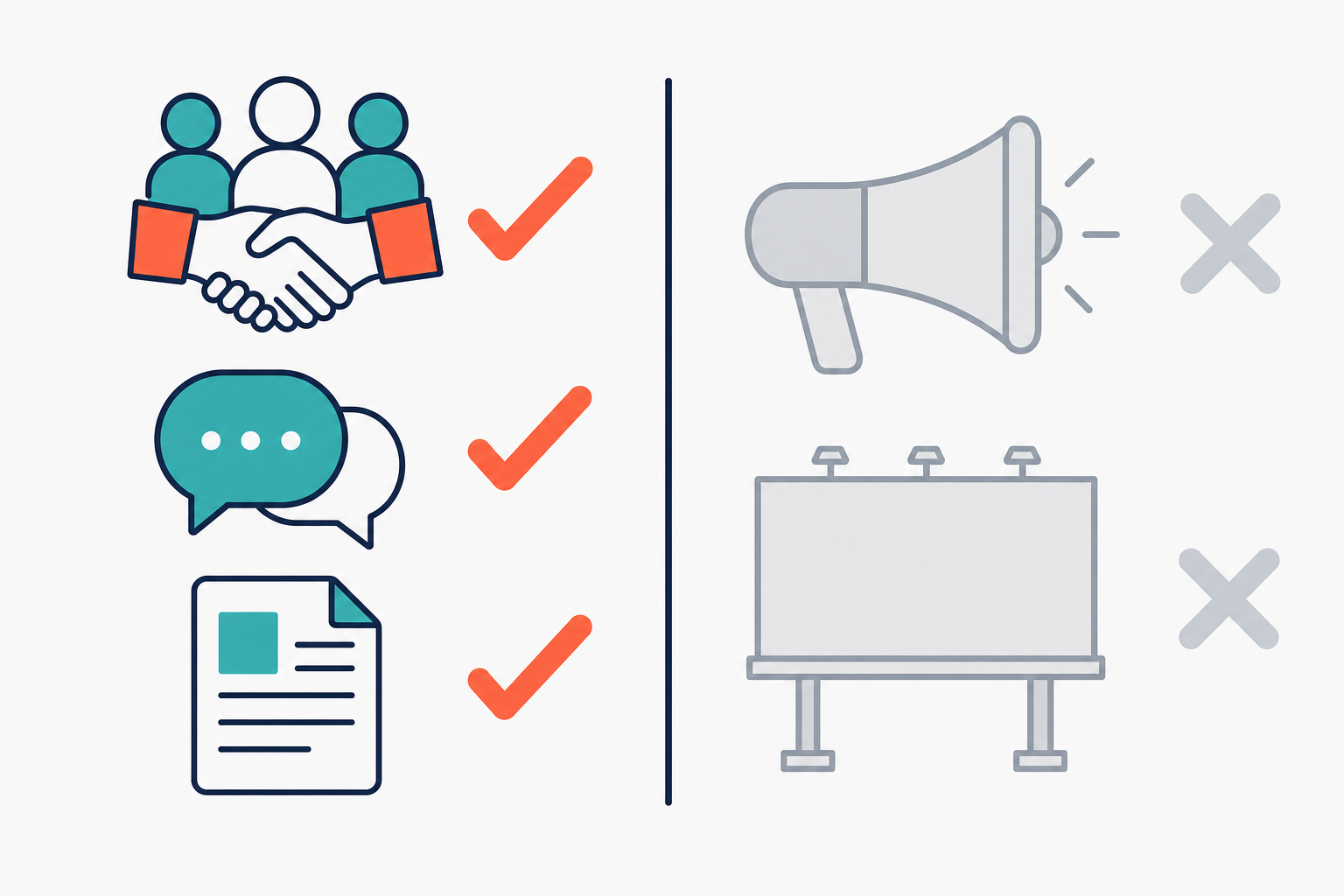
Before product-market fit, the only channels that work are the ones where you can talk to a human and learn. Everything that abstracts you away from the customer is a distraction you cannot yet afford.
| Stage | Primary goal | Primary motion | Who does it | What to measure |
|---|---|---|---|---|
| First 10 | Prove pain is real | Network + warm intros + design partners | Founder, hands-on | Conversations that convert to commitment |
| First 100 | Find the repeatable ICP | Referrals + targeted outreach + community | Founder + first hire | Activation rate, referral rate, payback |
| First 1000 | Build a scalable engine | Paid, SEO, partnerships, sales team | GTM team | CAC, LTV, channel ROI |
Channels to lean into now:
- Personal outreach - cold DMs and emails written one at a time to named people.
- Communities - be genuinely useful in the rooms where your buyers already are.
- Design partnerships - deep relationships that produce product and proof.
Channels to ignore until later:
- Paid ads - you will burn cash optimizing for a customer you cannot yet describe.
- SEO - real leverage, but a 6 to 12 month payoff you cannot bank on for your first 10.
- Conferences and booths - expensive, low-signal, easy to hide behind.
Those scalable channels are the right answer once you have proof. See B2B customer acquisition strategies for when you are ready to scale, and fold it all into a wider go-to-market strategy.
How Do You Turn Your First Customers into a Growth Engine?
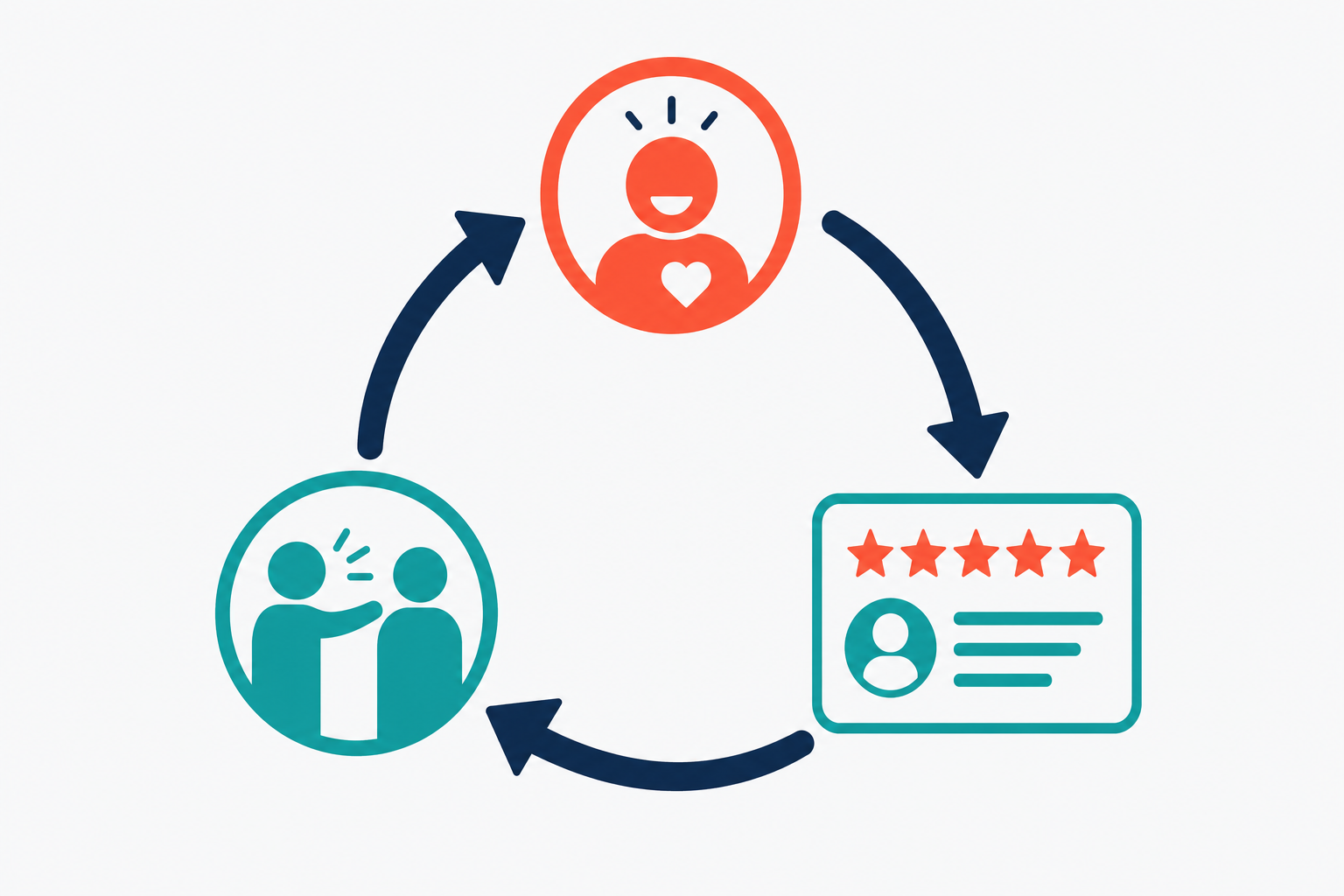
Your first customers are not just revenue. They are the fuel for everything that comes next, if you harvest them deliberately.
- Derive your ICP from real wins. The segment that bought fastest and stuck around defines who to target next. Stop guessing; read the data.
- Manufacture proof. Turn each success into a case study, a metric, a quote. Proof is the currency that lowers the cost of every future sale.
- Build a referral loop. Ask every happy customer for one introduction. Ten customers who each refer one person doubles your base for free.
- Feed the roadmap. Ship the things your first customers begged for. Their retention is the clearest signal you have product-market fit.
What Mistakes Kill Early Customer Acquisition?
Most early-stage founders fail at customer acquisition for the same handful of reasons. Nearly all of them come from trying to scale before you have earned the right to.
- Building a funnel too early. Automation before you understand the buyer just scales your confusion.
- Hiding behind the product. Coding for another month feels safe. It is not. Sales conversations are the work.
- Chasing everyone. If your customer is "any business," you will reach no one. Narrow until it feels uncomfortably specific.
- Under-pricing to zero. Free users teach you nothing about willingness to pay. Charge, even if it is small.
- Not asking for the sale. Founders run great discovery calls and never close. Ask for the commitment out loud.
- Ignoring the first churn. When an early customer leaves, that is your most valuable interview. Chase the reason down.
FAQ
How many customers do I need before I raise a seed round? There is no fixed number, but most seed investors want to see 5 to 20 paying customers or committed design partners, plus evidence of urgent pain and early retention. Quality of proof matters more than raw count at this stage.
Should I offer my product for free to get my first customers? Charge something, even a token amount. Free users tell you nothing about willingness to pay and often churn silently. A small paid commitment is far stronger evidence that the problem is real and worth solving.
How long should it take to get my first 10 customers? Expect one to three months of concentrated, hands-on selling. If you have talked to 100-plus qualified people and cannot land 10, the signal is usually a targeting or pain problem, not an effort problem, and it is worth pausing to re-examine your ICP.
What is a design partner and why do they matter so much? A design partner is an early adopter who co-builds with you, giving deep feedback and real usage in exchange for influence over the roadmap and often a discount. They matter because they simultaneously validate the problem, shape the product, and become your first reference customers.
Key Takeaways
- Get your first customers by selling manually, founder-to-founder, not by building funnels.
- Your first 10 come from your network, warm intros, communities, and design partners, in that order of warmth.
- Treat your first 100 customers as a learning engine that reveals your real ICP, not as a growth target.
- Before product-market fit, ignore paid ads and SEO; lean into personal outreach and deep design partnerships.
- Turn every early win into proof, referrals, and roadmap fuel to seed the channels you scale later.
- The fatal mistakes are scaling too early, hiding behind the product, targeting everyone, and never asking for the sale.
Related: How to Market a Startup Before Product-Market Fit.
Once the manual motions are working, the next stage is covered in our first 1000 customers playbook.