
Marketing due diligence is the process VCs run after they say "we're interested" and before they send a term sheet, where they and their associates pull apart your CAC, LTV, payback period, channel mix, and cohort retention to check that the growth story in your deck matches the underlying data. It is not a metrics review - it is a credibility check on your entire growth engine.
By the time a fund reaches this stage, the partner already likes you. What kills the deal now is not a weak pitch - it is a spreadsheet that does not reconcile, a growth channel that turns out to be one founder's LinkedIn posts, or a cohort chart that quietly excludes the customers who churned. This post is the process view: what gets requested, who reviews it, what the red flags are, and how to prep so your data room survives contact with an analyst who does this every week.
If you have not yet built your headline traction narrative, start with how to show traction to investors - this post assumes that story exists and walks through how it gets stress-tested.
What Do Vcs Actually Check Before a Term Sheet?
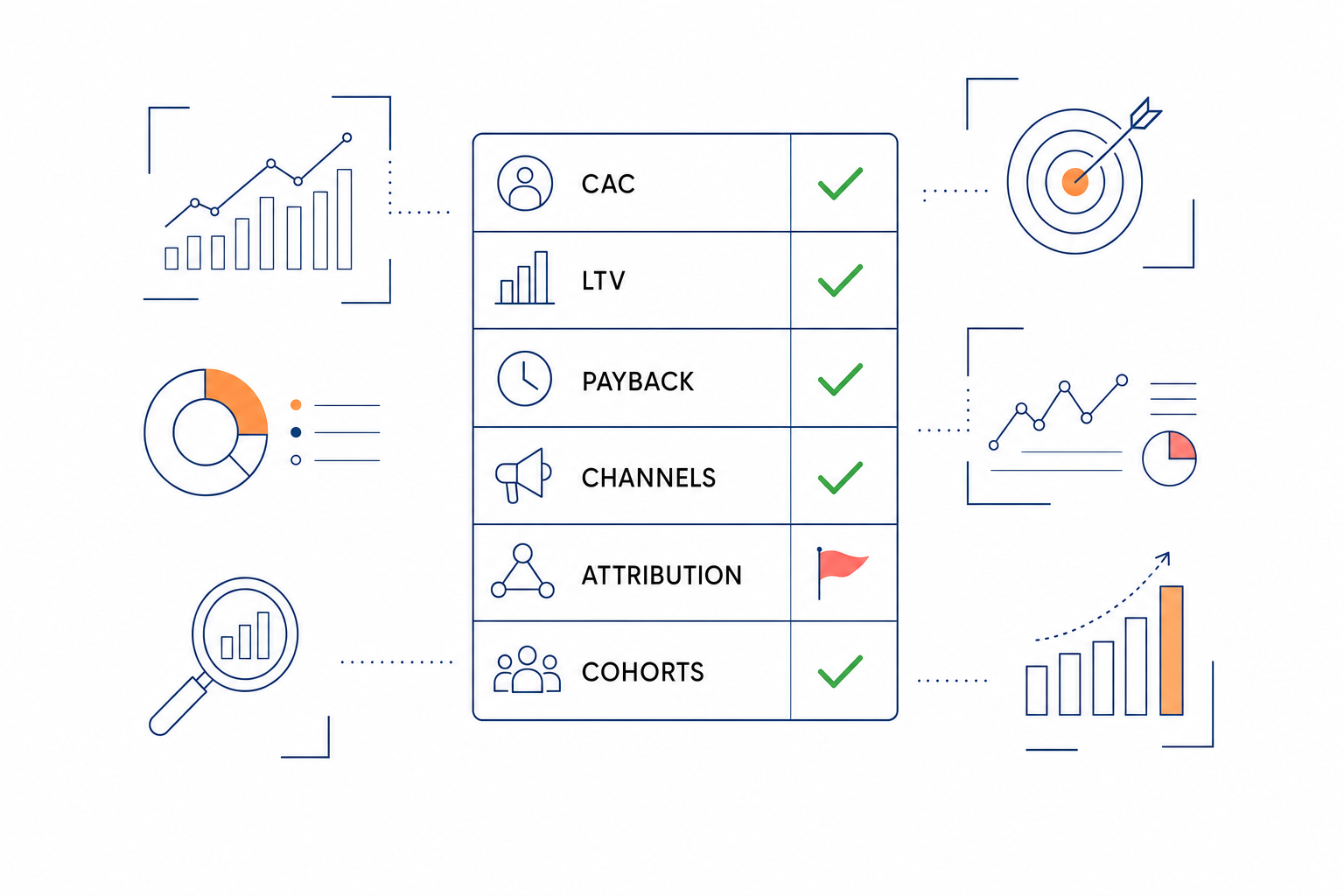
Once a fund moves from "interested" to "let's dig in," a partner or associate - sometimes a growth-focused operating partner, sometimes an outside consultant on a retainer - runs a structured review of your marketing and growth data against five questions:
- Does the data match the deck? Numbers in the pitch are cross-checked against raw exports from your analytics, ad platforms, and billing system.
- Is the unit economics story real? CAC and LTV are recalculated from source data, not taken from your slide.
- Is growth diversified or fragile? How much of new revenue depends on one channel, one campaign, or one person's network.
- Is retention durable? Cohort-by-cohort, not blended, and checked for whether it is improving or decaying.
- Is the attribution credible? Can you show where customers actually came from, or is "organic/direct" doing a lot of unexplained work.
This is distinct from the metrics you'd put on a traction slide. A slide picks the best numbers to tell a story; diligence checks whether the story survives someone else pulling the thread. For the benchmark ranges investors compare you against by stage, see traction benchmarks by funding stage.
What Goes in the Marketing Section of the Data Room?
Most generic due diligence checklists online are written for private equity buyouts - founder background, cap tables, leases, AR aging. Those matter too, but they are not marketing diligence. The marketing-specific data room artifacts are narrower and more technical:
- Raw CAC and LTV calculation with formula and source data shown, not just the output number
- Channel-by-channel spend and output for the trailing 12-24 months (paid, organic, content, partnerships, outbound)
- Cohort retention tables by signup month, revenue-based if you have expansion revenue
- Ad account read-only access (Google Ads, Meta, LinkedIn) or exported reports covering the same period as your deck claims
- Analytics access (GA4, product analytics, or your BI tool) so the diligence team can rebuild your funnel independently
- CRM export showing pipeline source, win rate, and sales cycle length by channel, if you sell B2B
- Attribution methodology write-up - what model you use and why, plus known blind spots
- List of any paused, discontinued, or one-time campaigns that boosted a historical period
Prepping this before diligence starts, rather than scrambling when the request lands, is the single biggest lever founders have. If your reporting stack cannot answer these questions on demand, see marketing analytics for fundraising for how to build the instrumentation before you need it.
How Do Vcs Scrutinize CAC, LTV, and Payback?
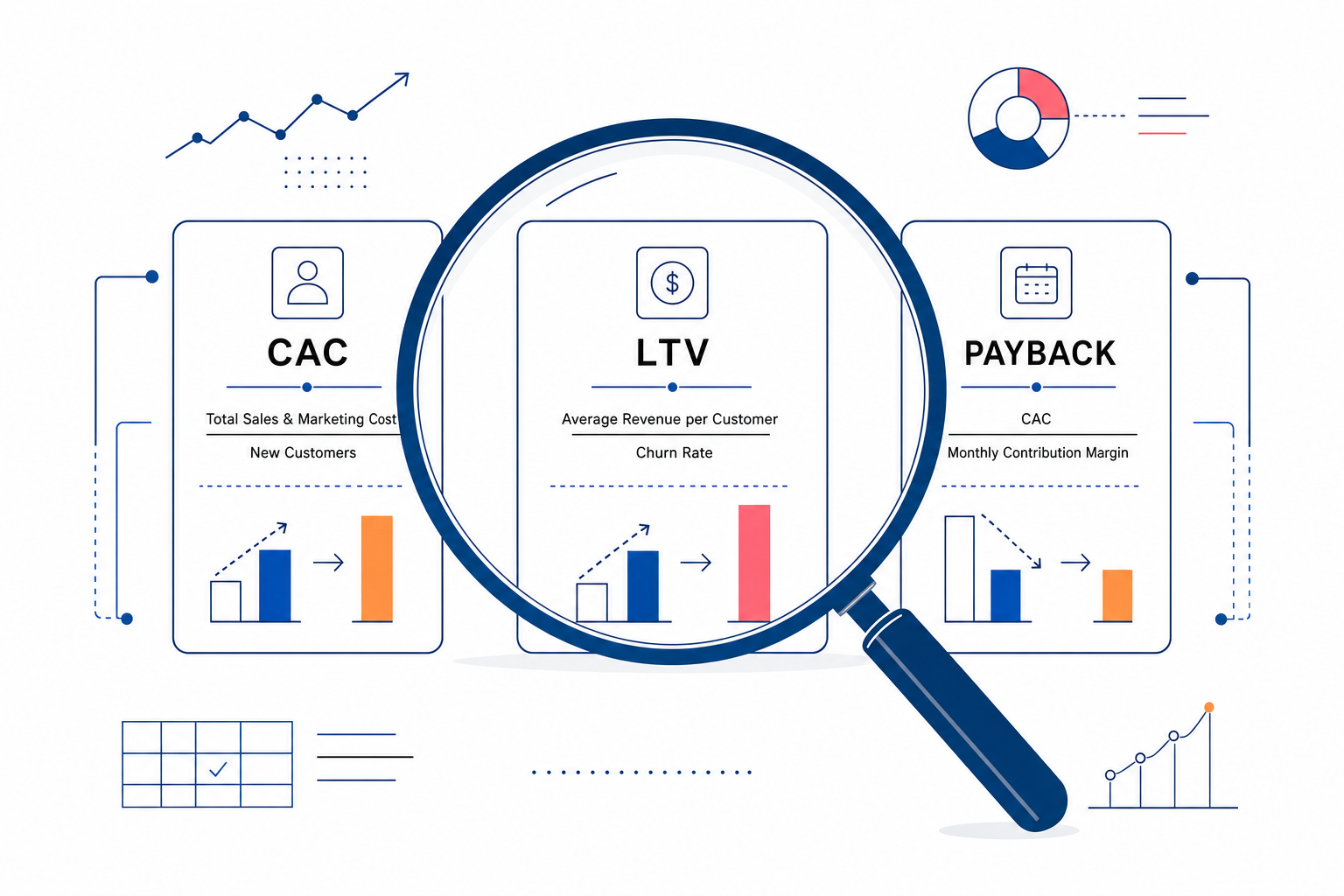
This is where most decks get quietly recalculated. A diligence team will not accept your blended CAC at face value - they rebuild it three ways and compare:
| Check | What they look at | Red flag |
|---|---|---|
| Fully-loaded CAC | Total sales + marketing spend (including salaries, tools, agency fees) divided by new customers, not just ad spend | CAC only counts media spend, excludes headcount and tooling |
| CAC by channel | Blended CAC broken into paid, organic, referral, sales-assisted | Blended number hides a channel with unsustainable CAC propping up the average |
| LTV methodology | Whether LTV uses actual observed retention curves or an assumed churn rate | LTV projected off 3 months of data extrapolated to 3 years |
| Payback period | Gross-margin-adjusted CAC payback, usually expected under 12-18 months for SaaS | Payback calculated on revenue, not gross margin, inflating the number |
| CAC trend over time | Whether CAC is rising, flat, or falling as spend scales | CAC rising faster than revenue with no plan to address it |
| Marginal CAC | What it costs to acquire the next customer at current scale, not the historical average | Historical CAC used to justify a much larger future spend plan without evidence it holds |
The most common deal-affecting finding here is not fraud - it is optimistic math. A founder uses gross CAC instead of net, or projects LTV off a cohort that is six months old. Neither is dishonest, but both erode trust once the diligence team catches it themselves rather than being told upfront. For the calculation itself, see the startup customer acquisition cost guide; for what happens when paid CAC creeps up under scrutiny, scaling paid acquisition without blowing up CAC covers the fix.
Why Does Channel Concentration Raise Red Flags?
A diligence team maps what percentage of new customers or revenue comes from each acquisition source. Concentration risk shows up in a few recognizable patterns:
- Single-channel dependency - over 60-70% of new revenue from one paid channel, with no evidence a second channel can scale
- Founder-led growth with no system - most pipeline traced back to one founder's personal network, cold outreach, or content, with no repeatable process behind it
- Platform risk - growth dependent on a single ad platform, marketplace, or app store algorithm that could change overnight
- Customer concentration inside the channel - a handful of accounts or one partnership responsible for a disproportionate share of revenue
None of these automatically kill a deal at seed or Series A, where some concentration is normal and even expected. What matters is whether you can name it, quantify it, and show a credible plan to diversify - versus getting caught flat-footed when the associate asks "what happens if this channel goes to zero next quarter."
How Do Investors Check If Your Attribution Is Credible?
Attribution is one of the easiest places for a deck to be technically true but practically misleading. Diligence teams probe it a few specific ways:
- They ask which attribution model you use (last-touch, first-touch, multi-touch, or self-reported) and whether it changed recently - a model switch right before fundraising is a known way to flatter a metric.
- They check the size of your "direct" or "organic - unattributed" bucket. A large unexplained bucket often means paid or referral traffic is being undercounted in your favor.
- They cross-reference your CRM source field against ad platform conversion data to see if the two systems agree within a reasonable margin.
- They ask for a sample of individual deals or customers and trace the path manually, rather than trusting the aggregate dashboard.
If your attribution setup has known gaps - and most startups' do - the credible move is disclosing them proactively with your best estimate of the impact, not waiting to be caught. Diligence teams have seen every version of this; what erodes trust is the surprise, not the gap itself.
What Do Vcs Look for in Cohort and Retention Data?
Blended retention (all customers, all time) is close to useless for diligence because it smooths over trend changes. What a competent diligence team asks for instead:
- Retention curves broken out by signup cohort (monthly or quarterly), so they can see whether newer cohorts retain better or worse than older ones
- Net revenue retention separated from logo retention, if you have expansion or upsell revenue
- Retention by acquisition channel - paid customers often retain worse than organic or referral customers, and averaging them hides that
- An honest explanation for any cohort that looks anomalously good or bad, including pricing changes, a product relaunch, or a one-time promo
The question that comes up most often: "is this getting better or worse as you scale?" A shrinking, improving cohort curve is a strong signal. A cohort curve that looks great early and then degrades as more recent cohorts are added is one of the fastest ways to lose confidence in a growth story - because it suggests the earliest customers were a non-representative, hand-picked group.
Questions That Kill Deals in Marketing Diligence
Certain questions show up in almost every process, and how a founder answers them tends to correlate with whether the deal survives:
"Can you walk me through exactly how you calculated this CAC number, starting from raw spend data?"
"What percentage of last quarter's new revenue came from a channel you are not confident you can scale?"
"If we pulled your ad account today, would the numbers match what's in the deck?"
"Which of your current cohorts would you be uncomfortable showing us in full, and why?"
Founders who answer these directly - including "here's the gap, here's what we're doing about it" - tend to keep momentum. Founders who get defensive, stall, or produce numbers that shift under questioning tend to see the process slow down and eventually stall, even when the underlying business is fine. Diligence is as much a trust exercise as an accuracy exercise.
How Should Founders Prepare for Marketing Diligence?
- Build the data room before you need it. Assemble CAC/LTV calculations, channel breakdowns, and cohort tables as a standing artifact, updated monthly, not a fire drill triggered by a term sheet conversation.
- Reconcile your systems in advance. Pull your own ad account exports and CRM data and check that they roughly agree with your deck before an investor does it for you.
- Document known gaps and limitations. Every startup has attribution blind spots or a channel that is more fragile than it looks. Write down what you know and your plan, and lead with it.
- Separate blended metrics from channel-level ones. Have both ready. Blended tells the headline story; channel-level is what survives scrutiny.
- Rehearse the calculation, not just the number. Be ready to walk through your CAC or LTV formula line by line on a screen share, live.
- Grant read-only access early when asked. Slow-walking platform access reads as evasive even when nothing is wrong.
Key Takeaways
- Marketing due diligence starts once a VC is already interested - it verifies the growth story rather than building the pitch.
- The core artifacts are a rebuilt CAC/LTV calculation, channel-by-channel spend and output, cohort retention tables, and platform access, not a generic PE-style document checklist.
- Diligence teams recalculate CAC and LTV from source data rather than trusting the deck; fully-loaded, channel-level numbers hold up better than blended ones.
- Channel concentration and shaky attribution are the two most common sources of red flags, even in otherwise strong businesses.
- Cohort retention trends matter more than a single blended retention number - investors want to know if the curve is improving or decaying as you scale.
- Deals stall less over bad numbers and more over founders who get defensive or produce numbers that shift under questioning - proactive disclosure of known gaps builds trust.
- Preparation is a standing practice - a monthly-updated data room beats a scramble triggered by a term sheet timeline.
Frequently Asked Questions
What Is Marketing Due Diligence?
Marketing due diligence is the process VCs and their teams use to verify a startup's growth engine before investing - checking CAC, LTV, channel concentration, attribution, and cohort retention against raw source data rather than pitch deck summaries. It happens after initial investor interest and before a term sheet is finalized.
What Is the Difference Between Marketing Due Diligence and a Traction Slide?
A traction slide is a curated summary designed to tell your best growth story in a pitch. Marketing due diligence is the verification process that checks whether that story holds up against raw data - ad account exports, CRM records, and cohort tables - typically run by an associate or growth-focused partner after the initial pitch has landed.
What CAC and LTV Numbers Do Vcs Expect to See in Diligence?
There is no single universal number - expectations vary by stage, business model, and sector - but diligence teams consistently want fully-loaded CAC (including salaries and tools, not just media spend), LTV built from observed retention rather than assumptions, and a gross-margin-adjusted payback period, usually under 12-18 months for SaaS businesses.
What Is Channel Concentration Risk in Growth Diligence?
Channel concentration risk is when a large share of new customers or revenue - commonly cited as over 60-70% - comes from a single acquisition source, such as one paid channel, one founder's network, or one platform, with no evidence a second channel can scale. It is a common diligence flag because it makes future growth fragile to a single point of failure.
How Far Back Does Marketing Diligence Data Need to Go?
Most diligence requests cover the trailing 12-24 months of channel spend, output, and cohort data, though the exact window scales with company stage - seed-stage companies may only have a few months of usable data, while Series B and beyond are expected to show multi-year trends with month-by-month granularity.