
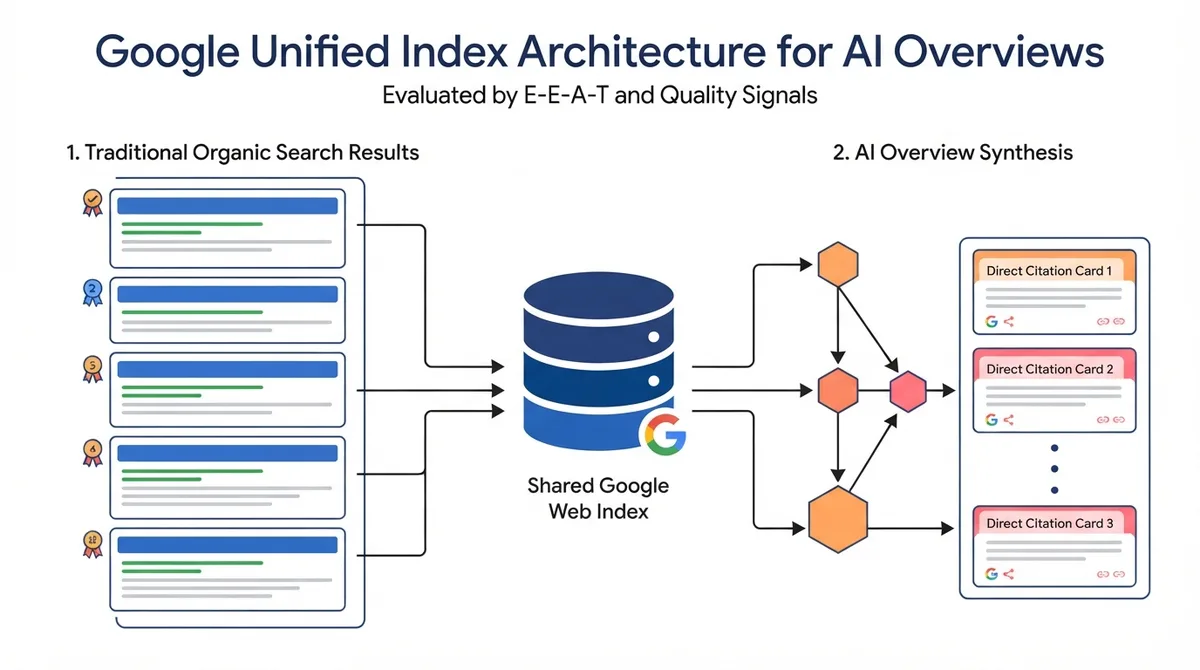
Google Search Central's core guidance on AI Overviews is that there is no special AI-Overviews markup or separate AI index. The same helpful, people-first, high-quality content and standard structured data that ranks in organic Search is what surfaces in AI Overviews, drawn from the same index and judged by the same E-E-A-T signals.
There is a growing industry of AI SEO advice that directly contradicts what Google has publicly stated about how AI Overviews select sources. Before you restructure your entire content strategy around third-party speculation, you should know what Google Search Central AI Overviews content guidance actually says -- and where the gaps in that guidance create room for interpretation.
This post breaks down Google's official recommendations, the practical steps they imply, and the myths circulating in the SEO community that do not hold up against what Google has published.
What Google Search Central Actually Says About AI Overviews
Google's official position on AI Overviews content selection is deliberately concise, and that brevity has led to widespread misinterpretation. If you have not seen the feature in your own results yet, here is how to turn on Google AI Overviews.
Google has stated that AI Overviews draw from the same index that powers traditional search results. There is no separate "AI index" or "AI ranking algorithm." Content that performs well in organic search has a higher baseline probability of being cited in AI Overviews. This is the single most important piece of official guidance, and it has a direct strategic implication: traditional SEO fundamentals remain the foundation of AI Overview visibility.
Google has also clarified that AI Overviews are designed to direct users to the web. The citations within AI Overviews are functional links, and Google has stated that these links receive meaningful click-through. This counters the narrative that AI Overviews eliminate web traffic entirely -- though it does not eliminate the click-through rate reduction that data consistently shows.
On content quality, Google Search Central's guidance aligns with their long-standing E-E-A-T framework: Experience, Expertise, Authoritativeness, and Trustworthiness. Content demonstrating first-hand experience, subject matter expertise, and authoritative sourcing is preferred by the AI Overview system. There is no shortcut or special optimization that bypasses these fundamentals.
Google has not published detailed technical specifications for how AI Overviews select specific sources from their index. This absence is intentional and consistent with how Google handles algorithmic details across all search features. The guidance is directional, not prescriptive.
How to Align Your Content Strategy with Google'S Guidance
Google's guidance, while high-level, implies several concrete actions that align with both AI Overview optimization and broader AI search optimization strategy.
Maintain Strong Organic Rankings
Since AI Overviews draw from the same index, organic ranking strength is a prerequisite for citation. Continue investing in traditional SEO: technical health, content quality, backlink acquisition, and user experience. Do not abandon these fundamentals in pursuit of AI-specific tactics.
Double Down on E-E-A-T Signals
Google's emphasis on E-E-A-T is your clearest signal about what influences AI Overview source selection. Implement author bios with verifiable expertise credentials. Publish content that demonstrates first-hand experience. Build authoritative backlink profiles from industry sources. Ensure your organization's trustworthiness signals -- secure site, transparent contact information, editorial standards -- are strong.
Structure Content for Extractability
While Google has not explicitly stated that content structure influences AI Overview citation, the mechanics of synthesis require extractable claims. Content that leads with clear answers, uses descriptive headings, and separates claims into distinct structural elements is inherently easier for any synthesis system to process. This aligns with Google's general guidance to create content that is "helpful, reliable, and people-first."
Implement Comprehensive Structured Data
Google Search Central has long recommended structured data for helping Google understand content. Schema markup -- Article, FAQ, HowTo, Organization, Author -- provides machine-readable context that any AI system, including AI Overviews, can use to evaluate and categorize your content. This is not speculation; it is a direct extension of Google's documented structured data guidance. For a practical walkthrough, see our guide to structured data for AI search.
Monitor Your AI Overview Presence
Google Search Console provides some data on AI Overview impressions. Use this alongside third-party tools to understand which of your pages are being cited in AI Overviews and for which queries. This data informs iterative optimization and helps you identify content gaps. Our AI search competitor analysis guide provides a framework for competitive benchmarking in this space. If a page you expected to be cited shows no AI Overview impressions at all, our guide on AI Overviews not appearing helps you rule out region, query type, and indexing issues first.
Myth-Busting: What Google Has Not Said (but the SEO Industry Claims)

The gap between Google's official guidance and industry advice has produced several persistent myths that can lead your strategy astray.
Myth: You Need a Separate AI SEO Strategy That Replaces Traditional SEO
Google has been explicit that AI Overviews draw from the same index as traditional search. There is no separate AI algorithm requiring a separate strategy. The reality is that AI Overview optimization layers on top of traditional SEO -- it does not replace it. Brands that abandon traditional SEO fundamentals to chase AI-specific tactics will lose both organic rankings and AI citation potential.
Myth: Certain Schema Types Guarantee AI Overview Inclusion
No schema type guarantees AI Overview citation. Structured data helps Google understand your content, which can improve citation likelihood, but it is not a citation trigger. The industry advice that "implementing FAQ schema will get you into AI Overviews" overstates what structured data does. It is a supporting signal, not a ranking factor for AI Overviews specifically.
Myth: Long-Form Content Performs Better in AI Overviews
Google has not stated any content length preference for AI Overview citation. The synthesis model extracts claims, not entire articles. A 500-word page with a perfectly structured, authoritative answer to a specific question can be cited ahead of a 5,000-word guide that covers the same topic with less precision. Quality and structure matter more than length.
Myth: You Can Optimize Specifically for AI Overviews Without Affecting Organic
Some practitioners suggest micro-optimizations that target AI Overviews without changing how content performs in organic search. In practice, the changes that improve AI Overview citation -- better structure, clearer answers, stronger E-E-A-T signals -- also improve organic performance. The two are not independent, and trying to treat them as separate optimization tracks creates unnecessary complexity. For the broader picture of how AI Overviews have reshaped SEO, see our Google AI Overviews impact analysis.
Myth: AI Overviews Will Replace Organic Results Entirely
Google has publicly committed to driving traffic to the web through AI Overview citations. While click-through rates on AI Overview queries are lower than traditional results, organic search results still appear below AI Overviews and still receive clicks. The claim that organic SEO is "dead" because of AI Overviews is not supported by Google's stated position or by current traffic data.
Frequently Asked Questions
Does Google Penalize Content That Is Optimized for AI Overviews?
No. Google has not indicated any penalty for content optimized for AI Overviews. Since the optimizations that improve AI Overview citation -- structured content, strong E-E-A-T signals, clear answers -- align with Google's general content quality guidelines, there is no tension between AI Overview optimization and compliance with Google's policies.
Should I Create Content Specifically to Target AI Overviews?
Creating content specifically to answer questions that AI Overviews address is a sound strategy, but it should be driven by user intent, not AI Overview gaming. Google's guidance consistently emphasizes creating content for people first. If a piece of content genuinely answers a user question well, it is a strong candidate for AI Overview citation regardless of whether that was the explicit goal.
How Does Google'S AI Overview Guidance Differ from Advice About Other AI Search Engines?
Google's guidance applies specifically to Google AI Overviews and is grounded in their existing index and E-E-A-T framework. Other AI engines like Perplexity and ChatGPT have different source selection mechanisms and do not follow Google's ranking signals. AEO best practices that work across multiple platforms require additional considerations beyond what Google recommends. See our guide on AEO best practices in 2026 for a cross-platform approach.
Does Google Recommend Special Markup for AI Overviews?
No. Google Search Central does not publish any special markup or schema for AI Overviews. AI Overviews draw from the same index as organic Search, so the standard structured data and helpful, people-first content that Google already recommends is what makes content eligible for AI Overview citation.
What Type of Content Does Google Recommend for AI Overviews?
Google recommends helpful, people-first content that demonstrates E-E-A-T: Experience, Expertise, Authoritativeness, and Trustworthiness. There is no special AI-Overviews markup or separate AI index -- the same high-quality content that ranks in organic search is what surfaces in AI Overviews.
Can Structured Data Improve My Chances of Appearing in AI Overviews?
Yes, though no schema type guarantees AI Overview citation. Standard structured data like Article, FAQPage, and Organization schema helps Google understand your content, which can improve citation likelihood as a supporting signal. For a practical walkthrough, see our guide to structured data for AI search.
How Can I Measure Whether My Pages Are Being Cited in AI Overviews?
Use Google Search Console to see AI Overview impressions for your pages, then layer in third-party tools to find which queries trigger citations. This data reveals content gaps and shows which pages earn visibility. Track this alongside organic rankings so you can spot where AI citation and traditional results diverge.
Why Has Google Not Published Detailed Technical Specifications for AI Overviews?
Google intentionally avoids releasing granular algorithmic details, and AI Overviews follow that same pattern. The guidance is directional rather than prescriptive, leaving room for interpretation. This silence is consistent with how Google treats all search features, so practitioners must test and infer rather than rely on documented mechanics.
Do AI Overviews Reduce the Click-Through Rate on My Organic Results?
Yes, data consistently shows lower click-through rates on queries where AI Overviews appear, since the summary answers users above traditional results. However, Google states the citation links receive meaningful clicks and organic results still appear below. The impact is a reduction, not the elimination, of web traffic.
Should I Abandon Long-Form Content Because AI Overviews Extract Short Answers?
No. The synthesis model extracts claims, not entire articles, so a concise, well-structured page can outrank a longer one with less precision. Length is not a citation factor Google has stated. Focus on clear, authoritative answers and strong E-E-A-T rather than padding word count to chase overview inclusion.
Key Takeaways
- Google AI Overviews draw from the same index as traditional search -- strong organic rankings remain the foundation of AI citation potential.
- E-E-A-T (Experience, Expertise, Authoritativeness, Trustworthiness) is the closest thing to a stated ranking factor for AI Overview source selection.
- No schema type, content length, or formatting trick guarantees AI Overview citation -- the fundamentals matter more than tactical optimizations.
- AI Overview optimization supplements traditional SEO; it does not replace it, and Google has been explicit about this.
- The gap between Google's official guidance and industry advice is significant -- ground your strategy in what Google has actually stated, then test from there.