
Content with proper schema markup has a 2.5x higher chance of appearing in AI-generated answers, and sites with complete Tier 1 schema see up to 40% more AI Overview appearances. Structured data transforms your content from plain text that AI must interpret into explicitly labeled entities that AI systems can confidently extract, verify, and cite. In 2026, Google AI Overviews, ChatGPT, and Perplexity all rely on schema markup to surface accurate answers. Here's how to implement structured data that earns AI citations.
Structured data is the language AI speaks. Without it, your content exists in translation -- and the AI may get it wrong.
Why Structured Data Matters for AI Search
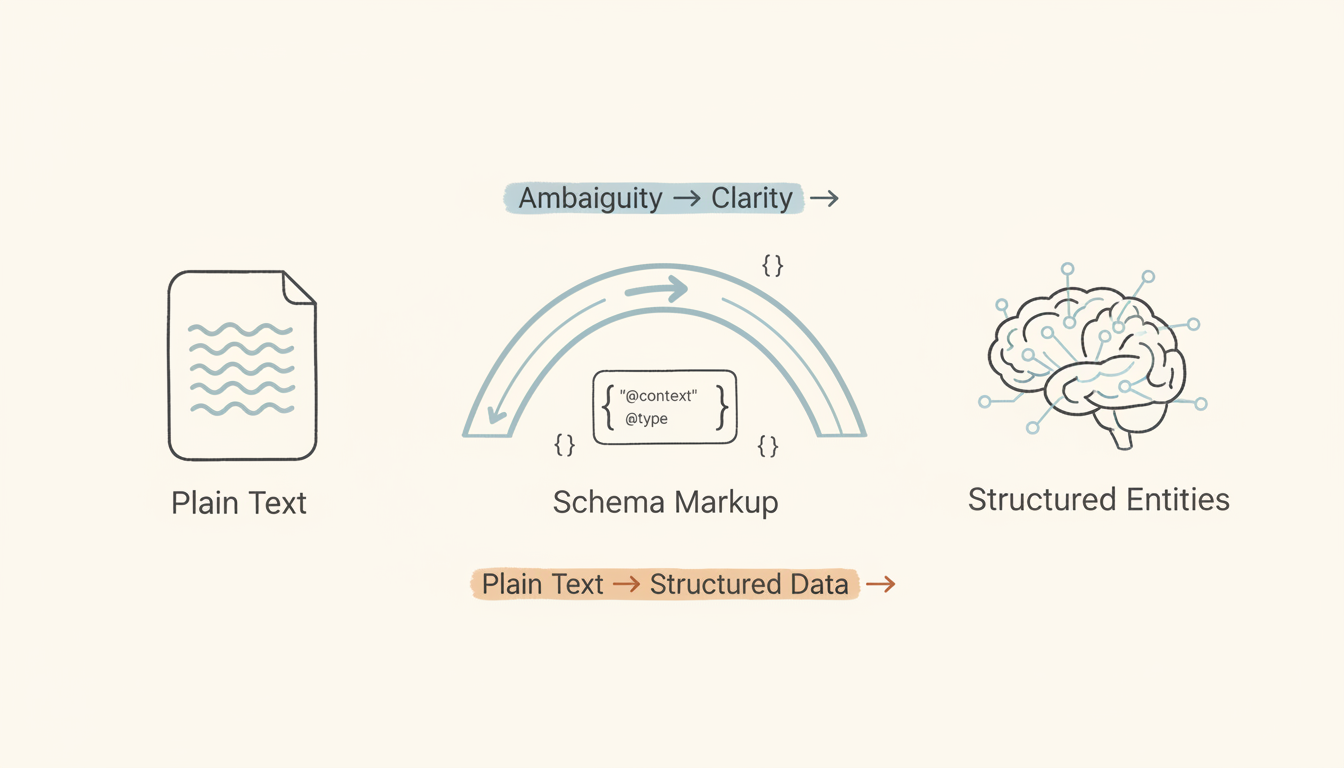
Structured data AI search engines rely on acts as a translation layer between your content and AI systems. Rather than forcing AI to parse and guess meaning through natural language processing, schema provides explicit signals about what your content represents. This aligns with Google Search Central guidance on AI Overviews, which stresses that the same structured data and helpful, people-first content that ranks in organic Search is what surfaces in AI answers.
The Machine Readability Advantage
Schema provides explicit definitions that AI systems can process without interpretation errors or contextual guessing.
Without Schema | With Schema |
AI interprets meaning from context | AI receives explicit definitions |
Higher risk of misinterpretation | Reduced extraction errors |
Content treated as plain text | Content organized as entities |
Lower confidence in citations | Higher citation confidence |
Schema transforms your pages from unstructured text into organized information that AI can confidently analyze, summarize, and reference.
How AI Uses Structured Data
When processing queries, AI systems use schema to:
- Identify content type: Is this a FAQ, product, how-to guide, or article?
- Extract specific answers: Pull precise data points without interpretation
- Verify information: Cross-reference structured claims with knowledge bases
- Attribute sources: Credit content accurately with proper context
- Build confidence: Trust well-marked content over ambiguous pages
Which Schema Types Matter Most for AI Visibility?
Not all schema types contribute equally to AI citations. Focus on these high-impact options.
Faqpage Schema
FAQPage schema is essential for question-answer content. AI systems parse FAQ schema to extract concise answers that match user queries directly, similar to how optimizing FAQ schema for Google AI Overviews can improve visibility in search results.
Best for:
- Q&A sections within articles
- Dedicated FAQ pages
- Product and service questions
Implementation tip: Keep answers between 40-60 words for optimal extraction. FAQPage schema improves AI citation rates by 30% on average.
Howto Schema
HowTo schema structures step-by-step instructions in a format AI can easily process and cite. When implementing instructional content, understanding HowTo schema for AI search is crucial for maximizing extraction accuracy.
Best for:
- Tutorial content
- Process explanations
- Instructional guides
Implementation tip: Number steps explicitly and keep each step to 1-2 sentences.
Article Schema
Article schema establishes content type and authorship, reinforcing expertise and credibility signals that AI systems evaluate. Using Article schema for AI platforms helps search engines understand content context and authorship signals.
Best for:
- Blog posts
- News content
- Educational articles
Implementation tip: Include author information with credentials for E-E-A-T signals.
Organization Schema
Organization schema helps AI distinguish your brand from competitors and establishes entity recognition in knowledge graphs.
Best for:
- Homepage
- About pages
- Contact pages
Implementation tip: Include official logo, social profiles, and specific location data.
Person Schema and E-E-A-T Signals
Person schema reinforces the Experience, Expertise, Authoritativeness, and Trustworthiness (E-E-A-T) signals that AI systems evaluate when selecting sources to cite. By marking up author credentials, professional bios, and affiliations with structured data, you give AI platforms explicit proof of expertise.
Key properties to include in Person schema:
- jobTitle and worksFor: Establishes professional authority
- sameAs: Links to LinkedIn, professional profiles, and published works
- alumniOf and hasCredential: Formal qualifications that AI can verify
- knowsAbout: Explicit topic expertise signals
AI platforms like Google AI Overviews and Perplexity weigh author expertise heavily when deciding which content to cite for YMYL (Your Money or Your Life) topics. Person schema makes these signals machine-readable rather than requiring AI to infer them from context.
Speakable Schema
Speakable schema marks content suitable for voice assistants to read aloud--increasingly important as AI assistants handle more voice queries.
Best for:
- News articles
- Summaries and key points
- Content designed for audio consumption
Implementation tip: Mark only the most important 2-3 sections as speakable.
Localbusiness Schema for AI Visibility
LocalBusiness schema is critical for service-based and location-dependent businesses that want to appear in AI-generated local recommendations. AI platforms like Google AI Overviews pull structured local data to answer queries such as "best [service] near me" and populate local knowledge panels.
For multi-location businesses, implement a hierarchical schema structure: an Organization entity at the parent level with individual LocalBusiness entities for each location. Each location should include:
- address, geo, and openingHoursSpecification: Core location signals
- areaServed: Defines the geographic service radius
- hasMap: Links to Google Maps listing
- aggregateRating: Location-specific review data
Align your LocalBusiness schema with your Google Business Profile data. Inconsistencies between schema markup and GBP listings confuse AI systems and reduce citation confidence.
Service and Offercatalog Schema
For businesses that sell services rather than products, Service and OfferCatalog schema types fill a gap that Product schema cannot. AI systems use these to understand service offerings, pricing structures, and availability without guessing from page copy.
Use Service schema with properties like serviceType, provider, areaServed, and hasOfferCatalog. For professional services, subtypes like LegalService, FinancialService, or MedicalBusiness provide even more specific signals that AI can match to user intent.
Review and Rating Schema
Review schema helps AI surface social proof alongside your content in citations. Implement AggregateRating for overall business ratings and individual Review markup for specific testimonials.
Important guidelines:
- Use first-party reviews collected on your own site, not scraped third-party reviews
- Google penalizes self-serving review markup -- ratings must reflect genuine customer feedback
- Ensure rating values are consistent across schema and visible page content
- Include reviewCount and ratingValue as required properties
AI platforms cross-reference review schema with external review signals. Inflated or inconsistent ratings damage trust scores.
Schema Impact by Type
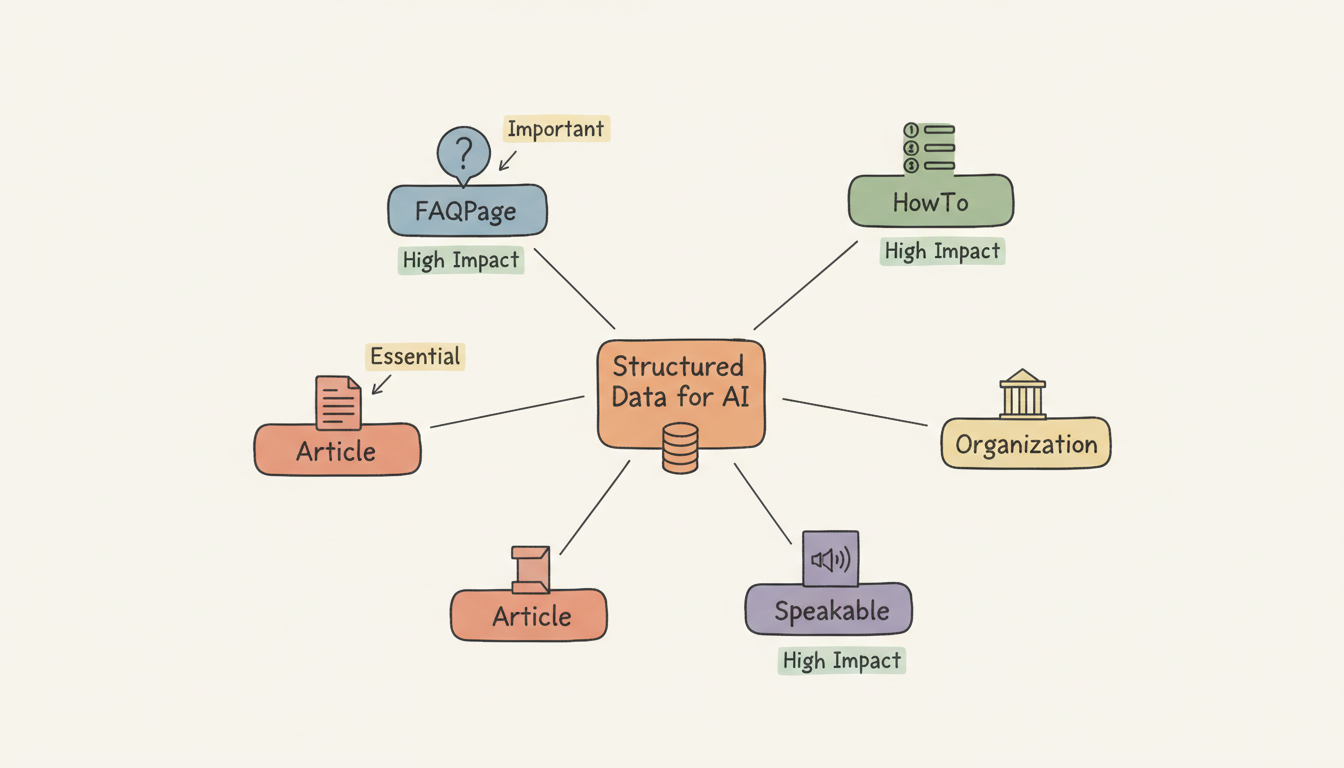
Different schema types drive different levels of AI citation impact. Use this table to prioritize your implementation.
Schema Type | AI Citation Impact | Implementation Priority |
FAQPage | High | Essential for Q&A content |
HowTo | High | Essential for tutorials |
Article | Medium-High | Essential for all content |
Organization | Medium | Essential for brand pages |
Product | Medium-High | Essential for e-commerce |
Speakable | Medium | Important for voice |
Review | Medium | Important for testimonials |
How Should I Implement JSON-LD Structured Data?
JSON-LD (JavaScript Object Notation for Linked Data) is the preferred format for structured data AI search schema implementation. It separates structure from content, making it easier for machines to parse without disrupting readability.
Why JSON-LD Over Microdata
JSON-LD separates schema from HTML, making it the cleaner and more reliable choice for AI search optimization.
- Cleaner implementation that doesn't clutter HTML
- Easier to maintain and update
- Better supported by modern AI systems
- Reduces extraction errors
- Can be placed anywhere in the document
Implementation Example: Faqpage
Here is a minimal FAQPage schema example you can adapt for your own Q&A content.
{
  "@context": "https://schema.org",
  "@type": "FAQPage",
  "mainEntity": [{
    "@type": "Question",
    "name": "How does schema markup help AI search?",
    "acceptedAnswer": {
      "@type": "Answer",
      "text": "Schema markup helps AI search by providing explicit signals about content meaning. AI systems use structured data to identify content types, extract specific answers, and cite sources with higher confidence."
    }
  }]
}
Always validate schema before publishing:
- Google Rich Results Test: Confirms schema is valid and eligible for rich results
- Schema.org Validator: Checks syntax and structure
- Browser Developer Tools: Verify JSON-LD loads correctly
Invalid schema can be worse than no schema--AI may ignore malformed markup entirely.
Common Schema Mistakes to Avoid
These are the most common errors that prevent schema from contributing to AI citations.
Marking Up Hidden Content
Schema should describe visible content. Marking up content users can't see violates guidelines and risks penalties.
Over-Marking Pages
Not every page needs every schema type. Match schema to actual content purpose. A simple blog post doesn't need Product schema.
Outdated Information
Schema with outdated dates or information damages trust. When tracking content freshness signals for answer engines, update dateModified when content changes.
Missing Required Properties
Each schema type has required fields. FAQPage needs both question and answer; HowTo needs steps. Missing properties render schema ineffective.
Generic Implementations
Copy-paste schema that doesn't reflect actual page content provides no value. Customize schema to match specific content.
How Often Should I Audit and Maintain Schema Markup?
Schema markup is not a set-it-and-forget-it implementation. Schema drift -- where markup falls out of sync with actual page content -- is one of the most common reasons AI systems stop citing previously trusted content.
Establish a quarterly audit schedule to review all schema across your site. During each audit:
- Validate syntax: Run all pages through Google Rich Results Test to catch newly deprecated properties
- Check content alignment: Ensure schema descriptions, dates, and entities match visible content
- Review dateModified: Update timestamps whenever content changes substantively
- Monitor deprecated types: Schema.org regularly updates its vocabulary -- deprecated properties can trigger validation warnings
Beyond quarterly audits, implement trigger-based updates. When prices change, staff turns over, services are added, or business hours shift, update the corresponding schema immediately. AI systems that encounter stale structured data may reduce their confidence in your content across all pages, not just the outdated ones.
Implementing Schema for AI Optimization
Follow these five steps to implement schema that improves AI visibility across all major platforms.
Step 1: Audit Current Schema
Check existing pages using Google's Rich Results Test. Identify which high-value pages lack schema or have errors.
Step 2: Prioritize by Impact
Start with:
- Pages already ranking well organically
- Content targeting question-based queries
- Your most important commercial pages
Step 3: Match Schema to Content Type
Use this reference table to select the right schema type for each content format on your site.
Content Type | Primary Schema | Secondary Schema |
FAQ content | FAQPage | Article |
Tutorials | HowTo | Article |
Blog posts | Article | FAQPage (if Q&A included) |
Product pages | Product | FAQPage, Review |
Company info | Organization | LocalBusiness |
Step 4: Implement and Validate
Add JSON-LD to page headers. Test each implementation before publishing. Monitor for errors in Search Console.
Step 5: Track Results
Monitor AI visibility changes after implementation. Schema effects may take 2-4 weeks to manifest as AI systems re-index content. Sites that validate schema monthly see 25% fewer Search Console errors.
Schema and the AI Knowledge Graph
Beyond individual pages, structured data AI search schema contributes to knowledge graph positioning. When AI systems build understanding of entities and relationships, structured data provides the explicit connections.
Building entity recognition:
- Consistent Organization schema across properties
- Links between related entities
- Clear attribute definitions
- Cross-platform data consistency
Strong knowledge graph presence increases the likelihood AI will recognize and trust your brand as an authoritative source.
How Different AI Platforms Use Structured Data
Each AI platform processes schema markup differently, and understanding these differences helps you prioritize implementation for maximum cross-platform visibility.
ChatGPT Search
ChatGPT Search crawls web content alongside Bing's index and uses structured data to identify authoritative sources. It values FAQPage and Article schema for conversational answers, and Organization schema to correctly attribute information to specific brands.
Perplexity AI
Perplexity AI aggregates and cites multiple sources per response. It relies on structured data to identify content type and extract data points. FAQPage, Organization, and Product schema help your content appear as a cited source in Perplexity's footnoted answers.
Google AI Overviews
Google AI Overviews use structured data to identify and cite content. Pages with valid schema in Search Console receive preferential treatment. Article schema identifies content type, FAQPage enables Q&A extraction, and HowTo schema maps step-by-step instructions to AI Overview citations. If you do not see the feature in your own results yet, here is how to turn on Google AI Overviews.
Bing Copilot
Bing Copilot leverages schema via Bing Webmaster Tools. It emphasizes Organization and LocalBusiness schema for entity recognition, Speakable for voice responses, and Review and Product schema to generate comparison-style AI answers for commercial queries.
What Tools Should I Use for Schema Implementation and Monitoring?
The right tools simplify schema creation, validation, and ongoing monitoring. Choose tools based on your technical level and site scale.
Tool Category | Tool | Best For | Cost |
Validation | Google Rich Results Test | Testing individual pages for rich result eligibility | Free |
Validation | Schema.org Validator | Full schema syntax and structure validation | Free |
Generation | Google Structured Data Markup Helper | Visual schema creation for non-developers | Free |
Generation | Schema Pro (WordPress) | Automated schema for WordPress sites | Paid |
Monitoring | Google Search Console | Tracking schema errors and rich result performance | Free |
Enterprise | BrightEdge SearchIQ / ContentIQ | Large-scale schema audits and AI visibility tracking | Enterprise |
For most sites, start with free validation tools and Google Search Console for monitoring. Enterprise SEO platforms add value when managing schema across hundreds or thousands of pages where manual validation becomes impractical.
JSON-LD generator tools can accelerate initial implementation, but always validate generated markup against your actual content. Auto-generated schema that doesn't match visible page content can trigger quality penalties.
Why AI Engines Prioritize Structured Data (and How They Actually Use It)
AI engines prioritize structured data because it reduces the computational overhead of semantic interpretation. Without schema, AI systems must infer meaning from context -- a process prone to errors and hallucinations.
The AI Processing Pipeline
Understanding the AI processing pipeline clarifies why structured data matters. When a query arrives, AI engines parse schema markup, map entities to knowledge graph nodes, and rank sources by confidence. Schema directly improves entity extraction and source ranking in this pipeline.
What Makes AI Search Different from Traditional SEO
Traditional SEO optimizes for keyword matching and backlink authority. AI search evaluates entity clarity, factual consistency, and structured signal density. What makes AI search different is that it rewards machine-readable precision over keyword frequency -- a fundamental shift that structured data directly addresses.
Priority Schema Types That AI Engines Actually Care About
Not all schema types carry equal weight. Organizing implementation by tier helps you prioritize effort toward the schemas with the highest AI citation rates.
Tier 1: Must-Have Schema Types (Highest AI Citation Rate)
Tier 1 schema types generate a 3:1 improvement in AI citation rate compared to unstructured content. These are the must-have schema types that drive the highest AI citation rates across all major platforms.
- FAQPage: Directly maps to AI question-answer extraction pipelines
- HowTo: Step-by-step structure that AI engines can decompose and reassemble
- Article / BlogPosting: Establishes content type, authorship, and publication metadata
- Organization: Anchors entity recognition across your entire domain
Tier 2: High-Value Schema Types (Industry-Specific)
These high-value schema types deliver strong AI citation improvements for specific industries and content models.
- LocalBusiness: Critical for service-area businesses targeting location-based AI queries
- Product: Essential for e-commerce and comparison-focused AI answers
- Event: High citation rate for time-sensitive queries on AI assistants
- Course: Strong performance in educational AI query verticals
Tier 3: Supporting Schema Types
Supporting schema types reinforce your entity graph and improve cross-platform consistency without driving citations independently.
- BreadcrumbList: Improves site structure understanding
- Speakable: Signals voice-optimized content to AI assistants
- SiteLinksSearchBox: Reinforces brand entity in AI knowledge graphs
JSON-LD is not optional for AI search in 2026. It is the standard all major AI engines -- Google, Bing, Perplexity, and ChatGPT -- rely on to extract structured signals from your pages.
Implementation Guide: JSON-LD Schema That AI Engines Love
This structured data AI search implementation guide covers the JSON-LD schema patterns that AI engines extract most reliably. JSON-LD is your only real option for modern AI search optimization -- it keeps markup separate from content, making it easier for AI crawlers to parse without interference from HTML structure.
Why JSON-LD Is Your Only Real Option
JSON-LD is your only real option because Microdata and RDFa embed schema inside HTML tags, creating parsing conflicts when AI engines process rich text. JSON-LD lives in a dedicated script block, giving AI systems a clean, unambiguous signal layer.
Step-By-Step Implementation Process
Follow this step-by-step implementation process to add schema without breaking existing page functionality.
- Audit current pages using Google Rich Results Test to identify missing or broken schema
- Select the appropriate schema type based on content purpose (use the tier guide above)
- Write JSON-LD in a dedicated
<script type="application/ld+json">block in the page head - Validate using Schema.org Validator before deploying
- Monitor Search Console for errors after deployment
Advanced Implementation: Schema Nesting for Maximum AI Understanding
Schema nesting for maximum AI understanding means embedding related schema types inside a parent entity. For example, nesting FAQPage inside an Article schema creates a compound signal that tells AI engines both the content type and the specific Q&A pairs it contains -- dramatically improving extraction confidence.
Testing and Measuring Your AI Search Performance
Testing and measuring your structured data AI search performance requires tracking signals beyond traditional rank tracking. AI citations do not always correlate with position -- a page can rank 5th in organic results but be cited 1st in AI overviews.
Tools for AI Search Visibility Tracking
Use these tools to measure AI search visibility and schema effectiveness.
- Google Search Console: Tracks rich result impressions and schema errors
- Semrush AI Toolkit: Monitors AI Overview appearances and citation frequency
- Perplexity.ai direct queries: Manual citation checks for target keywords
- Bing Webmaster Tools: Schema validation and Copilot visibility signals
Key Metrics to Track in 2026
These are the key metrics to track in 2026 for structured data performance.
- AI Overview impression rate: Percentage of impressions from AI-generated results
- Schema error rate: Track via Search Console > Enhancements
- Citation frequency: How often AI tools cite your content for target queries
- Rich result CTR delta: Click-through rate improvement after schema implementation
The Future of Structured Data in AI Search (What'S Coming in Late 2026)
The future of structured data AI search optimization points toward dynamic, real-time schema validation. In late 2026, AI systems will cross-reference schema claims against live sources -- penalizing inaccurate schema rather than ignoring it.
What Is a 4-Week Action Plan for Implementing Structured Data?
Use this structured data AI search action plan across four focused weeks to systematically improve your schema coverage.
Week 1: Audit and Prioritize
Run Google Rich Results Test on your top 20 pages. Identify pages with missing schema or validation errors. Prioritize pages with high impressions but low AI Overview appearances.
Week 2: Implement Core Schema
Implement Tier 1 schema types on your highest-traffic pages. Start with Article and Organization schema site-wide, then add FAQPage to content with Q&A sections.
Week 3: Add Advanced Schema Types
Add Tier 2 schema types relevant to your industry. Implement schema nesting for compound entity signals on key content pages.
Week 4: Test and Optimize
Run full validation on all new schema. Set up ongoing monitoring in Search Console. Establish your baseline metrics for AI citation tracking.
Key Takeaways
Here are the most important structured data AI search principles from this guide.
- Structured data AI search optimization gives AI engines explicit signals instead of forcing them to guess meaning from unstructured text.
- Tier 1 schema types (FAQPage, HowTo, Article, Organization) deliver the highest AI citation rates -- implement these first.
- JSON-LD is your only real option: it keeps schema separate from HTML and is supported by all major AI platforms.
- A 4-week action plan -- audit, implement core schema, add advanced types, then test -- is the fastest path to measurable AI visibility gains.
- Test quarterly with Google Rich Results Test and monitor AI citation frequency via Search Console and Semrush AI Toolkit.
FAQs
Common questions about structured data schema implementation for AI search visibility.
Does Schema Guarantee AI Citations?
No. Schema increases the probability of AI citations by reducing ambiguity and building confidence, but doesn't guarantee selection. Content quality, authority, freshness, and relevance still matter. Schema is one optimization layer among several.
Which Schema Format Should I Use?
Use JSON-LD for all new structured data AI search schema implementations. It's the format preferred by Google, supported by all major AI systems, and easiest to maintain. Avoid microdata and RDFa for new implementations.
How Much Schema Is Too Much?
Implement schema that accurately describes your content--no more, no less. Multiple schema types on one page are fine if each reflects actual content. Over-marking with irrelevant schema wastes effort and may trigger quality reviews.
How Does Structured Data Work with ChatGPT and Perplexity?
ChatGPT favors FAQPage and Article schema for conversational answers. Perplexity relies on schema-defined entities for its footnoted responses. Implementing both schema types maximizes your cross-platform structured data AI search visibility.
What Tools Can I Use to Test and Monitor Schema Markup?
Google Rich Results Test and Schema.org Validator are the best free tools for testing individual pages. Google Search Console tracks schema errors and rich result performance site-wide. BrightEdge ContentIQ provides enterprise-scale schema auditing for larger sites.
How Often Should I Update My Schema Markup?
Run a full schema audit quarterly and update immediately whenever content changes substantively -- new services, price changes, staff updates, or revised business hours. Stale schema where the markup no longer matches visible content erodes AI trust. Always update dateModified in Article schema when you revise page content.
Related: Google Search Central Ai Overviews Guidance
Related: for a deeper look, see our guide on bing copilot search.