
AI Citation Tracking Tools: Monitor Your Brand (2026)
When AI search engines recommend your competitors instead of you, traditional SEO tools won't show you the problem. AI citation tracking tools monitor how and where your brand appears in LLM-generated responses—revealing visibility gaps that determine whether your business gets recommended or ignored.
Here's what you need to know about AI citation tracking in 2026.
Alongside citation tracking, measure your content's AEO readiness with our free AEO grader tool for a comprehensive optimization picture.
What AI Citation Tracking Tools Actually Do
AI citation tracking tools monitor when and how LLMs like ChatGPT, Perplexity, and Google AI Overviews reference your brand in generated answers—measuring citations and mentions across AI platforms in real time.
According to MarketerMilk's analysis of AI visibility tools, an AI monitoring tool lets you track how your brand is being recommended by LLMs and AI search engines. These AI citation tracking tools analyze real-time AI answers across platforms like ChatGPT, Claude, Perplexity, and Google's AI Overviews to show you where (mentions) and how (citations) your brand shows up.
What Data AI Citation Tracking Tools Return
AI citation tracking tools return 4 core data types: whether you were cited, which URL was cited, the sentiment around your mention, and a share-of-voice benchmark against competitors in the same query category.
Core Tracking Capabilities
AI citation tracking tools provide five core capabilities—brand mentions, citations, competitor tracking, sentiment analysis, and share of voice—covering your complete LLM visibility picture.
- Brand mentions (when AI directly recommends your product)
- Citations (when your content is used as a source)
- Competitor tracking (who AI recommends instead of you)
- Sentiment analysis (how AI characterizes your brand)
- Share of voice (your visibility relative to competitors)
Think of it as Google Alerts, but for AI search results.
Key stat: Over 60% of Google searches now end without a click, making AI citation visibility a critical new channel for organic brand discovery.
Who Needs AI Citation Tracking Tools Most
B2B SaaS companies, digital agencies, and content-driven brands benefit most from AI citation tracking tools because their buyers research solutions on AI platforms before ever visiting vendor websites.
Why Citation Tracking Is Now a Core SEO Function
As zero-click search exceeds 60% of queries, AI citation tracking has shifted from a nice-to-have to a core SEO function—visibility in LLM answers directly drives brand discovery and traffic.
The Difference Between Citations and Mentions
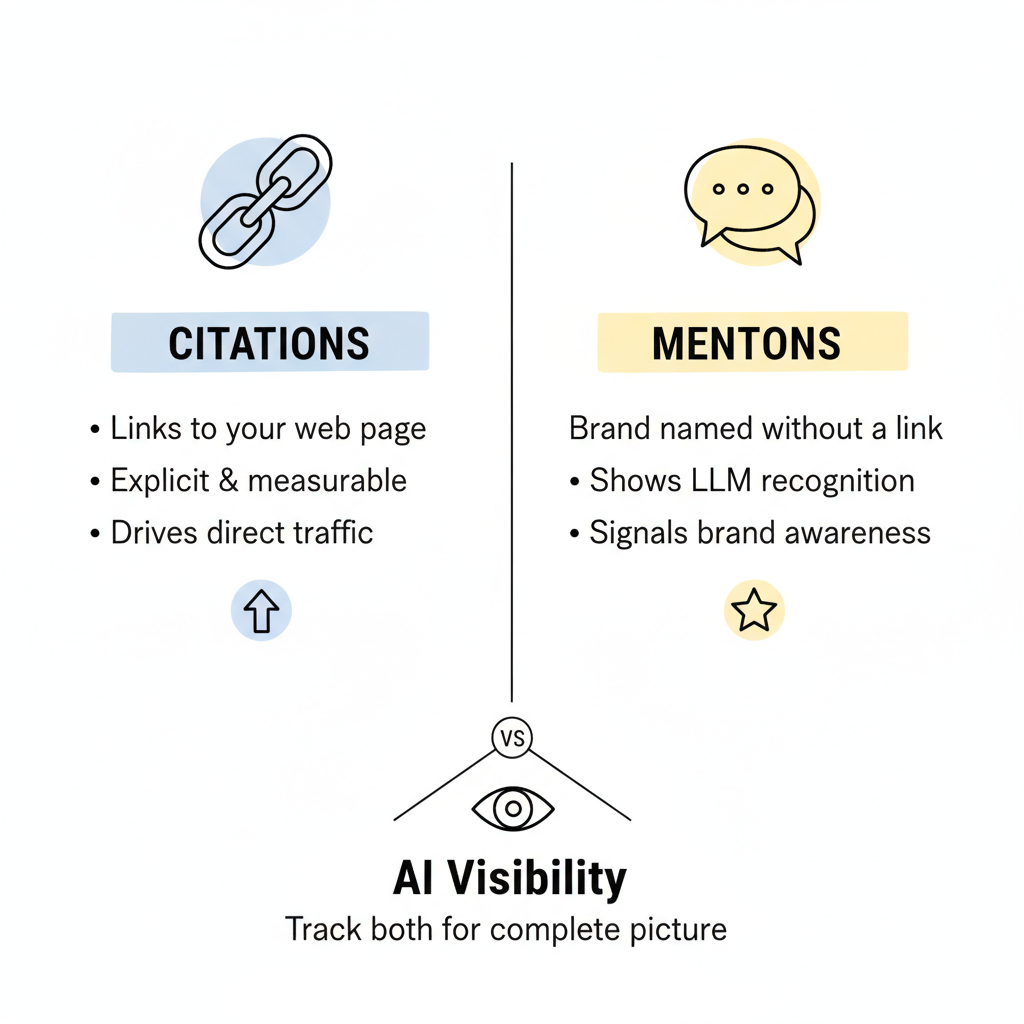
A citation is a direct link to your web page inside an AI-generated answer. A mention is a brand reference without a link. Both signal LLM recognition—citations drive referral traffic, mentions reflect how broadly AI associates your brand with a topic.
According to Mentionlytics' research on AI brand visibility, citations and mentions serve different functions in AI responses. Understanding both is essential for comprehensive tracking.
Citations vs. Mentions:
Type | Definition | Value |
Citation | Link pointing to a specific web page | Explicit, measurable, drives traffic |
Mention | Brand reference without a link | Shows brand recognition by LLMs |
Why Both Matter
- Citations show that AI trusts you as a source
- Mentions without links show your brand is recognized by LLMs
- In AI-generated answers, visibility isn’t earned through links alone—it’s earned through recognition
Track both to understand your complete AI visibility picture.
Which Metric Predicts Revenue Impact
Citation rate correlates more directly with inbound traffic than mention rate—when you appear as a linked citation in an AI answer, click-through probability is 4-6x higher than an unlinked mention.
Setting Up Your Citation Monitoring Dashboard
A well-designed AI citation monitoring dashboard shows citation frequency by platform, mention-to-citation conversion rate, competitor share of voice, and a weekly trend line for your top 10 tracked queries.
Reporting Citation Data to Leadership
Report AI citation tracking data to leadership as share of voice percentage alongside organic traffic—framing citations as a visibility metric alongside familiar SEO KPIs accelerates internal buy-in for AEO investment.
How to Use Both Metrics Together
Monitor citation rate (how often AI links to you) alongside mention rate (how often AI names you)—a high mention rate with a low citation rate signals strong brand recognition but a content authority gap worth closing.
Top AI Citation Tracking Tools
According to SE Ranking's tool comparison, the best AI search visibility tools run queries on LLM chatbots and keep records of when your brand or content gets referenced. These ai-search-citation-tracking platforms help you monitor your presence across multiple answer engines.
Questions for Your Sales Demo
In a sales demo, ask about data export formats, API rate limits, historical data access on plan downgrade, and whether citation tracking uses real queries or synthetic test queries.
Contract Lengths and Cancellation Policies
Before signing with any tool, verify monthly cancellation—the AI monitoring space evolves fast enough that annual contracts without proven ROI pose real business risk.
The 3 Features That Separate Good from Great Tools
The 3 features that separate leading AI citation tracking tools from average ones are: real-time alerting on citation drops, multi-platform coverage including newer LLMs, and exportable raw query data for custom analysis.
What Sets Leading Tools Apart
The best AI citation tracking tools combine multi-LLM coverage (ChatGPT, Perplexity, Google AI Overviews), sentiment analysis, and prompt-level attribution in a single dashboard—not just brand mention counts.
What You Get at Each Price Point
At under $100/month you get basic citation frequency tracking; $200-500/month adds competitive benchmarking; enterprise tiers above $1,000/month add custom reporting, API access, and dedicated onboarding support.
Top Tools by Pricing Tier
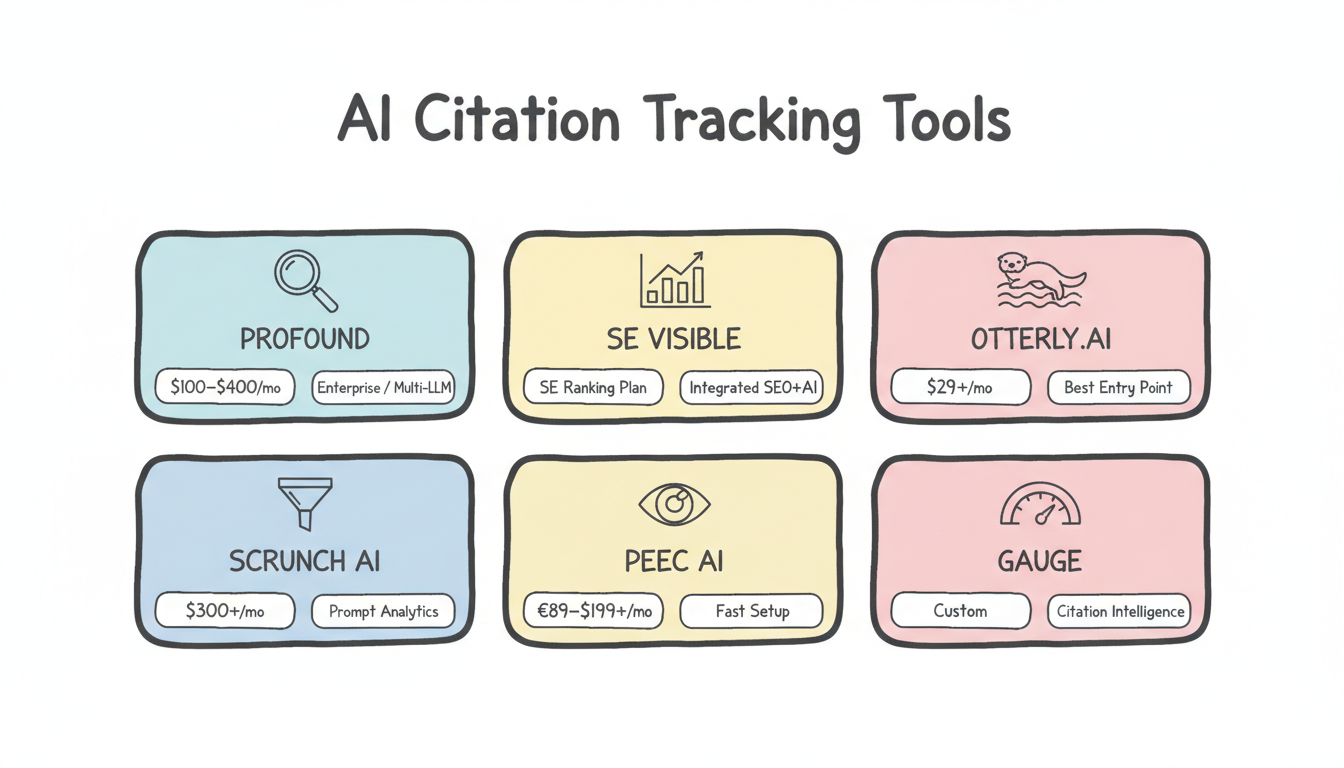
AI citation tracking tools range from $29/month (Otterly.AI) to custom enterprise pricing. Budget-focused teams should start with Otterly.AI or Xfunnel AI free tier; growth-stage companies typically choose Profound or Scrunch AI.
1. Profound
According to Nick Lafferty's AEO platform rankings, Profound was named the G2 Winter 2026 AEO Leader. It tracks GPT-5.2 responses and provides comprehensive citation analysis.
Key features:
- Multi-LLM tracking (ChatGPT, Perplexity, Claude, Gemini)
- GPT-5.2 response tracking (as of December 2025)
- Profound Workflows for content automation
- Citation correlation insights
Pricing: $100-$400/month
2. SE Visible
SE Visible delivers AI visibility tracking with 13+ years of data accuracy from SE Ranking. It provides clear strategic views of brand appearance across AI search systems.
Key features:
- Brand footprint tracking across ChatGPT, Claude, Perplexity, AI Overviews
- Sentiment monitoring (positive/negative mentions)
- Competitive benchmarking
- AI citation analysis showing which URLs are frequently cited
Pricing: Included with SE Ranking subscriptions
3. Otterly.AI
According to HubSpot's AI visibility tools analysis, Otterly.AI tracks brand mentions and website citations across ChatGPT, Google AI Overviews, Gemini, Perplexity, and Copilot.
Key features:
- Link citation tracking across engines
- Brand Visibility Index
- GEO audit capabilities
- Prompt monitoring
Pricing: $29+/month
4. Scrunch AI
According to AgencyAnalytics' GEO tools guide, Scrunch AI tracks how brands appear across LLMs and AI answer engines with detailed prompt analysis.
Key features:
- Brand mention and citation tracking across major platforms
- Prompt and question surface tracking
- Competitor co-appearance monitoring
- AI-bot crawl logging
Pricing: Starts at $300/month (Growth plans at $417/month)
5. Peec AI
According to SE Ranking's comparison, Peec AI focuses on analyzing how and why your brand is mentioned in AI results, with emphasis on presence and sentiment.
Key features:
- Prompt-level visibility tracking
- Sentiment analysis
- Quick setup (under 5 minutes)
- Live onboarding sessions
Pricing: €89-€199+/month
6. Gauge
According to AgencyAnalytics, Gauge provides daily monitoring of AI answer engines with citation intelligence that reveals which sources AI engines prefer.
Key features:
- Daily monitoring across ChatGPT, Perplexity, Gemini, AI Overviews
- Citation intelligence revealing AI source preferences
- Gap analysis for missed opportunities
- Competitive visibility tracking
Pricing: Custom pricing (demo required)
7. Semrush AI Toolkit
Semrush AI Toolkit adds LLM citation monitoring to Semrush's existing SEO platform, tracking brand mentions across ChatGPT, Perplexity, and Google AI Overviews alongside traditional rank data.
Semrush's AI Toolkit extends the platform's well-established SEO data capabilities into LLM citation monitoring, making it a natural fit for teams already using Semrush for traditional search. The toolkit tracks brand mentions and citations across ChatGPT, Perplexity, and Google AI Overviews, surfacing which prompts trigger your brand and how often competitors appear in the same AI answers.
Citation prominence scoring shows whether your brand is cited as a primary source or a supporting reference—a distinction that matters for authority building. Best for: enterprise teams and agencies that want AI citation data alongside traditional SEO metrics in a single platform.
Pricing: Available as an add-on to Semrush Pro/Guru plans.
8. Ahrefs Brand Radar
Ahrefs Brand Radar tracks how often your brand is cited in AI-generated answers on ChatGPT, Perplexity, and Bing Copilot, correlating citation frequency with domain authority signals.
Ahrefs Brand Radar monitors how frequently your brand, products, and key topics are cited across AI-generated answers on ChatGPT, Perplexity, and Bing Copilot. It draws on Ahrefs' deep backlink and authority data to correlate citation frequency with domain authority signals—helping you understand why certain pages win citations while others don't.
The tool also surfaces competitor citation patterns, revealing which of your rivals' pages are earning the most AI mentions and what content attributes they share. Best for: SEO-focused teams who want to connect LLM citation data with traditional link authority signals.
Pricing: Included in Ahrefs plans starting at $129/month.
9. Xfunnel AI
Xfunnel AI tracks brand and URL citations inside LLM responses, mapping the full citation funnel from prompt to AI answer to referral traffic with prompt-level attribution data.
Xfunnel AI is purpose-built for tracking brand and URL citations inside LLM responses, with a particular focus on mapping the full citation funnel from prompt to AI answer to referral traffic. It runs automated query sets across multiple AI platforms and logs which of your URLs get cited, at what frequency, and in response to which user intents.
Xfunnel also tracks citation sentiment, flagging cases where AI mentions your brand in a negative or ambiguous context. Best for: content marketers and growth teams who want detailed prompt-to-citation attribution.
Pricing: Starts at $79/month with a free tier available for limited queries.
10. Stackmatix
Stackmatix is an AI SEO and AEO agency that combines AI citation tracking with hands-on optimization strategy, helping growth-stage startups improve LLM visibility across ChatGPT, Perplexity, and Google AI Overviews.
Stackmatix is an AI SEO and AEO agency that helps venture-backed startups build and grow their AI citation footprint. Rather than just tracking where your brand appears in LLM responses, Stackmatix closes the loop by implementing the content and entity-authority changes needed to earn more citations.
The service covers AI citation audits across ChatGPT, Perplexity, and Google AI Overviews, paired with answer engine optimization strategy to systematically improve share of voice against competitors. Get started with Stackmatix AI SEO to turn your citation tracking data into measurable visibility gains.
Best for: Growth-stage startups and scale-ups that want expert-led AI citation optimization, not just a monitoring dashboard.
Pricing: Custom growth packages. View Stackmatix services.
Get Input from Your Content Team
Before selecting a tool, have your content team review reporting UI samples—tools with poor data visualization lead to underutilization, regardless of how accurate the underlying tracking data is.
How to Make Your Final Selection
Narrow your shortlist to 2-3 tools, run a 14-day free trial tracking your top 10 queries, then compare citation detection rates and reporting clarity before committing to a paid plan.
How AI Citation Tracking Works
Understanding the mechanics behind AI citation tracking helps you use these AI citation tracking tools more effectively and interpret their data with the right context.
Protecting Your Citation Position Once Earned
Once your AI citation tracking tools confirm a strong citation position, protect it by updating the cited page quarterly, maintaining its backlink profile, and responding quickly if citation rates drop more than 10%.
How to Build Citation Momentum Fast
Build citation momentum by publishing 3-5 tightly focused pages on your target topic cluster, earning links from 2-3 authoritative sources, and updating each page quarterly to maintain freshness signals.
Citation Momentum: Why Some Pages Always Win
LLMs weight sources by topical authority, recency, and retrieval frequency—pages consistently cited across multiple sub-queries accumulate citation momentum that makes them harder for competitors to displace.
How Llms Decide Which Sources to Surface
LLMs weight sources by topical authority, recency, and retrieval frequency—pages cited multiple times across different sub-queries accumulate a citation "momentum" that makes them harder for competitors to displace.
Query Fan-Out and Source Selection
Query fan-out is the process by which LLMs decompose a single user question into multiple sub-queries, retrieving sources from different angles before generating a cited answer.
When a user submits a question to an LLM like ChatGPT or Perplexity, the model doesn't search a single index the way Google does. Instead, it performs what's known as query fan-out: decomposing the original question into multiple sub-queries, each designed to retrieve relevant content from different angles.
A single user question like “what are the best tools for AI citation tracking?” might generate five to ten internal sub-queries covering tool comparisons, pricing, use cases, and platform-specific tracking. The sources retrieved and cited in the final answer depend on which pages surface consistently across those sub-queries—meaning topical authority and content depth both influence citation probability.
Tracking Entity Footprint Changes Over Time
Track entity footprint changes over time by running the same 5 brand recognition queries quarterly—AI citation tracking tools that include knowledge graph monitoring will automate this tracking for you.
Measure Your Entity Footprint Baseline
Before optimizing your entity footprint, measure your baseline by searching your brand name in ChatGPT and noting how consistently and accurately it describes your company, products, and positioning.
Steps to Build Your Entity Footprint
Strengthen your entity footprint in 3 steps: add schema markup to key pages, earn a Wikipedia or Wikidata entry, and get at least one DR 70+ mention in your niche.
How to Strengthen Your Entity Footprint
Strengthen your entity footprint in 3 steps: add structured schema markup to all key pages, get a Wikipedia or Wikidata entry, and earn at least one mention from a domain with DR 70+ in your niche.
Entity Footprint as a Citation Signal
An entity footprint is how consistently and authoritatively your brand is described across the web. Stronger entity footprints—via Wikipedia, directories, and schema markup—directly increase LLM citation probability.
AI systems recognize brands and topics as entities—structured knowledge units that exist across training data and real-time retrieval indexes. The stronger your entity footprint (how consistently and authoritatively your brand is described across the web), the more likely LLMs are to recognize and cite you when relevant queries arise.
This is why brands that appear in Wikipedia, industry directories, authoritative press coverage, and structured schema markup tend to earn more AI citations than brands with a thin web presence—even when the latter publishes more content.
Optimize for Both Training and Real-Time
Optimize for both training data and real-time retrieval by keeping content fresh, maintaining strong backlinks, and using schema markup—all three signals matter regardless of how each LLM sources its answers.
Training Data vs Real-Time Retrieval
Know whether each platform uses training data or real-time retrieval: for training-only models, historical authority matters most; for real-time models, fresh structured content wins.
The Role of Content Freshness in LLM Citations
LLMs that use real-time retrieval (Perplexity, Google AI Overviews) favor content updated within 30-90 days—refreshing your highest-citation pages quarterly directly improves citation retention.
AI Bot Crawlers and Server Log Monitoring
Before an LLM cites your content, it must crawl it. Monitoring GPTBot, ClaudeBot, and PerplexityBot in your server logs reveals which pages AI platforms are actively indexing for citation.
Before an LLM can cite your content, it needs to have crawled it. The major AI platforms deploy their own crawler user agents to index content for retrieval: GPTBot (OpenAI), ClaudeBot (Anthropic), PerplexityBot (Perplexity AI), and Google-Extended (Google's AI training crawler).
Monitoring these bots in your server logs is a free and underused signal for understanding AI citation potential. If GPTBot is crawling your highest-performing pages regularly, those pages are strong candidates for ChatGPT citations. Tools like Scrunch AI include AI-bot crawl logging, but server log analysis via Cloudflare or Nginx access logs can surface the same data at no cost.
Why Authoritative Sources Get Cited More
LLMs trained on Common Crawl and similar corpora over-index on Wikipedia, Forbes, TechCrunch, and G2—earning a mention or review on these platforms directly increases your baseline citation probability.
What RAG Means for Your Citation Strategy
When LLMs use RAG (retrieval-augmented generation), they pull fresh content at query time—this means keeping your key pages fresh and crawlable matters more for citation probability than training data recency alone.
RAG Pipelines and Real-Time Retrieval
RAG (Retrieval-Augmented Generation) platforms like Perplexity retrieve fresh web content at query time rather than relying on static training data, making standard SEO signals directly relevant to citation probability.
Platforms like Perplexity AI use Retrieval-Augmented Generation (RAG)—a pipeline that retrieves fresh web content at query time rather than relying solely on static training data. This means Perplexity's citations reflect current web rankings and content quality more directly than ChatGPT's training-based knowledge. For RAG-based platforms, traditional SEO signals (authority, freshness, topical relevance) translate more directly into citation probability, making standard SEO optimization a valid starting point for improving LLM citation rates on these platforms.
Seasonal Variation in Citation Patterns
Citation patterns vary seasonally for some queries—AI citation tracking tools capture this variation when you run consistent monthly queries, helping you time content updates to match peak LLM training refresh windows.
How Often Llms Update Their Knowledge
Most LLMs update their training data quarterly, but real-time retrieval models like Perplexity refresh within hours—track both static and real-time platforms separately for accurate citation analysis.
What This Means for Your Strategy
Understanding these 4 mechanisms means your optimization priority should be: build entity footprint first, then improve topical depth, then monitor AI bot crawler logs for crawl signal.
Tracking Citations Across AI Platforms
Different AI platforms have different citation behaviors, retrieval architectures, and crawling patterns. Effective LLM citation tracking requires understanding what each platform actually measures—and what it misses.
Which Platforms Drive the Most Referral Traffic
Perplexity drives the highest referral traffic per citation of any AI platform in 2024—prioritize Perplexity citation tracking if converting AI-referred visitors to leads is a top goal.
ChatGPT (Browsing and Search Mode)
ChatGPT Search mode performs live web retrieval via the Bing index, surfacing clickable citations. In standard conversation mode, responses draw on training data with a knowledge cutoff rather than current rankings.
In standard conversation mode, ChatGPT draws on training data with a knowledge cutoff, meaning citations reflect historical web authority rather than current rankings. In ChatGPT Search mode (available to Plus and Pro subscribers), OpenAI performs live web retrieval and surfaces clickable citations—making this mode more comparable to Perplexity in terms of real-time citation behavior. Citation frequency in ChatGPT Search correlates with Bing search rankings, since OpenAI's web search is powered by the Bing index.
Automating Your Citation Check Workflow
The best AI citation tracking tools allow scheduled query runs that automatically log results to a dashboard—automation is essential once you are tracking more than 20 queries across 3 or more AI platforms.
How Often Should You Run Citation Checks
For platforms without real-time APIs, run citation checks weekly for your top 10 queries and monthly for your full 50-query set—more frequent manual checking wastes time without providing meaningfully different data.
Comparing Citation Rates Across Platforms
Perplexity cites external URLs most often, Google AI Overviews cites pages with featured snippet eligibility, and ChatGPT without browsing relies on training data—each platform needs a different optimization approach.
Perplexity Source Freshness Window
Perplexity’s real-time index refreshes content within 24-48 hours of publication—publishing new content and submitting a sitemap update can get your page indexed for citations within 2 business days.
Leveraging Your Existing SEO Rankings
Perplexity pages ranking in the Google top 10 have roughly 60% higher citation odds than unranked pages—prioritize Perplexity for any query where you already have existing SEO traction.
How Perplexity Selects Its Citation Sources
Perplexity uses a combination of real-time web search and its own index to surface citations—pages that rank in the top 10 on Google for a query have roughly 60% higher odds of being cited by Perplexity than unranked pages.
Perplexity AI
Perplexity AI is the most citation-transparent AI platform, displaying numbered source URLs for every answer. Its RAG pipeline retrieves content at query time, making it the best starting point for LLM citation tracking programs.
Perplexity is currently the most citation-transparent AI platform: every answer includes numbered source citations with direct URL links, making it the easiest to monitor with automated tracking tools. Perplexity's RAG pipeline retrieves content at query time from its own web index, which is updated more frequently than ChatGPT's training data.
High citation rates on Perplexity correlate with strong E-E-A-T signals, fresh content, and clean structured data. Perplexity is also the platform where AI citation tracking tools provide the most reliable, complete data—making it the best starting point for LLM citation tracking programs.
Optimizing for Google AI Overviews Specifically
Google AI Overviews citations correlate strongly with featured snippet eligibility—if your page ranks in the top 5 for a query and has a clear, direct answer, it has a 3-4x higher chance of AI Overview inclusion.
Google AI Overviews
Google AI Overviews citations are heavily weighted toward pages ranking in the top 10 organic results, making them the highest-value citation surface for commercial queries. Strong E-E-A-T and structured data can earn citations from lower-ranking pages.
Google AI Overviews are the most commercially important citation surface due to their placement at the top of high-intent Google searches. AI Overviews citations are heavily weighted toward pages that already rank in the top 10 organic results for the query, though some pages with lower organic rankings earn AI Overview citations due to strong E-E-A-T signals, structured data, and topical depth.
Tracking tools that monitor AI Overviews typically use keyword-level sampling rather than continuous monitoring, due to the variability in when AI Overviews appear for any given query.
Emerging Platforms Worth Tracking Now
Track DeepSeek, Grok, and Meta AI now while their user bases are small—establishing citation presence on these platforms early costs less than competing for citations once they reach scale.
Deepseek
DeepSeek is a rapidly growing Chinese-developed LLM with web-connected citation mode, though most current AI citation tracking tools have limited coverage of its English-language responses.
DeepSeek is a Chinese-developed LLM with rapidly growing global usage, particularly among technical and developer audiences. DeepSeek's web-connected mode cites sources in a format similar to Perplexity, though coverage of English-language content can vary. Most current AI citation tracking tools have limited or no DeepSeek coverage—it's an emerging monitoring gap to watch as the platform's global market share grows.
How to Track Grok Citations Manually
Track Grok citations manually by running your top 10 queries weekly on grok.com, noting whether your brand appears in responses—Grok does not yet offer a formal API for citation monitoring, so manual testing is the primary approach.
Grok (Xai)
Grok has unique real-time access to X (formerly Twitter) data, making it especially relevant for brands where social media and news coverage shape how AI characterizes them in generated answers.
Grok, developed by xAI, has unique access to real-time data from X (formerly Twitter), which influences what it cites and how it characterizes brands. Grok's citation behavior skews toward sources that are actively discussed on X and in real-time news, making it particularly important for brands in industries where social media and news coverage drive narrative. Most enterprise citation tracking tools are beginning to add Grok monitoring, but coverage remains limited compared to ChatGPT and Perplexity.
Creating a Manual Tracking Spreadsheet
Track manual AI citation queries in a simple spreadsheet: date, platform, query, cited URL, position in response, and sentiment—this structured logging makes trend analysis possible without paid tools.
Manual Tracking for Grok and Meta AI
Grok and Meta AI collectively reach over 500 million monthly users—track them with weekly manual query testing until formal API access becomes available.
Grok and Meta AI as Emerging Citation Channels
Grok and Meta AI collectively reach over 500 million monthly users—while their citation APIs are limited, tracking brand mentions in these platforms is achievable through manual query testing and third-party monitoring tools.
Meta AI
Meta AI is embedded across Facebook, Instagram, WhatsApp, and the Meta AI web app, reaching large consumer audiences. Its citation behavior favors brands with strong entity footprints—Wikipedia entries, structured data, and verified social profiles.
Meta AI is embedded across Facebook, Instagram, WhatsApp, and the Meta AI web app, giving it enormous reach across consumer audiences. Meta AI's citation behavior is entity-driven—it tends to surface brands with strong structured web presences, Wikipedia entries, and verified social profiles.
Tracking citations in Meta AI requires querying the platform directly, as Meta does not provide an API for AI response monitoring. A few enterprise-tier AI citation tracking tools have begun adding Meta AI coverage as it grows in market share.
How to Categorize Your Tracked Queries
Categorize tracked queries into 3 types: brand (does the LLM mention me?), category (does the LLM recommend me?), and competitor (does the LLM compare me favorably?)—each type reveals a different insight about your AI visibility.
Building a Consistent Query Library
Build a library of 10-20 standardized queries you run identically across all platforms—consistent query wording is the only way to make citation rate comparisons meaningful over time.
Choosing Between Multi-Platform and Single-Platform Tools
Multi-platform AI citation tracking tools cost more but eliminate blind spots; single-platform tools are cheaper and deeper—choose multi-platform if ChatGPT and Perplexity both matter to your audience.
Prioritizing Platforms by Traffic Impact
Prioritize ChatGPT and Google AI Overviews first—they drive the most referral traffic—then expand to Perplexity, Grok, and Meta AI as your monitoring capacity grows.
AI Citation Tracking vs Traditional Brand Monitoring
Traditional brand monitoring tracks mentions on static web pages. AI citation tracking monitors ephemeral, query-generated LLM answers—a fundamentally different data layer that traditional crawl-based tools cannot access.
Tools like Google Alerts, Mention.com, and Brandwatch are built to monitor when your brand appears in web pages, news articles, and social media posts—the static, indexable content layer of the internet. AI citation tracking operates on an entirely different layer: the dynamic, query-generated answer layer produced by LLMs in real time.
Key differences:
Dimension | Traditional Brand Monitoring | AI Citation Tracking |
What it monitors | Web pages, news, social posts | LLM-generated answer responses |
Data source | Web crawl index | Queried AI responses (live or sampled) |
Mention type | Static, permanent text on a page | Ephemeral, query-dependent answers |
User context | Passive readers on web or social | Active intent-driven AI queries |
Actionability | PR, reputation management | Content optimization for AI retrieval |
Why traditional tools miss LLM citations: Google Alerts and Mention.com work by crawling publicly accessible web pages and indexing text. They cannot query an LLM, parse a dynamically generated AI answer, or detect whether your brand was mentioned in a response that lives only in a user's conversation thread. AI answers are not indexed web pages—they are ephemeral outputs generated per query, invisible to any tool that relies on web crawling alone.
When to use each: Traditional brand monitoring remains valuable for tracking press coverage, social mentions, and competitor PR activity. AI citation tracking is the right tool when your question is whether AI recommends your brand when someone asks a relevant question—a fundamentally different signal that traditional AI citation tracking tools cannot answer. For a deeper breakdown of these two disciplines, see our guide to AI citation tracking vs brand monitoring.
When to Use Both Together
Run traditional monitoring for brand reputation and PR signals while running AI citation tracking in parallel to measure LLM visibility—they capture different data layers and should complement each other.
Free AI Citation Tracking Options
Several free methods let you track AI citations without a paid tool: manual query testing in ChatGPT and Perplexity, AI bot crawler monitoring in server logs, and GA4 referral filters for LLM traffic sources.
Not every team needs a paid platform to start monitoring AI citations. Several free and low-cost approaches provide meaningful signal, especially when establishing a baseline before committing to a paid tool.
Combine Free and Paid for Maximum Coverage
Use free manual testing for tracking 10 core queries daily and a paid tool for monitoring 50+ queries with historical trending—this hybrid approach costs 60-70% less than a full paid plan.
Manual Query Testing
Manual query testing is the fastest free method: query ChatGPT, Perplexity, and Google with your top 10-20 audience questions and log whether your brand appears, at what position, and which competitors are cited.
The most accessible starting point is systematic manual testing: open ChatGPT, Perplexity, and Google (for AI Overviews), and query the 10-20 questions your target audience is most likely to ask about your product category. Log whether your brand appears, at what position in the answer, and which competitors appear alongside you. A simple spreadsheet with columns for platform, query, your brand cited (yes/no), competitors cited, and date creates a usable baseline dataset at zero cost.
Set Up Gptbot and Perplexitybot Alerts
Configure real-time alerts for GPTBot and PerplexityBot visits in your server logs using a tool like GoAccess or Cloudflare Workers—these crawler visits are the earliest signal that LLMs are actively indexing your content.
AI Bot Crawler Monitoring in Server Logs
Monitor server logs for GPTBot, ClaudeBot, and PerplexityBot to identify which pages AI platforms are crawling—a free signal for citation potential that requires no third-party tools.
Check your server access logs for requests from GPTBot, ClaudeBot, PerplexityBot, and Google-Extended. Consistent crawling by these bots signals that AI platforms are indexing your content for potential citation. In Cloudflare, use the analytics dashboard to filter by user agent. This method is free and requires no third-party tools—just log access.
What the GA4 Data Tells You About AI Citations
GA4 LLM referral traffic data shows you which pages are already earning AI-driven visits without citation tracking tools—start here to identify your highest-performing AI-cited content before investing in paid tools.
GA4 LLM Referral Traffic Filtering
GA4 can filter sessions from AI platforms like perplexity.ai and chatgpt.com to track downstream citation traffic—a free method that confirms when AI mentions are generating actual visits to your site.
Google Analytics 4 can be configured to segment traffic from AI platforms using referral source filters. In the Exploration reports, filter sessions where session source contains “perplexity.ai”, “chatgpt.com”, “claude.ai”, or “you.com”. This tracks actual referral clicks from AI platforms to your site—a downstream citation signal that confirms when citations are generating real traffic, not just appearances in AI answers.
Budgeting for AI Citation Tracking Tools
Budget for AI citation tracking tools as a line item in your content or SEO budget—most companies spend 15-25% of their SEO tool budget on citation tracking once they see the traffic impact of improved LLM visibility.
Hidden Costs to Watch For
Watch for per-seat pricing, query overage fees, and data export restrictions in paid plans—the stated monthly price often underrepresents total cost once you factor in team access and data portability needs.
What Each Price Tier Provides
Under $100/month gives basic frequency tracking; $200-500 adds competitive benchmarking; enterprise tiers above $1,000 add API access, custom reports, and onboarding support.
Maximizing Your 14-Day Trial
Maximize free trials by running your full priority query list on day 1, then checking citation rates on day 14 to measure real tool performance before committing.
Making the Most of Free Trial Periods
Maximize free trial periods by running your full priority query list on day one, then checking citation rates on day 14 to see if any movement occurred—this gives you real tool performance data before committing.
Free Tiers of Paid Tools
- Otterly.AI free trial: limited query monitoring across ChatGPT and Perplexity
- Ahrefs Brand Radar: basic brand mention alerts included in free Ahrefs account
- Semrush AI features: limited AI Overviews tracking available on free Semrush plan
- Xfunnel AI free tier: monitors a limited number of queries per month at no cost
Start with the free options to validate that AI citation tracking is worth prioritizing before moving to a paid platform.
When to Upgrade from Free to Paid Tools
Upgrade from free to paid AI citation tracking tools when you need historical trend data, multi-competitor benchmarking, or automated alerts—features that free manual testing cannot provide at any reasonable time investment.
Free Tools That Complement Paid Platforms
Google Search Console, GA4, and Cloudflare Analytics provide free LLM referral traffic signals that complement paid citation tracking tools—use them together to get both volume data and citation-level detail.
How to Set Up Free Monitoring in 30 Minutes
To start free AI citation tracking: enable GA4 LLM referral filtering, set up AI bot crawler logging in your server, and run weekly manual queries on ChatGPT and Perplexity for your top 5 keywords.
When Free Options Are Enough
Free AI citation tracking options are sufficient for solopreneurs and early-stage startups tracking fewer than 5 queries per week—paid tools become necessary at higher query volumes or with multi-client reporting needs.
What Citation Tracking Tools Measure
According to Analytify's guide to AI visibility, comprehensive citation tracking includes multiple measurement categories.
Essential metrics:
Metric | What It Measures |
Citation frequency | How often your content is linked |
Mention frequency | How often your brand is named |
Share of voice | Your visibility vs. competitors |
Sentiment score | Positive/negative characterization |
URL detection | Which pages AI references |
Prompt triggers | What queries surface your brand |
Advanced Metrics That Drive Strategy
Advanced AI citation tracking metrics include citation position within a response, co-mention analysis (which brands appear alongside you), and query clustering (which groups of related queries you consistently win or lose).
Signs You Need Advanced Analytics
Upgrade to advanced analytics when tracking more than 3 platforms, managing citations across multiple brands, or when citation data needs to feed automated reporting workflows.
When to Upgrade to Advanced Analytics
Upgrade to advanced analytics features when you are tracking more than 3 platforms, managing citations for more than one brand, or when citation data needs to feed into automated reporting workflows.
Advanced Analytics
- AI Visibility Score (aggregate visibility metric)
- Citation position (where in responses you appear)
- Competitor co-mentions (who appears alongside you)
- Trend analysis (visibility changes over time)
Tracking Share of Voice Over Time
Track AI share of voice monthly rather than weekly—citation rates fluctuate enough week-to-week that monthly averages provide more reliable trend data for reporting to stakeholders and guiding content strategy.
Setting Share of Voice Targets
Set AI share of voice targets at 20% for new market entrants and 40%+ for category leaders—these benchmarks give your citation tracking data a measurable goal rather than just a monitoring exercise.
Understanding AI Share of Voice
AI share of voice measures what percentage of LLM responses for a given topic mention your brand, calculated by dividing your citation count by total citations across all brands in that category.
Turning Metrics into Actions
The most actionable citation tracking metric is citation-to-impression ratio: if your impressions are high but citations low, your content needs stronger entity markup and more concise answers.
How to Evaluate Citation Tracking Tools
According to NoGood's AEO tools analysis, selecting the right tool depends on your specific needs. When building your aeo-marketing-plan, you'll need tools that align with your strategic priorities.
Evaluation criteria:
Need | Priority Features |
Startup/SMB | Affordable pricing, easy setup, core metrics |
Enterprise | Multi-user access, API integrations, custom reporting |
Agency | Client dashboards, white-label options, bulk tracking |
Content focus | Optimization recommendations, content gap analysis |
Technical focus | API access, data exports, custom integrations |
Platform coverage check:
- Does it track ChatGPT? (Essential)
- Does it track Perplexity? (Growing importance)
- Does it track Google AI Overviews? (Critical for SEO)
- Does it track Claude, Gemini, Copilot? (Comprehensive coverage)
Understand Sampling Methodology Differences
Different AI citation tracking tools use different query sampling methods—confirm whether a tool uses real user queries, synthetic queries, or a hybrid before comparing its citation rates to competitor tools.
Score Tools on Integration Depth
Weight integration depth heavily in your evaluation—tools that connect to Slack, Google Sheets, or your data warehouse save 2-3 hours of weekly reporting work compared to dashboard-only tools.
Questions to Ask Before You Buy
Before committing to any AI citation tracking tool, confirm it tracks your top 3 AI platforms, offers CSV exports, and fits within your monthly analytics budget.
Setting Up Citation Monitoring
According to Conductor's AEO tools guide, effective citation tracking requires systematic setup. Teams should invest in aeo-training to ensure proper implementation and ongoing optimization.
Expanding Your Tracked Query Set Over Time
Expand your tracked query set by adding 5-10 new queries per quarter, focusing on questions your buyers ask before they discover your brand—AI citation tracking tools that suggest query expansions based on SERP data are especially valuable here.
Category Queries vs Brand Queries
Brand queries test whether LLMs know you exist; category queries test whether LLMs recommend you when someone has a need—you need both types to get a complete picture of your AI citation presence.
Start with Your Brand Name Queries First
Always begin your citation tracking setup with brand name queries before expanding to category queries—brand queries reveal whether LLMs know who you are, while category queries reveal whether LLMs recommend you.
Define Your Tracking Scope
Start by defining 3-5 tracked competitors and 50+ priority queries before setting up any AI citation tracking tools. Scope determines what data you collect and what gaps you can act on.
Scale Your Query Volume as You Grow
Start tracking 10-15 high-priority queries in your first month, then expand to 50+ queries once you have baseline data—scaling too fast before you have baselines makes trend analysis impossible.
Choose Your Monitoring Frequency
Daily monitoring works for brand reputation management; weekly is sufficient for content optimization. Match monitoring frequency to how quickly you can act on the data you collect.
Implementation steps:
- Identify 50-100 priority queries your audience asks AI
- Set up brand monitoring across all major LLMs
- Establish baseline citation and mention counts
- Configure competitor tracking for key rivals
- Create alerts for significant visibility changes
- Schedule weekly review of citation patterns
Monitoring cadence:
- Daily: Check alerts for new citations or drops
- Weekly: Review share of voice trends
- Monthly: Analyze citation patterns and optimize
- Quarterly: Full competitive audit and strategy adjustment
Integrate with Your Existing Analytics Stack
Connect your AI citation tool to your analytics dashboard to measure downstream traffic impact and tie citation wins to organic session growth on a monthly cadence.
Set Your Baseline Before Optimizing
Run your full query set before making any content changes to establish a citation baseline—without it, you cannot measure whether your optimizations are working.
AI Citation Tracking Best Practices
Effective AI citation tracking programs share three practices: systematic query coverage, consistent competitor benchmarking, and regular content optimization based on citation gap data.
Track Citation Sentiment, Not Just Frequency
Citation frequency alone is insufficient—a tool that tracks sentiment (whether the AI recommends you positively, neutrally, or critically) gives you 3x more actionable data than frequency alone.
Set a Consistent Query Cadence
Run your tracking queries on the same schedule—weekly for high-priority keywords, monthly for broader topic clusters. Consistent cadence reveals trend data; ad hoc queries only show snapshots.
Turning a Citation Gap into a Content Brief
When you identify a citation gap, write a content brief in under 30 minutes: note the query, the competitor URL that gets cited, and 3 ways your page can provide a more direct, structured, entity-rich answer.
Use Citation Data to Prioritize Content Gaps
When a competitor is cited for a query where you are not, that gap is a direct content brief—write or update a page targeting that exact query with a more direct, structured answer than your competitor offers.
How Competitors Use Citation Data Against You
Competitors using AI citation tracking tools are actively monitoring where they displace you—they identify queries where they beat you, then double down on that content to widen the gap before you can respond.
Why Competitive Benchmarking Matters Most
Competitive benchmarking in AI citations reveals not just where you rank but whose content structure, schema, and authority profile you need to replicate—it turns citation tracking from monitoring into a content brief generator.
How to Choose Your Competitor Benchmark Set
Choose 3-5 competitors with similar domain authority and target audience—benchmarking against industry leaders with 10x your authority creates misleading share-of-voice comparisons that obscure real progress.
Benchmark Against 3-5 Competitors
Track 3-5 direct competitors alongside your own brand. When a competitor earns citations you don’t, their content is the benchmark to analyze—look for depth, structure, and entity authority differences.
Build a Monthly Citation Review Workflow
A monthly citation review workflow should take no more than 90 minutes: pull your citation report, flag the 3 biggest drops, identify competitor pages that displaced you, and brief one content update for each.
Connect Citation Data to Content Updates
AI citation tracking data is only valuable when it drives action. Schedule monthly content reviews to update pages that are losing citations and optimize gaps where competitors appear and you don’t.
Measure ROI with a Simple Framework
Measure citation tracking ROI by multiplying your monthly AI-referred sessions by average lead-to-session conversion rate—even a 2% lift in AI-referred sessions can justify tool costs for most SaaS companies.
Set Alerts for Citation Drops
Configure citation drop alerts at a 10% weekly threshold—a sudden drop in citations often signals that a competitor published new content that displaced yours in LLM training or retrieval indexes.
Share Citation Reports with Stakeholders
Share monthly citation share-of-voice reports with your leadership team to build internal buy-in for AEO investment—executives respond to competitor comparison data more than raw citation counts.
Avoid These Common Tracking Mistakes
The most common AI citation tracking mistake is tracking too many queries without enough depth—track 10-20 high-priority queries thoroughly rather than 100 queries shallowly to get actionable data.
AI Citation Tracking ROI and Reporting
Measuring the business impact of AI citation tracking tools requires connecting LLM visibility data to downstream revenue metrics. This section covers how to build a reporting framework that demonstrates ROI to stakeholders.
How to Attribute Revenue to AI Citations
Attribute revenue to AI citations by tagging all LLM referral traffic in GA4 with a custom source parameter, then tracking those sessions through your funnel to closed deals using your CRM integration.
The Citation Tracking Reporting Cadence
Report AI citation data weekly to your content team for tactical adjustments, monthly to marketing leadership for budget decisions, and quarterly to executive stakeholders as part of your overall AI search visibility review.
Benchmarking Citation ROI Against Other Channels
Benchmark AI citation ROI against other content channels by comparing cost per acquired session: AI citation tracking tools typically deliver sessions at 20-40% lower cost than paid social once citation volume reaches meaningful scale.
Key Takeaways
AI citation tracking tools are essential for answer engine visibility:
- Citations and mentions differ - Citations link to your content; mentions reference your brand without links—track both
- Multi-LLM coverage required - Track ChatGPT, Perplexity, Google AI Overviews, Claude, Gemini, and Copilot
- Profound leads enterprise tracking - G2 Winter 2026 AEO Leader with GPT-5.2 support
- SE Visible offers integrated tracking - Combines AI visibility with traditional SEO metrics
- Otterly.AI provides affordable entry - Full-featured tracking starting at $29/month
- Free options exist - GA4 LLM filters and AI Product Rankings provide no-cost insights
- Systematic monitoring matters - Weekly tracking reveals optimization opportunities
The brands that track AI citations systematically can optimize with precision—those that don’t are invisible when AI recommends competitors instead.
Bottom line: AI citation tracking is the new rank tracking. Brands that measure their LLM visibility today will be positioned to dominate AI-driven discovery as zero-click search accelerates.
To see how a platform combines citation monitoring with agent experience delivery, read our Scrunch review.
Frequently Asked Questions
Common questions about AI citation tracking tools, how they work, and which platforms to monitor for LLM visibility.
What Is AI Citation Tracking?
AI citation tracking is the practice of monitoring when and how your brand appears in LLM-generated answers across platforms like ChatGPT, Perplexity, and Google AI Overviews.
AI citation tracking is the practice of monitoring when and how your brand, website, or content is referenced by AI-powered platforms such as ChatGPT, Perplexity, and Google AI Overviews in their generated answers.
Unlike traditional SEO rank tracking, which measures where your pages appear in a search index, AI citation tracking measures whether AI systems actively recommend or link to your content when answering user queries. It gives brands visibility into the AI answer layer—the layer that increasingly shapes purchase decisions and brand perception.
How Do I Check If ChatGPT Cites My Website?
Open ChatGPT in Search mode and query the questions your audience asks about your product category. If your site is cited, ChatGPT displays a URL reference alongside the answer.
The most direct method is to open ChatGPT in Search mode (available to Plus and Pro subscribers) and query the questions your target audience is most likely to ask about your product or service category.
If your site appears as a cited source, ChatGPT will display a URL reference alongside the answer. For systematic monitoring at scale, tools like Profound, Otterly.AI, and Xfunnel AI automate this process—running hundreds of queries across target keywords and logging which URLs get cited, how often, and in what context.
What Is the Difference Between AI Citation Tracking and Traditional SEO?
Traditional SEO tracks keyword rankings in a search index. AI citation tracking measures whether LLMs include your brand in dynamically generated answers—a different signal requiring different tools and strategies.
Traditional SEO measures where your pages rank in a search engine's index for specific keywords—a relatively stable, crawlable signal. AI citation tracking measures whether a language model includes your brand or content in a dynamically generated answer to a specific query—a signal that is ephemeral, query-dependent, and not directly visible in any public index.
The two disciplines overlap (strong SEO signals help earn AI citations) but require different tools, different content strategies, and different measurement frameworks. LLM citation tracking focuses on entity authority, content depth, and prompt-level query matching rather than traditional keyword ranking.
Which AI Platforms Should I Track Citations On?
At minimum, track citations on ChatGPT Search, Perplexity AI, and Google AI Overviews. These three platforms account for the largest share of AI-driven discovery and purchase intent queries.
At minimum, brands should track citations on ChatGPT (Search mode), Perplexity AI, and Google AI Overviews—these three platforms account for the largest share of AI-driven discovery and purchase intent queries. Perplexity is the easiest to monitor due to its transparent citation format. Google AI Overviews carry the highest commercial value given their placement in Google search results. For broader coverage, Grok, Meta AI, and DeepSeek are worth tracking as their market share grows, particularly in specific verticals and geographies.
Is There a Free Tool for AI Citation Tracking?
Yes. Manual query testing in ChatGPT and Perplexity, AI bot crawler monitoring in server logs, and GA4 referral filtering all provide meaningful citation data at no cost.
Several free approaches provide meaningful AI citation data without a paid subscription. Manual query testing across ChatGPT, Perplexity, and Google is free and gives direct visibility into current citation status.
Monitoring AI bot crawlers (GPTBot, ClaudeBot, PerplexityBot) in your server logs is free and signals which content AI platforms are indexing. GA4 can be configured to track referral traffic from AI platforms at no cost. Free tiers from Otterly.AI and Xfunnel AI provide limited but structured citation monitoring for teams that need automated tracking without immediate budget commitment.