
Answer Engine Optimization (AEO) has created an entirely new software category. Unlike traditional SEO tools that track blue-link rankings, AEO tools monitor how brands appear inside AI-generated answers across ChatGPT, Perplexity, Google AI Overviews, Claude, and other generative search platforms.
This guide provides a comprehensive comparison of AEO tools available in 2026—from free manual tracking methods to enterprise platforms—helping you select the right solution for your visibility monitoring and optimization needs.
The AEO Tool Landscape in 2026
The AEO tool market has matured rapidly. According to Search Party's analysis of the AEO tool landscape, visibility now depends on how AI models interpret sentiment, sources, and context—not just traditional SEO signals. This fundamental shift has created demand for specialized software.
Key AEO tool capabilities:
- Monitor brand mentions across multiple AI answer engines
- Track citation frequency and source attribution
- Measure sentiment in AI-generated responses
- Benchmark competitive AI visibility
- Identify content optimization opportunities
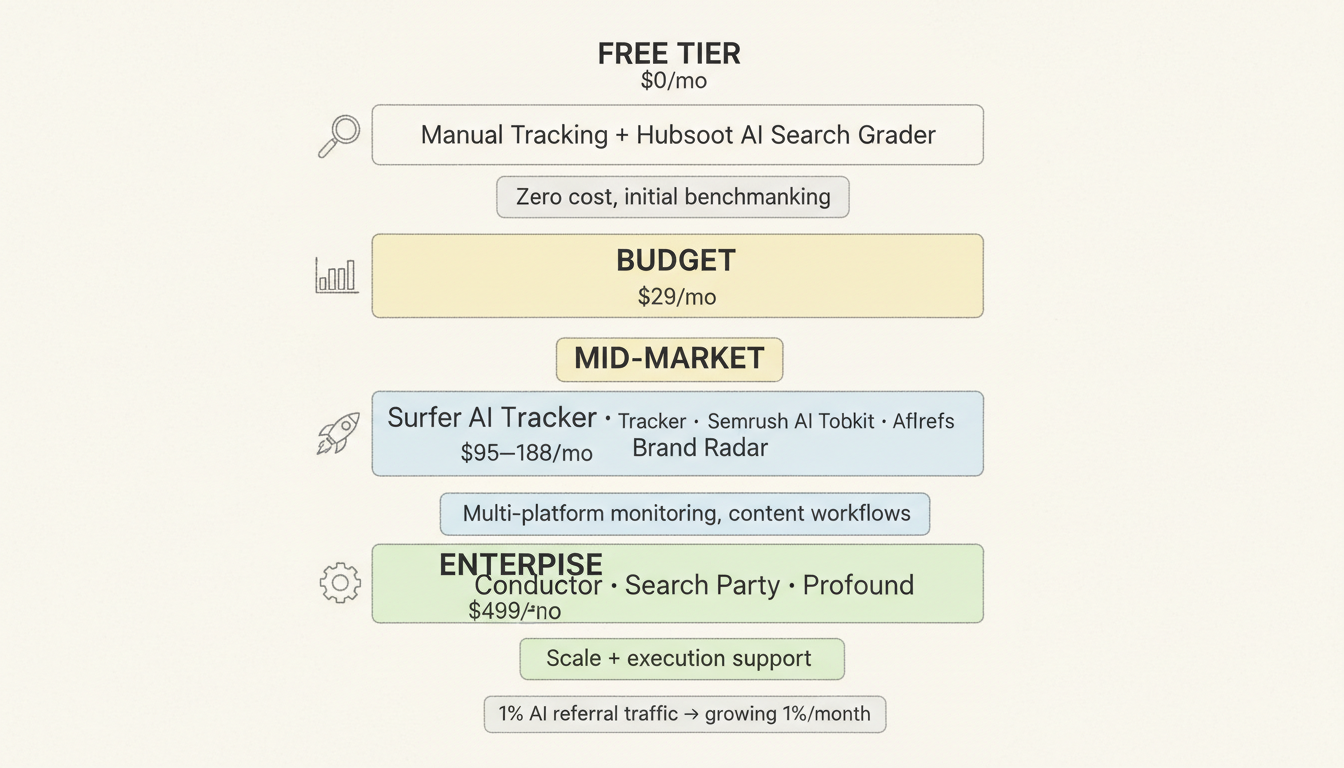
According to Conductor's 2026 AEO/GEO Benchmarks Report, AI referral traffic currently represents just over 1% of total web visits but is growing by roughly 1% each month. This makes early investment in AEO tracking increasingly strategic.
Research shows that only 30% of brands maintain visibility between repeated AI answer runs, making consistent monitoring essential rather than optional. Additionally, 85% of brand mentions in AI Search originate on third-party pages, meaning AEO tools must track both owned and earned visibility across the web. One risk to watch for is AEO tool sprawl—using too many disconnected tools fragments your data and slows response time, so consolidation should be part of your tooling strategy.
How AEO Tools Work: LLM + RAG Architecture Explained
Understanding how AI answer engines generate responses is essential for choosing the right AEO tools. Most modern AI search platforms use a combination of large language models (LLMs) and Retrieval-Augmented Generation (RAG) to produce answers. The LLM provides the language generation capability, while RAG handles real-time retrieval of external web content to ground responses in current, factual information.
This architecture means that content extractability—how easily AI systems can parse, extract, and reuse your content—is a critical factor in whether your pages get cited. Pages with clear heading hierarchy, concise answer paragraphs, FAQ formatting, and structured data are significantly more extractable. Research shows that schema markup for AEO matters substantially: pages with structured data see 2.8x higher citation rates in AI-generated answers—see our guide to AEO schema markup priority types for implementation details.
Effective AEO also requires a shift in keyword strategy toward AEO topics and question research—targeting question clusters rather than individual keywords. This means distinguishing between head questions (broad, high-volume), mid-tail questions (specific but common), and long-tail questions (highly specific, lower volume). It also means understanding the difference between product questions and informational questions, since AI platforms handle these query types differently and not all AI queries surface product results.
Manual AEO Tracking Methods (Free)
Before investing in paid tools, many teams start with manual tracking approaches.
DIY Prompt Monitoring
The simplest approach involves systematically querying AI platforms with relevant prompts and documenting responses.
Manual tracking process:
- Create a list of 20-50 prompts relevant to your business
- Query ChatGPT, Perplexity, and Google AI Mode weekly
- Document whether your brand appears and in what context
- Record which competitors get mentioned
- Track sentiment (positive, neutral, negative)
Advantages:
- Zero cost
- Full control over prompts
- Deep understanding of AI responses
Limitations:
- Time-intensive (2-4 hours weekly for thorough coverage)
- Inconsistent results (AI responses vary)
- No historical trending or automated alerts
- Limited scale across multiple keywords
Google Search Console + Analytics
While not AEO-specific, traditional Google tools capture some AI traffic data.
What you can track:
- Referral traffic from ai.google.com
- Click patterns from AI Overview impressions
- Query patterns that trigger AI responses
Limitations: Google Analytics doesn't cleanly distinguish AI referrals, and UTM parameters don't apply to AI-generated citations.
Semi-Automated AEO Tools (Low-Cost)
Several platforms offer AEO tracking at accessible price points for smaller teams.
Otterly.AI
Pricing: From $29/month Best For: Budget-conscious teams starting AEO tracking
According to SEO.com's AI visibility tools comparison, Otterly.AI provides competitive visibility tracking, citation and mention tracking, and LLM direct output tracking at the market's most accessible price point.
Key features:
- Track brand mentions across ChatGPT, Perplexity, Google AI Overviews, and Copilot
- Competitive visibility comparison
- Citation tracking and alerts
- Basic sentiment analysis
Best for: Solo marketers, small agencies, and startups testing AEO viability before scaling investment.
HubSpot AI Search Grader
Pricing: Free Best For: Initial AEO assessment and benchmarking
According to multiple analyses of free AI SEO tools, HubSpot AI Search Grader provides brand visibility scoring for AI search (ChatGPT, Gemini), competitive benchmarking, and actionable GEO insights at no cost.
Key features:
- Brand presence analysis across major AI answer engines
- Mention frequency and context reporting
- Sentiment and share-of-voice insights
- High-level optimization recommendations
Limitations: Basic functionality compared to paid platforms; designed for initial assessment rather than ongoing monitoring.
Peec AI
Pricing: $100-580/month range Best For: Teams wanting clean, focused tracking
According to Arc Intermedia's platform comparison, Peec focuses on analyzing brand performance across major answer engines with a simpler, more streamlined interface—clear dashboards and a "less noise" approach.
Key features:
- Set prompts, track visibility, review citations
- Clean interface without feature bloat
- Reliable tracking across major platforms
Trade-off: Better for monitoring than turnkey recommendations—you need in-house strategy to translate insights into action.
Mid-Market AEO Platforms
For growing teams needing deeper analysis and optimization guidance.
Surfer SEO AI Tracker
Pricing: From $95/month for 25 prompts (add-on to Surfer subscription) Best For: Content marketers already using Surfer for optimization
According to SEO.com's analysis, Surfer SEO's AI Tracker monitors AI visibility across LLMs including Google AI Overviews, SearchGPT, Perplexity, Claude, and ChatGPT. It tracks brand, product, and topic mentions that signal visibility in AI-generated answers.
Key features:
- Track brand visibility across major AI platforms
- AI-generated content scoring
- Clear charts showing changes over time
- Data-driven optimization suggestions
- Integration with Surfer's content optimization tools
Standout capability: Ties AI visibility tracking directly to content improvements within the existing Surfer workflow.
Semrush AI Visibility Toolkit
Pricing: From $99/month per domain Best For: SMBs and lean teams wanting focused AI tracking
According to Backlinko's SEO tools analysis, Semrush's AI Visibility Toolkit shows how your brand appears in AI Search answers, tracking mentions, sentiment, and high-intent queries.
Key features:
- Monitor AI platforms including ChatGPT, Perplexity, Gemini, Claude
- Track mentions and sentiment
- Identify high-intent queries
- Source domain analysis
Distinction: Semrush offers three tiers:
- AI Visibility Toolkit ($99/domain): AI-only tracking for focused monitoring
- Semrush One: SEO + AI visibility combined in one workflow
- Semrush Enterprise: Multi-brand, large-site, agency-scale operations
Ahrefs Brand Radar
Pricing: $188-699/month (included in Ahrefs subscription) Best For: SEO teams already using Ahrefs wanting AI visibility extension
According to platform comparisons, Ahrefs Brand Radar offers zero setup, large prompt coverage, and monitoring across AI platforms plus surfaces like Reddit and YouTube.
Key features:
- Real-time brand mention monitoring
- Competitor brand tracking
- AI-powered filtering
- Web signals tracking that shape AI answers
Best for: Teams that already use Ahrefs and want AI visibility plus brand monitoring at scale with minimal setup.
Ziptie.Dev
Pricing: Mid-market pricing Best For: Teams wanting practical optimization guidance
According to Arc Intermedia's analysis, ZipTie.dev provides practical prompt suggestions and optimization guidance—described as the "mid-market sweet spot" for teams needing actionable recommendations.
Enterprise AEO Platforms
Large organizations require additional capabilities around scale, governance, and strategic execution.
Conductor
Pricing: Enterprise pricing (typically $499+/month or custom) Best For: Enterprise brands needing comprehensive AEO/GEO analytics
According to Conductor's positioning, they offer the "only end-to-end, enterprise AEO platform built on the industry's most complete data engine."
Key features:
- Reporting across ChatGPT, Perplexity, Gemini, Claude, and Copilot
- Market share analysis by industry
- Share of voice measurement
- Citation tracking at enterprise scale
- Integration with content workflows
- Schema markup audit and recommendations—structured data can improve AI citation rates by 2.8x according to industry benchmarks
Case study: Clemson.edu earned the highest market share among higher education domains by leveraging Conductor's AI visibility-focused content strategy, achieving 91% AI Overview market share.
Conductor's end-to-end approach addresses a common pain point—AEO tool sprawl—by consolidating visibility tracking, content optimization, and technical monitoring in a single platform.
Search Party
Pricing: Enterprise/custom Best For: Marketing teams needing deep analytics plus execution support
According to Search Party's platform description, they offer the industry's leading analytics platform with prompt-level insights revealing how AI models form their answers.
Key differentiators:
- Sentiment scoring for positive, neutral, or negative brand mentions
- Source and citation tracking pinpointing where AI systems pull information
- Done-for-you AEO strategy and content execution from in-house experts
- Comprehensive monitoring across major AI answer engines
Best for: Teams that need expert-supported execution alongside analytics—not just dashboards but strategic implementation.
Profound
Pricing: Enterprise/custom Best For: Multi-engine visibility monitoring at scale
According to multiple platform analyses, Profound provides high-level visibility into how brands appear across multiple AI answer engines with snapshot-based reporting.
Key features:
- Multi-engine monitoring of AI-generated answers
- Snapshot-based brand visibility reporting
- Competitive comparison views
- SOC 2 compliance for enterprise security requirements
Trade-off: Focuses on high-level snapshots rather than detailed analysis or optimization guidance.
Cognizo
Pricing: Enterprise tier Best For: Brands wanting visibility tracking plus optimization recommendations
According to Arc Intermedia's platform review, Cognizo blends visibility tracking with optimization recommendations—emphasizing what to do next rather than just showing dashboards.
Key features:
- Real-time AI visibility insights
- Actionable content recommendations
- Prompt focus area identification
- Content tweak suggestions
Content Optimization Tools with AEO Features
Several content-focused platforms have added AEO capabilities to their core optimization features.
Clearscope
Pricing: From $189/month Best For: Topic research and content gap analysis
According to expert analysis of AEO tools, Clearscope excels in topic optimization and content gap analysis but does not currently offer AI visibility tracking—requiring pairing with an AEO checker for complete strategy.
Frase
Pricing: From $45/month Best For: Content research and brief generation
Frase provides AI-powered content research, brief generation, and optimization—supporting AEO by helping create comprehensive, question-answering content that AI systems prefer to cite.
Jasper
Pricing: From $59/month Best For: AI content automation at scale
Jasper focuses on content generation rather than visibility tracking, helping teams produce AEO-optimized content that follows answer-first structures.
Emerging AEO Tools to Watch in 2026
Beyond the established platforms, several newer tools are gaining traction in the AEO space. These emerging solutions address specific gaps in the market—from content creation workflows to technical optimization and competitive benchmarking.
Writesonic
Pricing: From $49/month Best For: AEO content creation and answer-first content structures
Writesonic is an AI content generation platform with AEO-specific content creation workflows. It generates answer-first content structures optimized for citation by AI answer engines. Writesonic supports teams building an AEO content strategy with AI-generated answer-first content structures that align with how LLMs retrieve and present information.
Athena HQ
Pricing: Custom Best For: AI visibility tracking and competitive benchmarking
Athena HQ is an AI visibility tracking platform for monitoring brand presence across LLMs including ChatGPT, Perplexity, and Gemini. It targets enterprise and mid-market teams with competitive benchmarking features that reveal how your brand stacks up against competitors in AI-generated answers.
Goodie AI
Pricing: Custom Best For: Technical AEO optimization and schema markup
Goodie AI is a technical AEO tool focused on schema markup and site structure optimization. It helps improve content extractability for AI crawlers by auditing your page structure, heading hierarchy, and structured data implementation—making your content more parseable for RAG-based retrieval systems.
Additional Emerging Tools to Consider
Several other platforms are carving out niches in the AEO ecosystem:
- Quattr: An execution-focused platform helping teams transition from traditional SEO to AEO with actionable workflows and multi-AI-engine tracking
- MarketMuse: Topic authority planning tool that helps identify content gaps and build comprehensive topic coverage—a foundation for earning AI citations (from $149/month)
- Scrunch AI: Competitive AEO benchmarking platform that tracks how your brand compares to competitors across AI answer engines
- AirOps: Enterprise-grade platform combining AI visibility monitoring with content execution at scale, designed for teams managing large content portfolios
Custom API Solutions
Technical teams can build custom AEO tracking using available APIs.
ChatGPT API Integration
Use case: Programmatic prompt testing and response monitoring
Build custom tracking by:
- Systematically querying ChatGPT with relevant prompts via API
- Parsing responses for brand mentions
- Tracking changes over time
- Correlating with content updates
Google Knowledge Graph API
Use case: Entity and structured data analysis
Monitor how Google understands your brand entities and their relationships—foundational data that influences AI Overview source selection.
Tool Comparison Matrix
Tool | Type | Platforms Tracked | Starting Price | Best For |
Manual Tracking | DIY | All | Free | Initial assessment |
HubSpot AI Search Grader | Free | ChatGPT, Gemini | Free | Benchmarking |
Otterly.AI | Budget | ChatGPT, Perplexity, Google AIO, Copilot | $29/mo | Small teams |
Peec AI | Budget | Major AI engines | $100/mo | Clean, focused tracking |
Frase | Content + AEO | Content optimization for AI | $45/mo | Content research |
Jasper | Content + AEO | Content generation | $59/mo | AI content at scale |
Surfer SEO AI Tracker | Mid-market | ChatGPT, Perplexity, Claude, Google AIO | $95/mo | Content marketers |
Semrush AI Toolkit | Mid-market | ChatGPT, Perplexity, Gemini, Claude | $99/mo | SMBs |
MarketMuse | Content + AEO | Topic authority analysis | $149/mo | Topic authority planning |
Ahrefs Brand Radar | Mid-market | Multiple AI + web signals | $188/mo | Ahrefs users |
Clearscope | Content + AEO | Topic optimization | $189/mo | Content gap analysis |
ZipTie.dev | Mid-market | Multiple AI engines | Mid-market | Practical optimization |
Writesonic | Content + AEO | Content optimization for AI | $49/mo | AEO content creation |
Athena HQ | Mid-market | ChatGPT, Perplexity, Gemini | Custom | AI visibility tracking |
Goodie AI | Technical AEO | Schema + structure analysis | Custom | Technical AEO optimization |
Quattr | Mid-market | Multiple AI + organic | Custom | SEO-to-AEO transition |
Scrunch AI | Mid-market | Competitive benchmarking | Custom | Competitive AEO analysis |
Cognizo | Enterprise | Multiple AI engines | Enterprise | Tracking + recommendations |
Profound | Enterprise | Multiple AI engines | Custom | Multi-engine monitoring |
Conductor | Enterprise | ChatGPT, Perplexity, Gemini, Claude, Copilot | $499+/mo | Enterprise brands |
AirOps | Enterprise | Multiple AI engines | Custom | Content execution at scale |
Search Party | Enterprise | Multiple AI engines | Custom | Teams needing execution support |
How to Choose AEO Tools
Assess Your Current Stage
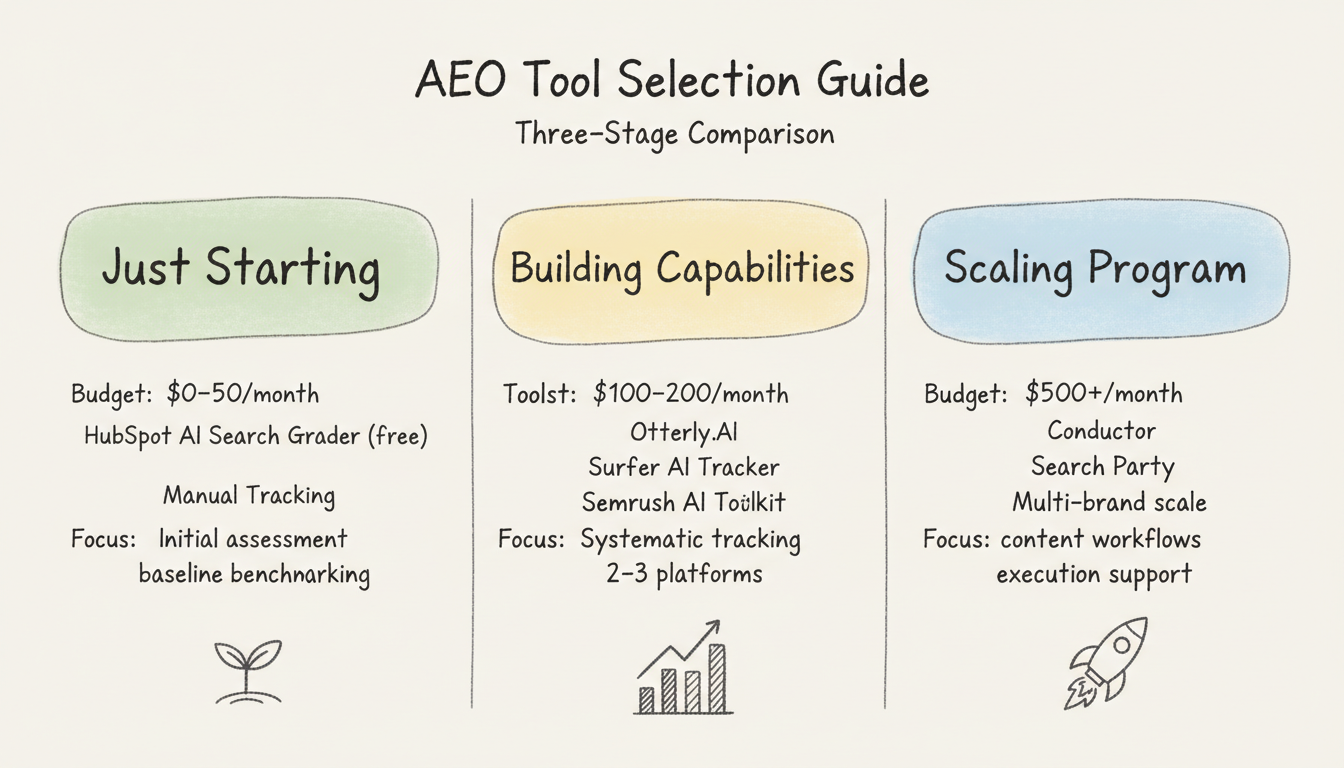
Just starting AEO:
- Begin with HubSpot AI Search Grader (free) for baseline assessment
- Supplement with manual tracking to understand AI response patterns
- Budget: $0-50/month
Building AEO capabilities:
- Invest in Otterly.AI, Surfer AI Tracker, or Semrush AI Toolkit
- Focus on systematic tracking across 2-3 priority platforms
- Budget: $100-200/month
Scaling AEO program:
- Consider Conductor, Search Party, or platform-native enterprise tiers
- Integrate with content workflows and team processes
- Budget: $500+/month
Match Tools to Resources
Limited technical resources: Choose platforms with done-for-you recommendations (Search Party, Cognizo)
Strong content team: Select tools that connect visibility insights to content workflows (Surfer, Semrush)
Data-driven organization: Prioritize platforms with deep analytics and export capabilities (Conductor, Ahrefs)
Consider Platform Coverage
According to research on AI platform distribution, ChatGPT accounts for 80%+ of AI referral traffic, with Perplexity second. Gemini and Copilot show stronger presence in specific industries.
Priority coverage:
- ChatGPT (mandatory for all)
- Google AI Overviews (critical for organic traffic)
- Perplexity (important for research-heavy industries)
- Claude, Gemini, Copilot (based on audience behavior)
Evaluate Citation and Extractability Features
When evaluating tools, prioritize those that assess content extractability—whether your pages are structured for AI parsing. Look for tools that track citation optimization metrics: which URLs get cited, citation frequency trends, and competitive citation gaps. The 2.8x schema lift statistic serves as a useful benchmark for evaluating tools that include schema analysis capabilities. Before selecting tools, run an AEO content audit to identify your current extractability gaps.
AEO Measurement: Metrics That Matter
Tracking AI visibility requires a different measurement framework than traditional SEO. The key metric to understand is share of answers—the AEO equivalent of share of voice. It measures what percentage of relevant AI queries return your brand in the response. For a full breakdown of what to measure, see our guide to AEO metrics and KPIs.
Citation optimization is the strategy of optimizing which URLs AI systems cite to maximize brand visibility and click-through. This goes beyond simply appearing in answers—it means ensuring AI platforms link to your most valuable pages and that your citation frequency trends upward over time.
Prompt testing provides a systematic methodology: querying AI platforms with variations of target questions to measure visibility consistency. Rather than checking a single prompt once, effective prompt testing involves running multiple variations across different platforms on a regular cadence. Combine prompt testing with AEO competitor analysis to benchmark your share of answers against industry rivals.
One critical finding: AI Search is inherently volatile. Research shows only 30% of brands persist between repeated AI answer runs for the same query, which means single-snapshot tracking can be dangerously misleading. Additionally, 85% of brand mentions in AI Search originate on third-party pages—meaning your owned vs earned visibility balance matters significantly. Tools that track only your own domain miss the majority of where your brand appears in AI answers.
Content Freshness and Refresh Cadence
Pages without quarterly content updates are 3x more likely to lose AI citations. Establishing a quarterly refresh cadence for AEO-targeted content is essential for maintaining citation rates over time. AEO tools can automate freshness monitoring through alerts for stale content and citation decay tracking. Our AEO measurement and tracking guide covers how to set up automated citation decay alerts. Tools with content workflow integration—such as Surfer and Conductor—support systematic refresh programs that keep your content current and citation-worthy.
FAQs
Do I Need AEO Tools If I Already Use SEO Software?
Traditional SEO tools don't track AI visibility. While strong organic rankings correlate with AI citations (86% domain overlap according to Semrush research), you need answer engine optimization services to monitor actual appearance in AI-generated answers.
Which AEO Tool Is Best for Small Businesses?
Start with HubSpot AI Search Grader (free) for assessment, then consider Otterly.AI ($29/month) for ongoing tracking. These provide essential visibility monitoring without enterprise investment. Many businesses also work with AEO consulting services to maximize results.
Can I Track AI Visibility Manually?
Yes, but it's time-intensive and lacks historical trending. Manual tracking works for initial assessment but becomes impractical at scale. Most teams graduate to automated tools within 2-3 months, particularly when implementing generative engine optimization best practices.
How Often Should I Check AI Visibility?
AI responses change frequently. Weekly monitoring catches major shifts; daily monitoring (available in most paid tools) identifies emerging patterns. Critical for brands in fast-moving industries where AEO future trends impact competitive positioning.
Do AEO Tools Actually Improve Visibility?
Tools provide visibility data—improvement requires action. Platforms that combine tracking with optimization recommendations (Surfer, Cognizo, Search Party) help translate insights into results, particularly when paired with a generative engine optimization agency.
What Is Content Extractability and Why Does It Matter for AEO?
Content extractability refers to how easily AI systems can parse and reuse your content in generated answers. Pages with clear heading hierarchy, concise answer paragraphs, FAQ formatting, and schema markup are significantly more extractable. Research shows structured data alone improves AI citation rates by 2.8x. When evaluating AEO tools, prioritize platforms that audit your content structure and provide extractability scoring alongside visibility tracking.
How Do I Measure Share of Answers in AI Search?
Share of answers measures what percentage of relevant AI queries return your brand in the response—the AEO equivalent of share of voice. Track it by defining 50-100 target questions, querying them across ChatGPT, Perplexity, and Google AI Overviews weekly, and calculating your appearance rate. Most enterprise AEO tools like Conductor and Search Party automate this with prompt-level tracking dashboards.
Why Does AI Search Visibility Fluctuate So Much?
AI Search is inherently volatile—research shows only 30% of brands persist between repeated answer runs for the same query. This happens because LLMs use probabilistic generation combined with RAG retrieval, meaning source selection varies with each run. Single-snapshot tracking can be misleading. Effective AEO monitoring requires multiple runs per query over time, which is why automated tools with daily or weekly cadences provide more reliable data than manual checks.
What Is the Best Schema Markup for AEO Visibility?
FAQPage, HowTo, and Article schema types have the strongest correlation with AI citations. Pages with proper structured data see 2.8x higher citation rates in AI-generated answers. Tools like Goodie AI and Conductor include schema audit features that identify missing or incomplete markup. Prioritize schema that makes your content's structure explicit to AI crawlers—question-answer pairs, step sequences, and entity relationships.
Key Takeaways
The AEO tool market offers options for every budget and capability level:
- Free options exist for initial assessment - HubSpot AI Search Grader and manual tracking provide starting points before investment
- Mid-market tools ($99-200/month) serve most needs - Surfer AI Tracker, Semrush AI Toolkit, and Ahrefs Brand Radar offer robust tracking for growing teams
- Enterprise platforms ($500+/month) add execution support - Conductor and Search Party provide strategic guidance alongside analytics
- Platform coverage matters - Prioritize ChatGPT and Google AI Overviews; add Perplexity and others based on audience behavior
- Tools require action to deliver value - Visibility data alone doesn't improve rankings; connect insights to geo content optimization workflows
- Measurement goes beyond dashboards — track share of answers, citation frequency, and prompt testing results to quantify AEO impact and justify continued investment
- Content freshness drives citation retention — pages without quarterly updates are 3x more likely to lose AI citations, making automated refresh alerts a valuable tool feature
The right AEO tool depends on your current stage, budget, and team resources. Start simple, prove value, then scale investment as AI search visibility becomes increasingly strategic. Understanding the relationship between SEO and AEO helps teams integrate both strategies effectively, while tracking Google AI Overview mobile vs desktop differences ensures comprehensive visibility monitoring.