
Answer Engine Optimization claims are everywhere in 2026. Agencies promise AI visibility, consultants tout citation strategies, and tools advertise AI search tracking. But what do actual results look like? Which businesses have documented real ROI from AEO marketing strategies?
This guide examines documented AEO case studies across industries—SaaS, e-commerce, and local business—breaking down methodologies, timelines, and measurable outcomes. If you're evaluating whether AEO investment makes sense for your business, these real-world examples provide the evidence base you need.
Introduction: The AEO Case Study Gap
The AEO industry faces a documentation problem. While traditional SEO has decades of case studies with standardized metrics (rankings, traffic, conversions), AEO is newer and metrics are less established.
Why AEO Case Studies Matter
For decision-makers evaluating AEO investment, case studies answer critical questions:
- What results are realistic? Industry benchmarks help set expectations
- What timeline should I expect? Most businesses want to know when they'll see returns
- What methodology works? Successful approaches provide implementation guidance
- What's the actual ROI? Revenue attribution justifies investment
The Documentation Challenge
AEO case studies are harder to find than SEO case studies for several reasons:
Newer discipline: AEO emerged seriously in 2024-2025, leaving less time for documented results.
Attribution complexity: Connecting AI citations to revenue requires more sophisticated tracking than traditional SEO, though Google Analytics 4 AI search tracking has made this easier.
Platform opacity: Unlike Google Search Console, AI platforms don't provide publisher dashboards.
Competitive sensitivity: Companies achieving strong AI visibility often guard their methods.
Despite these challenges, documented case studies do exist. Let's examine the most instructive examples.
GEO and AEO: Understanding Generative Engine Optimization Case Studies
Before examining individual case studies, it is important to understand the relationship between two terms increasingly used in this space: AEO (Answer Engine Optimization) and GEO (Generative Engine Optimization). While AEO focuses on optimizing content for answer engines such as Google AI Overviews and Perplexity, GEO describes the practice of optimizing specifically for generative AI outputs from platforms like ChatGPT, Claude, Gemini, Copilot, and Grok. In practice, these are complementary frameworks covering the same core discipline from different angles. The most successful brands optimize for both simultaneously, applying generative engine optimization strategies alongside traditional AEO tactics.
Why does this distinction matter for case studies? GEO has emerged as the fastest-growing term in the AI search optimization space, with approximately 4,400 monthly searches and a remarkable 315% year-over-year growth rate. Agencies and brands that frame their work as GEO are often describing the same methodologies documented in AEO case studies—content restructuring for AI extraction, schema markup, authority building, and citation optimization—but with an emphasis on generative model outputs rather than traditional answer boxes.
The platform landscape for GEO extends well beyond Google. ChatGPT dominates consumer generative search, while Claude (Anthropic) has gained traction in professional and developer audiences for its nuanced, well-sourced responses. Gemini (Google) integrates deeply with Google's index and offers multimodal capabilities. Microsoft Copilot leverages Bing's index and reaches a massive enterprise user base. Grok (xAI) provides real-time data access through the X platform and is increasingly relevant for news and trend queries. Each platform weights content differently, which means GEO strategies must account for platform-specific citation patterns.
For readers seeking a deeper comparison of these frameworks, see our guide on how AEO, SEO, and GEO work together. The case studies below demonstrate both AEO and GEO methodologies in action, with results spanning multiple generative AI platforms.
Case Study Framework and Methodology
Before diving into specific case studies, understanding how to evaluate AEO results helps separate signal from noise.
Key Metrics to Evaluate
Metric Category | Specific Metrics | Why It Matters |
Visibility | AI citation rate, Share of Voice | Did visibility actually improve? |
Traffic | AI referral visits, Overall organic growth | Did visibility translate to traffic? |
Engagement | Conversion rate, Time on site | Is AI traffic quality traffic? |
Revenue | Attributed revenue, ROI percentage | Does it justify investment? |
AI Conversion | AI-assisted conversion rate, LLM-referred conversion rate | Measures quality of AI traffic vs. other channels |
Share of Answers | Per-query citation frequency, brand mention rate | Distinct from Share of Voice—measures answer presence, not just visibility |
For a deeper dive into measurement approaches, see our comprehensive AEO metrics and KPIs framework.
Methodology Red Flags
Watch for these issues in case studies:
- Correlation claims: Traffic increased during AEO work, but was it caused by AEO?
- Cherry-picked timeframes: Short periods can show random variation
- Missing baselines: Results without "before" numbers are meaningless
- Vague metrics: "Improved visibility" without specific measurements
- LLM usage growth confounding: AI platform user counts are growing 30-50% quarter-over-quarter. Traffic increases during this period may reflect platform adoption, not optimization effectiveness. Credible case studies isolate AEO-attributed gains from baseline platform growth using control groups or before/after citation rate analysis.
Credibility Indicators
Look for case studies that include:
- Specific numeric baselines and outcomes
- Clear timeframes (minimum 90 days)
- Methodology descriptions
- Multiple metric types (not just one vanity metric)
- Third-party verification where possible
SaaS AEO Case Study Analysis
Software companies have been early AEO adopters, with several documented success stories that demonstrate the effectiveness of B2B AEO marketing approaches.
Case Study: B2B Fintech Platform
According to iPullRank's documented results, a fintech platform achieved significant gains through integrated SEO and AEO optimization:
Challenge: Declining organic visibility as AI Overviews captured informational queries in financial services.
Approach:
- Comprehensive content restructuring for AI extraction
- Schema markup implementation across product and educational pages
- Authority building through expert-attributed content
- Technical optimization for AI crawler accessibility
Results (over 12 months):
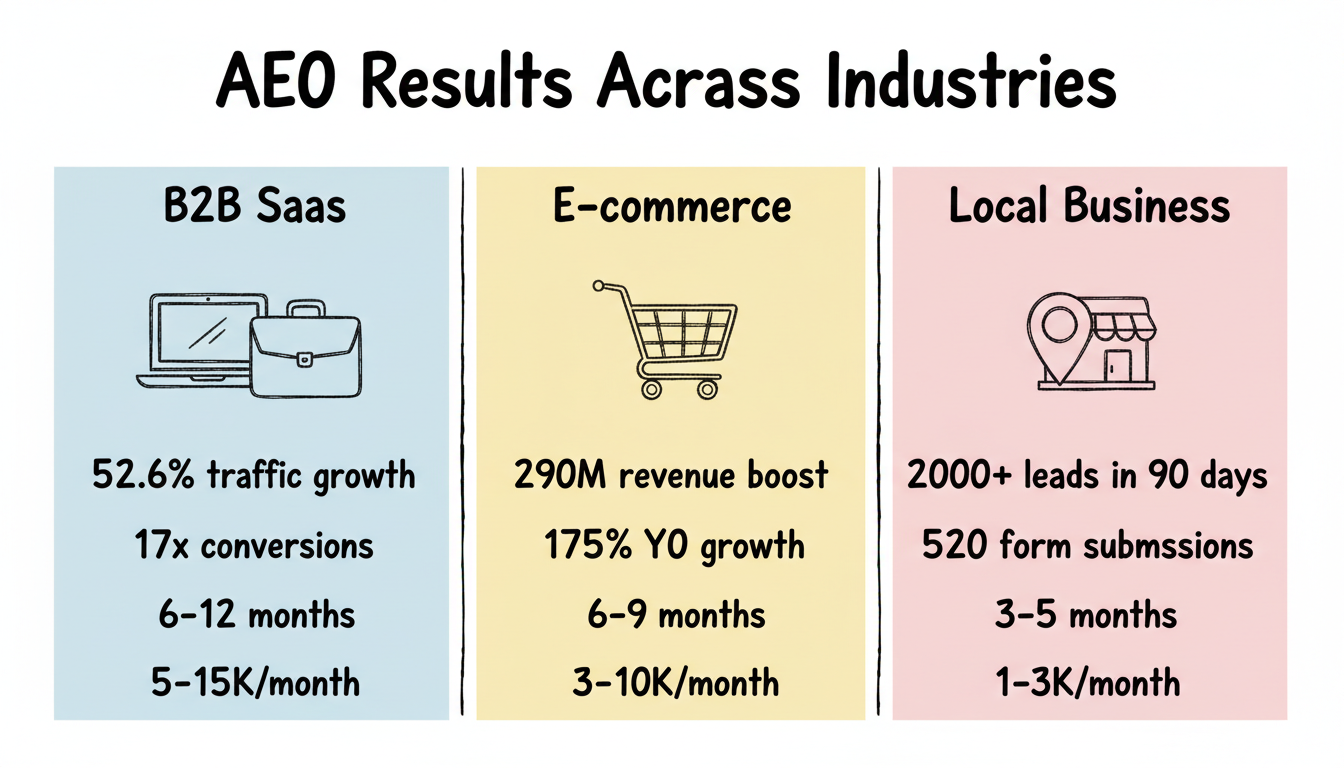
- 52.6% increase in organic traffic
- 17x improvement in conversion rates
- Significant growth in AI Overview appearances for target queries
- Improved brand mention frequency in AI responses
Key Insight: The fintech case demonstrates that AEO and traditional SEO reinforce each other—content optimized for AI extraction also performed better in traditional rankings.
Case Study: Gaming Accessories Brand (Steelseries)
NoGood's documented work with SteelSeries provides another SaaS-adjacent example:
Challenge: Competition from larger brands in AI-generated product recommendations.
Approach:
- AI search-optimized product content
- Expert review and comparison content
- Structured data for product information
- Brand authority signals enhancement
Results (over 6 months):
- 3.2x increase in AI search conversions
- Improved citation rates in product-related AI queries
- Growth in branded search from AI exposure
Key Insight: Product-focused businesses can achieve AEO results by ensuring AI systems have accurate, well-structured product information to cite.
SaaS AEO Benchmark Summary
Company Type | Traffic Growth | Conversion Impact | Timeline |
B2B Fintech | 52.6% | 17x improvement | 12 months |
Consumer Tech | N/A | 3.2x | 6 months |
Average SaaS | 30-50% | 2-5x | 6-12 months |
Enterprise & B2B AEO Case Studies: Breakout Results in 2025-2026
Beyond the SaaS case studies above, several enterprise and B2B organizations have documented extraordinary AEO and GEO results in the 2025-2026 period. These cases stand out for their scale, specificity, and the methodological innovations they reveal.
The Optimist B2B Tech Case: 4,900% Revenue Increase from LLM Referrals
The Optimist, a B2B content marketing agency, documented one of the most striking AEO results to date for a B2B technology client. Over a 14-month engagement, the client achieved a 4,900% revenue increase and 2,622% traffic growth from LLM-referred sources. The core methodology centered on first-party research and proprietary data as a content pillar. Rather than repurposing existing industry data, the team created original studies and datasets that LLMs would cite as authoritative, primary sources. They also used question research (sometimes called AEO Topics) to identify conversational queries distinct from traditional keyword targets—questions that users ask AI assistants rather than type into search engines. The key takeaway is that proprietary data creates a citability moat that competitors cannot replicate. When your organization is the original source of a data point, LLMs have no alternative but to cite you. Companies exploring AEO strategies specific to SaaS companies will find this approach particularly relevant.
ABM Agency / Chemours: $90M+ Pipeline Through AI Citations
Chemours, an industrial chemicals company, partnered with an ABM-focused agency to achieve 82-84% AI citation rates across their target query set. The program generated over $90 million in pipeline attributed to AI-assisted discovery—a remarkable result for a highly technical B2B vertical where traditional content marketing has historically struggled. The methodology relied on deep E-E-A-T (Experience, Expertise, Authoritativeness, Trustworthiness) signal optimization. Content was authored by recognized industry experts with visible credentials, technical papers cited patents and peer-reviewed research, and the brand invested in building authoritative backlink profiles from industry-specific publications. This case demonstrates that enterprise-scale AEO works even in verticals where content is highly specialized and the audience is narrow but high-value.
Siege Media / Mentimeter: 124K ChatGPT Sessions in One Month
Siege Media's work with Mentimeter, an EdTech presentation platform, produced 124,000 ChatGPT-referred sessions and 3,400 conversions in a single month. The methodology focused on content structured for citability—clear definitions in opening sentences, data presented in tables rather than prose, step-by-step frameworks that LLMs can extract and reference directly. The team also employed a listicle and directory seeding strategy, ensuring the Mentimeter brand appeared in aggregator content and comparison lists that LLMs are known to scrape and reference when generating recommendations. The result demonstrates that conversion rates from LLM traffic can match or exceed traditional organic search, provided content is structured to facilitate both citation and user action after click-through.
AEO Tactics That Drive Results: Citability, E-E-A-T, and Llms.Txt
Across the case studies examined above, three tactical themes emerge repeatedly as drivers of AEO and GEO success. Understanding these tactics and how they connect to documented results helps translate case study insights into actionable strategy.
Content Citability: The Core AEO Success Factor
Citability is the degree to which AI systems can extract, attribute, and reference your content in their responses. Unlike traditional SEO content optimization, which prioritizes engagement metrics like time on page and scroll depth, citability prioritizes extraction—making it easy for an LLM to pull a clear, attributable answer from your content. The pattern across successful case studies reveals a consistent citability checklist: clear definitions in opening sentences of each section, data presented in tables rather than buried in paragraphs, explicit claims with named sources rather than vague assertions, and modular content blocks with descriptive headings that function as standalone extractable units. The Siege Media/Mentimeter case and The Optimist B2B case both achieved their results in large part by restructuring existing content around these citability principles.
E-E-A-T as the AEO Authority Framework
Google's E-E-A-T framework—Experience, Expertise, Authoritativeness, Trustworthiness—has become the primary lens through which AI systems evaluate source credibility for citation. Each dimension maps to AI citation likelihood in specific ways: Experience signals (first-hand accounts, original research) make content unique and hard to replicate; Expertise signals (author credentials, technical depth) establish domain authority; Authoritativeness signals (backlinks, industry recognition) confirm that other credible sources trust your content; and Trustworthiness signals (transparent sourcing, accurate claims) reduce the risk that an LLM will surface incorrect information. The Chemours case (82-84% citation rates) and The Optimist case (4,900% revenue growth) both demonstrate that deliberate E-E-A-T optimization is a core driver of AI citation success.
Llms.Txt: The Technical Tactic That Delivered 5x AI Traffic
The Concurate case study documented a 5x increase in AI-referred traffic after implementing an llms.txt file. An llms.txt file is a machine-readable document, similar in concept to robots.txt, that helps LLM crawlers understand your site structure and content priorities. It tells AI systems which pages are most important, provides brief descriptions of content on each page, and signals topical authority areas. To implement llms.txt, place the file at your domain root (e.g., yourdomain.com/llms.txt), list your most important pages with one-line descriptions, organize entries by topic cluster, and update the file whenever you publish significant new content. While still an emerging tactic, the documented 5x traffic increase suggests llms.txt is one of the highest-leverage technical AEO optimizations currently available.
E-Commerce AEO Case Study Analysis
E-commerce presents unique AEO challenges—lower AI Overview rates but high commercial intent when AI does appear.
Case Study: Major E-Commerce Marketplace
iPullRank's e-commerce case study documents results for a large marketplace:
Challenge: Competing for product visibility in AI-generated shopping recommendations and comparison content.
Approach:
- Product schema optimization at scale
- Category page restructuring for AI extraction
- User review and rating signal optimization
- Merchant authority content development
Results (over 18 months):
- 175% year-over-year growth in organic visibility
- $290 million revenue boost attributed to organic improvements
- Significant increase in AI citation for product categories
- Improved competitive positioning in AI shopping responses
Key Insight: At enterprise scale, AEO investment compounds—the $290M revenue attribution dwarfs the implementation investment.
E-Commerce AEO Considerations
E-commerce faces distinct AEO dynamics:
Lower AI Overview rates: According to industry research, e-commerce queries trigger AI Overviews only ~4% of the time, compared to 65-70% for B2B technology queries when comparing Google AI Overview vs traditional SERP performance.
High-value citations: When AI does recommend products, conversion intent is typically high.
Schema dependency: Product structured data is essential for AI systems to understand and recommend products accurately.
Review authority: AI systems heavily weight user reviews and ratings when making product recommendations, a key aspect of AI overview authority signals.
E-Commerce Strategy Implications
For e-commerce businesses, AEO ROI depends on:
- Product category: Some categories trigger more AI involvement
- Review volume: Strong review profiles support AI recommendations
- Schema completeness: Missing product data means missing AI opportunities
- Content breadth: Buying guides and comparisons capture informational queries
Conversational Merchandising: The E-Commerce AEO Frontier
An emerging dimension of e-commerce AEO is conversational merchandising—the practice of optimizing product content for buyer-AI dialogues where shoppers ask AI assistants for purchase recommendations rather than browsing traditional search results. As more consumers use ChatGPT, Gemini, and Copilot to ask questions like "best noise-canceling headphones under $200" or "ergonomic office chair vs standing desk for back pain," product pages structured to answer these comparative and evaluative queries gain a significant citation advantage.
The Netpeak e-commerce approach demonstrated this principle by restructuring product pages to directly address conversational queries with extractable comparison data. Practical tactics for conversational merchandising include adding Q&A structured data to product pages, creating comparison content optimized for conversational queries (e.g., "X vs Y for budget buyers"), and ensuring product specifications are presented in extractable formats like tables and definition lists rather than embedded in paragraph text. For a comprehensive tactical guide, see our e-commerce AEO playbook.
Local Business AEO Case Study Analysis
Local businesses present compelling AEO opportunities, particularly for service queries where AI provides recommendations.
Case Study: Restaurant (the Albert)
97 Switch's case study for The Albert restaurant demonstrates local business AEO potential:
Challenge: Competing for visibility in local dining recommendations, particularly in AI-assisted search.
Approach:
- Local SEO foundation optimization
- Google Business Profile enhancement
- Review generation and management
- Structured data for restaurant information
- Content development for menu and experience queries
Results (documented period):
- 7,200 website visits generated
- 520 form submissions (reservations/inquiries)
- Improved visibility in local AI recommendations
- Enhanced presence in "restaurants near me" AI responses
Key Insight: Local businesses can achieve significant results through coordinated local SEO and AEO efforts. The form submission metric (520) provides clear conversion attribution.
Case Study: Real Estate (444social)
Another 97 Switch case study for 444Social, a property management company:
Challenge: Generating leads for rental properties through digital channels including AI search.
Approach:
- Property listing optimization
- Local search visibility enhancement
- Content development for rental queries
- Review and reputation management
Results:
- 100% occupancy achieved across managed properties
- Significant increase in qualified lead generation
- Improved visibility in AI responses for local rental queries
Key Insight: For high-value transactions like real estate, even modest AI visibility improvements can generate significant revenue impact.
Case Study: Lead Generation (Sidegigster)
97 Switch's SideGigster case study shows B2B local service results:
Challenge: Generating leads for freelance and side gig opportunities.
Approach:
- Content optimization for gig economy queries
- Authority building in freelance space
- Structured data implementation
- AI search visibility optimization
Results (over 90 days):
- 2,000+ leads generated
- Significant organic traffic growth
- Improved AI citation for relevant queries
Key Insight: Even in niche markets, focused AEO efforts can generate substantial lead volume quickly (90-day timeframe).
Local Business AEO Benchmark Summary
Business Type | Key Metric | Result | Timeline |
Restaurant | Form Submissions | 520 | N/A |
Real Estate | Occupancy | 100% | N/A |
Lead Gen | Leads | 2,000+ | 90 days |
Platform-Specific Performance Analysis
Different AI platforms show different citation patterns. Understanding platform-specific dynamics helps prioritize optimization efforts, especially when developing a multi-platform AI search optimization strategy.
Google AI Overviews Performance
According to iPullRank's telecom case study, optimizing for Google AI Overviews specifically produced:
- 1.41 million AI Overview impressions per month
- 253% year-over-year growth in AI Overview visibility
- Strong correlation between traditional ranking and AI Overview appearance
Platform insight: Google AI Overviews draw heavily from already-ranking content. Traditional SEO excellence remains the foundation. Understanding Google AI Overview ranking factors is essential for success.
ChatGPT Citation Patterns
ChatGPT citation patterns differ from Google:
- Training data influences baseline brand visibility
- Real-time browsing (when enabled) adds current content opportunities
- Authority and comprehensiveness correlate with citation likelihood
- Response variability makes tracking more challenging
Perplexity Citation Dynamics
Perplexity's transparent source display creates unique dynamics:
- Sources are prominently displayed, increasing brand visibility value
- Recency signals appear to weight heavily
- Factual accuracy affects ongoing citation likelihood
- Click-through rates from citations are higher than other platforms
Claude, Gemini, Copilot, and Grok Citation Patterns
Beyond ChatGPT and Perplexity, four additional AI platforms have become significant for AEO practitioners seeking platform-specific optimization differences across ChatGPT, Perplexity, Gemini, and Copilot:
Claude (Anthropic): Claude weights authoritative, well-structured content and is particularly responsive to content with clear sourcing and nuanced analysis. Its growing market share in professional and developer audiences makes it an important platform for B2B and technical content visibility.
Gemini (Google): Gemini's deep integration with Google's index gives it unique access to fresh content. Its multimodal capabilities mean image and video schema optimization matter more here than on text-only platforms. There is strong overlap between Gemini optimization and Google AI Overviews optimization, making it an efficient dual target.
Microsoft Copilot: Copilot leverages Bing's index and reaches a massive enterprise user base. Citations in workplace contexts—where Copilot is embedded in Microsoft 365 applications—drive high-intent traffic from professional users actively working on tasks.
Grok (xAI): Grok has real-time data access via the X (Twitter) platform, and recency signals are weighted heavily in its responses. Its growing relevance for news, trends, and current-event queries makes it a priority for brands in fast-moving industries.
Cross-Platform Optimization
The most successful case studies show optimization across platforms, leveraging AI search tools software to monitor performance:
Strategy | Google AI | ChatGPT | Perplexity | Claude | Gemini | Copilot | Grok |
Traditional SEO | Critical | Helpful | Helpful | Moderate | Critical | Helpful | Low |
Schema Markup | Critical | Moderate | Moderate | Low | Critical | Moderate | Low |
Content Freshness | Moderate | Moderate | Critical | Moderate | Moderate | Moderate | Critical |
Authority Signals | Critical | Critical | Critical | Critical | Critical | Critical | Moderate |
llms.txt | Moderate | Helpful | Helpful | Helpful | Moderate | Helpful | Low |
ROI Benchmarks by Industry
Based on documented case studies and industry analysis, here are realistic ROI expectations by sector when implementing comprehensive answer engine optimization strategies.
Industry ROI Benchmarks
Industry | Typical Investment | Expected ROI | Timeline to Positive |
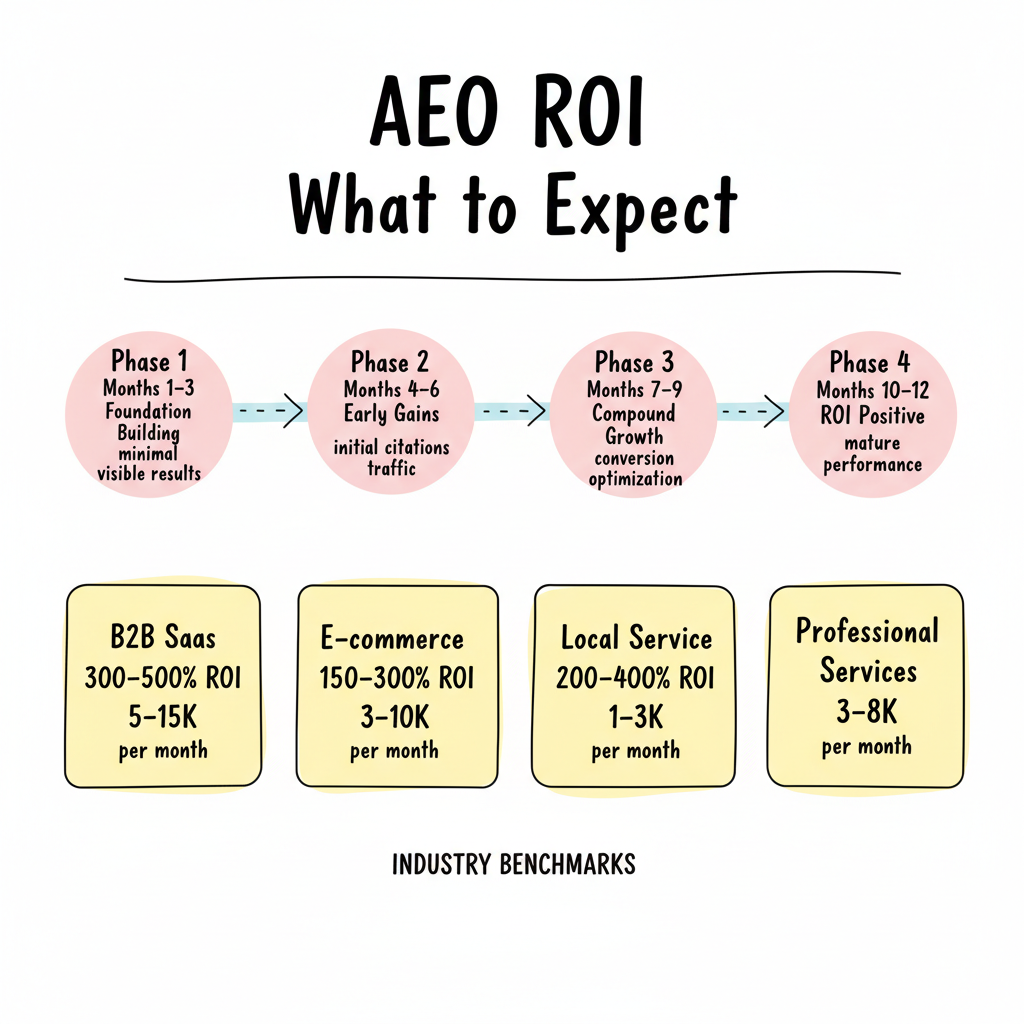
B2B SaaS | $5-15K/month | 300-500% | 4-6 months |
E-commerce | $3-10K/month | 150-300% | 6-9 months |
Local Service | $1-3K/month | 200-400% | 3-5 months |
Professional Services | $3-8K/month | 250-400% | 5-7 months |
ROI Calculation Framework
Calculate your potential AEO ROI using this framework:
Revenue Attribution:
AI Referral Traffic × Conversion Rate × Average Order Value = Direct RevenueFull Attribution (including assisted):
(AI Citations × Estimated Reach × Brand Lift Factor × Conversion Rate × AOV) + Direct Revenue = Total AttributionBased on case study analysis, realistic first-year expectations:
Months 1-3: Foundation building, minimal visible results Months 4-6: Initial citation improvements, early traffic gains Months 7-9: Compound growth, conversion optimization Months 10-12: Mature performance, ROI positive
Most documented case studies show positive ROI by month 6-9 for committed programs. Businesses seeking faster results may benefit from AEO consulting services to accelerate implementation.
Building Your Own AEO Case Study
Document your AEO journey to measure ROI and inform ongoing optimization.
Baseline Documentation
Before starting AEO work, document:
Visibility baseline:
- Current AI citation rate for target queries
- Share of Voice vs. competitors
- Brand mention frequency in AI responses
Traffic baseline:
- Current AI referral traffic (if any)
- Total organic traffic
- Conversion rates by source
Revenue baseline:
- Current organic revenue attribution
- Customer acquisition cost by channel
Ongoing Measurement
Track these metrics monthly:
Metric | Measurement Method | Target Improvement |
Citation Rate | Manual or tool tracking | +5% monthly |
Share of Voice | Competitive monitoring | +2-3% monthly |
AI Referral Traffic | GA4 segmentation | +10% monthly |
Conversion Rate | Attribution modeling | Maintain or improve |
Documentation Best Practices
For credible case study development:
- Use consistent timeframes: Monthly or quarterly measurements
- Control for variables: Note algorithm updates, seasonal factors
- Track multiple metrics: Visibility, traffic, and revenue together
- Document methodology: What you did and when
- Verify attribution: Be conservative in revenue claims
Understanding AI search ranking factors throughout your case study development ensures you're measuring the right signals and optimizing for sustainable growth.
Owned vs. Earned AEO: A Strategic Framework for Case Study Analysis
When analyzing AEO case studies—including your own—it is useful to distinguish between owned and earned AEO strategies. Owned AEO refers to optimizing your own pages for direct AI citation: schema markup, content restructuring, llms.txt implementation, and E-E-A-T signal building all fall into this category. Earned AEO, by contrast, focuses on getting your brand mentioned on third-party pages that LLMs already reference—strategies like Reddit and Quora seeding, listicle placement, directory optimization, and guest contributions on high-authority sites.
The distinction matters because different query types favor different approaches. Owned AEO tends to perform best for branded queries and product pages where your site is the natural authoritative source. Earned AEO is more effective for category and comparison queries ("best CRM for startups," "top project management tools") where LLMs aggregate information from multiple third-party sources.
A useful measurement framework for evaluating both owned and earned AEO is "Share of Answers"—a metric that tracks the percentage of AI responses where your brand appears for a given query set. Unlike traditional Share of Voice, which measures visibility in search results, Share of Answers measures presence in AI-generated responses specifically. Tracking Share of Answers across both owned and earned channels provides a complete picture of AEO performance and helps prioritize investment between the two strategies.
FAQs
What'S the Minimum Timeline for Meaningful AEO Results?
Based on documented case studies, expect minimum 90 days for initial visibility improvements and 6-9 months for significant business impact. The SideGigster case (2,000+ leads in 90 days) represents faster results; the fintech case (17x conversions over 12 months) shows sustained growth. For detailed methodology guidance, explore comprehensive resources on how to use Google AI Overview effectively.
Can Small Businesses Achieve AEO ROI?
Yes. Local business case studies like The Albert restaurant (520 form submissions) and 444Social (100% occupancy) demonstrate that smaller businesses can achieve meaningful results. Lower investment requirements ($1-3K/month) make positive ROI achievable faster. Many small businesses benefit from affordable AEO services tailored to their budget constraints.
How Do I Attribute Revenue to AEO Specifically?
Use three methods: (1) Direct—track AI platform referral traffic through analytics, (2) Assisted—monitor users who interact with AI platforms before converting, (3) Brand lift—measure branded search increases correlating with AI visibility growth. Most case studies use a combination. Implementing landing page optimization for AI search can improve attribution accuracy.
Are These Case Study Results Replicable?
Results vary by industry, competition, and execution quality. The benchmarks provided represent documented outcomes from committed programs. Your results will depend on starting position, investment level, and market dynamics. Use case studies as directional guidance, not guarantees. Understanding the broader context through resources like the generative engine optimization paper helps set realistic expectations.
Which Industry Sees the Best AEO ROI?
Based on available case studies, B2B SaaS and professional services show strongest ROI due to high customer lifetime values and informational query patterns that trigger AI responses. E-commerce shows lower ROI percentages but larger absolute revenue numbers at scale. Building an effective AI search team structure appropriate to your industry can significantly impact outcomes.
What Is GEO and How Does It Relate to AEO Case Studies?
GEO (Generative Engine Optimization) and AEO (Answer Engine Optimization) describe the same core discipline from different angles. GEO focuses on optimizing for generative AI outputs like ChatGPT and Claude responses, while AEO emphasizes answer-engine results including Google AI Overviews and Perplexity. The most successful case studies apply both frameworks simultaneously. With GEO search volume growing 315% year-over-year, understanding both terms is essential for evaluating optimization strategies and results.
What Is Content Citability and Why Does It Matter for AEO Results?
Content citability measures how easily AI systems can extract, attribute, and reference your content in their responses. High-citability content features clear definitions, data in structured formats like tables, explicit claims with named sources, and modular sections with descriptive headings. Case studies from Siege Media and The Optimist show that citability-focused content restructuring drives significantly higher AI citation rates than traditional SEO-optimized content alone.
How Does Llms.Txt Improve AI Search Visibility?
An llms.txt file is a machine-readable document, similar to robots.txt, that helps LLM crawlers understand your site structure and content priorities. The Concurate case study documented a 5x increase in AI-referred traffic after implementing llms.txt. Place the file at your domain root, list your most important pages with brief descriptions, and update it when you publish significant new content.
What Role Does E-E-A-T Play in AEO Case Study Success?
E-E-A-T (Experience, Expertise, Authoritativeness, Trustworthiness) is the primary authority framework that AI systems use when selecting sources to cite. Case studies with the strongest results consistently show deliberate E-E-A-T optimization: expert-authored content with visible credentials, proprietary research and first-party data, authoritative backlink profiles, and transparent sourcing. The Chemours case achieved 82-84% AI citation rates largely through deep E-E-A-T signal building in technical content.